
Popular Posts


Recent Comments
 | James on Why Cessationism is Unbiblical… |
 | Nate on The Problems with the Lutheran… |
 | Franciskus – p… on Francis – the Charismati… |
 | Riverbelle on The Problem with “Sacram… |
 | Russell on Why Churches Should Abandon St… |
Networks





Yes, Community of Goods Does Work!

Holy Treasure community house in Kettering. Tim and Jane to the right have lived in Christian community for over 20 years.
When I visited the Jesus Army in the UK and enjoyed their community of goods, I obviously wrote a lot about it on the Internet. Apart from writing on this blog and my Swedish one, I shared a lot of pictures and joyful reflections, just being happy and thankful of experiencing the community of goods I had read about in Acts chapters 2 and 4. It didn’t take long before many of my Christian friends started arguing against community of goods, using all kinds of arguments why we shouldn’t live like the apostles. Many of them were based on myths and false assumptions, and on of the most common is the idea that community of goods simply doesn’t work.
It’s quite strange how I, when I’m in a community house that has existed for 30 years, hanging around with people that have lived in community for most of their lives, get to hear from my friends back home in Sweden that community of goods doesn’t work and is doomed to fail. There are usually three arguments for this:
- The community of goods in Jerusalem obviously failed, since Paul had to fundraise money for the poor there around year 50 (2 Cor 8-9).
- Soviet! Stalin! Mao! Kim Jong Un! Communism sucks!!!!!1!
- I know of a Christian community that existed once, and people just got angry and today it is gone.
The Supernaturalist and Naturalist Worldviews

I couldn’t help but notice that when I had written about my friend Simon Adahl and all the miracles he is experiencing, and the post was share within the MennoNerds network that I am a part of, a brother who has studied theology and is a part of a Mennonite church asked why MennoNerds was sharing stuff like that (“reading it is a waste of time”). I understand that people who have not met Simon or others who experience the power of the Holy Spirit can have a hard time trusting them, but to me it’s very strange for a Christian to think it’s waste of time to read testimonies about miracles. After all, that’s basically what the four gospels are all about.
I won’t speculate in how this individual was thinking, but generally a lot of Christians are impacted by the naturalist worldview that has been quite dominating in Western society for the last two hundred years. Even though it is clearly non-Christian in its reasoning, it has impacted especially academic theology but also “liberal” churches that do not have much charismatic, Spirit-filled life. The consequences is a type of Christianity that is extremely different from the original, biblical Christianity.
In May this year, I had to privilege of holding a lecture at a Christian student organization in my home town of Uppsala, Sweden. I spoke about the supernatural worldview that has been dominating most cultures throughout world history and that most people still believe in today, but that has been challanged in recent years, especially in the Western world, by naturalism. Naturalism is, according to Oxford English Dictionary, “the idea or belief that only laws of nature (physical law) (as opposed to supernatural or spiritual) and forces operate in the world; the idea or belief that nothing exists beyond the natural world.”
Things that make the Jesus Army unique

Frida enjoying the Jesus Army
Today, me and Frida will travel to London to Jesus Army’s Spreading Flame community house, and after spending a day there we will go back to Sweden. Both of us have been very inspired and with the help of the Holy Spirit we hope to launch a similar church in Sweden that combines community of goods with the power of the Holy Spirit and evangelism. I’ve written a lot about the Jesus Army’s community of goods, their Jesus-centered focus and their social, eco-businesses, but there are many other things that make this church quite unique. Some examples:
The Jesus Army doesn’t sent out missionaries, instead they have an international partnership network called Multiply. Most of the churches and leaders connected to it are in Africa and Asia, and so many of them inspire and preach to the Britons rather than the other way around, while the Jesus Army still finance projects to fight poverty over there.

Training Year info
Jesus Army doesn’t have a Bible school, instead they have a training year where you live in a community house, work in a Kingdom business and partake in all the evangelism, social work, Bible studies, worship and prayer the church organize. You also get a mentor with whom you study Scriptures with and deepen your faith. Far more practical, biblical and intergrated with church life than most Bible schools I know of.
Jesus Army doesn’t do expensive weddings or celebrate Christmas and birthdays with lots of consumption and indulgence. Instead they value simplicity, fellowship and constant celebration. They want to avoid luxury and wealth, and are striving for a lifestyle of humbleness, free from materialism.

There are many more things to write, but our transport to London is leaving now. Blessings!
Community Houses are Better than Church Buildings

Fellowship in the New Creation Hall, Jesus Army's oldest community house
Jesus Army is ultimately a hourse church movement. While the revival that birthed the movement started in a small Baptist chapel in Bugbrooke, the Jesus Fellowship Church didn’t build new chapels or church buildings as they grew; instead they organised themselves in their community houses. Thus, the same buildings that were used for worship and preaching were used for living and sleeping, which of course reduced costs and increased flexibility. This is how the early church did it as well – they worshipped in their homes and had everything in common.
The church is simply organized in “households”, which generally corresponds to a community house plus church members that do not live in community. Generally this means between 30 and 50 people. They are often divided into cell groups of around 10 people each that have their own meetings once a week (just like cell groups in many other churches). All the church households in one city make up a congregation, which meets sometimes for regional events, and about six times a year there are national celebrations where the whole church gets together. In the 80s they bought a big tent for some of these occasions, the Golden Marquee. Other times, like on Jesus London Day, they simply celebrate in public on the streets.
So apart from the Bugbrooke chapel, which they actually bought to have for weddings and funerals, the Jesus Army has not had any church buildings. But in 2000, the Northampton congregation decided to by a cinema and convert it to a Jesus Centre. The idea was to mainly use it as a social centre to help the homeless, immigrants, elderly and other groups while also having it as a place for worship, prayer meetings and big celebrations. It has been quite succesful and they have started Jesus Centres in Coventry, Sheffield and London as well.
(more…)
A Cross-Centered Church

We’ve just finished a very intense and Spirit-filled festival here at the Jesus Army in the UK, and the theme for the three-day event was “A Cross-Centered Church”. One of the most charasteristic things with the Jesus Army is our red crosses. Sadly, the cross has to many become a piece of jewelry, pieces of gold and silver which middle-class Christians hang around their necks to pretend to follow Jesus’s words in Luke 14:27 while they go on with their Mammon lifestyle. The Jesus Army just uses simple material as wood and plastic, and paints it all red to remind people on the blood of Jesus. A true cross isn’t a shiny golden relic, but a tool for torture and execution.
Jesus Army’s motto is “Love, power and sacrifice”, and on this cross-centered conference the focus has been on the latter. Why have Jesus Army succeeded with still practicing community of goods 40 years after it started when so many other Christian communities have ended after less than ten years? Well, they have emphasized from the beginning that it requires commitment and sacrifice. Jesus spoke a lot about denying yourself and leaving stuff behind when you’re following Him. He’s not calling us to comfortability, but to commitment.
A cross-centered church is a Jesus-centered church, and it’s not the cosy, lamb-petting Jesus that you see on postcards but the naked, wounded, dying Jesus with nailed hands and a pierced heart. “Greater love has no one than this: to lay down one’s life for one’s friends”, He said (John 15:13), and He truly showed it by dying for us so that we through His blood may receive eternal life. He died our death so that we may share His life.
Business according to the Kingdom of God

The Jesus Army does not only practice community of goods, but they also have several business which are owned by the communities, called Kingdom Businesses. What make these small corporations stand out is firstly that everyone gets the same wage – the managing director does not get any more than the one who wipes the floor. Secondly, you have to be a part of the Jesus Army, either as a community member or as a covenant member – meaning someone living outside the community but who still have made a commitment to spending time, energy and finances in the church – to be employed in the businesses. Thirdly, all profit go to one of the charitable funds of the church, either the Jesus Centres who are social centres for people in need, or stuff like evangelism, national conferences and other church stuff.

The Kingdom Businesses are basically “church at work”, and the Jesus people surely bring in a lot of ethics in what they do. Goodness foods distributes organic health food, TBS building supplies have started an EcoCentre programme that sells windmills, solar panels and other green technology. Several of those who are employed are people who have had difficulty getting a job.
I was very inspired by this – generally I’m skeptical towards businesses but since these are social, green and Christian I think they make a lot of good impact. Most churches don’t really care where people work, and so church goers worship Jesus on Sunday and sell products produced by child slaves on Monday without anyone reacting. For the people living in Jesus Army’s communities, church isn’t something you go to – it’s something you are, live in and work in 24/7. And while it brings several challenges, it’s scriptural, ethical and way more fun than the usual two-hours-a-week church.

Living like the Apostles at the Jesus Army

All the believers were together and had everything in common. They sold property and possessions to give to anyone who had need. (Acts 2:44-45)
Yesterday, me and my friend Frida arrived in Kettering, England, to visit one of my favourite churches, the Jesus Army. As I’ve pointed out several times before, the Jesus Army is one of the very few examples of when the Jesus hippies of the 70’s organized themselves in their own church instead of joining existing churches, and this has made them able to sustain the radicality, fire and passion for God that characterised the Jesus revival. What is most noticable is that the Jesus Army practices community of goods just like the apostolic New Testament church, something that unfortunately has become very rare among Protestant Christians.
You see, cessationism is sadly not just a doctrine of the margins within the Protestant movement, but a key factor in how both Luther and Calvin viewed Scripture. While claiming that they based their theology on Scripture alone, they deliberately ignored large parts of the Bible that didn’t fit with their theology. Cessationism is generally defined as the idea that miraculous gifts have ceased with the apostles, but within Protestantism we also teach that the community of goods we read about in Acts 2 and 4 ceased with the apostles.
With cessationism, you basically are your own god who make your own bible. Jack Deere, a former cessationist, writes in Surprised by the Power of the Spirit how he didn’t like fasting very much, so he claimed that fasting has ceased with the apostles as well. After all, there are not so many people fasting in the later books of the New Testament. But the problem is of course that the Bible never says that anything – miracles, community, fasting or whatever – would cease with the apostles, and so cessationism is just a way for Christians who claim to be Bible-believing to have a reason not to believe in all of the Bible.
(more…)
“Is He a Medium?” “No, He’s a Christian”
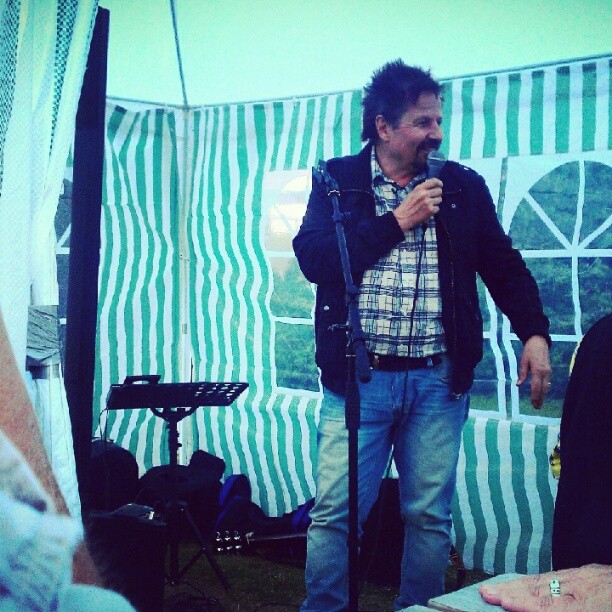
Simon Adahl
A few days ago I attended a meeting with Simon Adahl, a musician and evangelist that has experienced many miracles. I have already written about how he was saved after his atheist wife saw the apostle Matthew, and how he and his friend Orjan prophesied in a Californian bar and told people stuff about them that they heard from God, which resulted in that four people received Jesus. Let me share with you some other cool things that they have experienced.
Simon loves missions, and when he attends the big Pentecostal conferences here in Sweden he is usually not on the platforms bragging about all the cool miracles he experiences, instead he is sitting in a booth marketing IBRA, a Swedish media missions organization, or Dagen, the biggest Christian newspaper. But of course, the Holy Spirit is active even when you’re not on a platform (thank God). This summer, a lady came to Simon and said that she had been healed from asthma.
“That’s great!” Simon said. “When did that happen?” “Two years ago, in the chair over there”, the lady responded and pointed inside Simon’s booth. This lady had been suffering from severe asthma since she was a little child, and had been using inhalers every night. She said that since the moment she was prayed for in the booth, all asthma disappeared and she hadn’t had a need for inhalers for two years.
Orjan was also at the meeting and he told us about how he and his wife went with Simon and his wife together with some friends from church on a holiday on a ferry to Finland. They were dancing at a club and when they sat down to have something to eat, they sat right by a man they hadn’t met before, who introduced himself as Peter. Orjan felt the Spirit of the Lord coming upon him and he told Peter “Right now, God is renewing your life!” And he commanded him to prophesy over them.
ISIS, the US and the Iraqi Government – who are the good guys?

Flag of ISIS
This article is part of a Synchro-Blog by the MennoNerds to express responses to the violence in Iraq, specifically answering the question: How do non-violent, peace-making Christians respond to the violence in Iraq both by ISIS and by the nations attacking ISIS. Go here to read all the articles.
The conflict in Iraq is escalating and the United Nations is now warning that the Islamic State, more commonly known as ISIS, may perform a genocide against minorities like Christians and Yazidis. To prevent this, US forces are bombing ISIS militants, France is supporting Kurdish militias and voices are being heard that a new Western invasion in Iraq is necessary. I have also noticed a rise of islamophobia among Christians here in Sweden, since friends of mine have said that this shows the true face of Islam and that Muslims must be restricted to come to Europe.
ISIS is totally mad, their violent fundamentalism is very dangerous and their behaviour is as far from Jesus’ teaching about non-violence and enemy love that you can go. When I read about them I see many parallells to militias like M23 and the Lord’s Resistance Army in central Africa that I have studied in my peace and development studies. They behead civilians, rape women and want to create their own fundamentalist state.
And just like the conflicts in Congo or Uganda, it’s hard to point out the good guys. There are many reasons people think that this applies to the American forces – they’re trying to save lives while ISIS want to kill entire minorities, they are democratic while ISIS are fundamentalists, they are somewhat Christians while ISIS are militant islamists. But remember that American forces have killed over 120 000 civilian Iraqis since 2003.
Is Israel Practicing Apartheid?

Click the image for higher resolution
Desmond Tutu, formerly archbishop of the Anglican Church in South Africa and a well-known anti-apartheid activist, is one of those people that accuse the state of Israel of practicing the crime of apartheid when it comes to how Palestinians are being treated. This is a quite controversial accusation though, even if it is supported by several human rights advocates and academics, it has also received a lot of criticism, since the situation in Israel and Palestine is noticably different from the South African case.
Mitchell G Bard from Jewish Virtual Library points at the fact that around 20% of Israeli citizens are Arabs that have equal rights compared to Jews and other people groups in Israel. Arabs and Muslims are represented in Knesset, in the courts and at the universities. FW De Klerk, former South African President who together with Nelson Mandela ended apartheid, also says that because of this reason it is unfair to call Israel an apartheid state. “You have Palestinians living in Israel with full political rights. They are represented in the Knesset. You don’t have discriminatory laws against them, for example that they may not swim at certain beaches or anything like that.”
However, people who use the apartheid analogy to describe Israeli policy usually discusses how Palestinians are treated by Israel in the West Bank and Gaza rather than how Arabs are treated within Israel. The thing is that race actually can equal nationality according to international law. The International Convention on the Elimination of All Forms of Racial Discrimination, which Israel along with most other countries has signed, defines racial discrimination as “any distinction, exclusion, restriction or preference based on race, color, descent, or national or ethnic origin which has the purpose or effect of nullifying or impairing the recognition, enjoyment or exercise, on an equal footing, of human rights and fundamental freedoms in the political, economic, social, cultural or any other field of public life” (emphasis mine).
Embarrassing Christian Climate Change Deniers

David Suzuki
Kumi Naidoo, international director of Greenpeace, tweeted an article today that caught my attention. Written by David Suzuki at EcoWatch, it discusses climate change deniers and their mutually exclusive arguments. At a recent conference organized by the Heartland Institute, one of the biggest centers for climate change “skepticism” in the United States, the speakers were arguing that climate change isn’t happening, or that it’s happening but that it’s cooling the earth instead of warming it, or that it is warming it but it’s not caused by humans but by the sun, volcanoes or something else, or that it is happening and it is caused by humans but it’s to expensive to do anything about it.
Obviously, these four theories are not compatible with each others, yet they were uttered at the same conference. The only common thread was, according to Bloomberg news, the constant jokes about Al Gore. I wasn’t at the event, but I recognize the pattern from various climate skeptic blogs that I’ve encountered; and I would like to add another thing that I think is almost universal among climate change deniers: conspiracy theories.
When I took a course in climate change at Uppsala University, we watched a British climate change “skeptic” documentary that argued that the earth is indeed warming, but it’s caused by the sun rather than carbon dioxide. It ended with an attempt to explain why most scientists believe in man-made climate change if it’s so obvious that it is caused by the sun, and the answer was – I’m not kidding now – that they are communists. The voice-over explained to us that after Soviet collapsed, Marxists and leftits felt disillusioned in how they now would crush capitalism, and found their escape in the environmental movement and its demand to decrease fossil fuel usage.
(more…)
Poem: I Love Jesus

These are the lyrics to a song I wrote just a couple of weeks ago. I haven’t recorded it yet so it’s hard for me to give you the melody, but for now you can at least read the lyrics as a poem:
I Love Jesus, I love Him so
He’s the only one who knows my heart and saves my sinful soul
Of course I love my family, my friends and even foes
But Jesus is my number one forevermore
I love Jesus, I love the Son of God
‘Cause He hangs around with idiots, the losers and the odd
He criticizes people who are self-righteous and proud
And when He sees injustice He gets angry and loud!
I love Jesus, I love what He said
He’s like I’m the way, the truth, the life, the gate, the light, the bread
He debated with the Pharisees and turned them on their heads
And to His disciples He said go and raise the dead!
(more…)
Francis – the Charismatic Hippie Pope

Pope Francis, in a Brazilian favela
Who would have thought that a Jesus freak would become pope? The main focus of this blog has always been that signs and wonders need to be combined with peace and justice – charismatic Christians need to be activists and activist Christians need to be charismatic – since this is what Jesus taught to His disciples and Holy Spirit activism has the power to transform lives and bring hope in even greater ways that non-supernatural activism. Unfortunately, a lot of times charismatic and evangelical Christians are not huge fans of peace and justice – something that is painfully obvious when you see what many of them write about the Gaza war – and many Christian activists are not very charismatic or evangelical.
But there is, I believe, a growing movement within Christianity that realizes that a charismatic life in the Spirit should be combined with activism for a better world; a movement that crosses all denominations, places and cultures. And by God’s grace we have a sympathizer among the leader of the biggest church in the world: pope Francis.
Few have missed that Francis is a passionate advocate for peace and justice: he has criticized capitalism for neglecting the poor, he lives simply and promotes economic equality, he has prayed for peace in the Middle East both at the Western wall and at the West Bank wall. But what not as many know is that Francis also is a charismatic pope, who believes in Spiritual gifts and who blesses both the Catholic charismatic renewal and Pentecostals.
John Piper: Why Jews Don’t Have a Divine Right to the Land Anymore

Pastor Piper
Ten years ago, John Piper held a sermon on Israel, Palestine and the Middle East. It was a hot topic then and may be an even more hot topic now, and I really recommend you to read it. It may not be any convincing for Jews themselves, since they don’t believe in the New Testament, but Piper gives a good case why Christians should not think that Israel has to occupy Gaza and the West Bank in order for Jesus to come back, but instead support a solution that secures the safety and peace of both Israelis and Palestinians, no matter how the borders look like. Below, I qoute point 3-5 from Piper’s seven-point sermon:
3. The promises made to Abraham, including the promise of the Land, will be inherited as an everlasting gift only by true, spiritual Israel, not disobedient, unbelieving Israel.
This was the point of Romans 9. When Paul grieved over the lostness of so many Jews who were rejecting Jesus and were perishing, he said in verses 6-7, “It is not as though the word of God has failed. For not all who are descended from Israel belong to Israel, 7 and not all are children of Abraham because they are his offspring.” In other words, the promises cannot be demanded by anyone just because he is Jewish. Jewish ethnicity has a place in God’s plan, but it is not enough to secure anything. It does not in itself qualify a person to be an heir of the promise to Abraham and his offspring. Romans 9:8 says it clearly: “It is not the children of the flesh who are the children of God, but the children of the promise are counted as offspring.” Being born Jewish does not make one an heir of the promise—neither the promise of the Land nor any other promise.
This was plain in the Old Testament, and it was plain the teachings of Jesus (which we will see under truth #4). For example, in the terrible list of curses that God promised to bring on the people if they broke his covenant and forsook him was this: “ And as the Lord took delight in doing you good and multiplying you, so the Lord will take delight in bringing ruin upon you and destroying you. And you shall be plucked off the land that you are entering to take possession of it” (Deuteronomy 28:63 ). Throughout the history of Israel, covenant breaking and disobedience and idolatry disqualified Israel from the present divine right to the Land. (See also Daniel 9:4-7 ; Psalm 78:54-61 .)
Resurrecting Pentecost and other Jesus Hippie Songs!
 Here’s a song I wrote, it’s called Resurrecting Pentecost!
In a world where all magic is rationalized
And our skeptical doubt make us suffer and die
We need a supernatural healing fire explosion
Let’s go out on the streets with the power of God
Let us empty the prisons and hospitals
Let us birth revival and total transformation
By the power of His Name
We will never be the same
‘Cause we are
Resurrecting Pentecost
Raising up at any cost
Acts in modern times
Healing people eagerly
Sharing all things equally
Proclaiming that Jesus Christ is Lord
Jesus Christ is Lord!
The author

Micael Grenholm, a Swedish charismactivist, apologist and author.
A Living Alternative

God vs Inequality

 Charismactivism