
Home » Posts tagged 'Bible Study' (Page 12)
Tag Archives: Bible Study
The author

Micael Grenholm, a Swedish charismactivist, apologist and author.
Seven Reasons Why Inequality Sucks

Inequality in Sao Paulo, Brazil. Photo: Milton Jung
I’ve already described how the Bible tells us to support social and economic equality and bridge the gap between the rich and the poor. Now that I am going to one of the most unequal countries in the world, I feel the need to return to this topic. Let me explain why I’m convinced that inequality is immoral, unjust and unholy.
There is a very common argument against equality, used by Christians and non-Christians alike: inequality is acceptable and right if everyone benefits from it. For example, if inequality produces more economic growth than equality would have done, and rich and poor alike benefits from this growth, then inequality is something good.
There are several problems with this argument:
1. Inequality produces social problems. In 2009, Richard Wilkinson and Kate Pickett authored a book called The Spirit Level, which looked upon how inequality impacts social issues in OECD countries. The results were staggering: they found correlation between inequality and infant mortality, crime, poor health, lack of education, etc. Of course the poor suffered most, but even the rich were worse off in unequal societies compared to equal ones. Thus, the thesis that everyone can benefit from inequality is not true when it comes to social aspects and quality of life.
The Ministry of the Apostle
Old School Apostle
“Pastor” comes from the Latin word for shepherd, and is commonly used as a description for the person leading a congregation. You know how many times the term is used in that sense in the Bible?
Once: Ephesians 4:11.
The other ministries Paul lists there – apostles, prophets, evangelists and teachers – are much more described and discussed in the Scriptures. Still, in many churches and denominations today, pastors are much more common than apostles and prophets (and often evangelists as well).
Let’s focus on the ministry of the apostle. The Greek word describes someone who have been send, a clear illustration to Matthew 28:18-20. Looking at the lives of Peter, James, John, Paul and the others we see that their ministry simply is about missions and church planting. It’s a translocal ministry that equip local churches and start new ones so that the Gospel may reach the end of the world.
Catholics and Orthodoxs have tried to replace the ministry of the apostle with church tradition. Protestants have tried to replace it with the Bible. In both cases, apostleship is viewed as something cessational and temporary, a ministry that gave us the foundation of our faith only in order to disappear after that. This is contradicted by the simple facts that:
1. Apostleship is never described in the Scriptures as something that would cease or decline; on the contrary, more and more apostles pop up the further we read the New Testament (Rom 16:7, 2 Cor 8:23).
Living in Resurrection Power

I pray that the eyes of your heart may be enlightened in order that you may know the hope to which he has called you, the riches of his glorious inheritance in his holy people, and his incomparably great power for us who believe. That power is the same as the mighty strength he exerted when he raised Christ from the dead and seated him at his right hand in the heavenly realms, far above all rule and authority, power and dominion, and every name that is invoked, not only in the present age but also in the one to come. (Eph 1:18-21)
Christ is truly risen from the dead!! This is an undeniable cornerstone for our faith and should be central in the gospel we preach. If miracles cannot happen and Jesus has not risen, Christianity is worthless according to 1 Cor 15. But if miracles do happen and Jesus has risen, Christianity is the most important thing in the world.
But not only is the resurrection of Christ the basis for our doctrine, it should also be the fuel for how we live our lives. As Paul writes above, the same power that rose Jesus from the dead is in us. Through the Holy Spirit we have the same authority to do miracles like He did, the power of the resurrection is available for everyone who wants it!
Jack Deere: The Voice of Angels

Angelic visitation
One of the best books I’ve ever read is Surprised by the Voice of God by Jack Deere. Through a combination of great Bible studies and awesome testimonies, Deere explores what Paul said was the gift we especially should desire: prophecy. Here is an excerpt from pages 137-139, concerning how God can give prophetic messages through angels:
Angels function not only as servants and guardians, they also function as agents of supernatural divine revelation. In the early church, angels were famous for engineering jail breaks (Acts 5:19; 12:7ff.). They also brought supernatural guidance and revelation to God’s servants. Philip was directed by an angel to bring the Gospel to the Ethiopian eunuch (Acts 8:26). Cornelius, the first gentile convert, was visited by an angel prior to his conversion with instructions for what he should do (Acts 10:3ff.). When Paul and all of his sailing companions were in danger of lsing their lives at sea, God send an angel who brought prophetic revelation to save them (Acts 27:23-26). And the greatest prophetic book, the book of Revelation, was communicated to John through an angel (Rev. 1:1).
[…]
Many people do not report encounters with angel for fear of what others might think. Early in my ministry a lady in my church told me the following story. Neither the lady nor my church were charismatic. Actually, our church had definite prejudices against the gifts of the Spirit. The woman had never wold anyone this story for fear of being thought crazy.
God vs Wealth, part 6: The Old Testament
To read other parts of the series, go here.

“What about king David?” people ask me when we debate whether a Christian should be rich or not. David was a “man after God’s own heart” (Acts 13:22) who clearly loved and feared the Lord, and yet he was very rich. Same thing is true for many believers in the Old Testament – kings like Solomon or Hezekiah as well as landlords as Abraham and Job. They believed in God, and still were rich.
However, we must remember that just because you are a believer, all your actions do not necessarily reflect the will of God. The only person in the Bible that we know lived a totally holy life is Jesus Christ. But when it comes to Abraham for example, he had married his sister. Should we use that as an argument for us to do the same?
Likewise, when it comes to David and Solomon, they lived in polygamy. We know however that Scripture condemns polygamy in other places. And interestingly enough, the same Bible verse that forbids Old Testament kings to take several wives also tells them not to accumulate wealth. This verse is not so famous, but is is a clear debunking of the “what about king David”argument. In Deutoronomy 17, God speaks of the lifestyle of the future king of Israel. Among other things, He says:
He must not take many wives, or his heart will be led astray. He must not accumulate large amounts of silver and gold. (Deut 17:17)
God vs Wealth, part 5: Three Heresies
To read other parts of the series, go here.
In the first four parts of my God vs Wealth series, I’ve presented why I am convinced that Christians shouldn’t be rich. Now, I will discuss some counter arguments against that thesis.
1. There’s nothing wrong with being rich as long as you value God more than your money
This theory, which I’ve mentioned in some of the previous posts in this blog series, is basically saying that as long as your money doesn’t affect your relationship with God negatively, you can be as rich as you want. The problem is not owning money, the problem is if the money owns you. However, Jesus does not agree with this:
“Do not store up for yourselves treasures on earth, where moths and vermin destroy, and where thieves break in and steal. But store up for yourselves treasures in heaven, where moths and vermin do not destroy, and where thieves do not break in and steal. For where your treasure is, there your heart will be also.” (Mt 6:19-21).
In other words, it’s wrong to argue that you can be rich as long as your money doesn’t hinder your relationship with God, because where your treasure is your heart will be also – you cannot have treasures on earth and your heart in Heaven! The word “treasure” is used in James 5 as well where wealth also is criticised. We have to get rid of it to attain full devotion to the Lord.
Humanitarian Passion

Image from Wikimedia Commons
As you may have noticed, I’ve written a lot about humanitarian aid the last couple of days. I feel a growing passion for this issue, and I really want to spread it on to others. However, I have noticed that it is not so easy to do.
To my experience, most people are quite uninterested in humanitarian aid; they aren’t reading much about it nor giving that much money to it. When I look at the statistics of my Swedish blog, the posts last year that got the least views are those who concerned humanitarian crises (with the single exception of Gaza). And when I get reports from humanitarian organizations, they constantly talk about that their projects are underfunded.
Why is it like this? Why are rich people spending billions on sports, entertainment and luxuries while people suffer and die in Syria because of lack of humanitarian aid? Some would say that this is caused by human nature, we cannot help that we aren’t so interested in saving the lives of people far away. However, this cannot explain how humanitarian aid workers lay down their lives to help people they’ve never met. Humanitarian passion is rare but does exist.
Should Every Christian Be an Activist?

Christian activists
Some time ago I was having lunch with the leader of the Swedish Pentecostal movement. I had contacted him in order to share my vision of combining signs and wonders with peace and justice, and he offered to meet me. When we sat there I explained how important it was to eradicate poverty, fight climate change and work for peace, and then I remarked that I had to leave the lunch a bit early since I was going to participate in an act of civil disobedience in a detention center not far away, where the police would deport people to Iraq the same night. He looked at me and said “I really share your conviction that these issues are very important, but please reflect upon how much the ordinary believer is obliged to do.”
I got his point. Most Christians aren’t willing to lay so much time on activism as I do; in fact, for many of them “activist” is a quite alien term. And I agree with that there are different functions in the body of Christ – some focus on activism, others on preaching, others on evangelism and so on.
Still, just as the presence of preachers doesn’t mean that everyone else shouldn’t know any theology, every believer should care for peace and justice to some extent. The question is: what extent? Well, when we look at the Scriptures, it is striking that many of the commandments to all believers are very radical when it comes to peace and justice:
Why I as an Activist Love the Gifts of the Holy Spirit!
This text is also published at Jesus Radicals today.

Photo: Iris Ministries
The Pentecostal and charismatic movements have a bad reputation among Christian anarchists and activists. There are too many examples of healing evangelists who control the masses through manipulation and hysteria, with promises of supernatural encounters only to gain money and status for themselves. Furthermore, many Pentecostals and charismatics support nationalism, war, discrimination and inequalities. They bless the Israeli occupation of Palestinian lands, they preach a prosperity gospel where strong faith leads to great wealth, they deny climate change and don’t care about the environment.
Yet, I am totally convinced that every Christian activist should embrace the gifts of the Spirit and pursue signs and wonders. Why? Because the mess I just described is of course not genuine a fruit of the Spirit, it is a result of what I call the Corinth Syndrome, when charismatic Christians portray their own crazy ideas and practices as divinely inspired.
Why Did Jesus Tell the Disciples to Buy Two Swords?
The following text was originally published by someone on a site called Harmless as Doves. I thought it was so good that I copied it and saved it on my computer, but now I’ve seen that the original site has been removed. So here it is, re-entering the Internet:
 Luke 22:35-38 is often cited to challenge the Christian pacifist perspective. In this passage, Jesus instructed his disciples to buy swords, amongst other items.
Luke 22:35-38: Then Jesus asked them, “When I sent you without purse, bag or sandals, did you lack anything?” “Nothing,” they answered. He said to them, “But now if you have a purse, take it, and also a bag; and if you don’t have a sword, sell your cloak and buy one. For it is written: ‘he was numbered with the transgressors’; and I tell you that this must be fulfilled in me. Yes, what is written about me is reaching its fulfillment.” The disciples said, “See, Lord, here are two swords.” “That is enough,” he replied.
First we must ask, why did Jesus want them to buy swords? It seems unlikely that Jesus’ instructions were intended to prepare his disciples for armed conflict and self defense, because two swords does not seem to be “enough,” as Jesus put it, to defend twelve men. In fact, in the passage itself Jesus explained the purpose for the swords. Jesus instructed his disciples to buy the swords, “for it is written: ‘he was numbered with the transgressors.’”
Here, Jesus referenced Isaiah 53:12, which contains one of the many Old Testament prophesies concerning the life of the Messiah. Jesus wanted the swords present when he was arrested, because the presence of the swords would indicate to those arresting him that he was one of the “transgressors,” that he was leading a violent rebellion. Jesus again referenced this while he was being arrested:
Let the Poor Rise Up and Walk!
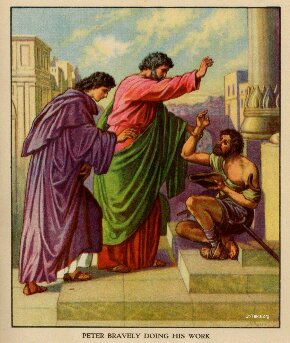
Acts 3 is one of my favourite Bible passages, since it presents a great example of how the gifts of the Spirit are tools both for evangelism and activism. When Peter and John went up to the temple to pray, they passed a lame man who was begging for money. Peter said to him: “Silver or gold I do not have, but what I do have I give you. In the name of Jesus Christ of Nazareth, walk.” (v. 6).
The man, who had been lame from birth, gets completely healed and starts jumping and dancing. People wonder what’s going on, Peter preaches the Gospel and explain that God did this miracle in order to give glory to His Son, and many of the listeners get saved. This single healing both rescued a man from the boundage of poverty and made it very easy for Peter to evangelize.
Heidi Baker, a charismatic missionary to Mozambique, shares a modern example of a similar event in her book Always Enough (pp. 167-9). A woman asked her to pray for her husband, named Carlos, who had been lame in his legs for two years. Heidi came home to their mud hut where the man was sitting on a reed mat with a pair of scissors in his hand, cutting up little pieces of paper. He sold this to the local matress vendors, earning just a couple of cents a day.
God vs Wealth, part 3: Sharing Everything
To read other parts of the series, go here.

I wear a red cross around my neck. I got it when I visited a church called Jesus Army in the UK a couple of years ago. Many people in this church practice community of goods. They eradicate the gap between rich and poor simply through sharing all they have together in community houses called New Creation Christian Community.
This is of course very biblical. We read about the first church in Jerusalem which was led by the apostles themselves: “All the believers were together and had everything in common. They sold property and possessions to give to anyone who had need.” (Acts 2:44-45). This should not be surprising, they simply obeyed the commands of Jesus. He clearly told all His disciples in Luke 12:33 to sell what they have and give to the poor.
It is thus misleading to think that this command was just given to one certain rich man in Matthew 19:16-22. I have heard countless rich Christians arguing that Jesus told him to sell what he had just because his money was a stumbling block to his relation with God, and thus rich Christians with a good relationship with God can ignore this command and continue to be rich. But the gospels doesn’t say that he had to sell his stuff because they affected his relationship with the Lord, the only reason Jesus gives is that the poor will get money – something they need no matter how our spiritual situation looks like. And again, He did say the same thing to all His disciples, and they all obeyed it.
(more…)
God vs Wealth, part 2: Equality
To read other parts of the series, go here.
It’s not controversial to say that we should give money to the poor. The question is how much we should give. Some Christians are arguing that we should give tithe, one tenth of our income. But we can’t limit our giving to that, keeping nine tenths of our income no matter if we need it or not. The Old Testament tithe was not a maximum amount but a minimum. Deutoronomy describes how we should act towards the poor even after we’ve given tithe: if we are able to help them but are not doint it, they may call to the Lord, and we will be guilty of sin.

If the rich only give tithe, they are still rich, and the poor are still poor. We need equality. The richest 20% of th world’s population consume 80% of the world’s resources. The poorest 20% consume 2% of the resources. The latter group suffer of hunger, lack of clean water and diseases, and they don’t live very long. At the same time, the rich spend billions on entertainment, luxury and other unnecessary stuff. This is totally unjust and needs to be changed.
God vs Wealth, part 1: It’s Wrong to Be Rich
To read other parts of the series, go here.
There are a lot of misconceptions and false teachings concerning wealth and poverty in the church today, so in response to that I am producing a series of approximately ten parts called “God vs Wealth”. This is the first part.
 I’ve heard countless pastors, preachers and priests who say that there is no problem with being rich, as long as you don’t worship your money you can be as wealthy as you want. I’m having some serious trouble with this teaching. Why on earth did Jesus say “woe to you who are rich” if there are no problems with being rich? “Woe” is not a positive word, it’s a warning.
James, the brother of Jesus, is also warning rich people:
Now listen, you rich people, weep and wail because of the misery that is coming on you. Your wealth has rotted, and moths have eaten your clothes. Your gold and silver are corroded. Their corrosion will testify against you and eat your flesh like fire. You have hoarded wealth in the last days. Look! The wages you failed to pay the workers who mowed your fields are crying out against you. The cries of the harvesters have reached the ears of the Lord Almighty. You have lived on earth in luxury and self-indulgence. You have fattened yourselves in the day of slaughter. You have condemned and murdered the innocent one, who was not opposing you. (Jam 5:1-6)
If there’s something James is not saying, it’s “There’s no problem with being rich”. He is not talking to the rich in a certain city but to all rich Christians, since his letter lack a certain adress. And his message is that need to get rid of their wealth to escape coming misery.
Supernatural Protection in War
One of the most amazing events during World War Two was that a small Italian village called San Giovanni Rotondo never was bombed. The Allied forces tried to eliminate a German base there several times, but they never succeeded. The reason? All the pilots who flew near the village suddenly saw a monk who stretched out his hands towards them, signing that he wanted them to turn back.
General Bernardo Rosini of the United Air Command reported that

“Each time that the pilots returned from their missions, they spoke of this Friar that appeared in the sky and diverted their airplanes, making them turn back. Everyone was talking about these incredible stories. But since the episodes kept recurring, the Commanding General of USAF General Nathan F. Twining, who happened to be in Bari, decided to pilot himself a squadron of bombers to destroy a target near San Giovanni Rotondo.
“When he and his pilots were in the vicinity of the target, they saw the figure of a monk with upraised hands appear in the sky. The bombs got loose from the plains falling in open areas, and the planes made a sharp turn to return to base without the pilots intervening.
“Back on the ground, everybody asked everybody else about the happening and wanted to know who was that friar. The General was told about Padre Pio and decided to visit him with the pilots in that squadron. The pilots immediately recognized Padre Pio, and he told the general: “So you are the one that wanted to destroy everything.”

