Popular Posts


Recent Comments
 | James on Why Cessationism is Unbiblical… |
 | Nate on The Problems with the Lutheran… |
 | Franciskus – p… on Francis – the Charismati… |
 | Riverbelle on The Problem with “Sacram… |
 | Russell on Why Churches Should Abandon St… |
Networks





Can God say something prophetically that the Bible already says?
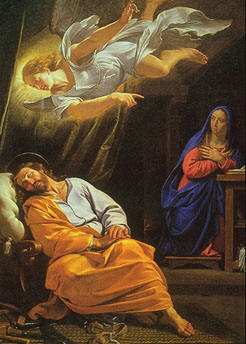
The Angel gives an “unnecessary” message to Joseph
The strange Strange Fire conference has put me into debate with some cessationists, especially when making this video. One common cessationist argument is that if the gift of prophecy still exists, the Bible isn’t our only source for doctrine about God, and thus the door to heresy stands wide open. Tom Pennington also uses this argument in his (bad) case for cessationism.
What I try to explain then is that firstly, prophecy has multiple purposes. 1 Samuel 9 contains a fascinating story about how Saul is looking for his father’s donkeys, and walks to prophet Samuel to see if he can use his prophetic gift to find out where they are. Before he even says something, Samuel invites him to dinner and adds “As for the donkeys you lost three days ago, do not worry about them; they have been found.” Then he reveals that the Lord has showed him that Saul is the new king of Israel, and anoints him.
Now, neither the revelation about the donkeys nor that Saul was to be king was doctrinal revelation; rather, they revealed a practical circumstance and God’s plan for an individual. These prophetic aspects should of course always be tested (1 Th 5:19-22), but there is not much need to worry about false doctrines here.
Furthermore, God can also confirm what He has previously said in the Bible. For example, God can, if He wants to, send an angel to me to tell me that He loves me. I told this to a cessationist, whereby he asked “Why would God send an angel to tell me that He loves me if that information has already been revealed to me in the bible?”
Pope Francis, Capitalism and the Gifts of the Holy Spirit

Francis. Photo: Tomaz Silva
I told you he would be a good pope! Francis has become extremely popular both within and outside the Catholic world. He both teaches and practices simplicity and mercy; he wears simple clothes and refuses to live in the fancy apostolic palace while emphasizing the duty of Christians to embrace the poor, wounded and lost. Recently, his apostolic exhortation Evangelii Gaudium has received a lot of attention in the media. It is mainly about evangelism and missions, but what has caught the attention of many is his criticism of capitalism:
“Just as the commandment ‘Thou shalt not kill’ sets a clear limit in order to safeguard the value of human life, today we also have to say ‘thou shalt not’ to an economy of exclusion and inequality. Such an economy kills.
“How can it be that it is not a news item when an elderly homeless person dies of exposure, but it is news when the stock market loses 2 points?
“As long as the problems of the poor are not radically resolved by rejecting the absolute autonomy of markets and financial speculation and by attacking the structural causes of inequality, no solution will be found for the world’s problems or, for that matter, to any problems.”
Many are quite surprised by this and speculate whether it is an influence of Latin American liberation theology, since pope Francis comes from Argentina. However, while Francis definitely has a stronger emphasis on social justice than his predecessors, this thoughts should probably by no means have been alien to them. John Paul II wrote in his encyclical letter Centesimus Annus:
“It would appear that, on the level of individual nations and of international relations, the free market is the most efficient instrument for utilizing resources and effectively responding to needs. But this is true only for those needs which are ‘solvent’, insofar as they are endowed with purchasing power, and for those resources which are ‘marketable’, insofar as they are capable of obtaining a satisfactory price. But there are many human needs which find no place on the market. It is a strict duty of justice and truth not to allow fundamental human needs to remain unsatisfied and not to allow those burdened by such needs to perish.”
All Things Charismatic – A Mennonite’s Perspective on Visions, Prophesy, and Miracles
Deborah once again writes awesomingly about signs and wonders from a Mennonite perspective. I agree on *almost* everything, not being as critical as her towards the first group of charismatics she describes (those who believe that all people can prophesy).

 If you read this article and you like it, you can check out some of my earlier thoughts on the Charismatic movement by reading this blog post: http://debdebbarak.wordpress.com/2013/07/29/a-mennonite-who-speaks-in-tongues/
In our modern world, the Charismatic movement has gotten a somewhat bad rap unless you are Pentecostal yourself. There are two main ways of thinking of the charismatic movement according to the Christians that I have met. The first way is to view it as a super incredible movement which is the answer to all of life’s problems. I see this view played out all the time by churches which claim that they have raised people from the dead (I sincerely have my doubts about that one), go on mission’s trips with no other purpose than to preform healings, and have youth meetings where the only purpose is to receive Words from the Lord for one another. Although these churches do provide…
View original post 1,983 more words
Suffering and Revival in the Congo – the Story of Helen Roseveare

Helen Roseveare
A month ago, I wrote about the mix of tears and joy, suffering and glory that Iris Ministries in the Democratic Republic of Congo is experiencing. While people are losing their children and the women are raped by soldiers; miracles are abundant and the church has a burning passion for God. This paradoxal relationship between the cross and the glory may be hard for Western people to understand, but it is very real. Today I want to introduce you to a missionary who also experienced this in the Congo – but 50 years ago. Her name is Helen Roseveare.
After studying medicine in the UK and feeling the calling to be a missionary, Helen went to what was then Belgian Congo and started to develop the pretty much non-existant health care system. She was the only doctor for two and a half million people, saving thousands of lives. In the early 60’s, civil war broke lose as the Congolese people wanted to be liberated from Belgian colonialism. The war was extremely brutal. Helen was raped, twice.
Government soldiers came to my bungalow, ransacked it, then grabbed me. I was beaten and savagely kicked, losing my back teeth through the boot of a rebel soldier. They broke my glasses, so I could not see to protect myself from the next blow. Then, one at a time, two army officers took me to my own bedroom and raped me. They dragged me out into a clearing, tied me to a tree, and stood around laughing. And while I was there, beaten and humiliated and violated and ridiculed, someone discovered in the bungalow the only existing hand-written manuscript of a book I had been writing about God’s work in the Congo over an eleven-year period. They brought it out, put it on the ground in front of me, and burned it.
It takes less than that for others to leave both the country and the faith. But Helen knew the power and love of the living God, and she knew that He had called her to Congo to be an instrument of grace and peace. In an interview with Jesus Army, she told about the revival fires that her church saw in the midst of chaos:
God vs Poverty, part 3: Working
This is as the title suggests the third part of my God vs Poverty series.
In the last part of God vs Poverty, I talked about the importance of giving aid to the poor. I am critical to the “trade instead of aid” idea expressed by people like Dambisa Moyo (who thinks that all aid to Africa should be stopped in five years) simply since it is irresponsible, harmful and not very smart. Trade is not the magical solution to poverty reduction, since many companies only have their own profit in mind. In contrast, aid agencies have a genuine goal to help the poor.
Still, trade is important. In fact, it’s necessary for poverty reduction. Acts 20:33-35 says:
“I have not coveted anyone’s silver or gold or clothing. You yourselves know that these hands of mine have supplied my own needs and the needs of my companions. In everything I did, I showed you that by this kind of hard work we must help the weak, remembering the words the Lord Jesus himself said: ‘It is more blessed to give than to receive.’”
In other words, if we are able to work but aren’t doing it, we are using resources that could have been given to the poor. As long as we are healthy and there are job oppurtinities, we should work. But we must remember that all jobs aren’t good jobs!
Selling Christmas
How could you possibly celebrate the birth of a Saviour in a better fashion than mass consumption and environmental destruction? Well, perhaps you can. Christmas is all about generosity, and Jesus surely liked that, but the Christmas generosity seems to be about buying stuff that you primarily give to rich people, while the Jesus genorosity was about selling stuff and giving the money to the poor (Mark 10:21).
How about we use this season where everyone wants to buy stuff to sell stuff? It’s good for the environment and we will be able to give a lot more to beggars and aid organizations. Simply go to second hand websites or donate them to some charity driven second hand store.
It’s something that’s surely gonna make the reason for the season very happy 🙂 Merry christmas!

Shopping Jesus, from Soul Thoughts
“Tell my wife, Jesus is the son of God!”
I just received these glorious news from Christ for all Nations’ mission campaigns.

Happy guy heald by Jesus
Dear Mission Partners,
This has been one of those nights that are hard for me to describe. As always, our emphasis was on the preaching of the Gospel of salvation, to which many thousands responded. But when the Gospel is preached the inevitable result is miracles. Even though I hardly said anything about healing, the Holy Spirit loves to confirm the lordship of Jesus and manifest His Kingdom through supernatural demonstrations.
Tonight we saw so many healings: A man blind for ten years healed. A woman with an issue of blood healed. A deaf man healed. A lady threw her walking stick away. A woman took off her neck brace. I even danced with the woman who had been lame. But the most moving testimony came at the very end. I asked our video team to quickly give me the raw video watch it above so you can see for yourself what happened just a few moments ago.
A man who had been deaf for almost two years had just arrived in town from another city by train and had unwittingly ventured into the city centre (Independence square – where our campaign is being held). He was a Muslim. He had no intention of coming to a Gospel meeting and he could not understand anything that was going on anyway, so he lied down and went to sleep. But when he woke up, to his utter amazement, he could hear! He came to the platform and stood before me trembling, overcome with emotion. He had a look of shock on his face. “My name is Mohammed,” he said, and he proceeded to tell me his story.
How to Help the Victims of Super Typhoon Haiyan
You probably haven’t missed it – the super storm Hayian has killed thousands, displaced 600 000 and affected 10 million people primarily in the Philippines. So many people are in desperate need of humanitarian aid right now, and doubts whether the aid really reaches the target could be fatal if it leads to inaction. I cann assure you that the three organizations below are serious, effective and accountable and highly recommend that you donate large sums to them, while praying passionately that God will do miracles through His Philippine church and save many lives through the power of the Holy Spirit.

Image from christianaid.org.uk
Christian Aid‘s local partner organisations are already assessing the damage and they have dispatched four emergency response assessment teams in the worst hit areas. They’ve helped people reach emergency shelters and will be providing families with essential items such as food, blankets, basic first-aid kits, cooking utensils, shovels for cleaning up and cash assistance. Read the latest update on the situation in the Philippines here.
Please donate today to help them reach people left homeless, hungry and vulnerable (£,€ or $).

Image: UNICEF
UNICEF is rushing emergency supplies to areas of the Philippines ravaged by Super Typhoon Haiyan on 8 November, as the latest estimates indicate that up to 4 million children could now be affected by the disaster.
Why Don’t We Serve on Sunday Services?
In this clip, my favourite theologian John Wimber shares how he thought a church service looked like before he, as a newly converted believer, had ever visited one. He thought that people met at church, worshipped, had a good time and then decided who should go where: “You go downtown, I’ll take Anaheim”, etc. Then they would go out, heal some sick, cast out some demons and lead a few people to Christ, and then they would have lunch afterwards.
Unfortunately, John’s church wasn’t like that. After having attending a whole bunch of boring services he once asked his pastor “When are we gonna do the stuff?” “What stuff?” “You know, the stuff Jesus did – healing the sick, raising the dead” “Well, we don’t do that anymore. You just have to believe that it was done once.” John was confused and asked “What do we do then?” “What we did last morning!” John gasped: “For this I gave up drugs?”
I had similar thoughts when I was a new believer. I always thought it was strange that the church meetings were called “services”, since 95% of the people in my church weren’t serving very much. In fact, we hardly did anything except singing a few hymns and walking to the altar to receive communion.
When I later on joined a charismatic church the singing part got a bit more active, but beside that you didn’t do anything in church except receiving – receiving a sermon, receiving prayer or receiving a cute song from the Sunday school group.
(more…)
The Sweetness of Revival
God has been speaking to me about the Jesus Movement the last couple of months, and I’m planning to do some deeper research of this renewal when I get the time. For you who aren’t aware of it, it sprang up mainly among saved hippies in the 60’s and 70’s and spread from the US to Europe. The Jesus People, or Jesus Freaks as they gladly called themselves, were passionate charismatics who preached the Gospel in the power of signs and wonders while many of them also were pacifist peacemakers and radical supporters of social justice – many of them practiced community of goods. In other words, it was a Holy Spirit Activism movement!
As I read and watch clips about the Jesus Movement, I get the impression of a theology that is in all ways charismatically evangelical, but expressed in a very attractive and simple way. A review of a book about the movement simply dubbed it “sweetness”. I like that! The Jesus Freaks were radical, zealous and crazy, but above all that also very sweet.

Worship with the team from Iris Global
I encountered this sweetness in another context two days ago in Stockholm, Sweden. My friend had invited me to a prayer meeting that he hosted together with a travelling team from Iris Global. Iris Global is, as those of you who follow this blog should know by now, also a movement that combines signs and wonders with social justice, and these folks were no exception.
Surprise Sithole on poverty, aid and how it feels to raise the dead

Mr Sithole and me
One of my best experiences from my visit to Iris Ministries South Africa this summer was to meet and do a interview with their leader Surprise Sithole. Surprise has, as I’ve written before, had an amazing life with many miracles as he has been preaching the Gospel and helped the poor in southern Africa. In the interview I asked him how he likes the idea of combining miracles with peace and justice, what his conception of poverty is and how it feels to see God raise someone from the dead. This is what he answered:
Risk of Genocide in the Central African Republic

Soldiers in CAR
Today UN officials announced that the conflict in the Central African Republic (CAR) may escalate to a genocide. Since the Seleka rebels preformed a coup in March, the situation has turned chaotic – women are raped, children are killed, and violent hostility between Christians and Muslims is growing. Eugene Richard Gasana, Rwanda’s UN ambassador, said “I had the impression it is like in 1994 at home.”
Doctors without borders have been working in CAR for several years, helping the sick, wounded and dying. Over and over again they have tried to sound the alarm for the horrible humanitarian crisis, but unfortunately the world has been passive. Please give a generous gift so that they can continue to save lives. And pray eagerly for peace and justice in CAR. Thank you!
Our Orthodox Heritage

The Church of the Holy Sepulchre, where it is belived that Jesus died and rose again
For several years I have preached that we must resurrect the Jerusalem church. This church combined amazing miracles with radical economic equality, they were zealous in evangelism so that people came to faith every day, and they faithfully hold on to the teachings of the apostles (Acts 2:42-47). They were in all ways doing church as Jesus wanted them to do, since it was led by His hand picked apostolic disciples. From the first post I wrote on this blog throughout my writing, I’ve emphasized that we must be like the church of Jerusalem.
Yesterday I found their website.
The greek orthodox patriarchate of Jerusalem seems to be the exactly sam church that was founded on the day of Pentecost 2’000 years ago. Even if Jerusalem has been conquered and even destroyed a couple of times the church claims to have an apostolic succession back to good ol’ James, Jesus’ brother. They celebrate their services in Koine Greek, the language of the New Testament, and their main church is built upon the place where they think that Jesus died for our sins and rose from the dead. I find this extremely cool.
World Council of Churches Focuses on Peace and Justice

I really like the WCC. I like how they recognize how global Christianity is and that they want to learn and bless each other in order to be able to celebrate communion together. And I really like how they emphasize peace and justice. What I hope is that they also will inspire to global revival.
What the Holy Spirit has done in the 20th century through the charismatic movement is truly ecumenical. On Asuza Street, people from all denominations were welcome to experience the baptism of the Spirit. After creating its own distinctive denominational movement, Pentecostalism, the fire started to spread into mainline churches. Today, charismatics can be found in basically all Christian traditions and in all nations were Christianity is found.
Exploring the Lord’s Prayer as a Dangerous Prayer
Really good exposition by Deborah-Ruth Ferber! It clearly show both how beautiful and radical the Lord’s prayer is.
 The following is my lay exposition of the Lord’s Prayer. Although I have studied Theology at both the undergrad and graduate levels this is meant simply for personal devotions rather than actual Greek/Theological exegesis.
Our Father – I’m saying Father here, not Mother, but Father. Not that I have any problems with calling You Mother, but right now I need You to be a Daddy to me. I tend to rely and trust women more than I do men, mostly because I am a woman and don’t always understand the ways of men. But I’m learning to trust You. I’m learning to be held by You. I’m learning to believe that You’re a strong Daddy that will protect me.
Who Art in Heaven – You live in the Highest realm. You don’t just look down on earth, though – You also came as a participant. You have all the…
View original post 1,278 more words
The author

Micael Grenholm, a Swedish charismactivist, apologist and author.
A Living Alternative

God vs Inequality

 Charismactivism