Popular Posts


Recent Comments
 | James on Why Cessationism is Unbiblical… |
 | Nate on The Problems with the Lutheran… |
 | Franciskus – p… on Francis – the Charismati… |
 | Riverbelle on The Problem with “Sacram… |
 | Russell on Why Churches Should Abandon St… |
Networks





Ulf Ekman’s Multiple Conversions

Ulf Ekman. Photo by Josefin Casteryd
I live in the same city as the world’s arguably most famous living Swedish Christian, namely Ulf Ekman. The founder and long-term leader of the Scandinavian Word of Faith movement (with many branches in the former Soviet Union), Ekman surprised many when he revealed last year that he and his wife would convert to Catholicism, which they also have done. Yesterday, Ulf Ekman was being interviewed on national Swedish television about his life, faith and different controversial topics like abortion, support for Jewish migration to the West Bank and prayer for healing (which apparently is controversial in a Swedish secular context).
Ekman’s conversion from being neo-Pentecostal to being Catholic wasn’t the first religious shift he has made. In his youth he was an atheist socialist in Gothenburg, protesting against capitalism and the Vietnam war, but when a Christian friend talked to him about how Jesus could give him forgiveness for his sins, he was saved. He went to Uppsala (my town) to study theology and became a Lutheran priest in the Church of Sweden. However, in the early 80’s he studied at Kenneth Hagin’s Rhema Bible college in Tulsa, Oklahoma, and when he came back he was a full-blooded prosperity preaching Pentecostal. He founded the Word of Life church in Uppsala in 1983, and the movement quickly spread to the rest of Scandinavia and to the USSR.
For Ekman, his conversion from atheism to Christianity also meant a political conversion from socialism to conservatism. He wasn’t afraid of preaching politics from the pulpit, whether it was against Sweden’s abortion laws, for the policies and military decisions of the state of Israel or simply prayers that the Social Democrats would lose the Swedish elections. (more…)
Christian Nonviolence and ISIS: You’re Asking the Wrong Question
This post is written by Micah Bales at his own blog and is published here with permission. It is the best article I’ve seen so far about Christian nonviolence and ISIS.
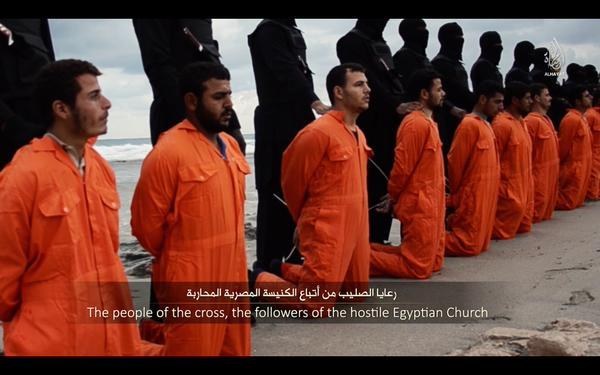
A couple of folks I really respect – Kate Gould of Friends Committee on National Legislation (aka, the Quaker Lobby), and Jim Wallis of Sojourners – were recently on the O’Reilly Factor. For those of you who don’t watch cable news, this is a television program where Bill O’Reilly basically screams at people and incites hatred of anything non-white, non-rich, and non-Republican. I normally don’t watch the show. But when I heard that Kate and Jim were going to be talking, I tuned in.
I knew almost immediately this wasn’t going to be good. It’s Bill’s program, so he gets to frame the question. Here’s what he asks: Do Christian pacifists have a solution for stopping ISIS?
It’s the wrong question. O’Reilly knows it’s the wrong question, and that’s why he’s asking it. Unfortunately, both Gould and Wallis attempt to answer his question directly and rationally. Gould presents an argument for diplomatic measures to curb ISIS’ support. Wallis tries to explain that O’Reilly’s rhetoric of holy war will only lead to a wider conflagration and cost more lives.
This is great for Bill O’Reilly. To these subtle, rational arguments, all he has to do is scream and berate. At one point, O’Reilly interrupts Jim Wallis mid-sentence and demands: How would you stop the ISIS savages from murdering innocent people? How? (more…)
How to Become a Saint
Don’t you want to be a saint? Here’s how you become a saint.
Step 1: Be saved.
If you don’t know how to be saved check this article or simply listen to the wise words of the apostle Paul: “If you declare with your mouth, ‘Jesus is Lord,’ and believe in your heart that God raised him from the dead, you will be saved.” (Rom 10:9)
Step 2:
There is no step 2, you’re already a saint! 😀 Congratulations, well done saint. There is no need for any pope. There is no need for any canonization. All it takes to be a saint is to follow Christ, and here are som Bible verses that prove this:
“Lord, I have heard from many about this man, how much harm he did to Your saints at Jerusalem” (Acts 9:13)
“I ask you to receive sister Phoebe in the Lord in a manner worthy of the saints …” (Romans 16:2).
“For the equipping of the saints for the work of service, to the building up of the body of Christ” (Ephesians 4:12).
“…the mystery which has been hidden from the past ages and generations, but has now been manifested to His saints, to whom God willed to make known what is the riches of the glory of this mystery among the Gentiles, which is Christ in you, the hope of glory.” (Colossians 1:26-27)
“All the saints greet you, especially those of Caesar’s household.” (Philippians 4:22)
Co-Suffering with Jesus and the Poor

I attended a 48-hours prayer meeting a couple of years back in Stockholm, and during a worship session a dear friend of mine approached me, asking me to pray for her so that she may receive the same passion for the poor that the Lord has given me. I was so glad that this was what she wanted, but as I started praying I realized that it would be impossible for her to have the same passion as I have without feeling the pain and suffering of making sacrifices, knowing more about the horrible face of poverty and realizing how many it is that do not get help.
This was why I became an activist in the first place – I realized that innocent people were dying while I was playing video games and dreamt of getting a car and a house. I just prayed that God would make it impossible for my friend to close her eyes to the suffering of the poor, and that she would partake in their suffering.
I don’t know if she ever got the same passion for them as I have, at least she’s not revealing it as clearly on Facebook 🙂 But there and then I think we both realized that this was truly what was necessary for passion. When we follow Christ, a cross is always attached. As He Himself said:
“Whoever does not carry their cross and follow me cannot be my disciple… suppose a king is about to go to war against another king. Won’t he first sit down and consider whether he is able with ten thousand men to oppose the one coming against him with twenty thousand? If he is not able, he will send a delegation while the other is still a long way off and will ask for terms of peace. In the same way, those of you who do not give up everything you have cannot be my disciples.” (Luke 14:27, 31-33)
Amazing Healing Miracles in Cameroon, Ghana and Benin!
I love to follow Daniel Kolenda’s Youtube Channel. Daniel is evangelist at Christ for all Nations, successor of Reinhard Bonnke and a passionate follower of Jesus. At the channel he publishes Bible studies, mission reports as well as wonderful testimonies of God’s miracles like these:
 She was deaf in both ears for 17 years. She was rejected by family members and failed in school. She felt like a prisoner in solitary confinement and wanted to take her own life.
In January of 2014, Christ for all Nations visited Titi Bongo’s city of Yaoundé, Cameroon. Hundreds of thousands gathered that week to experience the Gospel. On the second night, as evangelist Daniel Kolenda was praying for the sick, Titi began to feel an intense burning in her ears and realized one of her ears could hear.
She to the platform to testify together with her brother. Her brother told the evangelist that although one ear had been healed, the other was still deaf and asked for more prayer. Evangelist Kolenda prayed for the ear twice. The first time, nothing happened, but the second time, he began to say the name of Jesus in her deaf ear in French, “Jésus, Jésus, Jésus” Suddenly she could understand and began to repeat the name, each time it became more clear and more powerful. He asked if she could hear now. She was smiling from ear to ear. She could hear, she could speak and she was praising the name of Jésus! (more…)
Testing Prayer: Science and Miraculous Healing

Professor Brown
This week will be a sabbatical for me, where I won’t use any internet in order to rest and write on my book. To prevent you from being bored, dear blog readers, I want to share with you this very interesting lecture by Candy Gunther Brown, Professor of religion at Indiana University, on mecially verified healings. Enjoy!
Divest the Churches from Fossil Fuels in Jesus’ Name!
Today is Global Divestment Day, a day when people all around the world pledge to divest out of fossil fuels. Divestment is the opposite of an investment–it simply means getting rid of stocks, bonds or investment funds that are unethical or morally ambiguous. Thousands of churches, schools and local government have pledged to divest out of fossil fuels in order to prevent a climate catastrophy. The campaign writes:
The divestment campaign highlights a conflict that most politicians are reluctant to address. If the world is to avoid catastrophic global warming, most known fossil fuel resources need to stay in the ground. Yet fossil fuel companies not only plan to extract and sell their existing reserves but are exploring ever more sensitive territory to find new ones, thus ruining any chance of securing a safe planet.

Cartoon by Max Gustavsson
Christians and churches – it’s time to become fossil-free! Stop harming God’s creation and the environment for the poor, live simply and sustainably. Sell all what you have, give the money to the poor and whatever energy you use, whatever goods you consume, make sure that the dirty oil- and gas-industry doesn’t get a cent. The horrible effects of climate change may already be irreversable, we must do whatever we can to turn this ark around and steward God’s creation in a sustainable way.
“Go Out, Come In” – a New (or Old) Type of Church Service
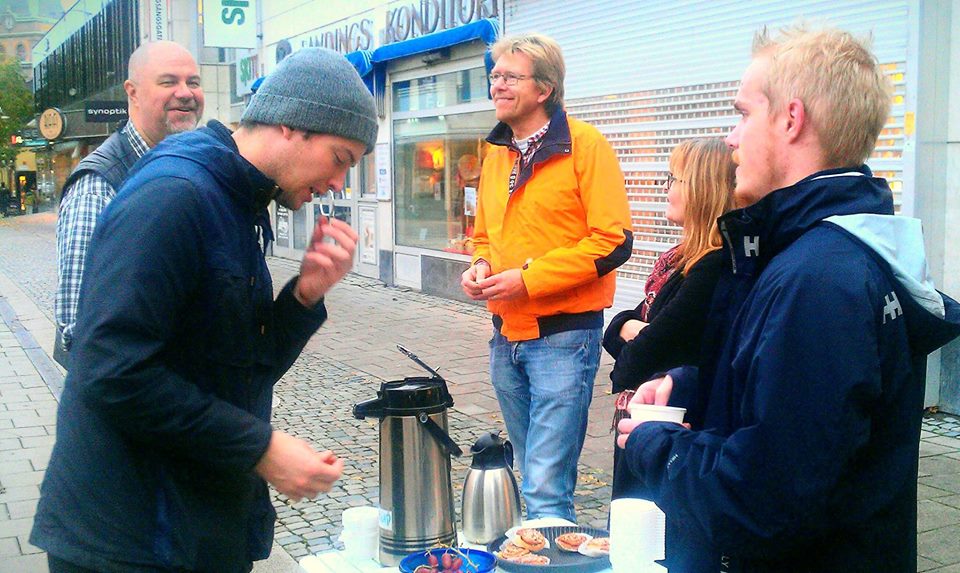
Outside
I love my church! Uppsala Mosaik is a small house church in Uppsala, Sweden (not to be confused with the mega church Mosaic in Los Angeles, California (we’re way smaller than them)) focusing on the Kingdom of God. We’re evangelical, charismatic and activist, and our aim is, like many other churches, to love God and love people.
When I visited Mosaik for the first time in 2010, I was amazed by its structure. We met in a pub back then. We had coffee break in the middle of the service, between worship and Jesus stories. Jesus stories, by the way, are when everyone can share a testimony about what Jesus has done in their life. And when the service was coming to an end, students flooded the pub while Mosaik volontueers started to serve free pancakes.
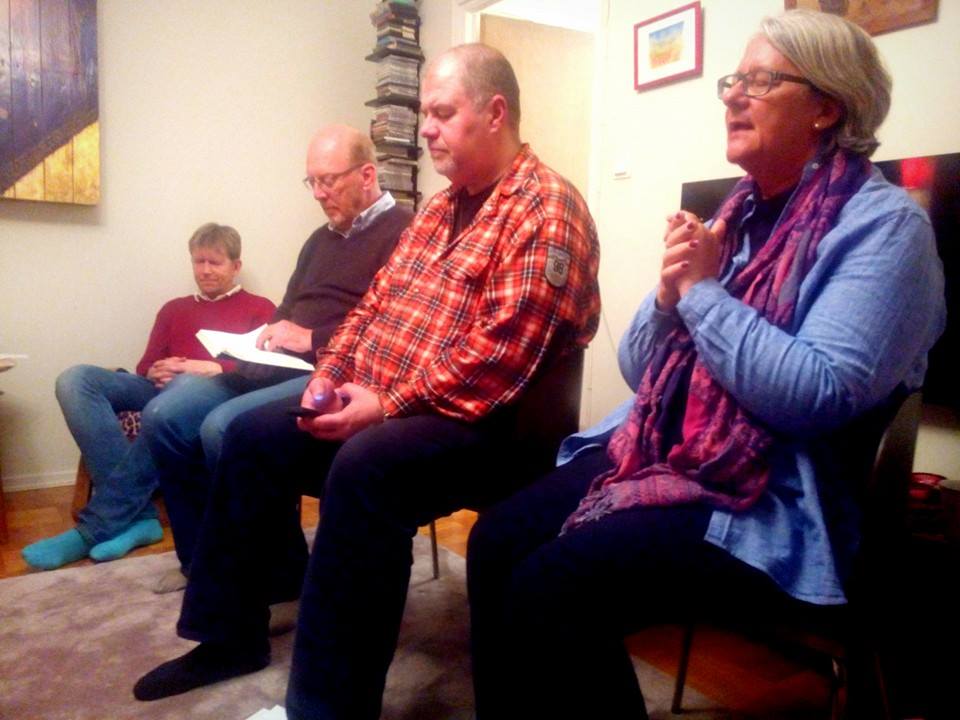
Inside
I sat down with the pastor, Hans Sundberg, and he explained the theology behind what Mosaik looked like. In Sweden, people are leaving churches like crazy, so that statistically, if the drop-off speed would remain at this rate, there would be no Christians here in 2040. Now, God is good and we pray for revival, but Hans was convinced that the church must leave the old Christendom-structures that builds large cathedrals expecting people to fill them, and becoming sad when they don’t.
Language Miracles
The Bible describes how the early Christians were able to speak new existing languages when the Holy Spirit baptized them. There are reports of this happening in modern times as well.
J.W. Hutchins was baptised by the Holy Spirit at the Asuza Street revival in Los Angeles in 1906, and when she spoke in tongues a man who had been a missionary to Uganda exclaimed that she spoke the Luganda language. She also heard the external, audible voice of God telling her to go to Africa, so she became a missionary.
My pastor Hans Sundberg experienced something similar when he was evangelizing on the streets of Uppsala, Sweden, in the 70’s. He was debating with a man from Iran who believed in Bahá’í, when his friend Maria came and prayed for him silently. She prayed louder and louder, and Hans realized that she was praying in tongues. The Iranian man dropped his jaw and stared at Maria, understanding every word. She was speaking in Farsi about Jesus, although she didn’t know farsi.
In 2011, Hans was visiting Nepal to teach at a Bible school run by Touching Asia. During a prayer session before class, a man at the front spoke loudly in tongues. Afterwards, another student came to him and asked him some questions, and everyone became really excited. hans asked them what was going on, and they explained that there are over 20 languages in Nepal, and when the man had spoken in tongues he had been unknowingly prophesying to the other man in his own language, that wasn’t spoken by so many, about a coming revival to his village. (more…)
Baptized with Fire
To be baptized with water is awesome, but to be baptized with fire is even awesomer. John the Baptist, who really knew baptism, said: “I baptize you with water. But one who is more powerful than I will come, the straps of whose sandals I am not worthy to untie. He will baptize you with the Holy Spirit and fire.” (Lk 3:16)
Who could this be? Spoiler alert: It’s Jesus. Before He levitated up to Heaven, He told His disciples:
Do not leave Jerusalem, but wait for the gift my Father promised, which you have heard me speak about.For John baptized with water, but in a few days you will be baptized with the Holy Spirit… you will receive power when the Holy Spirit comes on you; and you will be my witnesses (Acts 1:4-5, 8)
And this happened ten days later:
When the day of Pentecost came, they were all together in one place. Suddenly a sound like the blowing of a violent wind came from heaven and filled the whole house where they were sitting. They saw what seemed to be tongues of fire that separated and came to rest on each of them. All of them were filled with the Holy Spirit and began to speak in other tongues as the Spirit enabled them. (Acts 2:1-4)

World’s Richest Country Makes Feeding the Poor Illegal

Me sitting with Doinita, a Romanian Pentecostal who has to beg to survive
I wish this was a joke. The government of Norway will soon make begging illegal. Many have already pointed out how ironic this is since Norway is in the top five of richest countries in the world (in fact, if you exclude city-states from the list, that have an unfair chance of climbing the top of it, Norway is the richest country in the world). But the madness doesn’t end there. When details in the law proposal were released two days ago, it turned out that the government also wants to criminalize those who help begging people:
The scope of the law, which was originally intended to ban homeless people from begging on the street, has been extended to also criminalise those offering money or other help… Under the law, organised begging would become a crime, punishable with a prison sentence of up to one year. The same punishment would apply to those aiding beggars.
Some of you may recall that a town called Fort Lauderdale in Florida has inforced a similar law, so that 90-year-old Arnold Abbott was arrested when he was handing out food to homeless people through his organization Love Thy Neighbor. I wrote a blog post about this in November last year, reflecting on how strange it is that some reach the conclusion that helping the poor is not helping the poor, while not helping the poor is in fact helping the poor.
Just like my country Sweden, Norway has had many visitors from eastern Europe that are extremely poor and marginalised, who are begging on the streets. Most of them are Romanis, the most discriminated ethnic group in Europe. In Romania, Romanis were slaves up to 1850, and even today 80 % of Romanis in the country are unemployed, 80 % lack water, sanitation or electricity and one in seven of Romani children never attend school. 30 % cannot read or write.
The Economy of Need and the Economy of Greed
 Jobs, growth and enterprise are constantly viewed as something solely positive in the political and economical debate. More jobs are good, less jobs are bad. If a policy may lead to “fewer American/Ukrainian/Indonesian jobs”, it should be rejected. Economic growth must increase as much as possible. As long as an activity is legal and you get paid for it, it’s good and should be supported and celebrated.
The Bible, on the other hand, says that work means “doing something useful” with our hands. The Christian calling to holiness, compassion and altruism doesn’t stop when we’re earning money. On the contrary, if it’s somewhere we should live like Jesus it is at our workplace, where most of us will spend a lot of time and energy.
This is why the early Christians didn’t think that all jobs were good, such as slave trading (1 Tim 1:10), occultism (Rev 22:15) and politicians (Mt 20:25-26). The Apostolic Tradition from the third century named other jobs as well, such as gladiators, prostitutes and soldiers, as unacceptable for Christians. This is basically concluded from what kind of activities the job requires compared to what ethics are Christian called to follow.
However, as Christians try to “do something useful” in our work, we should also take a look at activities that may not be as harmful as for example being a gladiator, but rather, unnecessary. The Bible encourages simplicity and equality and says that we should not be rich, and that means that we should not consume unnecessary stuff but be sufficient with food and clothing (1 Tim 6:8) and give away one shirt of we have two (Lk 3:11). If we should not consume superfluities, we should not produce them as well.
How to be Saved
Why am I a Christian? I started to follow Jesus to be saved. Saved from what? Saved from death, destruction and suffering.
When I was fifteen, I had some very depressing thoughts about life and death. My worldview, which I shared with many of my friends, was that there was nothing after death, and that I along with all of humanity are inevitably heading for nonexistance, where it won’t be dark because we will not have eyes to see with and it will not be quiet since we will have no ears to hear with. We won’t even remember that we’ve ever lived, and in the end no one else will remember it either. Everything is pointless. It takes less than that to give you anxiety.
My Lutheran father brought me to church on April 2 2006, and I wasn’t too excited since I had been there before and literally thought that it was the most boring place on earth. But for the first time, I actually started to listen to what they were saying. The Apostles’ Creed said “I believe in the resurrection of the body, and life everlasting”. Now, these were good news! I started to read the Gospels, learned that “gospel” really means good news and that it’s central message is that when we follow Jesus into the Kingdom of God, we get eternal life:
The life appeared; we have seen it and testify to it, and we proclaim to you the eternal life, which was with the Father and has appeared to us. (1 John 1:2)
Very truly I tell you, whoever obeys my word will never see death. (Jesus in John 8:51)
To those who by persistence in doing good seek glory, honor and immortality, God will give eternal life. (Romans 2:7)
For the perishable must clothe itself with the imperishable, and the mortal with immortality. When the perishable has been clothed with the imperishable, and the mortal with immortality, then the saying that is written will come true: “Death has been swallowed up in victory.” (1 Cor 15:53-54)
I was thrilled, realizing this! Death will not be victorious, Jesus will be! If I believe in Him, I will be immortal. I drank deeply from the comforting words in the Bible that spoke about the eternal glorious life that Jesus promised His followers. (more…)
3 Additional Ways the Modern Church Looks Nothing Like the Early Church

Paul preaching the Gospel. Art by Giovanni Paolo
This awesome article has been frequently shared by people in my networks the last couple of days; Preston Sprinkle writes about 4 ways the modern church doesn’t look like the early church (and, as several have pointed out, this goes especially for the modern mainstream Western church). These four areas are:
1. How we view other Christians. When the early disciples called themselves brothers and sisters, they actually treated each other like brothers and sisters and had a community that was far more relational and sacrificial than fellowship in most Western churches.
2. How we spend our money. The early Christians didn’t collect money for church buildings and pastors’ wages but for the poor.
3. How we think about power. The early church refused to be patriotic but was pacifist and persecuted.
4. How we study the Bible. Early Christians let every new convert study the Scriptures in a detailed manner, and most disciples then knew the Bible better than many Western church goers today.
I totally agree with all of Sprinkle’s points, and I’m glad that more and more start descovering the radical roots of the Christian faith. However, I would like to pinpoint three additional areas where the early church looked different from the mainstream Western church life today: (more…)
The Church’s Responsibility for the Holocaust

Emblem of the German Christians
Today is 70 years since the Nazi death camp Auschwitz was liberated by Soviet troops, and it is also the International Holocaust Remembrance Day. We must never forget the horrible attrocities during the world war when approximately seven million Jews, Romas, disabled, homosexuals and others were brutally killed by the Nazi regime and their allies. And as Christians, we must never forget that many who participated in this called themselves Christians, and that parts of the church leadership supported Nazism – although there was a lot of Christian resistance as well.
A lot has been written about the religious views of Hitler himself, and it seems to be a bit self-contradictory and populistic – which isn’t too strange since he, after all, was a Nazi. I’ve heard several neo-Nazis and other racists today declare that they fight for “Christian values” while they also hate religion and, of course, revere pagan gods. This is obviously extremely paradoxical but could be explained by that for many racists religion is merely a suit, which importance is heavily subordinated the nationalist and racist values that one fights for. Hence, the Party Platform of NSDAP read in 1920:
“We demand the freedom of all religious confessions in the state, insofar as they do not jeopardize the state’s existence or conflict with the manners and moral sentiments of the Germanic race. The Party as such upholds the point of view of a positive Christianity without tying itself confessionally to any one confession. It combats the Jewish-materialistic spirit at home and abroad and is convinced that a permanent recovery of our people can only be achieved from within on the basis of the common good before individual good.”
The state-censored religion proposed here should be unacceptable to any descent Christian, but both Catholics and Protestants started to dance to the Nazi pipe after Hitler became dictator. Paul Althaus, one of Germany’s leading Lutheran theologians, wrote “Our Protestant churches have welcomed the turning point of 1933 as a gift and miracle of God”.
The author

Micael Grenholm, a Swedish charismactivist, apologist and author.
A Living Alternative

God vs Inequality

 Charismactivism