Popular Posts


Recent Comments
 | James on Why Cessationism is Unbiblical… |
 | Nate on The Problems with the Lutheran… |
 | Franciskus – p… on Francis – the Charismati… |
 | Riverbelle on The Problem with “Sacram… |
 | Russell on Why Churches Should Abandon St… |
Networks





Fighting Terrorism Like Jesus

France has once again been subject to an attack which the president has dubbed “terrorist”. A man has been decapitated and the aggressor has been said to wave a black Islamic State flag. Meanwhile, over 40 people have been killed in bombings at a hotel in Tunisia and a mosque in Kuwait. Some believe that the attacks have been coordinated.
The threat of violent extremism shouldn’t be diminished. The Islamic State has an ideology very similar to Nazism – a belief that they’re superior and have the right to kill people who don’t look like and believe like them. Much like the 21-year old boy who went into a church in Charleston, South Carolina, last week and killed nine people because of the colour of their skin. He wasn’t labeled a terrorist that quickly as the guy in France was – instead we got to see childhood pictures of him and speculations about his mental state.
It is ridiculous how common this media logic is: dark-skinned aggressors are politically motivated terrorists, while light-skinned aggressors are confused lone-wolves with mental problems. Even Norwegian terrorist Anders Behring Breivik is not very often described as a terrorist, although it has been stated in court that he isn’t a psychopath but had a xenophobic ideology as the basis of his crime.
Speaking of xenophobia, Europeans who lean towards those ideas will most surely use the recent attack in France as an argument for deporting more Muslims to countries like Syria and Iraq, where there is war and terror fully operating. Now, that’s a horrible solution to the problem. The attacks in Tunisia and Kuwait today are illustrative: most victims from Islamic terrorism live in the middle east. Most of the Islamic State’s victims are Muslims! “Solving” Islamic terrorism with deportations is like “Solving” the holocaust and world war two with deporting every Nazi and Jew to Germany. It only gets worse if you do that.
So what is the solution then? Let’s look at the Bible. Did you know that one of Christianity’s greatest missionaries was a terrorist? His name was Saul.
Community of Goods: the Best Way to Eradicate Poverty

To share everything is commanded in Scripture and eradicates poverty better than anything else.
Last week I was attending one of the bigger Christian conferences here in Sweden called Torp, where I was speaking on the topic of how to combine miracles, evangelism and social justice. I pointed to the fact that Pentecost in Acts chapter 2 does not just include signs and wonders but also community of goods, i.e. having all possessions in common so that nobody is rich and nobody is poor (Acts 2:44-45). I argued that if we want to resurrect the spiritual power and evangelism of the Biblical Pentecost we ought also want to resurrect community of goods. I developed my thoughts on community of goods and how it relates to Jesus’ command to sell everything one has in this MennoNerd video:
These thoughts were new and radical to several of those who were listening. Some were curious, others sceptical. One pastor in particular raised two objections. Firstly, he said, community of goods cannot be equated with using Spiritual gifts or doing evangelism because there is no command saying “practise community of goods”, just a description of how the early Christians did so. Secondly, the pastor thought that the Swedish evangelical church was already very generous when it comes to giving alms to the poor, so he saw no need of preaching community of goods as something we should resurrect in evangelicalism.
My direct response to his first question repeated what I had been saying in the lecture, and that I briefly talk about in the video above, namely that community of goods is the practical application of Jesus’ command to sell everything one has and give the money to the poor – which he gives not just to one rich young ruler (Mk 10:21) but to all his disciples (Lk 12:33). Jesus himself practised community of goods with his disciples (Jn 13:29), and he told them to teach their new disciples to do everything he had commanded them to do (Mt 28:20). To sell everything one has doesn’t mean to live completely without possessions, for then the early Christians would have been nudists, instead we see how the community of goods in the book of Acts is described as being the consequence of the early Christians selling everything they have (Acts 4:32-35).
Why Did the Early Christians Go to the Synagogues?
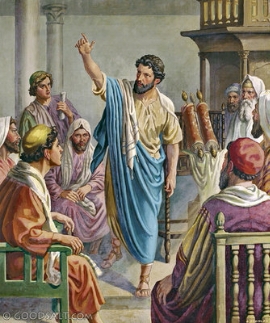
Was it really just to pray and worship with their Jewish brothers, or had they something else in mind?
I had a discussion with a friend the other day about church buildings; while I think that they are unnecessary for the most part and that we should focus on planting house churches instead, he enjoyed church buildings and saw no reason to diminish their role. One of his arguments for using church buildings was that the early Christians went to the temple and synagogues. My response was that they went to the temple and synagogues to evangelise.
Perplexed, he asked “Where in the Bible do Christians evangelise in synagogues?” Well, here’s a summary.
Jesus in the Synagogues
Let’s start with Christ. Luke 4:15 says that Jesus “was teaching in their synagogues, and everyone praised him.” Later, in verse 21 of the same chapter, we read: “He went to Nazareth, where he had been brought up, and on the Sabbath day he went into the synagogue, as was his custom. He stood up to read, He began by saying to them, ‘Today this scripture is fulfilled in your hearing.'”
Justice and Equality According to God
In this sermon, I talk about what the Bible says about justice. You rarely find someone who says that s/he is against justice, but you do find a lot of different definitions of justice. Here are five definitions of economic justice, together with my comments on which is the best from a Christian perspective:
1. Same for All
This is the idea that in a just and equal world, everybody has the exact same amount of money. There are hints towards this perspective in Lk 3:11 and 2 Cor. 8:13-15. However, this definition has received a lot of criticism simply because different people have different needs – people in poor countries without social safety nets need more money than people in rich countries, for example. This why not so many actually agree with this definition, even if we who try to promote equality are often accused of this while we really mean definition no. 2:
2. According to our needs
This is how the early church viewed economic justice: “All the believers were together and had everything in common. They sold property and possessions to give to anyone who had need.” (Acts 2:44-45) We can also see this in Ex. 16 where the people collect heavenly bread every day, and since the greedy are unable to store up a lot for themselves, everyone are able to collect what their family needs for that particular day. The socialist motto “From each according to his ability, to each according to his need” is based on the same line of thinking, but it was a biblical idea long before Marx was even born.
The Audible Voice of Jesus Saved Omid’s Life
Fire of God, Stockholm
Omid was saved after he heard the audible voice of Jesus Christ: “I’m real. Don’t take your life.”
Yesterday I was attending the Fire of God Revival Conference in Stockholm. I’m not a big fan of the setting (giant auditorium with coloured spotlights and smoke machines) but the Spirit and message was awesome. Three ordinary guys – Patrick, Charles and Omid – have together with Nigerian pastor Francis Anene arranged the conference. At this first meeting they shared their testimonies, and of the four Omid’s testimony touched me the most.

Omid Seppänen
Omid Seppänen was born in Finland, raised in a family with a Muslim father who taught him the Qur’an and a Christian mother who brought him to church. Needless to say, he became religiously confused. As a teenager, he rebelled against his parents and became an atheist. He went to parties every weekend for two years, drank and used drugs, and started to become very depressed.
One night, he saw the devil himself, physically, standing in his room. He was shocked, not the least since he didn’t believe that the devil existed! This vision terrified him, and his depression increased.
Church Leadership Should be Small-Scale

My pastor Lotta (left) reads the Bible with some new visitors at a Sunday meeting in our house church Mosaik
Why do most churches train their leaders to take care of groups of hundreds or even thousands of believers, when Biblical pastors trained groups of 20 or 30 people?
I talked to an associate pastor some time ago, and he shared with me the burden of him having the pastoral responsibility for families in his church. Since that meant 80 people, he had constantly work to do, and he felt pressured for not spending enough time with each family. There were two other pastors in the church, but they were also overloaded with work concerning the youth and the congregation as a whole (which includes over 400 people). I asked the associate pastor if he could delegate some pastoral care to cell group* leaders, but he was unsure whether they would accept the challenge. Many Christians just expect the pastor to do the work for them.
It’s biblical to delegate. Exodus 18 tells us about how Moses’ father-in-law, Jethro, saw how Moses was being worn out with all the judging work, and so he recommended him to appoint God-fearing men to help him out, some having responsibility for a thousand people, other for one hundred, fifty and ten (Ex 18:20-21). When the apostles realized that they didn’t have time to help the poor, they appointed some other Spirit-filled people to do it (Acts 6:1-8). Leadership isn’t about doing everything yourself, but to inspire and give mandate to others so that they too can serve the Kingdom of God.
The Biblical church had various different types of leadership roles: apostles planted churches and had most authority in doctrinal disputes, evangelists preached the Gospel publicly and trained other disciples how to share their faith, prophets heard the voice of the Lord and brought important messages to the church, and teachers taught theology. And then we have presbyters, or pastors. (more…)
The Desperate Need for Christian Hospitality
Have you ever wanted to meet an angel? If so, let some homeless people into your home.
Scripture says: “Do not forget to show hospitality to strangers, for by so doing some people have shown hospitality to angels without knowing it.” (Hebr 13:2). And even if the person we’re hosting turns out to be mere human, that’s not a very big problem since we are then simply doing a very good deed: “Share with the Lord’s people who are in need. Practice hospitality.” (Rom 12:13).

Homeless people getting a home
In Sweden where I live, almost 50% of all the households are single households, meaning that only one person lives in them. We have almost half a million vacation houses standing empty most months of the year. And yet, so many – even Christians – are arguing that we don’t have space for more immigrants, that we should send Syrian refugees back to war and Romanian beggars back to misery. How about showing some hospitality instead?
Summer Plans

Yesterday I defended my paper on the Isreli-Palestinian conflict and since it seems to have gone pretty well, this means that I know can graduate with a bachelor’s degree in peace and development studies. And it’s summer break! Now, I will get much-needed time to work on some really cool projects that I’ve felt God wants me to do.
First of all, I will spend more time writing on my book. An American publisher has given me the opportunity and honor to publish a work on church history through them. The main thesis of the book is that Christian movements that have emphasized evangelism and miracles have almost always also emphasized peace, justice and social activism. I hope to get the project finished by the end of this year.
Secondly, I will release my very first documentary film. It’s about how the Jesus Army in the UK practice community of goods, and will hopefully give insights on how it’s not only possible but also really nice to share all one’s stuff with others. Half the movie is already edited, and I hope to get this thing done this summer.
Thirdly, I will of course continue to blog here as well as publish videos on my Youtube channel. I have an unfinished blog series on a Biblical, non-Zionist perspective on the Israeli-Palestinian conflict which could be suitable to pick up now that I’ve studied the actual conflict a bit more, and when it comes to the Youtube videos I’m thinking about perhaps posting some theological sketches that could be fun to do, and perhaps reboot my old God vs Wealth series to some better quality. We’ll see, God knows 🙂
Away from keyboard, I will visit and speak at some Christian conferences here in Sweden, travel to the Jesus Army together with some friend as well as rest, enjoy God’s creation, evangelize and help the poor.
So, what are you up to this summer? And would you like to help me out in some of my projects? Let me know in the comments!
The Importance of Both Preaching Healing and Eternal Life
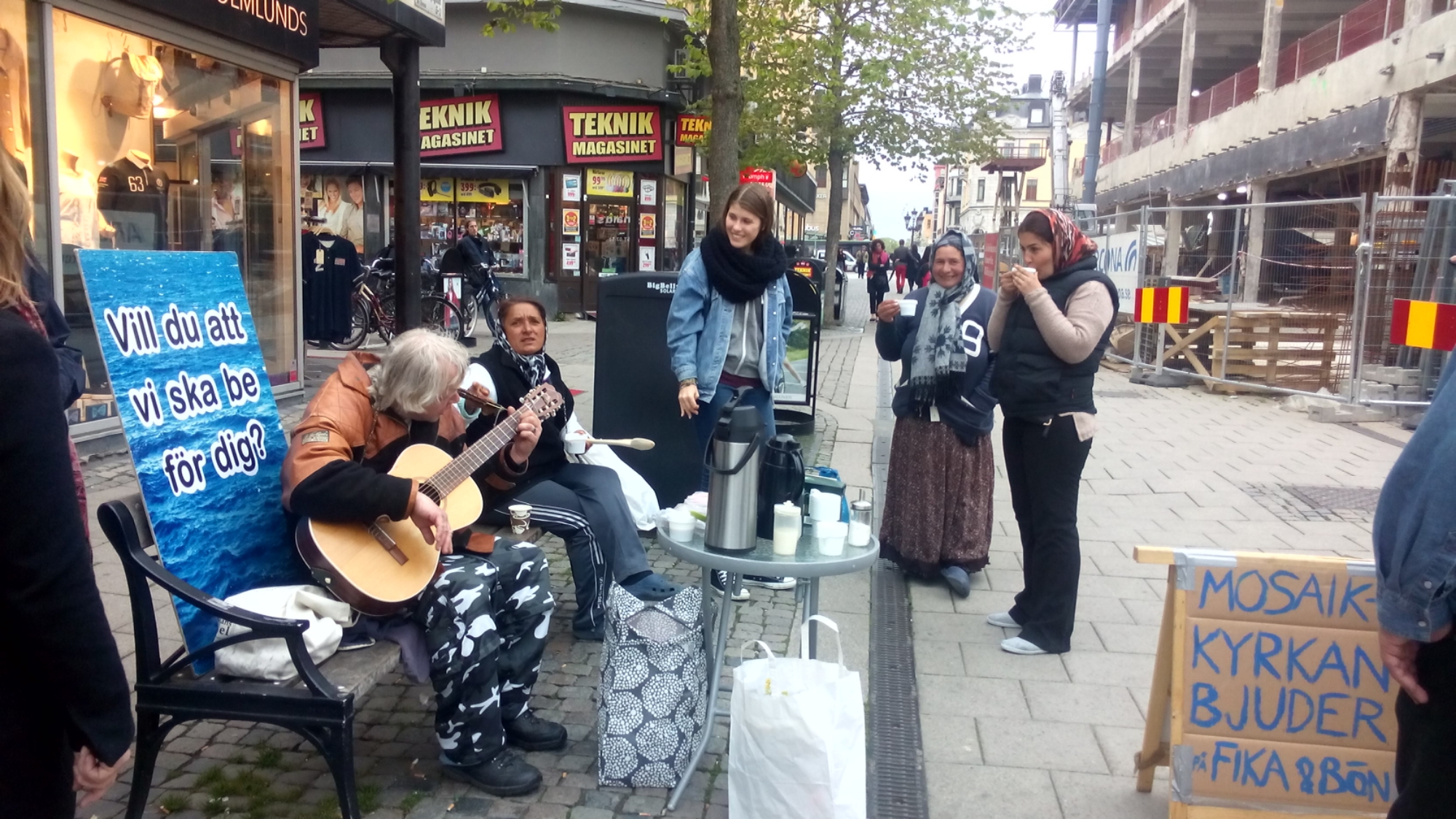
My church evangelising, telling people about both healing and eternal life
Why are not everybody healed when they receive prayer? Why was that person healed but not this person, even though they both believed in Jesus? Charismatics are often asked these questions, and as they are related to theodicy and the problem of evil and suffering, they take some time to answer. I have appreciated the Kingdom theology response to why not everyone are healed developed by John Wimber, which can be read in his great book Power Healing.
In this blog post I want to address a particular type of healing theodicy, where one points to the death of a loved one as an argument for the strange selectiveness of God’s healing. I have several times heard friends describe how a dear relative was very sick and they prayed and prayed, bit eventually they died. Several of those who have told me this have then said that because of this they have some problems with the healing message; some of them have been mad at God for healing others but not the one they prayed for.
Such a scenario reminds me of how Martha questioned why Jesus didn’t heal Lazarus while he was dying:
“Lord,” Martha said to Jesus, “if you had been here, my brother would not have died. But I know that even now God will give you whatever you ask.”
Jesus said to her, “Your brother will rise again.” Martha answered, “I know he will rise again in the resurrection at the last day.”
Jesus said to her, “I am the resurrection and the life. The one who believes in me will live, even though they die; and whoever lives by believing in me will never die. Do you believe this?” (Jn 11:21-26)
Christians Caused Climate Change – Now it’s Time We Fix it!

Many of those who invented and fueled industrialism and capitalism were, or claimed to be, Christians.
Sure, some Muslim oil sheiks and Confucian factory workers have also played their role, but Christians are responsible to a very large extent to the inequality and environmental destruction which this economic system has brought. Now, followers of Jesus around the globe need to step up against the biggest beast that global mass consumption has birthed: climate change.
Climate change – isn’t it a weird term for a phenomena that may very well kill hundreds of thousands of people, ruin cuties and destroy whole countries? It’s like naming a genocide something like “population change” or, as the Guardian’s excellent podcast The biggest story in the world pointed out, calling a bomb an “unexpected delivery”. Human emissions of greenhouse gases is, according to 97% of scientists researching the matter, destroying the system and will eventually crush civilisation. What we’ve created is Creation Destruction.
The sad thing is that while this catastrophe is caused primarily by rich people, most of those that will get hurt from it are poor. This is often called “climate injustice”. What our hyper-consumption has caused harms not just polar bears, but human beings living in poverty. To stop this, we need to act quickly.
Why Testimonies Are Important
Every time my house church meets, we share Jesus stories – testimonies about what God has done for us during the last week. It’s always very encouraging and often pretty amazing; we’ve heard about cancers getting healed, people receiving visions as well as evangelistic opportunities, prophetic insights and ordinary Jesus trot. In my latest contribution to the MennoNerd vlogging relay race, I talked about testimonies and some testimonies that have impacted me:
The Gospels are testimonies, Acts is a testimony, Revelation is a testimony. Church history is filled with testimonies. The Psalms encourages us to share testimonies (Ps 145:11-12). Testimonies rock, basically. When I was a younger Christian I refused to read any Christian books besides the Bible, ’cause my experience was that most of them deradicalized the Bible. But when I discovered Christian biographies and testimony accounts by saints that have encountered the miraculous power of the Holy Spirit, I became a Christian book nerd.
My fellow MennoNerd Allen Green followed up my testimony vlog with talking about martyr accounts and testimonies of sufferings for Christ, which I agree are also very important and encouraging in a way to read – not in a happy-clappy sense obviously but as a reminder of that Jesus is worth suffering for, faith in Him stands in the midst of hardships and injustice. In fact, the most powerful testimonies I’ve read both contain miracles and suffering, which I think was noticable in my video where I mentions some books that I recommend.
God, let us experience both the cross and the glory!
Why is there Something Rather than Nothing?

I was listening to a TED talk the other day on this topic by philosopher Jim Holt. In a detailed manner he described the puzzle of existence and explained why it cannot simply be “pushed back” one level by saying “big bang did it” or “the multiverse did it”, because the question is more fundamental than so: it is not just about why this or that happened but why anything happens, why there are whys.
As an atheist, he quickly also excludes God from the equation, saying that we then must explain what created God and that the universe is way to non-perfect and mediocre to have been created by an all-powerful, intelligent being.
What solution does Holt then himself have to the puzzle? I waited curiously to the end to hear it, but it was a bit of an anticlimax. Holt says that we can theoretically imagine three types of realities: (more…)
It’s Time to Become Pentecostals for Real!

Happy Pentecost! I don’t know how it is in your country, but here in Sweden Pentecost is hardly celebrated at all – we’re must more eager to celebrate National Cinnamon Bun Day or Waffle Day (yeah, we have those). But Pentecost is worth celebrating – it’s the amazing power-boosting of the church when it receives the power and love it needs to perform its divinely commanded mission to save the world.
The book of Acts describes how the Holy Spirit baptized all of the early Jesus followers – men and women alike – and gave them the miraculous gifts of prophecy, speaking in tongues and preaching an epic sermon that leads to 3000 people accepting Jesus as their Saviour and receiving eternal life. It’s dramatic, it’s fantastic and it’s very supernatural.
Pentecost is repeatable – we can also experience the baptism of the Holy Spirit and be equipped with His miraculous gifts to spread the word about eternal life in Jesus. Pentecostals have always emphasized this: they often talk about preaching the “Full Gospel” – both salvation and Spiritual baptism – and the early Pentecostals said that they had restored the “Apostolic Faith”.
Had they, though? (more…)
Where is Jason Westerfield?
It’s almost been one month since pastor Bill Johnson called evangelist Jason Westerfield out as a false prophet, but Jason has still not said anything about this publicly. Here, I talk about this and comments some of the comments I’ve received from my previous video and blog post about Bill and Jason. I hope and pray that Jason soon will announce that he does not believe in new age and that he confesses Jesus Christ as divine Son of God.

Miracles in the Middle East

I have a friend called Elijah*, who used to be a Muslim but became a Christian after Jesus showed Himself to him in a prophetic vision. He know works with a missionary organisation and is spreading the Gospel in the Middle East. A couple of months back when he was visiting some churches in a South Asian city, a couple approached him when he was walking through a mall. They tried to convert him to Islam, but in 20 minutes time they became disciples of Jesus.
See, they told him that about six months earlier, they had been watching TV. As they zapped through the channels, they came to a Christian channel where Swedish pastor Stanley Sjöberg was preaching the Gospel. Since they were devout Muslims, they became upset, shut the TV down and went to bed.
The next morning, they told each other that they had had a strange dream. They soon discovered that it was exactly the same dream! Stanley Sjöberg had come to their house, they had let him in and he continued to preach about Jesus. As they protested, Stanley said “My friend Elijah will tell you more about Jesus”, and from nowhere they saw a Middle Eastern guy sitting next to Stanley. Stanley went on saying that they would meet him in a particular South Asian city, on one particular day at 5 PM.
They didn’t know what the dream meant and thought it was a bit freaky that they both dreamt it the same time, but after a bit if reasoning the wife said “Maybe Allah has given us this dream to find Elijah and convert him to Islam. Let’s go to that place – if we don’t find him we will just have a nice holiday.” (more…)
The author

Micael Grenholm, a Swedish charismactivist, apologist and author.
A Living Alternative

God vs Inequality

 Charismactivism