Home » Posts tagged 'Evangelism' (Page 4)
Tag Archives: Evangelism
The author

Micael Grenholm, a Swedish charismactivist, apologist and author.
Resources on Evangelism and Apologetics

Pancake Evangelism
Hello charismactivists and all you others who follow this blog! I got two pieces of fresh news for you. The first being that the URL to this website has shrunk to the much simpler name of holyspiritactivism.com. All the old links are still functional and redirects to this site. God bless WordPress for making this transition so easy and convenient 🙂
Secondly, I’ve created two new resource pages on the website to equip your work for the Kingdom of God. One is about street evangelism which provides some tips on how to share the Gospel as well as arguments for why all churches should make public evangelism as common as Sunday services:
7 Reasons Street Evangelism Rocks
Why All Christians should Participate in Street Evangelism
Why Did the Early Christians Go to the Synagogues?
How to Make a Mainline Church Evangelize on the Streets
7 Reasons Why House Churches are Awesome
Who needs buildings when you have homes? Here’s a video I made where I describe why I’m such a passionate promoter for house churches. The seven reasons are the following;
1. They’re biblical – Acts 2:46, 1 Cor 16:19, Col 4:15 and other passages tell us that the early Christians met in homes. The earliest archeologically discovered church, the Dura Europos church, was a house church. In fact, church buildings where people didn’t eat and sleep wasn’t constructed until the late third and early fourth century.
2. They’re utilized – again, people actually eat and sleep there. Most church auditoriums – the big room with a lot of pews – stands empty for the most part of the week. Homes, in contrast, are usually used daily.
3. They’re small – and this is a good thing! 1 Cor 14:26 tells us that everyone attending a church meeting should contribute with something. When was the last time you’ve experienced that? Frankly, you need a small group to have such a wonderful spiritual interaction. (more…)
Imams Receive Jesus in West Africa!
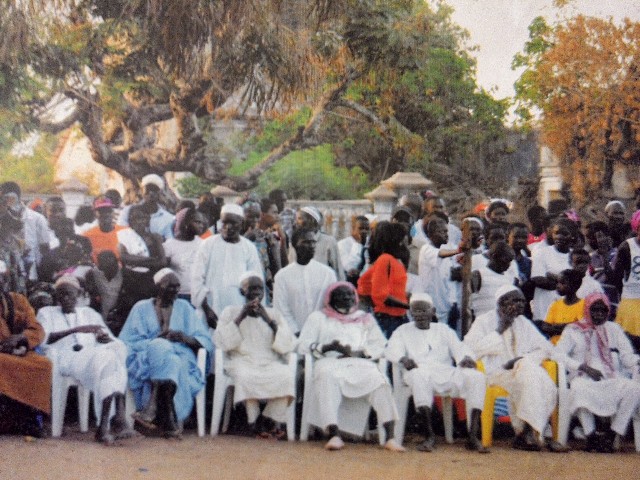
We have this wonderful little missions organization in Sweden called Go Out Mission, which regularly organizes evangelistic campaigns in Africa and Asia. The following report is from one of their local leaders, Oury Sow, who shares about a campaign they recently had in Guinea-Bissau, where the lame walked, the blind saw and Muslim leaders gave their lives to Christ. Here’s his report, translated to English:
First, we had the opportunity to hold a campaign in a small town inside the country. Already at the first evening there was about 1,500 people gathered during the sermon, and during prayer it increased to about 2500 people. 300 responded to salvation when I made the call, and after we prayed for the sick was three people who had the courage to come up to the stage to testify. A Muslim man from Gambia contacted me after the meeting and told me that he had come to Guinea-Bissau in order to get money, but now he said: “I have found Jesus instead and I feel so rich!”
The campaign continued to grow; many children were there early and were quick to the scene to respond to the invitation. A little girl who was now five years old had been born both deaf and dumb, but after prayer she both heard and she spoke her first words in life! What joy for the mother to hear her daughter say her name. What a Jesus we have! One woman who came to the first meeting had had problems with bleeding for 32 years, but after prayer the night before, she had gone home and all the bleeding had stopped! The woman and her husband were so thankful to God.
The third evening there was over 3000 people on site who heard a clear Gospel. The atmosphere then exploded when a 15-year-old girl who was unable to walk since birth, suddenly stands up, causing such a joy chaos that we had to let go of control and could not give testimonies from the stage. The girl’s mother fell to the ground in fear of God and people danced completely wild with joy just everywhere!
How Can the Jesus Army Grow?
Jesus People at the RAW youth event
As you probably should know by now from reading my previous posts, I think that a certain British church called Jesus Army is amazing. Since it combines Bible-believing, charismatic discipleship with community of goods and care for the poor, it is one of the most Biblical churches I know of. The more people who join this church and/or adapt its model of charismatic community building, the better. But how, then, can it grow? Here are my three suggestions:
1. More Public Evangelism
The apostolic church in Jerusalem didn’t just experience miracles and practise community of goods, they also evangelised every day in the temple courts (Acts 2:46, 5:20, 42) as I’ve written about several times before. This can be adapted in various ways today: evangelism on the internet, in shopping malls, outside of mosques, on the streets, handing out leaflets, preaching, showing a drama, serving free pancakes, offering prayer for healing… God loves when we present the Gospel creatively!
However, since the evangelism of the early church was public and corporal, it cannot really be equated with private evangelism that an individual performs to his or her friends and family. I often meet the idea that this would be more effective than public, corporal evangelism, but it is very problematic to view Jesus’ and the apostles’ model for evangelism as ineffective, and it mostly has anecdotic rather than empirical support. Research shows that evangelistic activity is one of the most important things churches can do in order to grow, which is about as surprising as the scientific discoveries of fuel promoting vehicles to drive or consumption of food promoting human survival.
Since corporate, public evangelism is not just about reaching out but also about training disciples, people get more equipped to share the Gospel in other settings as well if they get evangelistic training by the church. Thus, there is no reason to say that we should cut back on public evangelism to promote friendship evangelism, because public evangelism already promotes friendship evangelism.
Billy Graham Reacts to Franklin’s Islamophobia
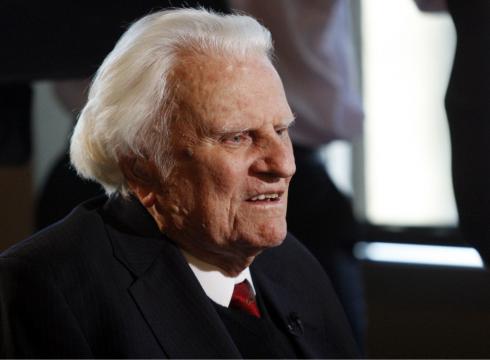
As I wrote in my last blog post, I’m pretty upset about Franklin Graham’s idea about deporting all Muslim immigrants from the United States. I think it’s a plain out stupid idea, not the least from an evangelistic perspective. And Franklin’s dad happen to be one of the greatest evangelists of the Western world. So I had to make a sketch about what I imagine (or rather, hope) that Billy’s reaction to Franklin’s proposal would be like:
I talked to a sister about this yesterday and she said that she was constantly shocked every time a Christian started to argue against immigration. Because of fear and comfort almost no Western Christian dare to go as missionaries to totalitarian Muslim countries – and when Muslims then show up here, where it’s super easy for us to share the Gospel, we want to deport them!
Deportation is anti-evangelism. A person is not saved by being forcefully transported by the police to a country they fled from, it just decreases the chance for them to hear the good news about eternal life through Jesus Christ. How then can evangelist Franklin Graham propose deportation of all Muslim immigrants? My theory is that either he didn’t think much at all, or he believes that Islamic terrorism is only a problem when it’s taking place in the United States. Even though most people who are killed by terrorism are Muslims in the Middle East – those whom Franklin doesn’t want to welcome in his country.
Now, I’m not entirely sure that Billy would react in real life as he does in the video – he has had some goofy moments in his later years, such as suddenly changing opinion on Mormonism after Mitt Romney became the Republican presidential candidate. The Billy character in the video surely represents my opinion though. And as you can tell, I don’t think Franklin’s proposal is anywhere near smart.
Why Did the Early Christians Go to the Synagogues?
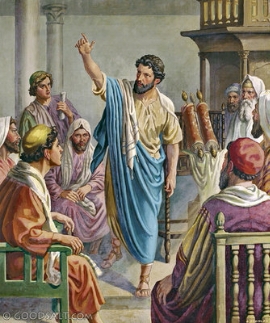
Was it really just to pray and worship with their Jewish brothers, or had they something else in mind?
I had a discussion with a friend the other day about church buildings; while I think that they are unnecessary for the most part and that we should focus on planting house churches instead, he enjoyed church buildings and saw no reason to diminish their role. One of his arguments for using church buildings was that the early Christians went to the temple and synagogues. My response was that they went to the temple and synagogues to evangelise.
Perplexed, he asked “Where in the Bible do Christians evangelise in synagogues?” Well, here’s a summary.
Jesus in the Synagogues
Let’s start with Christ. Luke 4:15 says that Jesus “was teaching in their synagogues, and everyone praised him.” Later, in verse 21 of the same chapter, we read: “He went to Nazareth, where he had been brought up, and on the Sabbath day he went into the synagogue, as was his custom. He stood up to read, He began by saying to them, ‘Today this scripture is fulfilled in your hearing.'”
Miracles in the Middle East

I have a friend called Elijah*, who used to be a Muslim but became a Christian after Jesus showed Himself to him in a prophetic vision. He know works with a missionary organisation and is spreading the Gospel in the Middle East. A couple of months back when he was visiting some churches in a South Asian city, a couple approached him when he was walking through a mall. They tried to convert him to Islam, but in 20 minutes time they became disciples of Jesus.
See, they told him that about six months earlier, they had been watching TV. As they zapped through the channels, they came to a Christian channel where Swedish pastor Stanley Sjöberg was preaching the Gospel. Since they were devout Muslims, they became upset, shut the TV down and went to bed.
The next morning, they told each other that they had had a strange dream. They soon discovered that it was exactly the same dream! Stanley Sjöberg had come to their house, they had let him in and he continued to preach about Jesus. As they protested, Stanley said “My friend Elijah will tell you more about Jesus”, and from nowhere they saw a Middle Eastern guy sitting next to Stanley. Stanley went on saying that they would meet him in a particular South Asian city, on one particular day at 5 PM.
They didn’t know what the dream meant and thought it was a bit freaky that they both dreamt it the same time, but after a bit if reasoning the wife said “Maybe Allah has given us this dream to find Elijah and convert him to Islam. Let’s go to that place – if we don’t find him we will just have a nice holiday.” (more…)
Salvation, Miracles and Activism: A New Form of Church Conference

Right now I’m at a Christian conference called Salvation, Miracles and Activism in my hometown of Uppsala, and I’m one of the organisers. It’s not a conference in a big auditorium; but just like my church we meet in the streets and in my home. We’re about fifteen people; if we had been more we would have met in several homes at once. Yesterday we started things off with a Jesus meeting in the city park, and afterwards we went to my place to watch the epic trailer for my upcoming documentary and plan today’s activities.

The theme of the conference is how to combine evangelism, Spiritual gifts and activism for peace and justice. We’re talking about these things in my living room right now, and in the afternoon we will do a demonstration for the Act Alliance campaign Act for Climate Justice, and in the evening we will evangelise together with the Pancake Church. Tomorrow we will have a “Come in, go out”-service with my church Mosaik.
Video: 7 Reasons Street Evangelism Rocks
Being a Christian isn’t just an indoor activity. Here are seven reasons why everyone – yes everyone – who have chosen to follow Jesus should share the Gospel about Him in public areas.
Check out the Biblical foundation for why churches should view street evangelism as mandatory meetings just like Sunday services.
And here’s a description of how my own church does this in practice.

Why All Christians Should Participate in Street Evangelism

As I’ve written about previously, my church has a 50/50 vision where half of our activities being outreaches, and one way we practice this is through “Come In, Go Out”-services (or “Go Out, Come In”) where we simply spend one hour inside and one hour outside. We see evangelism as something every Christian should be doing, just like prayer or Bible reading, and we are not just exhorting people to evangelize, we show and train them by doing it together.
At first I thought our “mandatory evangelism” was just a cool thing, but then I realised that in the Biblical Christian community, corporate evangelism in public places was indeed a part of what all believers were expected to participate in. In Acts 2:46-47 we read:
Every day they continued to meet together in the temple courts. They broke bread in their homes and ate together with glad and sincere hearts, praising God and enjoying the favor of all the people. And the Lord added to their number daily those who were being saved.
Thus, the Biblical, apostolic Church had two kinds of meetings: one internal in the homes and one external in the temple courts. It was in the homes where they were eating the Lord’s supper (or Jesus Lunch as I like to call it), so it was this meeting that developed into our modern Sunday services. The temple meetings were not internal, they included evangelism so that people were saved daily.
Why Both Conservative and Liberal Churches are Decreasing

Rachel Held Evans (photo from Wikipedia)
Evangelical blogger and author Rachel Held Evans is no longer evangelical; she has joined the Episcopalian church which, in the US, is not very theologically conservative but rather progressive or liberal. This isn’t very surprising since Evans has been very critical to evangelical theology as well as evangelical views on politics, women, the LGBT community etc.
In an interview that has been published in several media, including Sojourners, Evans names these progressive values along with sacramental church life as being the reason she joined Episcopalianism. She’s also asked to comment the fact that the Episcopalian church is rapidly losing church attendees, to which she responds:
Just about every denomination in the American church — including many evangelical denominations — is seeing a decline in numbers, so if it’s a competition, then we’re all losing, just at different rates… Lately I’ve been wondering if a little death and resurrection is exactly what the American church needs… A church might produce thousands of attendees without producing any disciples.
This is quite remarkable, since the point of one of Evans’ most famous articles on CNN’s Belief Blog is that evangelical churches must become more liberal to stop millenials from leaving them. This is a similar argument to John Shelby Spong‘s famous thesis that Christianity must change or die. A former bishop in Evans’ new church, Spong argued that this change includes stop believing in theism, stop beliving in the supernatural, stop believing that prayer is useful and stop believing in physical resurrection. Pretty ridiculous. Evans is far from this extreme, but her reasoning in the CNN article was similar: liberal Christianity is necessary for church growth.
“Go Out, Come In” – a New (or Old) Type of Church Service
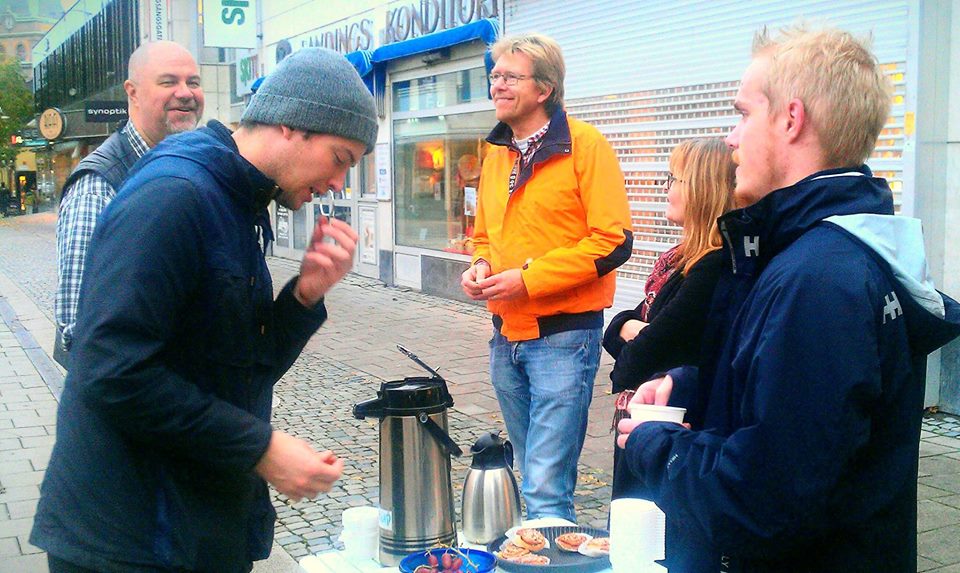
Outside
I love my church! Uppsala Mosaik is a small house church in Uppsala, Sweden (not to be confused with the mega church Mosaic in Los Angeles, California (we’re way smaller than them)) focusing on the Kingdom of God. We’re evangelical, charismatic and activist, and our aim is, like many other churches, to love God and love people.
When I visited Mosaik for the first time in 2010, I was amazed by its structure. We met in a pub back then. We had coffee break in the middle of the service, between worship and Jesus stories. Jesus stories, by the way, are when everyone can share a testimony about what Jesus has done in their life. And when the service was coming to an end, students flooded the pub while Mosaik volontueers started to serve free pancakes.

Inside
I sat down with the pastor, Hans Sundberg, and he explained the theology behind what Mosaik looked like. In Sweden, people are leaving churches like crazy, so that statistically, if the drop-off speed would remain at this rate, there would be no Christians here in 2040. Now, God is good and we pray for revival, but Hans was convinced that the church must leave the old Christendom-structures that builds large cathedrals expecting people to fill them, and becoming sad when they don’t.
3 Additional Ways the Modern Church Looks Nothing Like the Early Church

Paul preaching the Gospel. Art by Giovanni Paolo
This awesome article has been frequently shared by people in my networks the last couple of days; Preston Sprinkle writes about 4 ways the modern church doesn’t look like the early church (and, as several have pointed out, this goes especially for the modern mainstream Western church). These four areas are:
1. How we view other Christians. When the early disciples called themselves brothers and sisters, they actually treated each other like brothers and sisters and had a community that was far more relational and sacrificial than fellowship in most Western churches.
2. How we spend our money. The early Christians didn’t collect money for church buildings and pastors’ wages but for the poor.
3. How we think about power. The early church refused to be patriotic but was pacifist and persecuted.
4. How we study the Bible. Early Christians let every new convert study the Scriptures in a detailed manner, and most disciples then knew the Bible better than many Western church goers today.
I totally agree with all of Sprinkle’s points, and I’m glad that more and more start descovering the radical roots of the Christian faith. However, I would like to pinpoint three additional areas where the early church looked different from the mainstream Western church life today: (more…)
Malala + Holy Spirit Revival = Pandita Ramabai

Ramabai on an Indian post stamp
One of my favourite Pentecostal saints of all times is Pandita Ramabai (1858-1922), Indian activist, evangelist and holy roller. Over a hundred years before Malala she campaigned for women’s right to education, and she was extremely active in helping the poor and discriminated. Born in a Brahmite family in what is now the state of Karnataka, she started to study in an early age and learned Sanskrit along with sacred Hinduist texts, astronomy, physiology and more. This was controversial since she lacked a penis, but her father encouraged her as she learned more and more about society, religion and activism.
In 1883 she went to England and taught Sanskrit at an Anglican monastery in Wantage. There she was saved. “I realized,” she later wrote, “after reading the fourth chapter of St. John’s Gospel, that Christ was truly the Divine Saviour he claimed to be, and no one but He could transform and uplift the downtrodden women of India.”
As she returned to her home country, she bought a piece of land outside Pune and started a Christian social community for young widows called Mukti, Sanskrit for Liberation. She also helped people who were orphaned, disabled or homeless, and when a famine hit India in 1896, Ramabai rescued over a thousand people and brought many if them to the Mukti mission.
Heidi and Rolland Baker’s Extremely Inspiring Christmas Greeting!
Praise God for Heidi and Rolland Baker! These wonderful missionaries in Mozambique are so passionate about the love of the Father, the Gospel of Jesus Christ and the miraculous power of the Holy Spirit, and their missionary organization Iris Global has experienced glorious revival for the last 20 years. Their Christmas greeting above was published a few days after Christmas (probably because of the amazingly beautiful editing) but who cares about that when the video is a masterpiece when it comes to inspiration, passion and faith?
Heidi shares how 2014 has been a challenge for Iris because of the horrible floods in Mozambique, but she is amazed by how God used countless radical disciples to serve, encourage and relieve the suffering population and bring the Gospel of hope and life. As I’ve written before on this blog, Iris experiences amazing miracles like the blind seeing and the deaf hearing while helping the poor and vulnerable with good, serious development assistance.

Since I’m a monthly donor to Iris I also got a physical Christmas greeting from the Bakers, this postcard with a nice worship CD. The reason they send their supporters worship music is so that their love for Jesus may increase, they say. I love it. They’re just great. God bless them!
 Charismactivism