Home » Posts tagged 'Bible Study' (Page 10)
Tag Archives: Bible Study
The author

Micael Grenholm, a Swedish charismactivist, apologist and author.
Jonathan’s Enormous Sacrifice

Jonathan and David
I was preaching a prophetic sermon last Sunday. In my house church Mosaik we have been covering the Kingdom of God and the coming of the King in the Old Testament, and I was sitting in the kitchen figuring out what to speak about. My community brother Andreas entered and I asked him “What should I preach about, it must be from the Old Testament about the Kingdom of God?” “Jonathan”, Andreas answered. “Speak about Jonathan. You know what, I think that’s a prophetic word.”
Now what Andreas didn’t know was that I was actually looking at the texts about David, Jonathan and Saul in 1 Samuel 16-31, so it was prophetic allright. And a few hours later when the church gathered in our apartment I talked about how Jonathan made an enormous sacrifice.
As the son of Saul, Jonathan would eventually be the king of Israel. Instead, he helped and saved David simply because he loved him and recognized the power of God upon his life. He realized that the anointing of the Spirit isn’t static – it isn’t necessarily passing on to the next generation and it isn’t necessarily remaining on someone who once has received it – Jonathan clearly saw how his father became possessed and crazy.
Are there Apostles Today?

Paul the Apostle
The issue of modern apostles is a controversial one; since the apostles had such authority in the early church, modern-day apostles obviously would have a great degree of spiritual authority, and people usually doesn’t like that. The historical churches argue that their bishops are sort-of modern day apostles, and several Pentecostal and charismatic churches use the a-word when describing some of its leaders, especially in the majority (so-called “third”) world. Some evangelicals protest against this, arguing that there are no apostles today. I think they’re wrong.
To solve this question we obviously have to define what an apostle is. The word apostolos means “being sent out”, and when we look at what the apostles did in the New Testament, they were translocal church planting leaders who did miracles (Paul says that miracles are the sign of an apostle in 2 Cor 12:12). Now, these people do hang around today. Surprise Sithole, Heidi Baker and Hans Sundberg are just some people that have those kinds of ministries. Still, some are not ready to call these people apostles.
The main reason for this is that they point to Acts 1 where Matthias is elected to be an apostle since he has witnessed Jesus life from His baptism until his ascending to Heaven. Thus, since nobody has seen that today there are no apostles today, the argument goes. But if one thinks that the Acts 1 description is the definition of apostle, then Paul isn’t an apostle.
The key is of course that “the twelve” and apostles are not the same thing – there are many apostles, Paul lists additional ones in his letters (e.g. Rom 16:7). I would say that the Biblical understanding of an apostle is what we today call missionary – somebody travelling around planting churches, spreading revival and equipping the body of Christ. We’ve got rid of the title, not the ministry.
(more…)
Love Doesn’t Need Consumerism

Love looks like something – grandson and grandmother in Sri Lanka. Photo by Steve Evans
Love is extremely central to the Gospel: the reason Jesus came to give us eternal life is out of God’s eternal love for our world (Jn 3:16), He said that the greatest commandments in the Old Testament Law are “Love the Lord your God with all your heart and with all your soul and with all your mind, and love your neighbor as yourself.” (Mt 22:37-39) Jesus close disciple John just fell in love with Love, and emphasized it like crazy in his writings:
“Dear friends, let us love one another, for love comes from God. Everyone who loves has been born of God and knows God. Whoever does not love does not know God, because God is love. This is how God showed his love among us: He sent his one and only Son into the world that we might live through him. This is love: not that we loved God, but that he loved us and sent his Son as an atoning sacrifice for our sins. Dear friends, since God so loved us, we also ought to love one another. No one has ever seen God; but if we love one another, God lives in us and his love is made complete in us.” (1 Jn 4:7-12)
But all love isn’t good love. In the same letter, John warns us for loving things instead of people, creation instead of God: “Do not love the world or anything in the world. If anyone loves the world, love for the Father is not in them. For everything in the world—the lust of the flesh, the lust of the eyes, and the pride of life—comes not from the Father but from the world. The world and its desires pass away, but whoever does the will of God lives forever.” (1 Jn 2:15-17)
Revival and Community Transformation

The Iris Revival in Mozambique
Charismatics like myself love to talk about revival. Revival is usually defined as an “awakening” of the church, when it goes back to it’s original state. If the church doesn’t look like the book of Acts – where a lot of miracles happened, thousands were saved and Christians were living a holy, passionate life – it’s basically sleeping and needs to be revived.
Half a year ago, a girl from Switzerland contacted me via this blog and said that she wanted to visit Sweden “and the revival there”. We were honored and welcomed her, but we gently said that it would be wrong to say that it’s a revival in Sweden. Even when a lot of people do get healed here and many are saved when we prophesy for them, revival is the wrong word, at least yet. Revival is something more, revival is community transformation.
During the Welsh revival in the beginning of the 20th century, the prisons, bars and stadiums were emptied a like – everyone were storming the churches to seek God. Norwegian revivalist Hans Nielsen Hauge transformed his country not just spiritually but also socially and economically, so that one of Europe’s poorest nations started to flourish. And Mozambique is right now totally transformed by the Iris revival, that brings thousands of children out of poverty and plant thousands of churches in the power of healing and miracles.
Killing the Next Hitler
Yesterday was the International Holocaust Remembrance Day, a day that feels extremely important to remember in xenophobic Europe of today. As Spain is going fascist, the neo-Nazi “Christian” party Jobbik has 12% of seats in the Hungarian parliament and islamophobia is growing rapidly, many are afraid that the economic crisis will throw Europe back to a similar state like the 1930’s. The period when Adolf Hitler gained power.

Adolf Hitler as an Infant
There is a great number of extremely simplistic solutions to how the second world war would have been prevented, the most common is probably to kill Hitler as a child. I cannot count how many times I’ve heard people dream about this “what if” scenario. Not long ago it was discovered that Hitler actually almost died as a child when he fell through the ice, but a friend, who later became a priest, saved him. The Daily Mail called it “the most devastating act of mercy in history”.
But of course, Adolf’s soul was darkened not because of mercy but because of lack thereof. The upcoming genocide in the Central African Republic won’t be stopped by people who let children die but by people who save them. Our culture is so dipped in a logic of death that we think the best way to stop a murderer is to kill him, that the best way to stop the Holocaust was to kill civilians in German cities, that the best way to stop the war against Japan was to kill hundreds of thousands of innocent people with nuclear bombs.
God vs Poverty, part 5: Praying
This is the fifth and final part of my God vs Poverty series.
Once we start praying and working for a better world, there is a risk of struggling in our own strength and power. And since everyone are sinners (Romans 3:10-18), the human way lined with failures, accidents, discouragement and fatigue. The Bible says that through the power of God, we are able to more than in our own force (Philippians 4:13). And that can sometimes be a little bit more dramatic than getting some extra energy as by an invisible vitamin kick. Sometimes, it means walking on water or raising the dead.
The ministry of Jesus and the apostles not only included human deeds but also acts of God, things that only God can do. While they gave money to the poor (John 13:29) and they also used the miraculous gifts of the Spirit to help them. As they combined action with prayer, there was suddenly no limit to what their aid work was able to do.
For example: Jesus raised a widow’s son from the dead, which besides being extremely joyful in itself saved her from economic misery (Luke 7:11-17). Jesus also did food miracles out of His compassion for the hungry (Matt. 14:13-21; 15:29-39). His healing miracles had an activist dimension as well; in Mark 10:46-52 He heals a blind beggar, who thus is rescued not only from a life in darkness but also from a life in poverty.
Why Christians Should Support Free Migration

Refugees. Photo: Evan Bench
Restricted migration is intrinsically racist, because it is much easier for white people to enter Western nations then for people of other ethnicities. In fact, migration was almost totally open for white Europeans to enter the United States and Canada during the 19th century. Even today, it is very, very easy for Europeans to become Americans and for Americans to become Europeans. And within the European Union, migration is totally free.
For non-white people in other parts of the world though, it is extremely hard to enter Westen nations. Even Syrians, who clearly have very good reasons to leave their country right now, do not have open access to the West. The United States only allows 2000 Syrians to enter, after making sure they aren’t terrorists. Sweden is one of very few countries within the European Union to give permanent residency to Syrians, but still it is illegal for Syrians to get a visa to Sweden, so they have to enter illegally. That’s insane, people.
Yet, even Christians support the horror of restricted migration. The influential website GotQuestions.org says that Christians should oppose illegal immigration and not help illegal immigrants hide:
“Romans 13:1-7 makes it abundantly clear that God expects us to obey the laws of the government. The only exception to this is when a law of the government forces you to disobey a command of God (Acts 5:29). Illegal immigration is the breaking of a governmental law. There is nothing in Scripture that contradicts a nation having immigration laws. Therefore, it is a sin, rebellion against God, to illegally enter another country.”
The Promised Land, part 4: Has the Church Replaced Israel?

Stephen Sizer
The Promised Land is back! In the previous parts of the series, we have looked at the origin of Christian Zionism, we saw that it was totally absent in the early church and we have discussed how important it is to realize that just because one isn’t a Christian Zionist, one isn’t necessarily an anti-Semite (and shouldn’t either). Now, we will turn to exegesis to see what the Bible has to say about Israel and the Promised Land. Let’s start by discussing God’s Chosen People.
Israel is the name of a man, Jacob, and it was used to describe his descendants. These were expected to believe in the Lord, and thus be God’s people, but they were actually not the only ones that belonged to Israel. This is something Stephen Sizer has pointed out (and the following account is based on his works): the requirement to belong to God’s people was and is primarily faith, not race. In the Psalms, we read:
“I will record Rahab and Babylon among those who acknowledge me—Philistia too, and Tyre, along with Cush—and will say, ‘This one was born in Zion.’ Indeed, of Zion it will be said, ‘This one and that one were born in her, and the Most High himself will establish her.’ The Lord will write in the register of the peoples: This one was born in Zion.” (Ps 87:4-6)
Here, we see that Egyptians, Iraqis, Palestinians, Lebanese and Ethiopians all can be recognized as “born in Zion”, receiving full membership and citizenship of God’s people, if they acknowledge the Lord. Already Moses said in Deut 23:7-8: “Do not despise an Edomite, for the Edomites are related to you. Do not despise an Egyptian, because you resided as foreigners in their country. The third generation of children born to them may enter the assembly of the Lord.” In Esther 8:17 we read “And many people of other nationalities became Jews because fear of the Jews had seized them.” The requirement to belong to God’s people was faith, not race or nationality.
No Christmas Without Angels

Christmas angel
We have a lot of symbols for Christmas, and honestly I feel that neither jingle bells, snowflakes or Santa Claus are adequate representations of this holiday compared to angels. Angels play a huge role in the birth of Jesus. Massive, in fact. This is yet another reason I believe that people without charismatic experience or theology won’t get what the Gospel is all about. You cannot have Christmas without angels.
First of all, the angel Gabriel visits Mary to tell her that she will give a virgin birth to the Messiah (Lk 1:26-38). Then, he visits Joseph to ensure him that Mary has not been cheating but that the Holy Spirit has conceived the child (Mt 1:21). As the Son is born in Bethlehem, angels tell some nearby shepherds that the Messiah has been born, and sings a angelic song about glory to God and peace among men (Lk 2:8-15). After the visitation of the wise men (who surprisingly weren’t led by angels but just by a supernatural star and prophetic dreams) an angel tells Joseph that he must take his family to Egypt to escape Herod’s madness (Mt 2:13). And after some time, Joseph gets to know that it’s clear for him to go back to Israel by – you guessed it – an angel (Mt 2:19f.).
Basically, angels are involved in almost every event in the Christmas story. What do people do with that? Well, since many lack the experience of angelic visitations even within the church, even Christians try to remove them. They’re viewed as mythological ornaments or exotic phenomena without any relation or application to our own lives. I’ve heard Christians who argue that Biblical angels are not supernatural creatures, but since “angelos” means messenger they were simply random people that brought messages from God… with the ability to fly up to heaven, I guess (Lk 2:15).
This modern form of saduceism (Acts 23:8) is only possible among Christians who haven’t met angels. And so I want to use this Christmas season to share a testimony of some angelic visitations that have received much attention in Scandinavia. Two years ago, a Pentecostal church in Finland released a video where the pastor interviewed a woman called Marita Mäntyniemi. She had been driving in her car and suddenly she saw that several other cars had stopped in the middle of the road. She looked to the side and among the trees was a giant angel. It had a prophetic message on its wings about revival for Finland, and it was massive! People bent their knees in the snow and were astonished by the vision.
God vs Poverty, part 4: Liberating
This is as the title suggests the fourth part of my God vs Poverty series.
“Give a man a fish and he has food for a day. Teach him to fish and he has food for a lifetime.” We’ve all heard that, haven’t we? It’s a good proverb about the importance of empowerment and long-term solutions in aid giving. But what about the lake? What if the man cannot fish even after we taught him because the lake is polluted by a multinational corporation, or illegal to fish from because of an unrighteous regime? In other words, are there structures that are blocking development and poverty reduction?
The Bible is well aware of structures that oppress the poor. It is very common that the Old Testament not only talks about giving to the poor but treating them fair in court (see for example Prov. 22:22-23), so that they will not be discriminated. When Isaiah prophesies about true fasting, he doesn’t just talk about giving food and clothing to the ones in need but he also says that it includes “to loose the chains of injustice and untie the cords of the yoke, to set the oppressed free and break every yoke” (Is 58:6). In order to fight poverty effectively, we have to identify oppressing structures and crushing them.

Can God say something prophetically that the Bible already says?
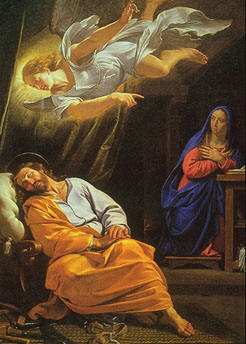
The Angel gives an “unnecessary” message to Joseph
The strange Strange Fire conference has put me into debate with some cessationists, especially when making this video. One common cessationist argument is that if the gift of prophecy still exists, the Bible isn’t our only source for doctrine about God, and thus the door to heresy stands wide open. Tom Pennington also uses this argument in his (bad) case for cessationism.
What I try to explain then is that firstly, prophecy has multiple purposes. 1 Samuel 9 contains a fascinating story about how Saul is looking for his father’s donkeys, and walks to prophet Samuel to see if he can use his prophetic gift to find out where they are. Before he even says something, Samuel invites him to dinner and adds “As for the donkeys you lost three days ago, do not worry about them; they have been found.” Then he reveals that the Lord has showed him that Saul is the new king of Israel, and anoints him.
Now, neither the revelation about the donkeys nor that Saul was to be king was doctrinal revelation; rather, they revealed a practical circumstance and God’s plan for an individual. These prophetic aspects should of course always be tested (1 Th 5:19-22), but there is not much need to worry about false doctrines here.
Furthermore, God can also confirm what He has previously said in the Bible. For example, God can, if He wants to, send an angel to me to tell me that He loves me. I told this to a cessationist, whereby he asked “Why would God send an angel to tell me that He loves me if that information has already been revealed to me in the bible?”
God vs Poverty, part 3: Working
This is as the title suggests the third part of my God vs Poverty series.
In the last part of God vs Poverty, I talked about the importance of giving aid to the poor. I am critical to the “trade instead of aid” idea expressed by people like Dambisa Moyo (who thinks that all aid to Africa should be stopped in five years) simply since it is irresponsible, harmful and not very smart. Trade is not the magical solution to poverty reduction, since many companies only have their own profit in mind. In contrast, aid agencies have a genuine goal to help the poor.
Still, trade is important. In fact, it’s necessary for poverty reduction. Acts 20:33-35 says:
“I have not coveted anyone’s silver or gold or clothing. You yourselves know that these hands of mine have supplied my own needs and the needs of my companions. In everything I did, I showed you that by this kind of hard work we must help the weak, remembering the words the Lord Jesus himself said: ‘It is more blessed to give than to receive.’”
In other words, if we are able to work but aren’t doing it, we are using resources that could have been given to the poor. As long as we are healthy and there are job oppurtinities, we should work. But we must remember that all jobs aren’t good jobs!
God vs Poverty, part 2: Giving
This is as the title suggests the second part of my God vs Poverty series.
Rich folks are experts on producing arguments why we shouldn’t give to the poor. Have you also heard Christians using this Bible verse as Bible proof for inaction:
“Each of you should give what you have decided in your heart to give, not reluctantly or under compulsion, for God loves a cheerful giver.” – 2 Cor 9:7
Was Paul’s point really that if you are a grumpy, greedy Scrooge McDuck, God is perfectly fine with that? No, of course Paul wants us to be cheerful givers, and he states in the next verse that we will be poorly rewarded in Heaven if we aren’t generous on earth, but his point is that we cannot force people to be generous. Giving to the poor still is our duty though: to refuse to give to the needy even if you’re able to, is sinful (Deut 15:9).
Another argument against giving to the poor is an unbiblical one: aid doesn’t work. This is both applied to foreign aid and giving to beggars on the streets. In the former case, people blame corruption and other structural problems, or they simply state that aid undermines incentives to work. In the latter case, people blaim drugs and other social problems, or state that rewarding begging undermines incentives to work.
(more…)
The Top Seven Strange “Strange Fire” Statements
As I’ve written before, evangelical pastor John MacArthur has recently organized a conference called “Strange Fire” and will publish a book by the same name, where he argues that the majority of the charismatic movement is a crazy, heretic, demonic mess. As I’ve gone through what MacArthur said at the conference I’ve realized that the event really lives up to its name. Here are the top seven strange Strange Fire statements!

Related articles
- The Good, the Bad, and the Ugly in John MacArthur’s Opening Address (marccortez.com)
- Not All Charismatics Bark Like Dogs (sacredprofane.wordpress.com)
- ‘Strange Fire’ Conference: Oh, MacArthur… (amyhopefrancis.com)
- John MacArthur’s #StrangeFire And Arlene Sanchez Walsh’s Latino Pentecostal Identity (politicaljesus.com)
A Response to Tom Pennington’s Seven Cessationist Arguments

Tom Pennington
While the strange Strange Fire conference mostly was dedicated to accuse the majority of charismatics for being weird, heretic non-Christians (yes, John MacArthur did say that most of us are non-Christians), at least one session was about the root cause of these people’s uncomfortability with the charismatic movement: their cessationist belief. I gave a short summary of why I think cessationism is unbiblical in my previous post, but I felt that the cessationist arguments given at Strange Fire were so bad that I cannot let them pass unanswered. The session was held by Tom Pennington and here are a short summary and a longer transcription of his lecture.
Before Pennington even starts to give his seven “biblical” arguments for cessationism, he admits that “the New Testament nowhere directly states that the miraculous gifts will cease during the church age.” Amen to that. But then he simply states that this is irrelevant “because the New Testament doesn’t directly say they’ll continue either.”
Wow, now I feel tempted to produce my own gospel. I don’t like to pray very much, so I’ll just preach that we don’t have to pray in the post-apostolic age. And if someone would say to me “The Bible actually never says that we should cease to pray” I will simply answer “it doesn’t directly say we should continue praying either.”
For a Bible-believing Christian who thinks that we should base our lives on the life and teaching of Christ, the burden of proof lies on the cessationist, not on the continuationist. Jesus commanded his disciples to heal the sick and cast out demons (Mt 10:6-8), and then he ordered them after His miraculous resurrection to teach their disciples everything He had commanded them (Mt 28:20). It’s Tom Pennington’s job to prove that we should not do the stuff that Jesus and His disciples did, the burden of proof does not lie on the charismatics.
All right, here are Pennington’s arguments:
1) “There were only 3 primary periods in which God worked miracles through unique men. The first was with Moses; the second was during the ministries of Elijah and Elisha; the third was with Christ and his apostles. The primary purpose of miracles were to establish the credibility of one who speaks the word of God—not just any teacher, but those who had been given direct words by God.”
I thought people didn’t believe in the “three miraculous periods” stuff anymore. The book of Judges is filled with miracles and prophecies. The book of Daniel as well. Genesis, Isaiah, Jonah – they all account for amazing miracles. And the whole Bible is per definition filled with the gift of prophecy!

