
Home » Posts tagged 'Bible Study' (Page 9)
Tag Archives: Bible Study
The author

Micael Grenholm, a Swedish charismactivist, apologist and author.
Living like the Apostles at the Jesus Army

All the believers were together and had everything in common. They sold property and possessions to give to anyone who had need. (Acts 2:44-45)
Yesterday, me and my friend Frida arrived in Kettering, England, to visit one of my favourite churches, the Jesus Army. As I’ve pointed out several times before, the Jesus Army is one of the very few examples of when the Jesus hippies of the 70’s organized themselves in their own church instead of joining existing churches, and this has made them able to sustain the radicality, fire and passion for God that characterised the Jesus revival. What is most noticable is that the Jesus Army practices community of goods just like the apostolic New Testament church, something that unfortunately has become very rare among Protestant Christians.
You see, cessationism is sadly not just a doctrine of the margins within the Protestant movement, but a key factor in how both Luther and Calvin viewed Scripture. While claiming that they based their theology on Scripture alone, they deliberately ignored large parts of the Bible that didn’t fit with their theology. Cessationism is generally defined as the idea that miraculous gifts have ceased with the apostles, but within Protestantism we also teach that the community of goods we read about in Acts 2 and 4 ceased with the apostles.
With cessationism, you basically are your own god who make your own bible. Jack Deere, a former cessationist, writes in Surprised by the Power of the Spirit how he didn’t like fasting very much, so he claimed that fasting has ceased with the apostles as well. After all, there are not so many people fasting in the later books of the New Testament. But the problem is of course that the Bible never says that anything – miracles, community, fasting or whatever – would cease with the apostles, and so cessationism is just a way for Christians who claim to be Bible-believing to have a reason not to believe in all of the Bible.
(more…)
Poem: I Love Jesus

These are the lyrics to a song I wrote just a couple of weeks ago. I haven’t recorded it yet so it’s hard for me to give you the melody, but for now you can at least read the lyrics as a poem:
I Love Jesus, I love Him so
He’s the only one who knows my heart and saves my sinful soul
Of course I love my family, my friends and even foes
But Jesus is my number one forevermore
I love Jesus, I love the Son of God
‘Cause He hangs around with idiots, the losers and the odd
He criticizes people who are self-righteous and proud
And when He sees injustice He gets angry and loud!
I love Jesus, I love what He said
He’s like I’m the way, the truth, the life, the gate, the light, the bread
He debated with the Pharisees and turned them on their heads
And to His disciples He said go and raise the dead!
(more…)
John Piper: Why Jews Don’t Have a Divine Right to the Land Anymore

Pastor Piper
Ten years ago, John Piper held a sermon on Israel, Palestine and the Middle East. It was a hot topic then and may be an even more hot topic now, and I really recommend you to read it. It may not be any convincing for Jews themselves, since they don’t believe in the New Testament, but Piper gives a good case why Christians should not think that Israel has to occupy Gaza and the West Bank in order for Jesus to come back, but instead support a solution that secures the safety and peace of both Israelis and Palestinians, no matter how the borders look like. Below, I qoute point 3-5 from Piper’s seven-point sermon:
3. The promises made to Abraham, including the promise of the Land, will be inherited as an everlasting gift only by true, spiritual Israel, not disobedient, unbelieving Israel.
This was the point of Romans 9. When Paul grieved over the lostness of so many Jews who were rejecting Jesus and were perishing, he said in verses 6-7, “It is not as though the word of God has failed. For not all who are descended from Israel belong to Israel, 7 and not all are children of Abraham because they are his offspring.” In other words, the promises cannot be demanded by anyone just because he is Jewish. Jewish ethnicity has a place in God’s plan, but it is not enough to secure anything. It does not in itself qualify a person to be an heir of the promise to Abraham and his offspring. Romans 9:8 says it clearly: “It is not the children of the flesh who are the children of God, but the children of the promise are counted as offspring.” Being born Jewish does not make one an heir of the promise—neither the promise of the Land nor any other promise.
This was plain in the Old Testament, and it was plain the teachings of Jesus (which we will see under truth #4). For example, in the terrible list of curses that God promised to bring on the people if they broke his covenant and forsook him was this: “ And as the Lord took delight in doing you good and multiplying you, so the Lord will take delight in bringing ruin upon you and destroying you. And you shall be plucked off the land that you are entering to take possession of it” (Deuteronomy 28:63 ). Throughout the history of Israel, covenant breaking and disobedience and idolatry disqualified Israel from the present divine right to the Land. (See also Daniel 9:4-7 ; Psalm 78:54-61 .)
The Promised Land, part 5: Canaan or Heaven?

The borders of the land of Israel according to Numbers and Ezekiel. From Wikipedia
In this fifth part of the Promised Land blog series, we will look at what the Bible really says about the land of Canaan, a.k.a. the Holy Land, a.k.a. Israel/Palestine. Christian Zionists are often convinced that God wants the Jewish people to possess Gaza and the West Bank, since these areas were included in the biblical land of Israel that God gave to the Jewish people. They say that this divine promise is eternal, and that it must be fulfilled before Jesus returns. A few even think that Israel will possess an even greater area, from Egypt to the Euphrates (including Syria, Jordan, Iraq and parts of Saudi Arabia).
This belief is affecting the current conflict in the Middle East in huge ways. Jews and Christians who are convinced that Gaza and the West Bank rightfully belongs to Israel are often skeptical towards a two-state solution, and they do not criticize the Israeli settlements or the occupation and blockade of Palestinian territory. They have strong lobby groups in both Israel and the US, and even though politicians are more pragmatic, it has been shown very clearly that American and Israeli politics have been shaped by these ideas.
Let us look then at what the Bible actually says about this. The land of Canaan is first mentioned in the book of Genesis, when God calls Abram from modern-day Iraq to resettle in the west. “To your offspring I will give this land.” He said (Gen 12:7) In Gen 15:18, He clarifies what land we’re talking about: “To your descendants I give this land, from the river of Egypt to the great river, the Euphrates”, and in 17:8, He clarifies how long this covenant will last – forever! “The whole land of Canaan, where you now reside as a foreigner, I will give as an everlasting possession to you and your descendants after you; and I will be their God.” This promise is later transfered to Jacob, or Israel (Gen 28:3-4). That settles it right? Israel has eternal, divine right to all Palestinian areas, as well as to Jordan, Syria and Iraq. Ka-boom!
Walking on Water

I was perplexed when I read the Gospel of Matthew for the first time and saw that Peter walked on water. I could not have imagined that in my wildest dreams. In all the children’s bibles and pop culture references I’ve read and heard, Jesus was portraid as the superhero who could even walk on water. But in reality, Peter also did this miracle, without being very super:
Shortly before dawn Jesus went out to them, walking on the lake. When the disciples saw him walking on the lake, they were terrified. “It’s a ghost,” they said, and cried out in fear. But Jesus immediately said to them: “Take courage! It is I. Don’t be afraid.”
“Lord, if it’s you,” Peter replied, “tell me to come to you on the water.” “Come,” he said. Then Peter got down out of the boat, walked on the water and came toward Jesus. But when he saw the wind, he was afraid and, beginning to sink, cried out, “Lord, save me!”
Immediately Jesus reached out his hand and caught him. “You of little faith,” he said, “why did you doubt?” And when they climbed into the boat, the wind died down. Then those who were in the boat worshiped him, saying, “Truly you are the Son of God.” – Matthew 14:25-33, NIV
Now, Peter shows some amazing faith and courage here! I mean, I would have been fully satisfied with Jesus’ answer “It is I. Don’t be afraid” and said “Awesome, welcome into our boat.” Instead, Peter loves Jesus so much that he wants to join him on the stormy ways, as long as he knows that it truly is Him.
(more…)
Justice: Same for All, Reward for Work or Something Else?
You rarely find someone who says that s/he is against justice, but you do find a lot of different definitions of justice. Here are five definitions of economic justice, together with my comments on which is the best from a Christian perspective:
1. Same for All
This is the idea that in a just and equal world, everybody has the exact same amount of money. There are hints towards this perspective in Lk 3:11 and 2 Cor. 8:13-15. However, this definition has received a lot of criticism simply because different people have different needs – people in poor countries without social safety nets need more money than people in rich countries, for example. This why not so many actually agree with this definition, even if we who try to promote equality are often accused of this while we really mean definition no. 2:
2. According to our needs
This is how the early church viewed economic justice: “All the believers were together and had everything in common. They sold property and possessions to give to anyone who had need.” (Acts 2:44-45) We can also see this in Ex. 16 where the people collect heavenly bread every day, and since the greedy are unable to store up a lot for themselves, everyone are able to collect what their family needs for that particular day. The socialist motto “From each according to his ability, to each according to his need” is based on the same line of thinking, but it was a biblical idea long before Marx was even born.
What a Truly Pentecostal Church Looks Like
Yesterday, on Pentecost day, I had the honour to preach in my dear house church Mosaik. We’re always outside in the park during the summer, and this Sunday we had som English speaking visitors – so for the first time in a year I preached in English. And since a friend of mine recorded it all, it’s now available for you guys!
I started with talking about the Pentecostal language miracle, when one is able to speak existing languages that one hasn’t studies, and gave some testimonies about when this has happened in modern times. This was also what my last blog post was about. Then, I talked about how Peter, in his Pentecostal sermon in Acts chapter 2, really emphasises miracles when he talks about Jesus. He presents the Messiah by saying “Jesus of Nazareth was a man accredited by God to you by miracles, wonders and signs, which God did among you through him, as you yourselves know” (Acts 2:22). Then he goes on with “God has raised this Jesus to life, and we are all witnesses of it. Exalted to the right hand of God, he has received from the Father the promised Holy Spirit and has poured out what you now see and hear. (vv. 32-33). Thus, Peter proves that Jesus is the Messiah by pointing at His miraculous ministry, His resurrection and the miracles His Spirit does.
The people “were cut to the heart” (v. 37) when they heard this and asked Peter what they should do, and he answered “Repent and be baptized, every one of you, in the name of Jesus Christ for the forgiveness of your sins. And you will receive the gift of the Holy Spirit.” (v. 38). 3000 people did so, and suddenly the apostolic league of disciples had become a mega church – but not in the modern sense, since they lacked a church building. They were a charismatic, evangelistic house church movement that spread rapidly, as Luke famously portrays:
They devoted themselves to the apostles’ teaching and to fellowship, to the breaking of bread and to prayer. Everyone was filled with awe at the many wonders and signs performed by the apostles. All the believers were together and had everything in common. They sold property and possessions to give to anyone who had need. Every day they continued to meet together in the temple courts. They broke bread in their homes and ate together with glad and sincere hearts, praising God and enjoying the favor of all the people. And the Lord added to their number daily those who were being saved. (Acts 2:42-47)
The International, Pentecostal Miracle of Tongues

Happy Pentecost! This weekend, millions of Christians all across the globe are celebrating the baptism of the Holy Spirit and the birth of the apostolic church. Pentecost has always been very important for me, I started this blog on Pentecost day 2012, writing about the meaning of Pentecost. This is because the apostolic Pentecost as it is described in Acts 2 combines everything I like: charismatic fire, economic communism, universal evangelism and overall simplicity, fellowship and joy.
It all started when the wonderful Holy Spirit descended with fire and the international gift of tongues:
When the day of Pentecost came, they were all together in one place. Suddenly a sound like the blowing of a violent wind came from heaven and filled the whole house where they were sitting. They saw what seemed to be tongues of fire that separated and came to rest on each of them. All of them were filled with the Holy Spirit and began to speak in other tongues as the Spirit enabled them.
Now there were staying in Jerusalem God-fearing Jews from every nation under heaven. When they heard this sound, a crowd came together in bewilderment, because each one heard their own language being spoken. Utterly amazed, they asked: “Aren’t all these who are speaking Galileans? Then how is it that each of us hears them in our native language? (Acts 2:1-8, NIV)
In my experience, this is quite a common miracle. When the early Pentecostals met at the Azusa Street revival in Los Angeles to enjoy the restoration of spiritual baptism, many claimed that people actually started to speak real languages. In the October issue 1906 of The Apostolic Faith, the official publication of the Azusa Street church, the following article is included:
Sister Hutchins has been preaching the Gospel in the power of the Holy Spirit. She has received the baptism with the Holy Ghost and the gift of the Uganda language, the language of the people to whom she is sent. A brother who has been in that country understands and has interpreted the language she speaks. Her husband is with her and her niece, who also has been given the African language.
Free E-Book: God vs Inequality

My blog series God vs Wealth has been quite popular, partly because it’s a bit controverisal, partly because I think many share my ideas about economic equality. In a world where the richer get richer while the poor are dying, many Christians realize that Jesus was critical towards the rich and modeled something that would both abolish poverty and wealth, since the two are dependent upon each other. I have returned to this topic several times on this blog, and a couple of weeks ago I got the idea that I perhaps should collect these texts in one volume. Today, I can present to you my first e-book ever: God vs Inequality!
You can download the whole book as a PDF right here: God vs Inequality. It contains all ten parts in the God vs Wealth series, as well as its sequal God vs Poverty and several other texts published on this blog like Should Christians Wear “Formal” in Church?, It’s Time for All Christians to Become Vegetarians and Seven Reasons Why Inequality Sucks. Everything is illustrated by some beautiful photos I captured when I was in South Africa last year (or, to be honest, random stuff I’ve taken from Google Images) and put into an amazing layout by my dear friend Andreas Lundström.
Feel free to spread the document on, print it out and copy-and-paste, I claim no copyright. If you want it in iBook-format, which is what Andreas used to create it with, just send me an e-mail to micael.grenholm(a)gmail.com. If you discover some typos or have general comments about the content, feel free to comment below.
Also I’m very excited about the “real” book A Living Alternative that I have co-authored together with my MennoNerd friends, which will be released this fall. For now though, enjoy God vs Inequality!
Reading the Bible with the Poor

Anelisa and Benjamin, two of Christi's three children
My church has a small house group in an area of our town that is experiencing some problems: many are poor, kids hang around in gangs and from time to time there is a riot when the youth destroy people’s cars in protest. We want to reach out to the people in this area and love to invite new people to our group. We especially love to connect with Muslims and share what Jesus has done for us with them.
Two months ago a Romanian family moved nextdoors. I have known this family for years and it ess actually I who helped them get the apartment. They are Roma and has been suffering from discrimination both in Romania and in Sweden. For a long time they were forced to beg on the streets, but the father, Christi, really try to get a job. By the grace of God, he has learned fluent Swedish with hardly any education.
We invited them to our house group. The children have an endless amount of energy, but finally we managed to read the Bible. We read through the Gospel according to Luke, and we had now come to chapter 6. I started to read in Swedish, and Christi continued in Romanian:
Looking at his disciples, Jesus said: “Blessed are you who are poor, for yours is the kingdom of God. Blessed are you who hunger now, for you will be satisfied. Blessed are you who weep now, for you will laugh. Blessed are you when people hate you, when they exclude you and insult you and reject your name as evil, because of the Son of Man. “Rejoice in that day and leap for joy, because great is your reward in heaven. For that is how their ancestors treated the prophets.
“But woe to you who are rich, for you have already received your comfort. Woe to you who are well fed now, for you will go hungry. Woe to you who laugh now, for you will mourn and weep. Woe to you when everyone speaks well of you, for that is how their ancestors treated the false prophets. (Luke 6:20-26)
Living Liberation Through Worship

This is a contribution for reflection for the Wild Goose Festival
A lot of Christian activists detach themselves from the Bible, evangelicalism and a devoted life to God. I know of so many Christians that used to be passionate about Jesus, then after they started working for peace and justice, they started to question their faith and it grew colder. I even know of some becoming atheists. I fear that Christian activism is one of the main secularizing movements in the church today.
Of course, it is with pain I’m writing this. As you can tell from my blog title, I’m a Christian activist myself. For over five years I’ve been telling fellow Christians to love their enemies, share all they have with the poor, end oppression and care for the creation. I am very critical to the lack of activism within evangelicalism, but I’m convinced that it isn’t because they read the Bible too much or take Jesus too seriously – on the contrary, they ignore large parts of God’s Word even though they claim to believe in it. Much like the pharisees in the time of the gospels.
If we do take Jesus and the Bible seriously, we’ll sell everything we have and give the money to the poor (Mk 10:21). We’ll never fight back but turn the other cheek(Mt 5:40-48). We’ll give to everyone that asks us (Lk 6:30). And not only that, we’ll heal the sick and raise the dead (Mt 10:8), prophesy and speak in tongues (Acts 2:6-21) and preach the Gospel to the whole world (Mt 28:18-20). If you follow Jesus, you can’t separate peace and justice from miracles, evangelism, Bible study or prayer. It’s all connected.
(more…)
The Miracle of the Resurrection of Christ
Paul summed up the Gospel like this:
“For what I received I passed on to you as of first importance: that Christ died for our sins according to the Scriptures, that he was buried, that he was raised on the third day according to the Scriptures, and that he appeared to Cephas, and then to the Twelve. After that, he appeared to more than five hundred of the brothers and sisters at the same time, most of whom are still living, though some have fallen asleep. Then he appeared to James, then to all the apostles, and last of all he appeared to me also, as to one abnormally born.”(1 Corinthians 15:3-8).
As you can see, Paul thinks that at the core of the Gospel lies Jesus’ death for our sins, His burial and His resurrection. And among these three, the resurrection receives most attention. He lines up everyone he knows of that has seen the resurrected Jesus, including himself. Then he goes on discussing the resurrection in the rest of the chapter.
Likewise, Paul, Peter and others who preach the Gospel in the book of Acts often emphasize the resurrection even more than they emphasize the cross. This used to confuse me, since the atonement happened on the cross. It was on the cross that Jesus died for our sins and defeated the devil – the cross is at the core of all atonement theories. The resurrection is great of course, Jesus is alive hallelujah, but shouldn’t the death of Jesus be the focus of the apostles rather than His resurrection?
(more…)
Holy Communion Requires Holy Community

Today, millions of Christians around the world are remembering the first last supper and celebrate holy communion themselves. However, all to often communion has become something different than what Jesus intended. I would like to take this opportunity to stress the importance of community when celebrating communion.
The famous text in 1 Cor 11 that most churches quotes when celebrating communion, has an interesting remark that is not quoted very often concerning the extent of the Eucharistic food and the socioeconomic status of the participants:
So then, when you come together, it is not the Lord’s Supper you eat, for when you are eating, some of you go ahead with your own private suppers. As a result, one person remains hungry and another gets drunk. Don’t you have homes to eat and drink in? Or do you despise the church of God by humiliating those who have nothing? What shall I say to you? Shall I praise you? Certainly not in this matter! (1 Cor 11:20-22)
Now, modern churches surely avoids the embarrassing situation of people getting drunk after receiving communion simply by just offering a little sip. But they aren’t solving the hunger problem by just offering a tiny biscuit. When I became a Christian, 1 Cor 11 confused me since I honestly believed that the communion ritual my Lutheran church celebrated was the actual one that Jesus instituted. But obviously it isn’t – the Biblical communion was a real meal.
(more…)
When Conspiratists View a Sixth Century Fragment as More Reliable than the First Century Gospels
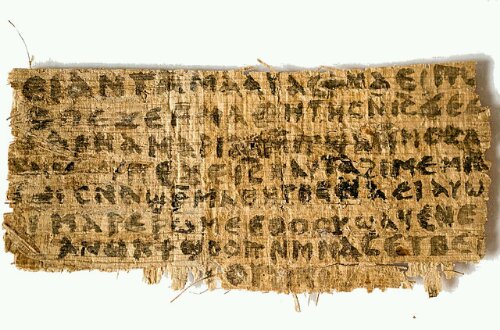
The Gospel of Jesus’ Wife
Two years ago, professor Karen L. King at Harvard Divinity School announced that they had found an ancient papyrus fragment where Jesus is saying that He has a wife. Needless to say, it caused a lot of controversy; apologets, academics, the Vatican and others said that the document was a modern fraud. One of the arguments for this was that the text seems to be based on the Gnostic Gospel of Thomas, and includes a typo made in modern times in a PDF document (!).
However, just a few days ago Harvard announced that the document had been subject to radiocarbon analysis and spectroscopy, and it turned out that both the papyrus and ink indeed were ancient, being produced somewhere between 659-859 AD. Professor King guessed that the original text, from which this papyrus was copied, could have originated in the second to fourth centuries, but this is speculation and not something the radiocarbon analysis show.
Harvard’s press release states that “[t]he fragment does not in any way provide evidence that the historical Jesus was married, as Karen L. King, the Hollis Professor of Divinity at Harvard Divinity School (HDS) has stressed since she announced the existence of the fragment in the fall of 2012.” King has said “don’t say this proves Dan Brown was right.” Rather, she sees this as an interesting contribution to our understanding of how Christians and pseudo-Christians viewed celibacy in the early church.
(more…)
A Defense for Penal Substitution

The Crucifixion by Simon Vouet
So the kids I like to play with tend to reject the doctrine of penal substitution, the idea that Jesus took the punishment for our sins in order to satisfy the wrath of God. A recent article on the Sojourners website gives a good example of this:
Essentially, the cross is explained exclusively in legal terms. You and I are the criminal, God is the blood-thirsty judge and executioner, and Jesus becomes the one who steps in between us and lets the angry judge beat and kill him in our place. Having killed an innocent person, this judge is somehow satisfied and a little less angry, so he sets friends of the innocent dead man free as he awaits the “end times” when he’ll finally get to let the bodies hit the floor and feel good about himself.
It’s actually quite twisted when you break it down. Jesus protects us from God? Or, if you accept the inspiration of Scripture (which I 100 percent do), it gets even more uncomfortable when you see Jesus say things like: “If you have seen me, you have seen the father, for we are one,” or in Hebrews, when it is stated that Jesus is the “exact representation of God’s being.”
Accepting both the inspiration of Scripture and the penal substitution theory of the atonement, one could actually say that Jesus died to protect us from Jesus.
Which is quite silly, really — from one aspect this makes God look schizophrenic, and on the other, it makes the cross look like a bad case of domestic violence — something I personally find offensive.
With hardly any Scriptural quotations at all, Benjamin Corey goes on claiming that penal substitution is responsible for the capital punishment and crual legal system of the United States, and like many other critics of the penal substitution theology he claims that the idea was founded by Anselm of Canterbury in the 11th century and that no Christian believed in it in the first millenia of the church.
Allow me to disagree.

