
Home » Posts tagged 'Acts' (Page 2)
Tag Archives: Acts
The author

Micael Grenholm, a Swedish charismactivist, apologist and author.
Fighting Terrorism Like Jesus

France has once again been subject to an attack which the president has dubbed “terrorist”. A man has been decapitated and the aggressor has been said to wave a black Islamic State flag. Meanwhile, over 40 people have been killed in bombings at a hotel in Tunisia and a mosque in Kuwait. Some believe that the attacks have been coordinated.
The threat of violent extremism shouldn’t be diminished. The Islamic State has an ideology very similar to Nazism – a belief that they’re superior and have the right to kill people who don’t look like and believe like them. Much like the 21-year old boy who went into a church in Charleston, South Carolina, last week and killed nine people because of the colour of their skin. He wasn’t labeled a terrorist that quickly as the guy in France was – instead we got to see childhood pictures of him and speculations about his mental state.
It is ridiculous how common this media logic is: dark-skinned aggressors are politically motivated terrorists, while light-skinned aggressors are confused lone-wolves with mental problems. Even Norwegian terrorist Anders Behring Breivik is not very often described as a terrorist, although it has been stated in court that he isn’t a psychopath but had a xenophobic ideology as the basis of his crime.
Speaking of xenophobia, Europeans who lean towards those ideas will most surely use the recent attack in France as an argument for deporting more Muslims to countries like Syria and Iraq, where there is war and terror fully operating. Now, that’s a horrible solution to the problem. The attacks in Tunisia and Kuwait today are illustrative: most victims from Islamic terrorism live in the middle east. Most of the Islamic State’s victims are Muslims! “Solving” Islamic terrorism with deportations is like “Solving” the holocaust and world war two with deporting every Nazi and Jew to Germany. It only gets worse if you do that.
So what is the solution then? Let’s look at the Bible. Did you know that one of Christianity’s greatest missionaries was a terrorist? His name was Saul.
Community of Goods: the Best Way to Eradicate Poverty

To share everything is commanded in Scripture and eradicates poverty better than anything else.
Last week I was attending one of the bigger Christian conferences here in Sweden called Torp, where I was speaking on the topic of how to combine miracles, evangelism and social justice. I pointed to the fact that Pentecost in Acts chapter 2 does not just include signs and wonders but also community of goods, i.e. having all possessions in common so that nobody is rich and nobody is poor (Acts 2:44-45). I argued that if we want to resurrect the spiritual power and evangelism of the Biblical Pentecost we ought also want to resurrect community of goods. I developed my thoughts on community of goods and how it relates to Jesus’ command to sell everything one has in this MennoNerd video:
These thoughts were new and radical to several of those who were listening. Some were curious, others sceptical. One pastor in particular raised two objections. Firstly, he said, community of goods cannot be equated with using Spiritual gifts or doing evangelism because there is no command saying “practise community of goods”, just a description of how the early Christians did so. Secondly, the pastor thought that the Swedish evangelical church was already very generous when it comes to giving alms to the poor, so he saw no need of preaching community of goods as something we should resurrect in evangelicalism.
My direct response to his first question repeated what I had been saying in the lecture, and that I briefly talk about in the video above, namely that community of goods is the practical application of Jesus’ command to sell everything one has and give the money to the poor – which he gives not just to one rich young ruler (Mk 10:21) but to all his disciples (Lk 12:33). Jesus himself practised community of goods with his disciples (Jn 13:29), and he told them to teach their new disciples to do everything he had commanded them to do (Mt 28:20). To sell everything one has doesn’t mean to live completely without possessions, for then the early Christians would have been nudists, instead we see how the community of goods in the book of Acts is described as being the consequence of the early Christians selling everything they have (Acts 4:32-35).
Why Did the Early Christians Go to the Synagogues?
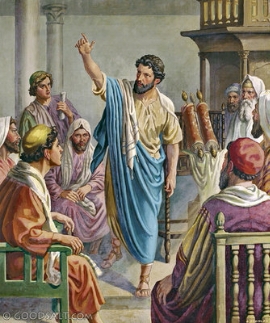
Was it really just to pray and worship with their Jewish brothers, or had they something else in mind?
I had a discussion with a friend the other day about church buildings; while I think that they are unnecessary for the most part and that we should focus on planting house churches instead, he enjoyed church buildings and saw no reason to diminish their role. One of his arguments for using church buildings was that the early Christians went to the temple and synagogues. My response was that they went to the temple and synagogues to evangelise.
Perplexed, he asked “Where in the Bible do Christians evangelise in synagogues?” Well, here’s a summary.
Jesus in the Synagogues
Let’s start with Christ. Luke 4:15 says that Jesus “was teaching in their synagogues, and everyone praised him.” Later, in verse 21 of the same chapter, we read: “He went to Nazareth, where he had been brought up, and on the Sabbath day he went into the synagogue, as was his custom. He stood up to read, He began by saying to them, ‘Today this scripture is fulfilled in your hearing.'”
It’s Time to Become Pentecostals for Real!

Happy Pentecost! I don’t know how it is in your country, but here in Sweden Pentecost is hardly celebrated at all – we’re must more eager to celebrate National Cinnamon Bun Day or Waffle Day (yeah, we have those). But Pentecost is worth celebrating – it’s the amazing power-boosting of the church when it receives the power and love it needs to perform its divinely commanded mission to save the world.
The book of Acts describes how the Holy Spirit baptized all of the early Jesus followers – men and women alike – and gave them the miraculous gifts of prophecy, speaking in tongues and preaching an epic sermon that leads to 3000 people accepting Jesus as their Saviour and receiving eternal life. It’s dramatic, it’s fantastic and it’s very supernatural.
Pentecost is repeatable – we can also experience the baptism of the Holy Spirit and be equipped with His miraculous gifts to spread the word about eternal life in Jesus. Pentecostals have always emphasized this: they often talk about preaching the “Full Gospel” – both salvation and Spiritual baptism – and the early Pentecostals said that they had restored the “Apostolic Faith”.
Had they, though? (more…)
Why All Christians Should Participate in Street Evangelism

As I’ve written about previously, my church has a 50/50 vision where half of our activities being outreaches, and one way we practice this is through “Come In, Go Out”-services (or “Go Out, Come In”) where we simply spend one hour inside and one hour outside. We see evangelism as something every Christian should be doing, just like prayer or Bible reading, and we are not just exhorting people to evangelize, we show and train them by doing it together.
At first I thought our “mandatory evangelism” was just a cool thing, but then I realised that in the Biblical Christian community, corporate evangelism in public places was indeed a part of what all believers were expected to participate in. In Acts 2:46-47 we read:
Every day they continued to meet together in the temple courts. They broke bread in their homes and ate together with glad and sincere hearts, praising God and enjoying the favor of all the people. And the Lord added to their number daily those who were being saved.
Thus, the Biblical, apostolic Church had two kinds of meetings: one internal in the homes and one external in the temple courts. It was in the homes where they were eating the Lord’s supper (or Jesus Lunch as I like to call it), so it was this meeting that developed into our modern Sunday services. The temple meetings were not internal, they included evangelism so that people were saved daily.
Baptized with Fire
To be baptized with water is awesome, but to be baptized with fire is even awesomer. John the Baptist, who really knew baptism, said: “I baptize you with water. But one who is more powerful than I will come, the straps of whose sandals I am not worthy to untie. He will baptize you with the Holy Spirit and fire.” (Lk 3:16)
Who could this be? Spoiler alert: It’s Jesus. Before He levitated up to Heaven, He told His disciples:
Do not leave Jerusalem, but wait for the gift my Father promised, which you have heard me speak about.For John baptized with water, but in a few days you will be baptized with the Holy Spirit… you will receive power when the Holy Spirit comes on you; and you will be my witnesses (Acts 1:4-5, 8)
And this happened ten days later:
When the day of Pentecost came, they were all together in one place. Suddenly a sound like the blowing of a violent wind came from heaven and filled the whole house where they were sitting. They saw what seemed to be tongues of fire that separated and came to rest on each of them. All of them were filled with the Holy Spirit and began to speak in other tongues as the Spirit enabled them. (Acts 2:1-4)

3 Additional Ways the Modern Church Looks Nothing Like the Early Church

Paul preaching the Gospel. Art by Giovanni Paolo
This awesome article has been frequently shared by people in my networks the last couple of days; Preston Sprinkle writes about 4 ways the modern church doesn’t look like the early church (and, as several have pointed out, this goes especially for the modern mainstream Western church). These four areas are:
1. How we view other Christians. When the early disciples called themselves brothers and sisters, they actually treated each other like brothers and sisters and had a community that was far more relational and sacrificial than fellowship in most Western churches.
2. How we spend our money. The early Christians didn’t collect money for church buildings and pastors’ wages but for the poor.
3. How we think about power. The early church refused to be patriotic but was pacifist and persecuted.
4. How we study the Bible. Early Christians let every new convert study the Scriptures in a detailed manner, and most disciples then knew the Bible better than many Western church goers today.
I totally agree with all of Sprinkle’s points, and I’m glad that more and more start descovering the radical roots of the Christian faith. However, I would like to pinpoint three additional areas where the early church looked different from the mainstream Western church life today: (more…)
Were the Apostles Mistaken in Having Everything in Common?
It’s YouTube Friday and the latest entry on the Holy Spirit Activism YouTube channel is this short interview with Huw Lewis, apostolic leader in the Jesus Army, where he explains why the JA practice community of goods. Community of goods means sharing possessions so that nobody is rich and nobody is poor and was being practiced by Jesus and the apostles (Jn 13:29) and in the first church in Jerusalem (Acts 2:44-45). Huw, I and many others think that it is a very good way of living and we encourage all believers to pray about joining a Christian community.
However, there are Christians who think that community of goods isn’t something good but rather, that the apostles were naïvely mistaken when they started to share their possessions. I found an article arguing for this at biblestudytools.com, an article that is used as the official explanation to what community of goods is about and that has received one of the top spots when you search for “community of goods” on Google. It’s horribly bad though so please let me criticise it for you.
All rich people or some?
In Acts 2:44, it is said that, in the infant church at Jerusalem, “all that believed were together, and had all things common,” and (Acts 4:34 f) “as many as were possessors of lands or houses sold them, and brought the prices of the things that were sold, and laid them at the apostles’ feet.” The inference from this, that there was an absolute disposal of all the property of all the members of the church, and that its proceeds were contributed to a common fund, has been disputed upon the ground that the example of Barnabas in selling “a field” for this purpose (Acts 4:37) would not have been mentioned, if this had been the universal rule. The thought conveyed is that all believers in that church held their property as a trust from the Lord, for the benefit of the entire brotherhood, and, as there was need, did as Barnabas.
The author of this article, H.E. Jacobs, almost immediately begins to argue that the Biblical community of goods was not required for all believers in Jerusalem to participate in. This is indeed a difficult task since Acts 4:34 says that all who had property sold it and gave it to the apostles so that they redistributed the money equally. And all really means all. Now, believers who didn’t own property such as widows probably weren’t obligated to give (instead, their participation in the common purse was by receiving) but Barnabas is rather used as an example of one among all the property owners who sold everything to introduce him to the readers. Likewise, Jesus’mother and brothers are mentioned in Acts 1 to highlight some of who were praying, not to say that the others weren’t praying.
How to Make a Mainline Church Evangelize on the Streets

Me and some friends were out on the streets evangelizing yesterday, by handing out free pancakes and sharing the Gospel
I’m not a reformer, Im a restorer. While several intentions of the reformation were good, the emphasis on reform in itself doesn’t express what we really want the church to look like, and so I know several Lutherans who defend unbiblical teachings and changes with the claim that the church should be constantly reforming itself, which isn’t a very Biblical idea. Restorationist Christians on the other hand, like Anabaptists or Pentecostals, have emphasized that we should restore the Biblical church and thus has a clearly expressed goal with the reforms. Just by looking at the Holy Scriptures, we see how Jesus did church, how the apostles did church and how they thought that we should do church. And they didn’t call it “church”, since that’s obviously an extremely boring word, they called it the Way (Acts 9:2); the Lifestyle, basically.
The charismatic movement, which I am a part of, have used restorationism to resurrect a hunger for the baptism of the Holy Spirit and miraculous gifts. But there are some things that I think still needs to be restored in most charismatic churches: mandatory evangelism, organic simplicity and community of goods. I will explain more about what these three things mean and how they should be practically restored in mainline churches in three blog entries, this being the first.
So what do I mean with “mandatory evangelism”? Well, the apostolic church which was funded and lead by guys who knew Jesus personally had two sorts of meetings, or “services” if you like: “Every day they continued to meet together in the temple courts. They broke bread in their homes and ate together with glad and sincere hearts” (Acts 2:46). They both met in the homes and in the temple courts. The latter was the place where Jesus had His theological debates – it was a place where all the religiously interested came to worship God and discuss with each other. And the early Christians both join the Jews for prayer in the temple (Acts 3:1), and to heal them (3:6-10) and preach the Gospel to them (5:21).
Living like the Apostles at the Jesus Army

All the believers were together and had everything in common. They sold property and possessions to give to anyone who had need. (Acts 2:44-45)
Yesterday, me and my friend Frida arrived in Kettering, England, to visit one of my favourite churches, the Jesus Army. As I’ve pointed out several times before, the Jesus Army is one of the very few examples of when the Jesus hippies of the 70’s organized themselves in their own church instead of joining existing churches, and this has made them able to sustain the radicality, fire and passion for God that characterised the Jesus revival. What is most noticable is that the Jesus Army practices community of goods just like the apostolic New Testament church, something that unfortunately has become very rare among Protestant Christians.
You see, cessationism is sadly not just a doctrine of the margins within the Protestant movement, but a key factor in how both Luther and Calvin viewed Scripture. While claiming that they based their theology on Scripture alone, they deliberately ignored large parts of the Bible that didn’t fit with their theology. Cessationism is generally defined as the idea that miraculous gifts have ceased with the apostles, but within Protestantism we also teach that the community of goods we read about in Acts 2 and 4 ceased with the apostles.
With cessationism, you basically are your own god who make your own bible. Jack Deere, a former cessationist, writes in Surprised by the Power of the Spirit how he didn’t like fasting very much, so he claimed that fasting has ceased with the apostles as well. After all, there are not so many people fasting in the later books of the New Testament. But the problem is of course that the Bible never says that anything – miracles, community, fasting or whatever – would cease with the apostles, and so cessationism is just a way for Christians who claim to be Bible-believing to have a reason not to believe in all of the Bible.
(more…)
What a Truly Pentecostal Church Looks Like
Yesterday, on Pentecost day, I had the honour to preach in my dear house church Mosaik. We’re always outside in the park during the summer, and this Sunday we had som English speaking visitors – so for the first time in a year I preached in English. And since a friend of mine recorded it all, it’s now available for you guys!
I started with talking about the Pentecostal language miracle, when one is able to speak existing languages that one hasn’t studies, and gave some testimonies about when this has happened in modern times. This was also what my last blog post was about. Then, I talked about how Peter, in his Pentecostal sermon in Acts chapter 2, really emphasises miracles when he talks about Jesus. He presents the Messiah by saying “Jesus of Nazareth was a man accredited by God to you by miracles, wonders and signs, which God did among you through him, as you yourselves know” (Acts 2:22). Then he goes on with “God has raised this Jesus to life, and we are all witnesses of it. Exalted to the right hand of God, he has received from the Father the promised Holy Spirit and has poured out what you now see and hear. (vv. 32-33). Thus, Peter proves that Jesus is the Messiah by pointing at His miraculous ministry, His resurrection and the miracles His Spirit does.
The people “were cut to the heart” (v. 37) when they heard this and asked Peter what they should do, and he answered “Repent and be baptized, every one of you, in the name of Jesus Christ for the forgiveness of your sins. And you will receive the gift of the Holy Spirit.” (v. 38). 3000 people did so, and suddenly the apostolic league of disciples had become a mega church – but not in the modern sense, since they lacked a church building. They were a charismatic, evangelistic house church movement that spread rapidly, as Luke famously portrays:
They devoted themselves to the apostles’ teaching and to fellowship, to the breaking of bread and to prayer. Everyone was filled with awe at the many wonders and signs performed by the apostles. All the believers were together and had everything in common. They sold property and possessions to give to anyone who had need. Every day they continued to meet together in the temple courts. They broke bread in their homes and ate together with glad and sincere hearts, praising God and enjoying the favor of all the people. And the Lord added to their number daily those who were being saved. (Acts 2:42-47)
The International, Pentecostal Miracle of Tongues

Happy Pentecost! This weekend, millions of Christians all across the globe are celebrating the baptism of the Holy Spirit and the birth of the apostolic church. Pentecost has always been very important for me, I started this blog on Pentecost day 2012, writing about the meaning of Pentecost. This is because the apostolic Pentecost as it is described in Acts 2 combines everything I like: charismatic fire, economic communism, universal evangelism and overall simplicity, fellowship and joy.
It all started when the wonderful Holy Spirit descended with fire and the international gift of tongues:
When the day of Pentecost came, they were all together in one place. Suddenly a sound like the blowing of a violent wind came from heaven and filled the whole house where they were sitting. They saw what seemed to be tongues of fire that separated and came to rest on each of them. All of them were filled with the Holy Spirit and began to speak in other tongues as the Spirit enabled them.
Now there were staying in Jerusalem God-fearing Jews from every nation under heaven. When they heard this sound, a crowd came together in bewilderment, because each one heard their own language being spoken. Utterly amazed, they asked: “Aren’t all these who are speaking Galileans? Then how is it that each of us hears them in our native language? (Acts 2:1-8, NIV)
In my experience, this is quite a common miracle. When the early Pentecostals met at the Azusa Street revival in Los Angeles to enjoy the restoration of spiritual baptism, many claimed that people actually started to speak real languages. In the October issue 1906 of The Apostolic Faith, the official publication of the Azusa Street church, the following article is included:
Sister Hutchins has been preaching the Gospel in the power of the Holy Spirit. She has received the baptism with the Holy Ghost and the gift of the Uganda language, the language of the people to whom she is sent. A brother who has been in that country understands and has interpreted the language she speaks. Her husband is with her and her niece, who also has been given the African language.
Is the Church of Acts Abnormal?

In my pursuit for combining signs and wonders with peace and justice, I often get to see parallells between the Charismatic and activist streams of Christianity. One is that both want to get back to the original church; Pentecostals, as you probably know, want to resurrect the charismatic explosion of Acts 2, and radical Christian activists want to see the community of goods and the overflowing love and unity of Acts 2.
But then there’s a problem both parties face. Some Christians don’t want to return to Acts, basically because they argue that Acts was temporary – we’re not supposed to live like that any longer. You will find this among cessationists, who argue that the miracles in the book of Acts died with the apostles, and among most other Christians as well who argue that the community of goods and radical economic equality of the early church was just a temporary experiment. The church of Acts may have been good for that time but is not very relevant for our churches today. Guess we’re smarter now, or something.
This view has always surprised me since the very reason we value the New Testament as the Word of God is that it’s written by the apostles, or their direct disciples. The apostles had authority (Acts 2:42) since they were elected by Jesus and were the first church leaders. How come that we value their words more than their lives? If they were healing the sick and practicing community of goods, how could that possible be abnormal Christian living?
Jack Deere has written about this. He’s an ex-cessationist who became one of the main leaders in the Charismatic Vineyard movement after the Vineyard pastor John White went to his church and healed som people and drove out some demons. He really nails the problems with the theology of the abnormal Acts in his book Surprised by the Voice of God (Kingston 1996, ss. 61-63), which I qoute below: (more…)
Let the Poor Rise Up and Walk!
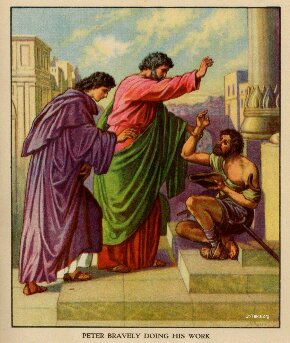
Acts 3 is one of my favourite Bible passages, since it presents a great example of how the gifts of the Spirit are tools both for evangelism and activism. When Peter and John went up to the temple to pray, they passed a lame man who was begging for money. Peter said to him: “Silver or gold I do not have, but what I do have I give you. In the name of Jesus Christ of Nazareth, walk.” (v. 6).
The man, who had been lame from birth, gets completely healed and starts jumping and dancing. People wonder what’s going on, Peter preaches the Gospel and explain that God did this miracle in order to give glory to His Son, and many of the listeners get saved. This single healing both rescued a man from the boundage of poverty and made it very easy for Peter to evangelize.
Heidi Baker, a charismatic missionary to Mozambique, shares a modern example of a similar event in her book Always Enough (pp. 167-9). A woman asked her to pray for her husband, named Carlos, who had been lame in his legs for two years. Heidi came home to their mud hut where the man was sitting on a reed mat with a pair of scissors in his hand, cutting up little pieces of paper. He sold this to the local matress vendors, earning just a couple of cents a day.
God vs Wealth, part 3: Sharing Everything
To read other parts of the series, go here.

I wear a red cross around my neck. I got it when I visited a church called Jesus Army in the UK a couple of years ago. Many people in this church practice community of goods. They eradicate the gap between rich and poor simply through sharing all they have together in community houses called New Creation Christian Community.
This is of course very biblical. We read about the first church in Jerusalem which was led by the apostles themselves: “All the believers were together and had everything in common. They sold property and possessions to give to anyone who had need.” (Acts 2:44-45). This should not be surprising, they simply obeyed the commands of Jesus. He clearly told all His disciples in Luke 12:33 to sell what they have and give to the poor.
It is thus misleading to think that this command was just given to one certain rich man in Matthew 19:16-22. I have heard countless rich Christians arguing that Jesus told him to sell what he had just because his money was a stumbling block to his relation with God, and thus rich Christians with a good relationship with God can ignore this command and continue to be rich. But the gospels doesn’t say that he had to sell his stuff because they affected his relationship with the Lord, the only reason Jesus gives is that the poor will get money – something they need no matter how our spiritual situation looks like. And again, He did say the same thing to all His disciples, and they all obeyed it.
(more…)
 Charismactivism