Popular Posts


Recent Comments
 | James on Why Cessationism is Unbiblical… |
 | Nate on The Problems with the Lutheran… |
 | Franciskus – p… on Francis – the Charismati… |
 | Riverbelle on The Problem with “Sacram… |
 | Russell on Why Churches Should Abandon St… |
Networks





Christian girl Abducted, Converted and Forced to Marry a Muslim in Pakistan

Pakistani Christians
A friend who is working with missions in Asia told me the other day about a Pakistani Christian girl, Samariya Nadeem, from Punjab in Pakistan, who was abducted by a Muslim landowner and forced to marry him after conversion to Islam. There is a petition directed to the Chief Minister of Punjab that asks him to free Samariya and make sure that freedom of religion and the freedom to marry volontarily is protected in Pakistan.
So far, police have failed to pursue any legal action against the local wealthy Muslim landowner who abducted the girl because of the influence he wields. Police investigators were also unable to talk to the bruised and terrified victim. Anonymous police sources confirmed that the girl was “abducted” and forced to marry. However, an Islamic cleric involved in the affair said that it was “not illegal to abduct and convert non-Muslims”.
Civil society groups and human rights activists have appealed to Punjab’s chief minister to take action and return Samariya to her parents and bring her abductor to justice. Kidnappings and forced marriages are a major issue in Pakistan, especially in Southern Punjab and in the interior of Sindh province. It is common in the region that young, religious minority, women and girls are forcefully converted and married away to influential landlords who keep them as slaves.
Clever Christian Comics
I really appreciate a lot of Adam Ford’s comics. Myself being an (nowadays somewhat inactive) comic drawer, I love the medium and I think Adam’s message is Gospel-centered, radical and thought-provoking. I don’t agree with everything, he is clearly Calvinist, but I love his zeal for truth and taking Jesus seriously. Now here are some comics!

Love Doesn’t Need Consumerism

Love looks like something – grandson and grandmother in Sri Lanka. Photo by Steve Evans
Love is extremely central to the Gospel: the reason Jesus came to give us eternal life is out of God’s eternal love for our world (Jn 3:16), He said that the greatest commandments in the Old Testament Law are “Love the Lord your God with all your heart and with all your soul and with all your mind, and love your neighbor as yourself.” (Mt 22:37-39) Jesus close disciple John just fell in love with Love, and emphasized it like crazy in his writings:
“Dear friends, let us love one another, for love comes from God. Everyone who loves has been born of God and knows God. Whoever does not love does not know God, because God is love. This is how God showed his love among us: He sent his one and only Son into the world that we might live through him. This is love: not that we loved God, but that he loved us and sent his Son as an atoning sacrifice for our sins. Dear friends, since God so loved us, we also ought to love one another. No one has ever seen God; but if we love one another, God lives in us and his love is made complete in us.” (1 Jn 4:7-12)
But all love isn’t good love. In the same letter, John warns us for loving things instead of people, creation instead of God: “Do not love the world or anything in the world. If anyone loves the world, love for the Father is not in them. For everything in the world—the lust of the flesh, the lust of the eyes, and the pride of life—comes not from the Father but from the world. The world and its desires pass away, but whoever does the will of God lives forever.” (1 Jn 2:15-17)
Revival and Community Transformation

The Iris Revival in Mozambique
Charismatics like myself love to talk about revival. Revival is usually defined as an “awakening” of the church, when it goes back to it’s original state. If the church doesn’t look like the book of Acts – where a lot of miracles happened, thousands were saved and Christians were living a holy, passionate life – it’s basically sleeping and needs to be revived.
Half a year ago, a girl from Switzerland contacted me via this blog and said that she wanted to visit Sweden “and the revival there”. We were honored and welcomed her, but we gently said that it would be wrong to say that it’s a revival in Sweden. Even when a lot of people do get healed here and many are saved when we prophesy for them, revival is the wrong word, at least yet. Revival is something more, revival is community transformation.
During the Welsh revival in the beginning of the 20th century, the prisons, bars and stadiums were emptied a like – everyone were storming the churches to seek God. Norwegian revivalist Hans Nielsen Hauge transformed his country not just spiritually but also socially and economically, so that one of Europe’s poorest nations started to flourish. And Mozambique is right now totally transformed by the Iris revival, that brings thousands of children out of poverty and plant thousands of churches in the power of healing and miracles.
Lonnie Frisbee and his Charismatic Hippie Communal Houses
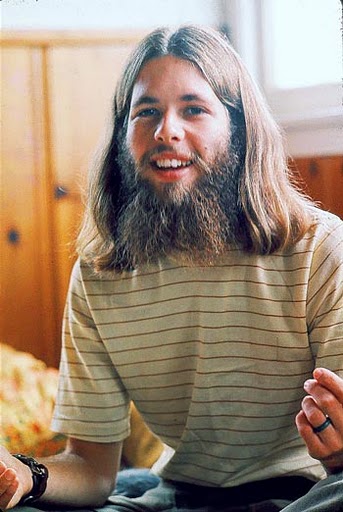
Lonnie Frisbee, 1949-1993
Lonnie Frisbee was an amazing Jesus freak. Being a key figure and informal leader of the Jesus People Movement in the 60’s and 70’s, his impact on Western Christianity is huge. With his long hair and beard he tried to look like Jesus himself “because there’s no one else I want to look like”, he preached on the beaches to his hippie friends that the Holy Spirit is even better than LSD and brought thousands of them to church.
The Jesus movement spread rapidly across California, US and the world, but most churches closed the door for them – after all, they were hippies. A church that did welcome them though was Calvary Chapel led by Chuck Smith, not because he was a hippie, nor because he wanted to become one, but because he liked them.
While Chuck emphasized Bible studying and evangelical values (which Lonnie thought was awesome) Lonnie himself was a holy roller. He cast out demons, spoke in tongues, healed the sick and prophesied loudly. He proclaimed himself to be a prophet and a mystic, and the whole Jesus Movement became a radical charismatic movement.
In 1980 he visited John Wimber‘s Vineyard church and released the youth into full scale charismatic renewal, which had a huge impact on Wimber himself and the whole third wave charismatic renewal. In John Wimber: The Way it Was, John’s wife Carol Wimber shares how important Lonnie was for the Vineyard, and she has some awesome testimonies from a trip to South Africa she, John and Lonnie made where they literally saw the blind and lame being totally healed when they imparted the power of the Holy Spirit to them.
Kevin Daugherty: Beware the Wild Goose
My blog friend and fellow MennoNerd Kevin Daugherty wrote this excellent piece on his blog Koinonia Revolution the other day. It’s so good I simply want to repost it all here:
 I come from a charismatic stream of Christianity. Most of the churches I have attended or been a member of have openly believed in the active presence of the Holy Spirit (the “Wild Goose“), a very personal relationship with Christ, faith healing, and active worship. This background developed in me a deep respect for religious experience, but unlike a stereotypical charismatic, I was quiet and contemplative, which caused me to develop a deep respect for the monastics, mystics, and Quakers. For the longest time, I had no idea I was part of the Charismatic movement (I was not really aware of the theological labels), but my background continues to influence me.
The Charismatic movement is a product of the 20th century and has its roots in Pentecostalism, but I find that Spirit-filled Christianity puts one in a large family of Christian traditions. I think Eberhard Arnold described this tradition well:
The life of love that arises from faith has been witnessed to over the centuries, especially by the Jewish prophets and later by the first Christians. We acknowledge Christ, the historical Jesus, and with him his entire message as proclaimed by his apostles and practiced by his followers. Therefore we stand as brothers and sisters together with all those who have lived in community through the long course of history: the Christians of the first century; the Montanists in the second; the monastics and Arnold of Brescia; the Waldensians; the itinerant followers of Francis of Assisi; the Bohemians and Moravians and the Brothers of the Common Life; the Beguines and Beghards; the Anabaptists of the sixteenth century; the early Quakers; the Labadists of the seventeenth and eighteenth centuries; and many other denominations and movements down to the present day. (Eberhard Arnold: Writings Selected, pg. 158-159)
I wish I could add something more, but I really think Arnold says it perfectly. Spirit-filled faith is part of a long prophetic tradition going through many individuals and communities—the Hebrew prophets, early Christians, medieval mystics, “spiritualist” Anabaptists, Quakers, Pentecostals, and many others.
Love, Power and Life: Understanding Missio Dei

Iris missionaries in Mozambique
The “Great Commission” is not so great. I mean, of course everything Jesus says is awesome, but we are making a huge error if we define missions only based on Matthew 28:18-20, basically because we are not given so much information about missions there. Jesus says: “make disciples of all nations, baptizing them in the name of the Father and of the Son and of the Holy Spirit, and teaching them to obey everything I have commanded you.”
Now, to understand what “everything I have commanded you” means, we obviously have to read the rest of the gospels! Missions is not only about baptizing people and telling them what to believe, it’s about raising up a non-violent army of passionate disciples that are willing to do the stuff Jesus commanded us to do.
If we stick to the Gospel of Matthew, Jesus starts teaching discipleship in the Sermon on the Mount (Mt 5-7). This is not a collection of random sayings of Jesus, it has a common theme: actions. Radical actions; love your enemies, give to the poor, do not store up treasures on earth, do not judge, do not look at someone with lust, etc. This is all part of the Great Commission – we are supposed to live like this, and those who we baptize are supposed to live like this. Thus, missions include peacemakting, social justice and holiness.
New Song: God is a Criminal
I wrote a song the other day! It goes like this:
1. God is a criminal, it isn’t hard to see
In the book of Acts He breaks the law to set the captives free
An unjust law is no law at all, compassion is the key
God is a criminal, so that’s what I want to be
2. God is a hippie, it isn’t hard to tell
He commands us to love our enemies and all our stuff to sell
Among the poor and prostitutes is where He likes to dwell
God is a hippie, and so am I as well
Killing the Next Hitler
Yesterday was the International Holocaust Remembrance Day, a day that feels extremely important to remember in xenophobic Europe of today. As Spain is going fascist, the neo-Nazi “Christian” party Jobbik has 12% of seats in the Hungarian parliament and islamophobia is growing rapidly, many are afraid that the economic crisis will throw Europe back to a similar state like the 1930’s. The period when Adolf Hitler gained power.

Adolf Hitler as an Infant
There is a great number of extremely simplistic solutions to how the second world war would have been prevented, the most common is probably to kill Hitler as a child. I cannot count how many times I’ve heard people dream about this “what if” scenario. Not long ago it was discovered that Hitler actually almost died as a child when he fell through the ice, but a friend, who later became a priest, saved him. The Daily Mail called it “the most devastating act of mercy in history”.
But of course, Adolf’s soul was darkened not because of mercy but because of lack thereof. The upcoming genocide in the Central African Republic won’t be stopped by people who let children die but by people who save them. Our culture is so dipped in a logic of death that we think the best way to stop a murderer is to kill him, that the best way to stop the Holocaust was to kill civilians in German cities, that the best way to stop the war against Japan was to kill hundreds of thousands of innocent people with nuclear bombs.
“An Angel Called me to Sweden”

Edward Thomas, coolest priest on earth. Photo: Rickard Kilström
The United States has given us a lot of crap over the years but one of the best things they’ve handed over is Ed Thomas, priest in the Church of Sweden and a friend of mine. Well, actually the United States is not responsible at all in sending him here, nor any American, but God Himself called Ed to Sweden. And I’m not talking about a vague feeling or a subjective interest that many Christians normally identify “calling” with – Ed was actually ordered to become a Swedish priest by the audible voice of God and an angelic visitation.
Ed shares this experience in the video above. He used to be a chef in the states, cooking food for celebrities like Tom Cruise and started to earn a lot of fame and money. He was a passionate believer and went through some program to know the will of God, praying every morning with some friends for almost a year in trying to figure out what God wanted them to do. Since his chef job was going very well he simply concluded that this is where God wanted him, and he was pleased with that since he was making a lot of cash out of it.
But one night, everything changed as Ed awoke hearing someone say “Edward!” There was no one there. He woke his wife up, who just told him “You’ve eaten too much strong food! It’s just a dream, go to sleep!” Ed fell asleep and a second time the voice woke him up saying “Edward!”
Should a Christian Work for the State?

Image: Ramone Romero
What jobs can Christians have? Many would probably answer “all, because Christians should spread the light everywhere” but that would be an overstatement. Should Christians for example be prostitutes? Even if Jesus never said “Don’t be a prostitute”, we understand from the Biblical ethics that prostitution is not a very suitable Christian workmanship. In the early church, the Apostolic Tradition from 215 AD lists prostitution as a non-Christian job, along with some other very interesting occupations:
If someone is a gladiator, or one who teaches those among the gladiators how to fight, or a hunter who is in the wild beast shows in the arena, or a public official who is concerned with gladiator shows, either he shall cease, or he shall be rejected. If someone is a priest of idols, or an attendant of idols, he shall cease or he shall be rejected. A military man in authority must not execute men. If he is ordered, he must not carry it out. Nor must he take military oath. If he refuses, he shall be rejected. If someone is a military governor, or the ruler of a city who wears the purple, he shall cease or he shall be rejected. The catechumen or faithful who wants to become a soldier is to be rejected, for he has despised God. (Apostolic Tradition 16:7-11)
According to the early church, Christians shouldn’t be gladiators, soldiers or governor. Ron Sider has written more about this in his book The Early Church on Killing. Even “rulers of a city” is ruled out. They kill and hurt people as well, indirectly. The political power is power through violence. The early Anabaptists and the early Pentecostals rejected political power for the same reason as the early Christians: they wanted to change society through love and the Holy Spirit, not by force or swords.
The Average Christian: A Black Pentecostal

Worshipper at Iris Village of Joy, Pemba, Mozambique
The course in dogmatics I’ve just taken at my seminary was, as I’ve previously written, lacking global perspectives in general and charismatic theology in particular, but our teacher was very aware of this. He stressed that charismatic theology becomes more and more important as a result of the spread of Pentecostalism in the global South while non-charismatic Christendom is dying in the North (West), and recommended us to check out Philip Jenkins’ The Next Christendom, a book that I’ve now have had a look at.
Jenkins argues that Christianity has never been just a Western religion but a global one, and that the privileged position of Western Christendom is about to fall down. Today, Christianity is basically growing everywhere except Europe: in Latin America, Africa, Asia and even the Middle East millions are being saved. With the help of statistical predictions, Jenkins argue that in 2050 only one Christian in five will be white, and that proportion will probably continue to shrink.
Now, charismatic theology is very dominant among the Southern churches. Recently, Christianity Today, which traditionally has not been a big fan of the charismatic movement, argued that most Africans aren’t charismatic, emphasizing that most of them belong to Catholic, Anglican, Reformed or independent churches. But Jenkins show that most Southern Christians within these traditions have charismatic theology, even if they don’t call themselves charismatics or Pentecostals.
A Modern Language Miracle in Jerusalem
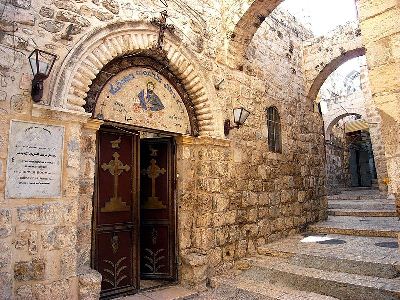
S.t Mark’s Church in Jerusalem
My dear friend Andreas have just returned from a trip to Israel and came back with some amazing stories. He shared how he and his friends were walking in the Old City of Jerusalem, and suddenly Andreas recognized the Church of S:t Mark, a Syriac Orthodox church that claims to be built on the house of Mary, the mother of Mark (Acts 12:12-17). Not only that, they claim that this also contains the upper room, the place of the Last Supper, several appearances of the resurrected Jesus and where the Holy Spirit ascended on Pentecost; although this is also claimed by the Cenacle. Anyways, they went inside to have a look.
It’s a pretty cool church. The liturgical language, Syrian, is similar to Arameic, the language of Jesus. The liturgy itself is extremely old, and even if it is doubtful that the practices of the church goes all the way back to biblical times, it’s a good indicator of how ancient Christianity looked like.
Andreas and his friends met a nun who was so excited to share what God is doing in their little church. She told them about a man who had came to the church, and how she guided him around. A few weeks later he returned, and the nun welcomed him back, but for some reason he looked confused and said something in Hebrew. The nun didn’t know Hebrew so she asked him to talk English like last time they met. The man was even more confused and talked a lot of Hebrew with her.
(more…)
The Problems with the Lutheran Augsburg Confession

Illustration of the Confession by Wenceslaus Hollar
I was raised in the Lutheran Church of Sweden, the biggest church in my country, formerly state-church, with around seven million members of whom 85 % according to a recent poll don’t believe in Jesus. When I was saved in 2006, Martin Luther was one of my spiritual heroes. As I read the Scriptures and compared it to Catholicism I realized that they had added a lot of stuff that Jesus and the apostles never talked about, and I thought Luther was one of the first to realize that and to resurrect the original Gospel. Arguing that Scripture should be the only source to theology and pointing at Paul’s emphasis on justification by faith and grace, he criticized the unbiblical Catholic indulgence and several unbiblical doctrines. I thought Luther was awesome.
As I learned more about Luther and Lutheranism however, I started to realize that perhaps he wasn’t entirely biblical either. In fact, he changed the order of biblical books according to his personal opinion, placing the letter of James, one of my favourite biblical books, last because it didn’t make sense with his interpretation of sola fide. And he was a quite violent man, justifying wars, capital punishment, persecution against Jews and execution of Anabaptists. In fact, as I discovered the existance of Anabaptists and their radical, pacifist Jesus-centered theology, I realized that Luther was not the only one protesting against Catholic errors, and far from the best.
I hope to return to my criticism of Luther in a future post, but right now I want to turn to the Augsburg Confession, one of the most important Lutheran documents that actually is one of the primary faith documents of the Church of Sweden, in line with the Nicene Creed. It’s a really weird document. It starts like this:
Most Invincible Emperor, Caesar Augustus, Most Clement Lord: Inasmuch as Your Imperial Majesty has summoned a Diet of the Empire here at Augsburg to deliberate concerning measures against the Turk, that most atrocious, hereditary, and ancient enemy of the Christian name and religion, in what way, namely, effectually to withstand his furor and assaults by strong and lasting military provision…
The Absense of the Holy Spirit Within Academic Theology
This is an assignment I’ve written for my dogmatics course at Johannelund Theological Seminary.

Alister McGrath’s Christian Theology is a standard introduction work for thousands of students that take courses in Christian dogmatics, including the people at my seminary. On 500 pages, McGrath talks about the most central issues of systematic theology. Five of those 500 pages are about the Holy Spirit. In comparison, 50 are dedicated to the doctrines of the church and the sacraments.
McGrath admits that the Holy Spirit should deserve a chapter of his own, especially with the popularity of the charismatic movement in mind, but still he doesn’t create such a chapter but restricts himself to five pages. Here, he writes about how the Holy Spirit is described, the debate concerning the Spirit’s divinity and finally what the Holy Spirit does. Only one paragraph is dedicated to charisms, the emphasis of the charismatic movement. One paragraph in a 500 page-book.
I would say that this priority is out of touch with reality. There are around 600 million charismatics and Pentecostals worldwide, most of them in developing nations, that are very interested in the Holy Spirit and his gifts. They have realized that the New Testament very often connects the Spirit to miracles, and that the miraculous power of the Spirit is accessible to all believers. Sharing this common knowledge, there is disagreement however on how one gets baptized or filled with the Spirit, how to pray for healing, how to hear the voice of God, the role of speaking in tongues, etc. In other words, there is certainly enough material for McGrath to fill a chapter.
Yet, he doesn’t, and I think it is not so much his personal fault but rather a tendency within academic theology as a whole: charismatics are excluded from theological discussion. This can also be seen in Norwegian theologian Jan-Olav Henriksen’s introduction to dogmatics: the chapter about the Spirit is combined with the chapter about the church, to hide the embarrassment of only giving six pages to the Holy Spirit. Just as in McGrath’s work, emphasis lies on the Spirit’s soteriological role, while charismatic phenomena are de-emphasized.
Why does it look like this? Let me share some theories.
The author

Micael Grenholm, a Swedish charismactivist, apologist and author.
A Living Alternative

God vs Inequality

 Charismactivism