Home » Evangelism & Missions (Page 5)
Category Archives: Evangelism & Missions
The author

Micael Grenholm, a Swedish charismactivist, apologist and author.
How Can the Jesus Army Grow?
Jesus People at the RAW youth event
As you probably should know by now from reading my previous posts, I think that a certain British church called Jesus Army is amazing. Since it combines Bible-believing, charismatic discipleship with community of goods and care for the poor, it is one of the most Biblical churches I know of. The more people who join this church and/or adapt its model of charismatic community building, the better. But how, then, can it grow? Here are my three suggestions:
1. More Public Evangelism
The apostolic church in Jerusalem didn’t just experience miracles and practise community of goods, they also evangelised every day in the temple courts (Acts 2:46, 5:20, 42) as I’ve written about several times before. This can be adapted in various ways today: evangelism on the internet, in shopping malls, outside of mosques, on the streets, handing out leaflets, preaching, showing a drama, serving free pancakes, offering prayer for healing… God loves when we present the Gospel creatively!
However, since the evangelism of the early church was public and corporal, it cannot really be equated with private evangelism that an individual performs to his or her friends and family. I often meet the idea that this would be more effective than public, corporal evangelism, but it is very problematic to view Jesus’ and the apostles’ model for evangelism as ineffective, and it mostly has anecdotic rather than empirical support. Research shows that evangelistic activity is one of the most important things churches can do in order to grow, which is about as surprising as the scientific discoveries of fuel promoting vehicles to drive or consumption of food promoting human survival.
Since corporate, public evangelism is not just about reaching out but also about training disciples, people get more equipped to share the Gospel in other settings as well if they get evangelistic training by the church. Thus, there is no reason to say that we should cut back on public evangelism to promote friendship evangelism, because public evangelism already promotes friendship evangelism.
How Should Christians View Multiculturalism?

Chapel of Grace, a multicultural church in the UK
It’s very popular to speak negatively about multiculturalism in Europe these days, the idea that multiple cultures can thrive and co-exist within the same state. It’s a bit strange since most European countries are democracy, and the idea that anyone can say, believe and live the way they want is quite essential to democracy, but Germany’s Angela Merkel, Britain’s David Cameron and Denmark’s Pia Kjaersgaard have all condemned multiculturalism as something that should be prohibited (Kjaersgaard have even condemned the idea of a multiethnic society).
Since the culture these politicians are defending is labeled Christian (even though it’s rather Constantinian), and the culture that they portray as the main antagonist is islamic culture, many Christians have condemned multiculturalism in a similar fashion and argued that Muslims should be deported so that European Christianity is preserved.
The condemnation of multicultural states is also known as nationalism, the idea that each state should have one language and one culture. But is this idea Biblical? Are Christians supposed to prohibit or promote multiculturalism?
In the Old Testament, God gave laws to the Israelites that were not just moral but also cultural. the Pentateuch tells the Israelites how they should eat, dress and behave, what holidays they should have and how they should worship the Lord. These cultural laws are still being practised by Jews to this day. And while immigrants were very welcome to Israel and were treated as natives (Lev 19:33-34), they were expected to follow most of the laws. There were some exceptions, kosher food was not required for example (Deut 14:21), but in general immigrants were expected to follow the cultural laws of Israel. Not much multiculturalism there. (more…)
Billy Graham Reacts to Franklin’s Islamophobia
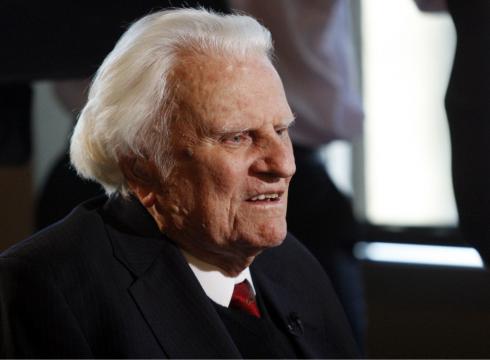
As I wrote in my last blog post, I’m pretty upset about Franklin Graham’s idea about deporting all Muslim immigrants from the United States. I think it’s a plain out stupid idea, not the least from an evangelistic perspective. And Franklin’s dad happen to be one of the greatest evangelists of the Western world. So I had to make a sketch about what I imagine (or rather, hope) that Billy’s reaction to Franklin’s proposal would be like:
I talked to a sister about this yesterday and she said that she was constantly shocked every time a Christian started to argue against immigration. Because of fear and comfort almost no Western Christian dare to go as missionaries to totalitarian Muslim countries – and when Muslims then show up here, where it’s super easy for us to share the Gospel, we want to deport them!
Deportation is anti-evangelism. A person is not saved by being forcefully transported by the police to a country they fled from, it just decreases the chance for them to hear the good news about eternal life through Jesus Christ. How then can evangelist Franklin Graham propose deportation of all Muslim immigrants? My theory is that either he didn’t think much at all, or he believes that Islamic terrorism is only a problem when it’s taking place in the United States. Even though most people who are killed by terrorism are Muslims in the Middle East – those whom Franklin doesn’t want to welcome in his country.
Now, I’m not entirely sure that Billy would react in real life as he does in the video – he has had some goofy moments in his later years, such as suddenly changing opinion on Mormonism after Mitt Romney became the Republican presidential candidate. The Billy character in the video surely represents my opinion though. And as you can tell, I don’t think Franklin’s proposal is anywhere near smart.
Heidi Baker and Iris Global – an Introduction

In May 1976, a 16-year-old girl called Heidi was kneeling at the altar of a small Pentecostal church at a Choctaw reservation site in Mississippi. She had been saved just two months earlier, and now she was astounded as she suddenly saw a white light coming over her while she heard a voice, audibly, that said “I am calling you to be a minister and a missionary. You are to go to Africa, Asia and England.”
Heidi married Rolland Baker, grandson to the great missionary H.A. Baker, and God took them on an amazing adventure across the world. Today they live in Mozambique and help thousands of orphaned children, planting thousands of churches and witnessing amazing miracles such as blind people seeing, deaf people hearing and dead people coming back to life. I’ve made a video about them and their organization Iris Global which you can watch below:
Heidi and Rolland have inspired me so much in my vision to combine miracles, evangelism and social justice, and I pray that they will continue to make an impact in Mozambique and all across the world for the glory of God.
Why Did the Early Christians Go to the Synagogues?
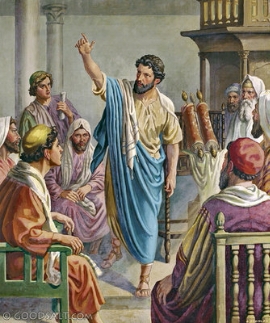
Was it really just to pray and worship with their Jewish brothers, or had they something else in mind?
I had a discussion with a friend the other day about church buildings; while I think that they are unnecessary for the most part and that we should focus on planting house churches instead, he enjoyed church buildings and saw no reason to diminish their role. One of his arguments for using church buildings was that the early Christians went to the temple and synagogues. My response was that they went to the temple and synagogues to evangelise.
Perplexed, he asked “Where in the Bible do Christians evangelise in synagogues?” Well, here’s a summary.
Jesus in the Synagogues
Let’s start with Christ. Luke 4:15 says that Jesus “was teaching in their synagogues, and everyone praised him.” Later, in verse 21 of the same chapter, we read: “He went to Nazareth, where he had been brought up, and on the Sabbath day he went into the synagogue, as was his custom. He stood up to read, He began by saying to them, ‘Today this scripture is fulfilled in your hearing.'”
Miracles in the Middle East

I have a friend called Elijah*, who used to be a Muslim but became a Christian after Jesus showed Himself to him in a prophetic vision. He know works with a missionary organisation and is spreading the Gospel in the Middle East. A couple of months back when he was visiting some churches in a South Asian city, a couple approached him when he was walking through a mall. They tried to convert him to Islam, but in 20 minutes time they became disciples of Jesus.
See, they told him that about six months earlier, they had been watching TV. As they zapped through the channels, they came to a Christian channel where Swedish pastor Stanley Sjöberg was preaching the Gospel. Since they were devout Muslims, they became upset, shut the TV down and went to bed.
The next morning, they told each other that they had had a strange dream. They soon discovered that it was exactly the same dream! Stanley Sjöberg had come to their house, they had let him in and he continued to preach about Jesus. As they protested, Stanley said “My friend Elijah will tell you more about Jesus”, and from nowhere they saw a Middle Eastern guy sitting next to Stanley. Stanley went on saying that they would meet him in a particular South Asian city, on one particular day at 5 PM.
They didn’t know what the dream meant and thought it was a bit freaky that they both dreamt it the same time, but after a bit if reasoning the wife said “Maybe Allah has given us this dream to find Elijah and convert him to Islam. Let’s go to that place – if we don’t find him we will just have a nice holiday.” (more…)
The Fine Tuning of the Universe and the Existence of God
Scientifically speaking, why the universe exists and why it looks like what it looks like is still a mystery. We don’t know why anything exists rather than nothing, or why energy-matter works as it does. Furthermore, there is still no explanation to why the universe’s force constants are as they are.
Christian apologist William Lane Craig, among others, talk about the universe being fine tuned for life, planets, stars and even atoms to exist, as you can see in the video above. The cosmological constant, Λ, has a value of approximately 10−122, and if this would change by less than a trillion’s trillionth of a percent, the universe would either be sucked back into a black hole right after big bang or disparse so quickly that stars would never form.
Leonard Susskind, professor of theoretical physics at Stanford, explain the fine tuning of the universe in more detail above. Now, if the universe was caused either by nothingness or from something unintelligent and non-designing, as atheists would argue, the fine tuning becomes really hard to explain. Our universe where the cosmological constant and other constants like the gravitational constant are suitible for stars, planets and life to exist, is ridiculously unlikely. Susskind is not a theist due to his lack of faith in miracles, but he isn’t an atheist either because of his inability to refute the idea that a divine entity caused this complex universe, and so he remains agnostic. (more…)
Video: 7 Reasons Street Evangelism Rocks
Being a Christian isn’t just an indoor activity. Here are seven reasons why everyone – yes everyone – who have chosen to follow Jesus should share the Gospel about Him in public areas.
Check out the Biblical foundation for why churches should view street evangelism as mandatory meetings just like Sunday services.
And here’s a description of how my own church does this in practice.

Why All Christians Should Participate in Street Evangelism

As I’ve written about previously, my church has a 50/50 vision where half of our activities being outreaches, and one way we practice this is through “Come In, Go Out”-services (or “Go Out, Come In”) where we simply spend one hour inside and one hour outside. We see evangelism as something every Christian should be doing, just like prayer or Bible reading, and we are not just exhorting people to evangelize, we show and train them by doing it together.
At first I thought our “mandatory evangelism” was just a cool thing, but then I realised that in the Biblical Christian community, corporate evangelism in public places was indeed a part of what all believers were expected to participate in. In Acts 2:46-47 we read:
Every day they continued to meet together in the temple courts. They broke bread in their homes and ate together with glad and sincere hearts, praising God and enjoying the favor of all the people. And the Lord added to their number daily those who were being saved.
Thus, the Biblical, apostolic Church had two kinds of meetings: one internal in the homes and one external in the temple courts. It was in the homes where they were eating the Lord’s supper (or Jesus Lunch as I like to call it), so it was this meeting that developed into our modern Sunday services. The temple meetings were not internal, they included evangelism so that people were saved daily.
Amazing Healing Miracles in Cameroon, Ghana and Benin!
I love to follow Daniel Kolenda’s Youtube Channel. Daniel is evangelist at Christ for all Nations, successor of Reinhard Bonnke and a passionate follower of Jesus. At the channel he publishes Bible studies, mission reports as well as wonderful testimonies of God’s miracles like these:
 She was deaf in both ears for 17 years. She was rejected by family members and failed in school. She felt like a prisoner in solitary confinement and wanted to take her own life.
In January of 2014, Christ for all Nations visited Titi Bongo’s city of Yaoundé, Cameroon. Hundreds of thousands gathered that week to experience the Gospel. On the second night, as evangelist Daniel Kolenda was praying for the sick, Titi began to feel an intense burning in her ears and realized one of her ears could hear.
She to the platform to testify together with her brother. Her brother told the evangelist that although one ear had been healed, the other was still deaf and asked for more prayer. Evangelist Kolenda prayed for the ear twice. The first time, nothing happened, but the second time, he began to say the name of Jesus in her deaf ear in French, “Jésus, Jésus, Jésus” Suddenly she could understand and began to repeat the name, each time it became more clear and more powerful. He asked if she could hear now. She was smiling from ear to ear. She could hear, she could speak and she was praising the name of Jésus! (more…)
“Go Out, Come In” – a New (or Old) Type of Church Service
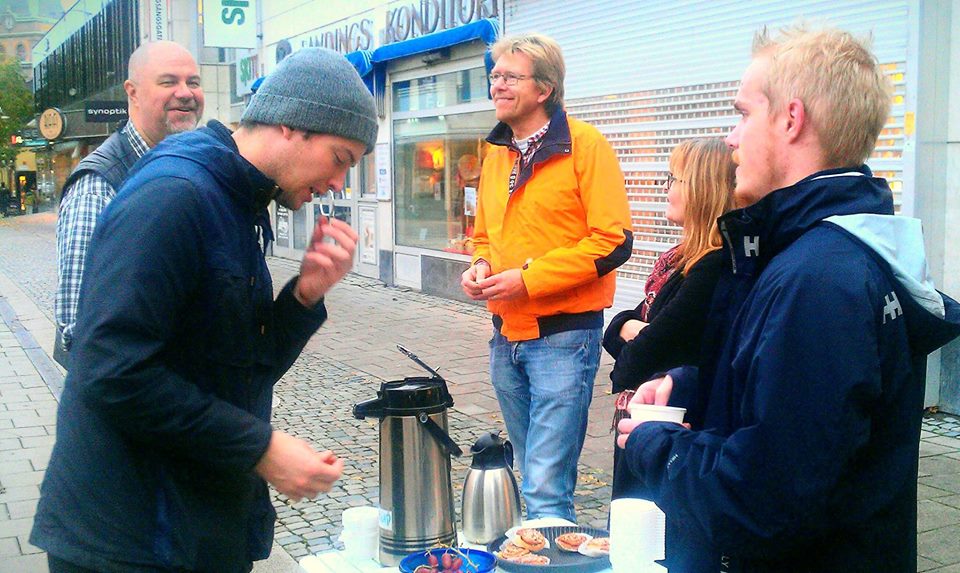
Outside
I love my church! Uppsala Mosaik is a small house church in Uppsala, Sweden (not to be confused with the mega church Mosaic in Los Angeles, California (we’re way smaller than them)) focusing on the Kingdom of God. We’re evangelical, charismatic and activist, and our aim is, like many other churches, to love God and love people.
When I visited Mosaik for the first time in 2010, I was amazed by its structure. We met in a pub back then. We had coffee break in the middle of the service, between worship and Jesus stories. Jesus stories, by the way, are when everyone can share a testimony about what Jesus has done in their life. And when the service was coming to an end, students flooded the pub while Mosaik volontueers started to serve free pancakes.

Inside
I sat down with the pastor, Hans Sundberg, and he explained the theology behind what Mosaik looked like. In Sweden, people are leaving churches like crazy, so that statistically, if the drop-off speed would remain at this rate, there would be no Christians here in 2040. Now, God is good and we pray for revival, but Hans was convinced that the church must leave the old Christendom-structures that builds large cathedrals expecting people to fill them, and becoming sad when they don’t.
Did Yasser Arafat Become a Christian Before He Died?

Yasser Arafat
RT Kendall, a preacher known for his zeal to combine evangelical and charismatic Christianity, says in an interview that he wouldn’t be surprised if he met Palestinian freedom fighter/terrorist Yasser Arafat in Heaven. In fact, he has met him here on earth five times, bringing him closer and closer to Jesus. Premier reports:
The first time RT Kendall was granted rare access to Arafat,the Christian writer and speaker told him he had prayed for him every day for 20 years. According to Kendall, the 20-minute appointment turned into an hour and 45 minutes, and an unlikely friendship began.
The third time Kendall visited Arafat, the pair watched The Passion of the Christ together, along with 30 members of the Palestine Liberation Organization (PLO).
Arafat wept during the viewing and allowed Kendall to pray for him at the end. During each of his five visits, Kendall was able to speak to Arafat about Jesus’ death and resurrection, and of how to accept Christ.
Kendall says that, despite Arafat’s translator attempting to intervene, the Arab leader was determined to hear more about Jesus and the gospel.
Now, there are no evidence that Arafat ever became a Christian. Of course, even if he did convert there are tons of reasons why he and PLO would keep silent about it. Kendall doesn’t say he know that Arafat received Jesus, but he “wouldn’t be surprised” if he did. And this is primarily because of two prophetic visions (I told you he’s charismatic!): (more…)
How to Make a Mainline Church Evangelize on the Streets

Me and some friends were out on the streets evangelizing yesterday, by handing out free pancakes and sharing the Gospel
I’m not a reformer, Im a restorer. While several intentions of the reformation were good, the emphasis on reform in itself doesn’t express what we really want the church to look like, and so I know several Lutherans who defend unbiblical teachings and changes with the claim that the church should be constantly reforming itself, which isn’t a very Biblical idea. Restorationist Christians on the other hand, like Anabaptists or Pentecostals, have emphasized that we should restore the Biblical church and thus has a clearly expressed goal with the reforms. Just by looking at the Holy Scriptures, we see how Jesus did church, how the apostles did church and how they thought that we should do church. And they didn’t call it “church”, since that’s obviously an extremely boring word, they called it the Way (Acts 9:2); the Lifestyle, basically.
The charismatic movement, which I am a part of, have used restorationism to resurrect a hunger for the baptism of the Holy Spirit and miraculous gifts. But there are some things that I think still needs to be restored in most charismatic churches: mandatory evangelism, organic simplicity and community of goods. I will explain more about what these three things mean and how they should be practically restored in mainline churches in three blog entries, this being the first.
So what do I mean with “mandatory evangelism”? Well, the apostolic church which was funded and lead by guys who knew Jesus personally had two sorts of meetings, or “services” if you like: “Every day they continued to meet together in the temple courts. They broke bread in their homes and ate together with glad and sincere hearts” (Acts 2:46). They both met in the homes and in the temple courts. The latter was the place where Jesus had His theological debates – it was a place where all the religiously interested came to worship God and discuss with each other. And the early Christians both join the Jews for prayer in the temple (Acts 3:1), and to heal them (3:6-10) and preach the Gospel to them (5:21).
Things that make the Jesus Army unique

Frida enjoying the Jesus Army
Today, me and Frida will travel to London to Jesus Army’s Spreading Flame community house, and after spending a day there we will go back to Sweden. Both of us have been very inspired and with the help of the Holy Spirit we hope to launch a similar church in Sweden that combines community of goods with the power of the Holy Spirit and evangelism. I’ve written a lot about the Jesus Army’s community of goods, their Jesus-centered focus and their social, eco-businesses, but there are many other things that make this church quite unique. Some examples:
The Jesus Army doesn’t sent out missionaries, instead they have an international partnership network called Multiply. Most of the churches and leaders connected to it are in Africa and Asia, and so many of them inspire and preach to the Britons rather than the other way around, while the Jesus Army still finance projects to fight poverty over there.

Training Year info
Jesus Army doesn’t have a Bible school, instead they have a training year where you live in a community house, work in a Kingdom business and partake in all the evangelism, social work, Bible studies, worship and prayer the church organize. You also get a mentor with whom you study Scriptures with and deepen your faith. Far more practical, biblical and intergrated with church life than most Bible schools I know of.
Jesus Army doesn’t do expensive weddings or celebrate Christmas and birthdays with lots of consumption and indulgence. Instead they value simplicity, fellowship and constant celebration. They want to avoid luxury and wealth, and are striving for a lifestyle of humbleness, free from materialism.

There are many more things to write, but our transport to London is leaving now. Blessings!
The Blind See and the Deaf Hear in Mbeya, Tanzania

Photo: Mission SOS
Two friends of mine here in Sweden have studied a year at SOS Mission Bible School, and a few days ago my Facebook feed was filled with testimonies about miracles thay had seen in Mbeya, southwest Tanzania, where they had done a missions trip. Mission SOS have put several videos from this event on their Vimeo, and I would like to share these amazing testimonies with you:
Update 1 Mbeya 2014 from Mission SOS on Vimeo.
First we have an intro video, where the campaign coordinator shares that miracles are taking place even before the campaign has started.
Update 2 Mbeya 2014 from Mission SOS on Vimeo.
Then comes the report from the first night of the campaign, where many were healed and saved. A young girl shares how she prayed for another girl who was totally deaf, and she starts to weep of joy when she explains how she was healed! (more…)
 Charismactivism