
Home » Posts tagged 'Church History' (Page 3)
Tag Archives: Church History
The author

Micael Grenholm, a Swedish charismactivist, apologist and author.
European Anabaptism vs Global Pentecostalism #MennoNerdsOnRace
A few days ago, the Anabaptist blogging network MennoNerds, which this blog is a part of, arranged a webinar called Race, Mutuality and Anabaptist community. It was all recorded via Google Hangouts and can be watched in the video above. Unfortunately, I wasn’t able to join the discussion live since time here was around 2 AM, but we MennoNerds now have a chance to contribute to the conversion via our blogs, which is what I’m doing right now.
Christianity is a Middle Eastern religion and for the first 300 years, most of the important theologians (the so called “church fathers”) came from the Middle East, Northern Africa and what is now Turkey. The present churches in for example Egypt, Syria and Ethiopia have survived since the time of the apostles. But since the Western Catholic church distanced itself from and condemned the eastern and oriental churches, the experiences, stories and theology of non-white Christians became peripheral. To this very day, it is common among Western Christians to identify themselves with and be inspired by Christian streams from Western Europe: Catholicism, Anglicanism, Calvinism, Lutherism, Anabaptism, Quakerism, Methodism, Salvationism, Baptism, and so on.
It gets increasingly problematic when people of European descent expect other people to submit to these European interpretations of the teachings of Jesus when they are born again, i.e. asking them to become “Lutherans” or “Anabaptists”. Don’t get me wrong, I love Anabaptism and identify myself with the movement, and I think that people like Drew Hart does an excellent job in outlining “Anablacktivism” and interpreting the Anabaptist message about justice and peace from an African-American perspective. Truth is that all of the church streams I mentioned above are global today – Catholicism is biggest in Latin America which their Argentinian pope signifies, Anglicanism is bigger outside England and the biggest Lutheran denomination in the world is Mekane Yesus in Ethiopia.
These voices need to be recognized and influential within these church streams. Yet, we cannot get away from the fact that if you want to get to the roots of the movement, as A.O. Green likes to do, you’ll have to read what a bunch of white, European men wrote. And that’s a bit boring, isn’t it?
(more…)
When Conspiratists View a Sixth Century Fragment as More Reliable than the First Century Gospels
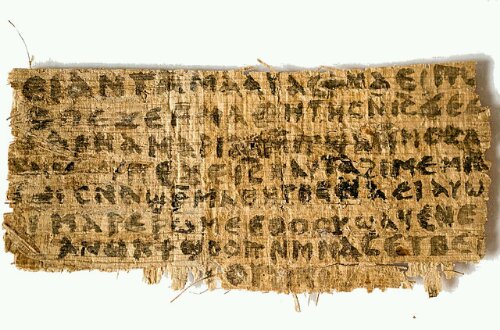
The Gospel of Jesus’ Wife
Two years ago, professor Karen L. King at Harvard Divinity School announced that they had found an ancient papyrus fragment where Jesus is saying that He has a wife. Needless to say, it caused a lot of controversy; apologets, academics, the Vatican and others said that the document was a modern fraud. One of the arguments for this was that the text seems to be based on the Gnostic Gospel of Thomas, and includes a typo made in modern times in a PDF document (!).
However, just a few days ago Harvard announced that the document had been subject to radiocarbon analysis and spectroscopy, and it turned out that both the papyrus and ink indeed were ancient, being produced somewhere between 659-859 AD. Professor King guessed that the original text, from which this papyrus was copied, could have originated in the second to fourth centuries, but this is speculation and not something the radiocarbon analysis show.
Harvard’s press release states that “[t]he fragment does not in any way provide evidence that the historical Jesus was married, as Karen L. King, the Hollis Professor of Divinity at Harvard Divinity School (HDS) has stressed since she announced the existence of the fragment in the fall of 2012.” King has said “don’t say this proves Dan Brown was right.” Rather, she sees this as an interesting contribution to our understanding of how Christians and pseudo-Christians viewed celibacy in the early church.
(more…)
No Christus Victor Here – Atonement According to the Apostolic Fathers

Polycarp, disciple of John the apostle and a smart theologian who was burned alive for the sake of the Gospel
As promised in my last blog post about atonement theology, I want to share what I’ve found when researching the early church fathers’ view on the death of Christ. My countryman Gustaf Aulén wrote a book 83 years ago called Christus Victor when he argued that the church fathers didn’t believe in penal substitution but in a “classical” atonement framework which he calls Christus Victor, the victorious Christ.
The difference between the two views is essentially that while penal substitution emphasises that Jesus took the punishment for our sins on the cross, Christus Victor emphasises that Jesus defeated the devil and his wicked forces when he died on the cross. A form of Christus Victor which according to Aulén was popular during the age of the church fathers was the ransom theory, the idea that God sent Jesus as a “bait”, and when satan killed him he got hooked by the power of God like a sloppy wet fish.
Now, I don’t have any problems at all with the Christus Victor perspective. As a third wave charismatic, I think it suits well with the Kingdom message of the Gospels – Jesus is indeed at war with satan, which is evident in His healings, exorcism and finally His death and resurrection. The Bible clearly speaks about how Christ defeated the powers of darkness on the cross. So I do believe in Christus Victor. What I don’t believe is that this perspective by any means replaces the fact that Jesus took the punishment for our sins on the cross, which is also what the Bible teaches. As William Evans brilliantly argues, Christus Victor and Penal Substitution are not mutually exclusive and should be viewed as equally true perspectives rather than conflicting paradigms.
I also have a problem with that this blog and that blog and even Wikipedia as well as several books uncritically says that the majority of the church fathers believed in Christus Victor and that it was dominant for a thousand years before Anselm of Canterbury messed it up, and therefore we should not believe in penal substitution. Firstly, even if they emphasised Christus Victor we cannot conclude that they didn’t believe in penal substitution unless they say so, and as I wrote in my last blog post I think it’s really hard to deny penal substitution without ignoring large parts of the Bible.
Ten Reasons Why the Catholic View on the Early Church is Wrong

Peter preaches in Jerusalem, Acts 2
Christian primtivism is the logical idea that the church Jesus founded was the church He wanted. It’s connected to the idea of restorationism, that teaches that we should restore Church to its original form when it starts to behave weird and contradict Scripture. As you’ve probably noticed I’m a passionate restorationist, and while I love and cooperate with people from the historical churches I think that their tendency to contradict the Biblical Church is quite harming. A couple of days ago a friend sent me an article on Catholic Answers called The Problems with Primitivism by Dwight Longenecker, which says that we should really not try to model church as Jesus and the apostles modeled it. Allow me to disagree. I will quote each of Longenecker’s arguments and turn them on their heads:
1 Cultural Relevance
First, each restorationist movement, although it seeks to return to the ancient church of the apostolic age, is actually produced as a reaction to the circumstances of its own age and culture. For example, the peasant movement of the Bogomils came out of a church weighed down with corruption and aristocratic influence. The radical reformers in 16th-century Europe and the New World were influenced by the utopianism, the rise of the nation state, and revolutionary spirit of their age… Restorationists believe they are restoring something ancient. In fact all they do is create an expression of Christianity which is a reaction against the circumstances and assumptions of the age in which they live.
Well, I know of no restorationist movement that claims that we need to speak Arameic and live in the Roman Empire to be the original church. All churches adapt the Gospel to their culture and historical context – including the Catholic Church. It’s hard to argue though that since we need to adapt to our culture we need to believe in purgatory and seven sacraments.
2 Information about the Early Church
Second, while restorationist movements are reactions to the particular age in which they live, they are also conditioned by the long history of restorationist movements. For hundreds of years, Protestants have perpetuated a particular vision of the early Church. Each new restorationist movement borrows those ideas, never questioning whether the tradition they are inheriting is actually true to the reality of the early Church or not. Therefore, the restorationist doesn’t so much restore primitive Christianity; he simply replicates are earlier restorationist model, reproducing what he has been told early Christianity was like.
It’s true that some restorationists are lazy, not double-checking their doctrines and practices by Scripture, but the same thing can definitely be said about Catholics. For example, they believe that there are seven sacraments – neither more nor less – an idea that originated with Peter Lombard in the 12th century! All restorationist movements at least try to break unbiblical traditions and restore biblical Christianity, Catholicism however is not even trying.
(more…)
New Book by Me and Friends, Coming Fall 2014

A Living Alternative
As some of you know, I am proud to be a part of the awesome MennoNerd blogging network, a bunch of bloggers that identify themselves with anabaptism, the radical reformation in the 16th century that wanted to go back to the Biblical roots in a better and more radical way than Luther, Calvin and Zwingli.
Unlike these mainline protestants, the anabaptists rejected violence and war, they argued that people should choose to follow Christ and not be baptized as infants, they protested against the state-church system and eagerly desired the supernatural gifts of the Spirit in a time where most protestants were cessationists.
Many people are not very familiar about what anabaptism is about, so that’s why me and my fellow MennoNerds are writing a book about it! It’s called A Living Alternative: Anabaptist Christianity in a Post-Christendom World, is published by Ettelloc Publishing and will be available this fall. The presentation of the book goes like this:
Basil the Great: Woe to the Rich!

Basil “kick-ass” the Great, 330-379
Back in the days, people really could write. In the patristics course I’m taking, I’m writing about early Christian attitudes toward wealth and community of goods. In my research I found this awesome sermon by Basil the Great (330-379) – a commentary to Matthew 19:16-22 simply called “To the rich”. Basil is one of the most influential church fathers, known for his defense of the divinity of the Holy Spirit, and boy he had some serious stuff to say about rich folks. I think the text is really prophetic in that it speaks directly to the unequal, consumerist, individualist society of today. Enjoy!
You call him teacher, and you won’t do his lessons? You acknowledge him to be good, and what he gives you you throw away? But, surely, he who is good supplies good things; this is obvious. Although what you ask about is eternal life, you give proof of being utterly addicted to the enjoyment of this present life. What, after all, is this hard, heavy, burdensome word which the Teacher has put forward? “Sell what you have, and give to the poor.”
If he had laid upon you agricultural toils, or hazardous mercantile ventures, or so many other troubles which are incidental to the life of the wealthy, then you’d have had cause for sorrow, taking the order badly; but when he calls you by so easy a road, without toil or sweat, to show yourself an inheritor of eternal life, you are not glad for the ease of salvation, but you go away pained at heart and mourning, making useless for yourself all that you had labored at beforehand. […]
Now, you are obviously very far from having observed one commandment at least, and you falsely swore that you had kept it, namely, that you’ve loved your neighbor as yourself. For see: the Lord’s commandment proves you to be utterly lacking in real love. For if what you’ve claimed were true, that you have kept from your youth the commandment of love, and have given to each person as much as to yourself, how has it come to you, this abundance of money?
Lonnie Frisbee and his Charismatic Hippie Communal Houses

Lonnie Frisbee, 1949-1993
Lonnie Frisbee was an amazing Jesus freak. Being a key figure and informal leader of the Jesus People Movement in the 60’s and 70’s, his impact on Western Christianity is huge. With his long hair and beard he tried to look like Jesus himself “because there’s no one else I want to look like”, he preached on the beaches to his hippie friends that the Holy Spirit is even better than LSD and brought thousands of them to church.
The Jesus movement spread rapidly across California, US and the world, but most churches closed the door for them – after all, they were hippies. A church that did welcome them though was Calvary Chapel led by Chuck Smith, not because he was a hippie, nor because he wanted to become one, but because he liked them.
While Chuck emphasized Bible studying and evangelical values (which Lonnie thought was awesome) Lonnie himself was a holy roller. He cast out demons, spoke in tongues, healed the sick and prophesied loudly. He proclaimed himself to be a prophet and a mystic, and the whole Jesus Movement became a radical charismatic movement.
In 1980 he visited John Wimber‘s Vineyard church and released the youth into full scale charismatic renewal, which had a huge impact on Wimber himself and the whole third wave charismatic renewal. In John Wimber: The Way it Was, John’s wife Carol Wimber shares how important Lonnie was for the Vineyard, and she has some awesome testimonies from a trip to South Africa she, John and Lonnie made where they literally saw the blind and lame being totally healed when they imparted the power of the Holy Spirit to them.
Kevin Daugherty: Beware the Wild Goose
My blog friend and fellow MennoNerd Kevin Daugherty wrote this excellent piece on his blog Koinonia Revolution the other day. It’s so good I simply want to repost it all here:
 I come from a charismatic stream of Christianity. Most of the churches I have attended or been a member of have openly believed in the active presence of the Holy Spirit (the “Wild Goose“), a very personal relationship with Christ, faith healing, and active worship. This background developed in me a deep respect for religious experience, but unlike a stereotypical charismatic, I was quiet and contemplative, which caused me to develop a deep respect for the monastics, mystics, and Quakers. For the longest time, I had no idea I was part of the Charismatic movement (I was not really aware of the theological labels), but my background continues to influence me.
The Charismatic movement is a product of the 20th century and has its roots in Pentecostalism, but I find that Spirit-filled Christianity puts one in a large family of Christian traditions. I think Eberhard Arnold described this tradition well:
The life of love that arises from faith has been witnessed to over the centuries, especially by the Jewish prophets and later by the first Christians. We acknowledge Christ, the historical Jesus, and with him his entire message as proclaimed by his apostles and practiced by his followers. Therefore we stand as brothers and sisters together with all those who have lived in community through the long course of history: the Christians of the first century; the Montanists in the second; the monastics and Arnold of Brescia; the Waldensians; the itinerant followers of Francis of Assisi; the Bohemians and Moravians and the Brothers of the Common Life; the Beguines and Beghards; the Anabaptists of the sixteenth century; the early Quakers; the Labadists of the seventeenth and eighteenth centuries; and many other denominations and movements down to the present day. (Eberhard Arnold: Writings Selected, pg. 158-159)
I wish I could add something more, but I really think Arnold says it perfectly. Spirit-filled faith is part of a long prophetic tradition going through many individuals and communities—the Hebrew prophets, early Christians, medieval mystics, “spiritualist” Anabaptists, Quakers, Pentecostals, and many others.
Should a Christian Work for the State?

Image: Ramone Romero
What jobs can Christians have? Many would probably answer “all, because Christians should spread the light everywhere” but that would be an overstatement. Should Christians for example be prostitutes? Even if Jesus never said “Don’t be a prostitute”, we understand from the Biblical ethics that prostitution is not a very suitable Christian workmanship. In the early church, the Apostolic Tradition from 215 AD lists prostitution as a non-Christian job, along with some other very interesting occupations:
If someone is a gladiator, or one who teaches those among the gladiators how to fight, or a hunter who is in the wild beast shows in the arena, or a public official who is concerned with gladiator shows, either he shall cease, or he shall be rejected. If someone is a priest of idols, or an attendant of idols, he shall cease or he shall be rejected. A military man in authority must not execute men. If he is ordered, he must not carry it out. Nor must he take military oath. If he refuses, he shall be rejected. If someone is a military governor, or the ruler of a city who wears the purple, he shall cease or he shall be rejected. The catechumen or faithful who wants to become a soldier is to be rejected, for he has despised God. (Apostolic Tradition 16:7-11)
According to the early church, Christians shouldn’t be gladiators, soldiers or governor. Ron Sider has written more about this in his book The Early Church on Killing. Even “rulers of a city” is ruled out. They kill and hurt people as well, indirectly. The political power is power through violence. The early Anabaptists and the early Pentecostals rejected political power for the same reason as the early Christians: they wanted to change society through love and the Holy Spirit, not by force or swords.
The Problems with the Lutheran Augsburg Confession

Illustration of the Confession by Wenceslaus Hollar
I was raised in the Lutheran Church of Sweden, the biggest church in my country, formerly state-church, with around seven million members of whom 85 % according to a recent poll don’t believe in Jesus. When I was saved in 2006, Martin Luther was one of my spiritual heroes. As I read the Scriptures and compared it to Catholicism I realized that they had added a lot of stuff that Jesus and the apostles never talked about, and I thought Luther was one of the first to realize that and to resurrect the original Gospel. Arguing that Scripture should be the only source to theology and pointing at Paul’s emphasis on justification by faith and grace, he criticized the unbiblical Catholic indulgence and several unbiblical doctrines. I thought Luther was awesome.
As I learned more about Luther and Lutheranism however, I started to realize that perhaps he wasn’t entirely biblical either. In fact, he changed the order of biblical books according to his personal opinion, placing the letter of James, one of my favourite biblical books, last because it didn’t make sense with his interpretation of sola fide. And he was a quite violent man, justifying wars, capital punishment, persecution against Jews and execution of Anabaptists. In fact, as I discovered the existance of Anabaptists and their radical, pacifist Jesus-centered theology, I realized that Luther was not the only one protesting against Catholic errors, and far from the best.
I hope to return to my criticism of Luther in a future post, but right now I want to turn to the Augsburg Confession, one of the most important Lutheran documents that actually is one of the primary faith documents of the Church of Sweden, in line with the Nicene Creed. It’s a really weird document. It starts like this:
Most Invincible Emperor, Caesar Augustus, Most Clement Lord: Inasmuch as Your Imperial Majesty has summoned a Diet of the Empire here at Augsburg to deliberate concerning measures against the Turk, that most atrocious, hereditary, and ancient enemy of the Christian name and religion, in what way, namely, effectually to withstand his furor and assaults by strong and lasting military provision…
Suffering and Revival in the Congo – the Story of Helen Roseveare

Helen Roseveare
A month ago, I wrote about the mix of tears and joy, suffering and glory that Iris Ministries in the Democratic Republic of Congo is experiencing. While people are losing their children and the women are raped by soldiers; miracles are abundant and the church has a burning passion for God. This paradoxal relationship between the cross and the glory may be hard for Western people to understand, but it is very real. Today I want to introduce you to a missionary who also experienced this in the Congo – but 50 years ago. Her name is Helen Roseveare.
After studying medicine in the UK and feeling the calling to be a missionary, Helen went to what was then Belgian Congo and started to develop the pretty much non-existant health care system. She was the only doctor for two and a half million people, saving thousands of lives. In the early 60’s, civil war broke lose as the Congolese people wanted to be liberated from Belgian colonialism. The war was extremely brutal. Helen was raped, twice.
Government soldiers came to my bungalow, ransacked it, then grabbed me. I was beaten and savagely kicked, losing my back teeth through the boot of a rebel soldier. They broke my glasses, so I could not see to protect myself from the next blow. Then, one at a time, two army officers took me to my own bedroom and raped me. They dragged me out into a clearing, tied me to a tree, and stood around laughing. And while I was there, beaten and humiliated and violated and ridiculed, someone discovered in the bungalow the only existing hand-written manuscript of a book I had been writing about God’s work in the Congo over an eleven-year period. They brought it out, put it on the ground in front of me, and burned it.
It takes less than that for others to leave both the country and the faith. But Helen knew the power and love of the living God, and she knew that He had called her to Congo to be an instrument of grace and peace. In an interview with Jesus Army, she told about the revival fires that her church saw in the midst of chaos:
The Top Seven Strange “Strange Fire” Statements
As I’ve written before, evangelical pastor John MacArthur has recently organized a conference called “Strange Fire” and will publish a book by the same name, where he argues that the majority of the charismatic movement is a crazy, heretic, demonic mess. As I’ve gone through what MacArthur said at the conference I’ve realized that the event really lives up to its name. Here are the top seven strange Strange Fire statements!

Related articles
- The Good, the Bad, and the Ugly in John MacArthur’s Opening Address (marccortez.com)
- Not All Charismatics Bark Like Dogs (sacredprofane.wordpress.com)
- ‘Strange Fire’ Conference: Oh, MacArthur… (amyhopefrancis.com)
- John MacArthur’s #StrangeFire And Arlene Sanchez Walsh’s Latino Pentecostal Identity (politicaljesus.com)
Ron Sider: The Early Church on Killing
They will beat their swords into plowshares
and their spears into pruning hooks.
Nation will not take up sword against nation,
nor will they train for war anymore. (Micah 4:3)A soldier of the civil authority must be taught not to kill men and to refuse to do so if he is commanded, and to refuse to take an oath. If he is unwilling to comply, he must be rejected for baptism. A military commander or civic magistrate must resign or be rejected. If a believer seeks to become a soldier, he must be rejected, for he has despised God. — Hippolytus of Rome

Ron Sider
Ron Sider is one of the most influential activist theologians in the Western church; his 1977 book Rich Christians in an Age of Hunger has been read by over 400 000 people and has been ranked as one of the top 50 books that have shaped evangelicals by Christianity Today. This same magazine has now made an interview with Sider because of the publication of his new book The Early Church on Killing: A Comprehensive Sourcebook on War, Abortion, and Capital Punishment.
As the title suggests, Sider looks at the writings from the church fathers and other early Christian documents to see what they thought about killing. And as we previously have written on this blog, he found that they were pacifists. They were against all forms of killing; war, abortion and capital punishment – which should confuse the traditional left-right political paradigm a lot.
Just war-proponents sometimes argue that the reason most church fathers argued that Christians shouldn’t join the military was that idolatry was so common in the Roman army. This, Sider says, is not true:
Their most frequent statement is that killing is wrong. Killing a human being is simply something that Christians don’t do, and they’ll cite the Micah passage or Jesus’ “love your enemies” to support that. But the clear statement that Christians don’t kill is the foundation.
The most frequently stated reason that Christians didn’t join the army and go to war is that they didn’t kill. But it’s also true that in Tertullian, for example, idolatry in the Roman army is a second reason for not joining the military. But it’s not true that idolatry is the primary or exclusive reason that the early Christians refused to join the military. More often they just say killing is wrong.
The Promised Land, part 3: Supersessionism = Antisemitism?
For the rest of the blog posts in this series, go here.

John Chrysostom, who used antisemitic rhetoric (Photo credit: Wikipedia)
As we’ve seen in the previous parts of this series, Christian Zionism is a new theology; it did not exist in the early church and has in its current version only existed for about 150 years. Before that, supersessionism was basically the universal teaching of the church. This is the teaching that Christ has fulfilled the promises to Israel and welcomed Gentiles into God’s people while those who do not believe in Him has been excluded from this people. Thus, the promise of the land does not refer to the Jewish people any more but to the church, which supersessionists interpret as the promise of Heaven.
We will look at the biblical foundation for this teaching in the next parts of this series. For now, I want to discuss whether this theology is antisemitic, which some Christian Zionist claim. When they talk about how the early church was “hijacked” by Gentiles that replaced Zionism with supersessionism (which was hard to do since there is no evidence for Christian Zionism in the early church to begin with), they often quote other church fathers, like John Chrysostom, who were downright antisemitic, and jump to other periods of church history when Christians have done horrible things towards Jews and argued that this is rooted in supersessionism. You can see example of this reasoning here and here.
The problem with this argument is that it fails to show how supersessionism would lead to antisemitism. All the texts I have read just assumes that this is the case rather than proving it. Instead of showing a logical connection between supersessionist and antisemitic thought, they merely point to antisemitic rhetoric and action through church history and say that since they were supersessionists, supersessionism causes antisemitism. (more…)
The Promised Land, part 2: The Men in Black Theory
For the rest of the blog posts in this series, go here.

The men in black using a neuralyzer
In the previous part of this series we looked at how the theology of Christian Zionism, which claims that the Jewish people must return to the land of Israel before the second coming of Christ, is very young. Its roots are found in the 16th century and its developed form didn’t appear until the 19th century. However, most Christian Zionists don’t view this as a problem, since they believe that this was not the birth of the theology but its resurrection – Christian Zionism was the original church teaching about the role of Israel, and the Puritans and Dispensationalists simply rediscovered it.
However, the early church did not believe in Christian Zionism. None of the church fathers, neither any anonymous early Christian writings, argued that the Jewish people must return to Israel before the second coming of Christ. On the contrary, they were supersessionists, teaching that Christ had fulfilled the covenant with and promises to Israel and that these now belonged to His followers, the church.
The non-existence of Christian Zionism in the early church is rather indesputable, even most Christian Zionists themselves acknowledge this. They claim that the apostles believed in Christian Zionism, but that it was immediately lost. I call this “The Men in Black Theory”. Just as the movie agents use their neuralyzer to erase people’s memories, Christian Zionism was suddenly deleted from the collective mind of the whole church right when the final pages of the New Testament was written.
 Charismactivism