
Home » Justice & Economics (Page 8)
Category Archives: Justice & Economics
The author

Micael Grenholm, a Swedish charismactivist, apologist and author.
No, It’s Not Gnosticism to Be Critical to Wealth

One of my greatest passions has for years been to teach what the Bible says concerning poverty and wealth. This is the topic for my blog and youtube series God vs Wealth, as well as my free e-book God vs Inequality. I think it’s very clear in the Bible and in early church writings that Christians should not be rich. Instead, we should live simply and practice community of goods and economic equality, just like Jesus and the apostles.
Someone who disagree with me is Dave Ramsey, Christian money guru who argues that Christians can and should be rich. In an interview with charismatic TV host Pat Robertson, Ramsey says:
“I think there’s a problem out there with some bad and toxic teaching that somehow [says] that if you’ve won money, if you’ve built a level of wealth, if you’ve become successful – biblically you have done something wrong. And that’s actually a form of heresy called gnosticism.”
Is it really gnosticism? It’s not the first time I hear a statement like this, and I would like to debunk it. Firstly, who are Ramsey talking about here? He’s saying that the modern “Gnostics” are attacking the production and accumulation of wealth, rather than the possession and storaging of wealth. Now, it’s important to differentiate between these. Ramsey is basically using the accumulation of wealth to defend the possession of it – he’s talking about “building a level of wealth” and “becoming succesful”.
As I argue in my e-book God vs Inequality, the Bible says that we should work and produce wealth, but not for personal gain but for the benefit of the common. Thus, while we work we should be content with food and clothing (1 Tim 6:8) and promote equality (2 Cor 8:13), having everything in common (Acts 2:45). Of course, there is a temptation in earning a lot of money, and many times people earn money through harmful means, destroying the environment or exploiting others, which is unacceptable for Christians. But the main problem for me and other Christian activists such as Shane Claiborne, Jim Wallis or Ron Sider is economic inequality and how rich Christians possess a lot of wealth instead of living simply and share all they have with the poor.
Why Jesus Doesn’t Like Inheritance
 It isn’t surprising that Jesus often is surprising, but I find this response of His particularily fascinating in that it’s defenitely not what I would expect someone else to say:
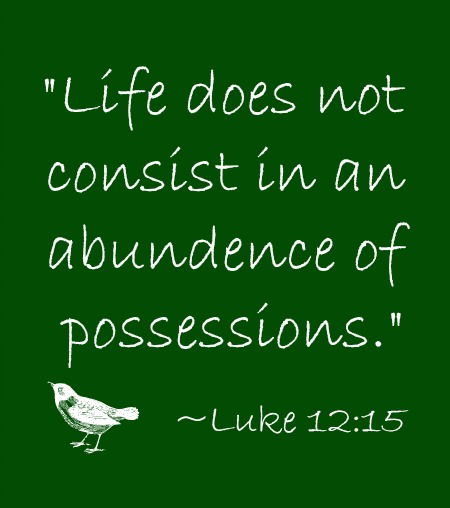
Someone in the crowd said to him, “Teacher, tell my brother to divide the inheritance with me.” Jesus replied, “Man, who appointed me a judge or an arbiter between you?” Then he said to them, “Watch out! Be on your guard against all kinds of greed; life does not consist in an abundance of possessions.” (Luke 12:13-15)
Most pastors, rabbis or other kind of leaders I know of would never, ever, give such an answer. They would politely obey the person and strongly encourage the person’s brother to share their inheritance equally. We all want to be fair, right? But Jesus firstly questions why the person views Him as a judge or an arbiter, secondly He warns the whole crowd for greed and for wanting an abundance of possessions.
See, if it’s fair to split an inheritance equally, how much more fair isn’t it to split all the world’s wealth equally? Jesus practiced community of goods with His disciples (John 13:29), and the church continued to do so when He had levitated into Heaven (Acts 2:44-45). But the inheritance of the world is private, those with rich parents inherits more than those with poor parents. Since the world doesn’t have the Jubilee economic system that Old Testament Israel was supposed to have, there is no mecanism to stop this other than tax, which in most cases doesn’t create much equality (in Sweden we used to have an inheritance tax, but the conservative “Christian democratic” government abolished it). (more…)
Three Awesome Books on Wealth, Miracles and Community of Goods

I got three amazing books in my hand that I can’t wait to read! Let me introduce them to you:
Rich Christians in an Age of Hunger: Moving from Affluence to Generosity by Ron Sider
Being one of the most popular books during the Jesus Movement in the 70’s, and according to Christianity Today, it’s the seventh most influential book that have shaped evangelicals. Sider goes against the commonly held view that it’s absolutely fine for Christians to be rich while thousands of people are starving to death, using Bible study, statistics on economic inequality and examples of radical Christian groups that have taken the economic teachings of Jesus seriously. Sider’s ideas are very similar to those I express in my series God vs Wealth, but to this point I have actually never read him – I got my ideas directly from the Bible.
A reader called Kelly writes on GoodReads:
“I was really floored by this book. The author first presents some startling and informative statistics on world hunger and poverty, where we have been and what is projected. Then he talks about God’s intense love for the poor, and that if we want to “be imitators of God” we must as Christians learn to share in that love. I left this book really wanting to do more to make a difference… even with specific ideas how! The best thing about this book was also the worst thing – sooo much information. Never before have a seen a pastor… talk so intelligently about ALL facets of poverty. Politics, economics, environment, sociology, religion – these topics were all included in great detail and from a Christian perspective. I have not seen anything more complete out there. That said, it was also very overwhelming (as it probably should be).”
Heidi Baker, the Widow and the Love of Jesus

Heidi Baker praying for a deaf woman
Earlier this year, Iris Global in Mozambique reported about the devestating floods that struck Mozambique, leaving hundreds of thousands of poor people in big need. Iris has been working hard ever since to rebuild homes and helping local communities develop, while they are also praying for the sick, preaching the Gospel and even raising the dead. Recently, they publiched a video showing the movement’s leader Heidi Baker buying a bed for a widow called Louisa, whose house has been destroyed in the floods:
It’s very touching to see the genuine care of Heidi and the overflowing joy of Louisa. Earlier this year, Heidi wrote a newsletter saying: (more…)
How to Transform a Mainline Church into a Christian Community

Worship in New Creation Christian Community, Jesus Army, United Kingdom
In this third and final part of “extreme church makeover”, we will look at how a mainline, conventional church that doesn’t practice community of goods like the church of the apostles (Acts 2:43-44), can be transformed into a church that does practice community of goods like the church of the apostles. Because of my trip to the Jesus Army in the UK – that practices community of goods – in August I have already written a lot recently about sharing everything and explained why it isn’t impossible and why the example of the apostolic church in Jerusalem should be followed rather than ignored. Hence, I won’t go into that in this blog post.
Let us instead discuss the practical part – how can we deliver mainline churches from the claws of mammon so that they practice economic equality instead of inequality? In my previous posts, where I’ve talked about how to make a mainline church evangelize on the streets and how to transform a mainline church into an organic house church, the practical applications have come in the form of bullet points in the end, which honestly is because I felt it necessary to explain why these reforms are needed so that in the end, I didn’t have too much time discussing the practice (I usually don’t want to spend more than one hour on blogging per day).
What I think is important to note when it comes to all of these three reforms, or restorations rather, is that they are indeed entirely possible. That is, I am fully convinced that we could see thousands – millions even – of churches around the world going back to the apostolic structure of mandatory evangelism, organic simplicity and community of goods. Just look at the charismatic movement. 120 years ago, most Protestant churches believed that miraculous gifts had ceased, and very few included healing, prophecy or speaking in tongues at their meetings. Now, this is the standard in millions of Protestant churches around the globe. When the Holy Spirit spreads revival, the church can change very fast.
Yes, Community of Goods Does Work!

Holy Treasure community house in Kettering. Tim and Jane to the right have lived in Christian community for over 20 years.
When I visited the Jesus Army in the UK and enjoyed their community of goods, I obviously wrote a lot about it on the Internet. Apart from writing on this blog and my Swedish one, I shared a lot of pictures and joyful reflections, just being happy and thankful of experiencing the community of goods I had read about in Acts chapters 2 and 4. It didn’t take long before many of my Christian friends started arguing against community of goods, using all kinds of arguments why we shouldn’t live like the apostles. Many of them were based on myths and false assumptions, and on of the most common is the idea that community of goods simply doesn’t work.
It’s quite strange how I, when I’m in a community house that has existed for 30 years, hanging around with people that have lived in community for most of their lives, get to hear from my friends back home in Sweden that community of goods doesn’t work and is doomed to fail. There are usually three arguments for this:
- The community of goods in Jerusalem obviously failed, since Paul had to fundraise money for the poor there around year 50 (2 Cor 8-9).
- Soviet! Stalin! Mao! Kim Jong Un! Communism sucks!!!!!1!
- I know of a Christian community that existed once, and people just got angry and today it is gone.
Things that make the Jesus Army unique

Frida enjoying the Jesus Army
Today, me and Frida will travel to London to Jesus Army’s Spreading Flame community house, and after spending a day there we will go back to Sweden. Both of us have been very inspired and with the help of the Holy Spirit we hope to launch a similar church in Sweden that combines community of goods with the power of the Holy Spirit and evangelism. I’ve written a lot about the Jesus Army’s community of goods, their Jesus-centered focus and their social, eco-businesses, but there are many other things that make this church quite unique. Some examples:
The Jesus Army doesn’t sent out missionaries, instead they have an international partnership network called Multiply. Most of the churches and leaders connected to it are in Africa and Asia, and so many of them inspire and preach to the Britons rather than the other way around, while the Jesus Army still finance projects to fight poverty over there.

Training Year info
Jesus Army doesn’t have a Bible school, instead they have a training year where you live in a community house, work in a Kingdom business and partake in all the evangelism, social work, Bible studies, worship and prayer the church organize. You also get a mentor with whom you study Scriptures with and deepen your faith. Far more practical, biblical and intergrated with church life than most Bible schools I know of.
Jesus Army doesn’t do expensive weddings or celebrate Christmas and birthdays with lots of consumption and indulgence. Instead they value simplicity, fellowship and constant celebration. They want to avoid luxury and wealth, and are striving for a lifestyle of humbleness, free from materialism.

There are many more things to write, but our transport to London is leaving now. Blessings!
Business according to the Kingdom of God

The Jesus Army does not only practice community of goods, but they also have several business which are owned by the communities, called Kingdom Businesses. What make these small corporations stand out is firstly that everyone gets the same wage – the managing director does not get any more than the one who wipes the floor. Secondly, you have to be a part of the Jesus Army, either as a community member or as a covenant member – meaning someone living outside the community but who still have made a commitment to spending time, energy and finances in the church – to be employed in the businesses. Thirdly, all profit go to one of the charitable funds of the church, either the Jesus Centres who are social centres for people in need, or stuff like evangelism, national conferences and other church stuff.

The Kingdom Businesses are basically “church at work”, and the Jesus people surely bring in a lot of ethics in what they do. Goodness foods distributes organic health food, TBS building supplies have started an EcoCentre programme that sells windmills, solar panels and other green technology. Several of those who are employed are people who have had difficulty getting a job.
I was very inspired by this – generally I’m skeptical towards businesses but since these are social, green and Christian I think they make a lot of good impact. Most churches don’t really care where people work, and so church goers worship Jesus on Sunday and sell products produced by child slaves on Monday without anyone reacting. For the people living in Jesus Army’s communities, church isn’t something you go to – it’s something you are, live in and work in 24/7. And while it brings several challenges, it’s scriptural, ethical and way more fun than the usual two-hours-a-week church.

Living like the Apostles at the Jesus Army

All the believers were together and had everything in common. They sold property and possessions to give to anyone who had need. (Acts 2:44-45)
Yesterday, me and my friend Frida arrived in Kettering, England, to visit one of my favourite churches, the Jesus Army. As I’ve pointed out several times before, the Jesus Army is one of the very few examples of when the Jesus hippies of the 70’s organized themselves in their own church instead of joining existing churches, and this has made them able to sustain the radicality, fire and passion for God that characterised the Jesus revival. What is most noticable is that the Jesus Army practices community of goods just like the apostolic New Testament church, something that unfortunately has become very rare among Protestant Christians.
You see, cessationism is sadly not just a doctrine of the margins within the Protestant movement, but a key factor in how both Luther and Calvin viewed Scripture. While claiming that they based their theology on Scripture alone, they deliberately ignored large parts of the Bible that didn’t fit with their theology. Cessationism is generally defined as the idea that miraculous gifts have ceased with the apostles, but within Protestantism we also teach that the community of goods we read about in Acts 2 and 4 ceased with the apostles.
With cessationism, you basically are your own god who make your own bible. Jack Deere, a former cessationist, writes in Surprised by the Power of the Spirit how he didn’t like fasting very much, so he claimed that fasting has ceased with the apostles as well. After all, there are not so many people fasting in the later books of the New Testament. But the problem is of course that the Bible never says that anything – miracles, community, fasting or whatever – would cease with the apostles, and so cessationism is just a way for Christians who claim to be Bible-believing to have a reason not to believe in all of the Bible.
(more…)
Is Israel Practicing Apartheid?

Click the image for higher resolution
Desmond Tutu, formerly archbishop of the Anglican Church in South Africa and a well-known anti-apartheid activist, is one of those people that accuse the state of Israel of practicing the crime of apartheid when it comes to how Palestinians are being treated. This is a quite controversial accusation though, even if it is supported by several human rights advocates and academics, it has also received a lot of criticism, since the situation in Israel and Palestine is noticably different from the South African case.
Mitchell G Bard from Jewish Virtual Library points at the fact that around 20% of Israeli citizens are Arabs that have equal rights compared to Jews and other people groups in Israel. Arabs and Muslims are represented in Knesset, in the courts and at the universities. FW De Klerk, former South African President who together with Nelson Mandela ended apartheid, also says that because of this reason it is unfair to call Israel an apartheid state. “You have Palestinians living in Israel with full political rights. They are represented in the Knesset. You don’t have discriminatory laws against them, for example that they may not swim at certain beaches or anything like that.”
However, people who use the apartheid analogy to describe Israeli policy usually discusses how Palestinians are treated by Israel in the West Bank and Gaza rather than how Arabs are treated within Israel. The thing is that race actually can equal nationality according to international law. The International Convention on the Elimination of All Forms of Racial Discrimination, which Israel along with most other countries has signed, defines racial discrimination as “any distinction, exclusion, restriction or preference based on race, color, descent, or national or ethnic origin which has the purpose or effect of nullifying or impairing the recognition, enjoyment or exercise, on an equal footing, of human rights and fundamental freedoms in the political, economic, social, cultural or any other field of public life” (emphasis mine).
Book Review: Pilgrims of a Common Life by Trevor J. Saxby
 For a long time, I didn’t want to read non-biblical Christian books. I thought that most of the time they were actually diluting the radical teachings of Jesus (and quite frankly I still think this is the case). But I discovered that there are two areas where I get very equipped by Christian litterature, namely church history and testimonies. This has helped me a lot both when I pursue signs and wonders, evangelize and work for peace and justice. I want to share with you some books that really has inspired me a lot and that I highly recommend. First out is Pilgrims of a Common Life: Christian Community of Goods Through the Centuries by Trevor J. Saxby.
Saxby has been a part of the Jesus Fellowship Church, or the Jesus Army, in the United Kingdoms since its beginning in the 70’s. The Jesus Army was the main fruit of the charismatic revival among hippies in the UK and they practiced community of goods, something Saxby was very attracted by. He doctored at Oxford in church history, writing his thesis about community of goods. In Pilgrims of a Common Life, he shows how community of goods has been practiced in all of church history in many different cultures, countries and churches.
In the first three chapters, Saxby effectively challenges the popular misconception that the apostolic church of Jerusalem was the only one practicing community of goods and that it was an exception rather than an example. He shows that community of goods is the logical consequence to the economic teachings of Jesus, he points at the fact that Jesus Himself practiced community of goods with His disciples, and he also looks at the cultural and historical context and shows how community of goods was not a foreign idea in first century Israel – the essenes practiced it and it was supported by both Greek and Jewish morals.
(more…)
Justice: Same for All, Reward for Work or Something Else?
You rarely find someone who says that s/he is against justice, but you do find a lot of different definitions of justice. Here are five definitions of economic justice, together with my comments on which is the best from a Christian perspective:
1. Same for All
This is the idea that in a just and equal world, everybody has the exact same amount of money. There are hints towards this perspective in Lk 3:11 and 2 Cor. 8:13-15. However, this definition has received a lot of criticism simply because different people have different needs – people in poor countries without social safety nets need more money than people in rich countries, for example. This why not so many actually agree with this definition, even if we who try to promote equality are often accused of this while we really mean definition no. 2:
2. According to our needs
This is how the early church viewed economic justice: “All the believers were together and had everything in common. They sold property and possessions to give to anyone who had need.” (Acts 2:44-45) We can also see this in Ex. 16 where the people collect heavenly bread every day, and since the greedy are unable to store up a lot for themselves, everyone are able to collect what their family needs for that particular day. The socialist motto “From each according to his ability, to each according to his need” is based on the same line of thinking, but it was a biblical idea long before Marx was even born.
What a Truly Pentecostal Church Looks Like
Yesterday, on Pentecost day, I had the honour to preach in my dear house church Mosaik. We’re always outside in the park during the summer, and this Sunday we had som English speaking visitors – so for the first time in a year I preached in English. And since a friend of mine recorded it all, it’s now available for you guys!
I started with talking about the Pentecostal language miracle, when one is able to speak existing languages that one hasn’t studies, and gave some testimonies about when this has happened in modern times. This was also what my last blog post was about. Then, I talked about how Peter, in his Pentecostal sermon in Acts chapter 2, really emphasises miracles when he talks about Jesus. He presents the Messiah by saying “Jesus of Nazareth was a man accredited by God to you by miracles, wonders and signs, which God did among you through him, as you yourselves know” (Acts 2:22). Then he goes on with “God has raised this Jesus to life, and we are all witnesses of it. Exalted to the right hand of God, he has received from the Father the promised Holy Spirit and has poured out what you now see and hear. (vv. 32-33). Thus, Peter proves that Jesus is the Messiah by pointing at His miraculous ministry, His resurrection and the miracles His Spirit does.
The people “were cut to the heart” (v. 37) when they heard this and asked Peter what they should do, and he answered “Repent and be baptized, every one of you, in the name of Jesus Christ for the forgiveness of your sins. And you will receive the gift of the Holy Spirit.” (v. 38). 3000 people did so, and suddenly the apostolic league of disciples had become a mega church – but not in the modern sense, since they lacked a church building. They were a charismatic, evangelistic house church movement that spread rapidly, as Luke famously portrays:
They devoted themselves to the apostles’ teaching and to fellowship, to the breaking of bread and to prayer. Everyone was filled with awe at the many wonders and signs performed by the apostles. All the believers were together and had everything in common. They sold property and possessions to give to anyone who had need. Every day they continued to meet together in the temple courts. They broke bread in their homes and ate together with glad and sincere hearts, praising God and enjoying the favor of all the people. And the Lord added to their number daily those who were being saved. (Acts 2:42-47)
Is Costa Rica Heaven on Earth?
My dear friend Andreas Lundström who helped me make my new E-book God vs Inequality also made this video for me. It’s based on this blog post about how Costa Rica is a good example of a country that combines a long life expectancy with a small ecological foot print. Most people are quite happy to live there, and they are managing to do so wighou destroying the environment very much. Also, their GDP per capita is about the same as the gross world product per capita: 13,000 dollars a year. If everybody lived like the average Costa Rican, wealth would be evenly distributed, while if everybody lived like the average American, we would need five planets.

As I have shown people this clip, some have been skeptical. They dig up facts about inequality within Costa Rica, or its horrible sex tourism, or its crima rate, and argue “look Micael, Costa Rica isn’t much of a paradise, is it?” And of course I’m not arguing that it is a sinless state, because such do not exist – the only perfect country is the Kingdom of Heaven. But you can’t get away from the fact that Costa Rica disproves the idea that you need to be rich to have a long happy life, or that it’s impossible to enjoy life without trashing the planet. This is also the case with Kerala in India, a state that combines good health care and education with very low GDP per capita.
The point of the video is that rich countries must get poorer and give away much more of their money to create a fair and sustainable world. Many rich people don’t like this biblical idea because the love for money is a root to all evil (1 Tim 6:10), but Costa Rica show us that low GDP doesn’t mean that you’ll die when your 40 – Costa Rica has a longer life expectancy than the United States! So if you want a fair and sustainable world, live on less than 13 000 dollars a year and give the rest of your money to the poor. God bless you.
Free E-Book: God vs Inequality

My blog series God vs Wealth has been quite popular, partly because it’s a bit controverisal, partly because I think many share my ideas about economic equality. In a world where the richer get richer while the poor are dying, many Christians realize that Jesus was critical towards the rich and modeled something that would both abolish poverty and wealth, since the two are dependent upon each other. I have returned to this topic several times on this blog, and a couple of weeks ago I got the idea that I perhaps should collect these texts in one volume. Today, I can present to you my first e-book ever: God vs Inequality!
You can download the whole book as a PDF right here: God vs Inequality. It contains all ten parts in the God vs Wealth series, as well as its sequal God vs Poverty and several other texts published on this blog like Should Christians Wear “Formal” in Church?, It’s Time for All Christians to Become Vegetarians and Seven Reasons Why Inequality Sucks. Everything is illustrated by some beautiful photos I captured when I was in South Africa last year (or, to be honest, random stuff I’ve taken from Google Images) and put into an amazing layout by my dear friend Andreas Lundström.
Feel free to spread the document on, print it out and copy-and-paste, I claim no copyright. If you want it in iBook-format, which is what Andreas used to create it with, just send me an e-mail to micael.grenholm(a)gmail.com. If you discover some typos or have general comments about the content, feel free to comment below.
Also I’m very excited about the “real” book A Living Alternative that I have co-authored together with my MennoNerd friends, which will be released this fall. For now though, enjoy God vs Inequality!
 Charismactivism