
Home » Justice & Economics (Page 5)
Category Archives: Justice & Economics
The author

Micael Grenholm, a Swedish charismactivist, apologist and author.
Making Community of Goods Common Again

Mike Farrant and Emil Nyström enjoying community at Jesus Army’s New Creation Hall in Northamptonshire
New wine requires new wineskins. I sense a radicality and a passion to follow Jesus in Europe today among the Christian youth. Many are inspired by Jesus first and foremost, but also histocial radicals like Francis and Clair of Assisi as well as modern like Heidi Baker and Shane Claiborne. With the increasing awareness of the suffering and misery the Western affluent lifestyle brings, with both environmental and social consequences, there is a longing to live more simple and equal, as in the apostolic age:
All the believers were together and had everything in common. They sold property and possessions to give to anyone who had need. (Acts 2:44-45)
Community of goods is a necessity. We need it to eradicate poverty and promote simplicity. And that in turn is what is needed to combat the secularism and individualism that is destroying the church spiritually. Jesus said that the “deceitfulness of wealth” will choke the word of God (Mt 13:22), and that is exatly what we see in rich countries. There is already an awareness of this, what is needed now is community houses. I talk about this here:
It’s Time to Build Eco-Friendly Houses for the Kingdom of God!

Stylized Earthship model
Building stuff is very Biblical: Jesus our Lord and Saviour worked as a carpenter, Paul was a tent-maker and the whole people of Israel were commissioned to build cities and villages across Canaan after they had colonized it in a not very pacifist way (I’m really looking forward to Greg Boyd’s book on how to deal with Old Testament violence that’s coming out soon). God realizes that shelter is important, He does not want us to be homeless.
1 Tim 6:8 is often translated as “if we have food and clothing, we will be content with that”, and even though Paul’s point clearly is that we should live simply and reject wealth, he isn’t saying that we should be content with homelessness. The word used for “clothing” is in Greek skepasmata, which literally means “coverings”, which can both refer to clothes and shelter. Similarly, the word translated as “food” literally means sustenance.
Historically, the church has indeed built a lot of stuff, but have we really built the right things? As you may know I’m very critical to church buildings, for various reasons that I give in the video above. In Europe where I live, we have hundreds of thousands of church buildings, most of which stand empty at night. We also have four million homeless people, and millions of refugees are expected to seek refuge in our rich subcontinent during the coming years. (more…)
Why Wealth is Wrong: The Bill Gates Argument

Bill Gates. Photo: UK Department for International Development, creative commons
When (rich) Christians defend mammonism, the idea that Christians may or should be rich, they often include arguments that aren’t necessarily based on Bible study – such as the arguments I discuss in my God vs Wealth series – but rather in philosophy or economics. These are the sorts of arguments I tackle in my Why Wealth is Wrong series. You can also read my discussions on the economic argument and the mathematical argument.
The Bill Gates argument for why it’s OK to be rich is a variant of the mathematical argument that involves billionaires. Look at Bill Gates, the mammonist says, he’s so generous! He has his Bill and Melinda Gates Foundation that does so much good for the world’s poor. This is because Gates is the richest man in the world, with his net worth of 75 billion US dollars. His abundant wealth allows him to be abundantly generous, and thus he as a rich man should not be condemned but celebrated both for his skills in computer invention and business, and his philanthropy.
The problem with the argument is that it tries to eat the cake and give it away at the same time: wealth is good, because you can give it away. This is the same error as the mathematical argument makes. Saying that wealth is good because billionaires can give lots of money to the poor, is like saying that it’s good to be fat because then you can lose a lot of weight. It’s trying to rationalize a phenomena by arguing that you can get away from it. (more…)
Did Jesus Say that Poverty Will Never be Eliminated?

My favourite Global Goal. To fight poverty we also need to fight wealth.
Today is a historic day, the United Nations General Assembly adopted the Global Goals for sustainable development just a few hours ago. These goals are sort of a sequel to the Millennium Development Goals (MDGs) which has been surprisingly successful in making the world a better place: extreme poverty has been cut in half, hunger too, more children go to school, less women and babies die in childbirth, and people live longer. Praise God! John Green, educated Youtuber and a Christian, explains briefly the achievements of the MDGs in this video:
The Global Goals step things up a bit though; the new ambition is to totally eliminate extreme poverty by 2030 and also make sure that nobody goes hungry. Other goals (there are 17 of them) include global gender equality with no more discrimination against women anywhere, reduced economic inequality, reasonable consumption, action against climate change and environmental pollution, etc.
Should Christians support the Global Goals? Duh, obviously. Helping the poor and caring for God’s creation is extremely Biblical, isn’t it? Well, some brothers and sisters do object against the goals in general and the first one about ending poverty in particular. The general critique against goals like this is that we should not imagine ourselves being able to turn this world into a paradise, since all men are sinful (Rom 3:23) and the Kingdom of God is not of this world (Jn 18:34). The particular critique against the idea of ending poverty is that Jesus actually said:
The poor you will always have with you, and you can help them any time you want. But you will not always have me. (Mark 14:7)
Why Does the Bible say “The Lord Sends Poverty and Wealth”?

Hannah praying
When the Lord miraculously helped an Israelite woman named Hannah to bear a child, she praised Him in a prayer that is recorded in 1 Samuel 2. It says, among other things: “The Lord sends poverty and wealth; he humbles and he exalts.” (v. 7) Like basically every Bible verse ever, it has often been taken out of context to be used as a proof text for people’s personal views. In this case, it has been argued that 1 Sam 2 divinely sanctions the poverty of the poor and the wealth of the rich, as well as promoting fatalism. I’ve heard several times “It’s not wrong to be rich, it says that the Lord sends wealth”, and sometimes also “It’s useless to fight poverty, it says that the Lord sends it.”
Here’s a radical idea: Let’s look at the context! Hannah says in verses 4 and 5: “The bows of the warriors are broken, but those who stumbled are armed with strength. Those who were full hire themselves out for food, but those who were hungry hunger no more. She who was barren has borne seven children, but she who has had many sons pines away.”
Thus, Hannah argues that there is a transition of fairness at work, where the first will be last and the last will be first. And who’s responsible for this?
Lecture: Signs, Wonders and Social Justice

You know what’s awesome? Miracles! You know what’s also awesome? Social justice! Let’s combine the two, like Jesus did. The Spiritual gifts that God has equipped His church with are supposed to be used to serve others (1 Peter 4:10), and obviously our activism for a more equal and just world will be even more effective when the Holy Spirit empowers us with supernatural abilities. A couple of months ago I hold a lecture on this core idea of Holy Spirit Activism:
It’s super-obvious that miracles and social justice go hand-in-hand in the Holy Scriptures: the Old Testament prophets exercised many miraculous gifts while promoting the rights of the poor and marginalised (see for example the book of Amos); Jesus healed the sick and cast out demons right before His famous Sermon on the Mount about social ethics (Mt 5); and as the apostolic church was filled with the Holy Spirit and spoke in tongues they eradicated the gap between rich and poor through community of goods (Acts 2).
In the lecture I go through these and other relevant Bible passages, as well as sharing testimonies from people today who combine miracles and social justice, like Simon Adahl and Heidi Baker. I also bring up and criticize theologians and philosophers who deny the existence of miracles or at least its presence in the life of the ordinary believer, like David Hume, Rudolf Bultmann and John MacArthur. Enjoy the video!
The Swedish, Charismatic Hotel Church that has Everything in Common

Magdalena, Theresia, Camile and Anne-Lie

Up on the roof!
The Maranata Church in Stockholm is probably the only charismatic church in Sweden that practises community of goods. A month ago when I visited the Jesus Army, one of very few British churches practising community of goods, I got to know two girls from Maranata: Anne-Lie and Elaine Vidén. Up to that point I had thought that no Christian groups in Sweden besides the monasteries had everything in common like the apostolic church in the book of Acts, but the Vidén sisters told me about how they had been living all their life in an extended family community. Yesterday, I paid them a visit.
The Maranata Church runs a hotel called Pilgrim’s Home close to Bromma Airport in Stockholm. Most of the community’s members work in the hotel or in a taxi firm that the church also runs. All the income the businesses generate goes to the account of the church, which pays for food and accommodation for the community’s members. On top of that, they also receive €70 every month to spend on what they want.
This system is very similar to how the Jesus Army works. They also run businesses which generate income to the community, they also pool their income into a common account and they also get pocket money – around 40 pounds a month.
Prophet Isaiah (700 BC): Bring Food to the Arab Refugees!
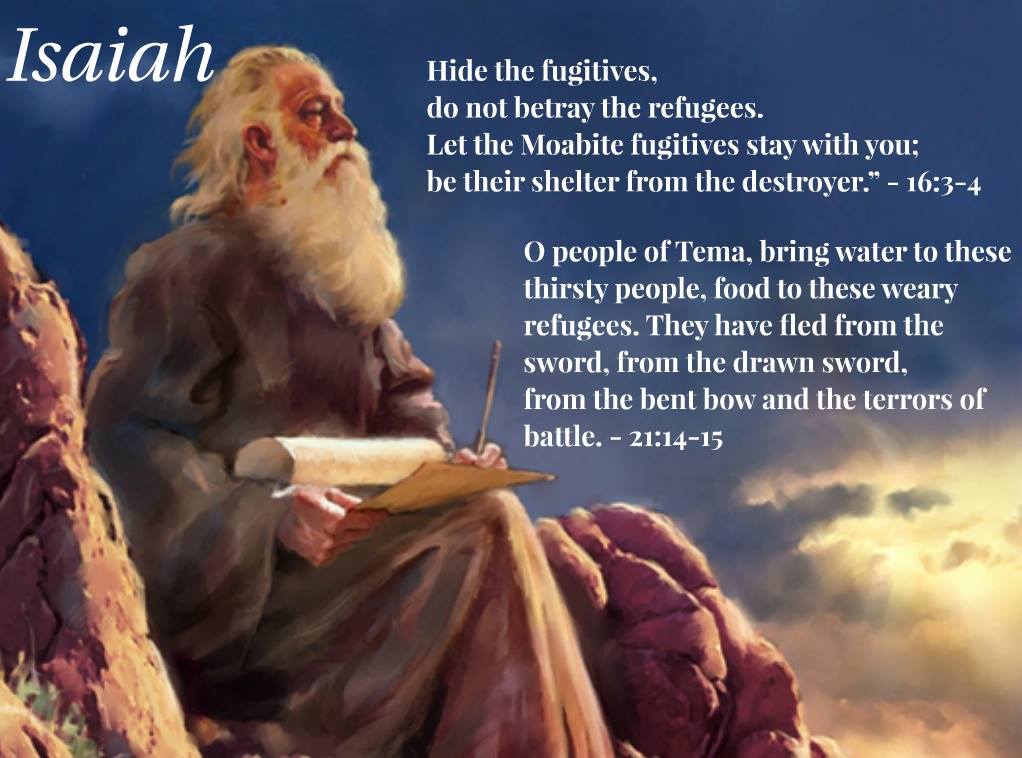
Earlier this summer when I was preparing my lecture Jesus vs Xenohpobia, I went to my favourite Bible study site biblehub.com and searched the Scriptures for the word “refugee”. Two passages touched me in a special way, both being from prophet Isaiah’s book.
Isaiah 16:3-4 says: “Hide the fugitives, do not betray the refugees. Let the Moabite fugitives stay with you; be their shelter from the destroyer.” This is in the middle of a prophecy against Moab, that warns the kingdom for an upcoming disaster. In the previous chapter, God says: “My heart cries out over Moab; her fugitives flee as far as Zoar, as far as Eglath Shelishiyah. They go up the hill to Luhith, weeping as they go; on the road to Horonaim they lament their destruction.” (Is 15:5).
It is thus clear that even though this catastrophe is described as being the result of God’s judgment due to the idolatry of the Moabite people, He still cares for them and wants people to give them shelter from the ones who destroy them. Even people who do not worship the Lord still deserves love, care and humanitarian aid. (more…)
How to Stop the Mass Drownings in the Mediterranean

The Mediterranean genocide is nothing new , over 25,000 people have drowned when they have tried to cross the sea to reach Europe during the last 20 years. European politicians have known about this problem for centuries, yet it is still ongoing. The reason for this is that they simply want it to be like this: they are stuck between being insanely evil or sacrificially merciful, and then they chose a deadly middle-way instead. That’s why Syrian children die in Mare Nostrum: it’s because of politics.
First of all, why do refugees die in the Mediterranean? It’s because they travel with extremely fragile boats provided by smugglers. These crooks usually demand lots of money – often around 1,000 euros and sometimes even as much as 10,000 euros. So why don’t the refugees fly with airplanes? Well, because they aren’t allowed to. As professor Hans Rosling explains in the video above, an EU directive has made sure that airlines must pay the costs of all immigrants who aren’t refugees and therefore are to be deported. Since no airline wants to take the risk of paying these costs, they simply deny all people from developing countries that don’t have a visa, entrance to their planes. And visas aren’t granted to refugees.
This is why all refugees must enter the EU illegally, on dangerous boat rides across the Mediterranean or inside trucks from Turkey to Greece. It’s illegal because there is no single way for them to enter legally. Still, since refugees must be granted asylum according to UN conventions that European countries have signed as well as EU:s own decisions, many who do enter a EU country will be granted asylum, and then suddenly become a legal immigrant. Pretty messed up system, isn’t it?
Countering 7 Arguments Against Community of Goods
We’ve now taken the train home to Sweden after an incredible Jesus Army week in the UK. One of the last things I got to do was to organize a little round table with Huw and Mike who both have lived in Christian community for almost 40 years, I brought up seven arguments against community of goods that I often hear when I discuss the topic, and asked them to counter them. You can enjoy it in the video above, and below are the seven arguments along with a brief summary of what we said:
1. There’s no command to have everything in common
Yes, the process of having everything in common – and thus eliminating poverty – starts with people selling what they have according to Acts 2:45 and 4:34. And to sell everything one has is exactly what Jesus commanded not just one rich ruler to do (Mt 19:21), but all His disciples to do (Lk 12:33)
2. Community was practised because the Jerusalem church was persecuted
They started to practise it before persecution, and the reason given was not that they excepted persecution but that they loved each other and didn’t want anyone to be poor. Besides, since “everyone who wants to live a godly life in Christ Jesus will be persecuted” (2 Tim 3:12), ought we not to live a life like that today?
3. Community was practised because the apostles errantly thought that Jesus would come back in their lifetime
Again, there is no reference in the Bible to any other reason for community of goods other than that the early Christians loved each other and didn’t want anyone to be in need. They also clearly wanted to follow the commands of Jesus, including the one in Lk 12:33. Besides, shouldn’t we have even more reason to expect Jesus’ soon return now 2000 years later? (more…)
Christian Community is for Everyone!

How good and pleasant it is when God’s people live together in unity! (Ps 133:1) We’ve now visited around seven different community houses here at the Jesus Army, and it’s so beautiful to see the mixture of different people. Everybody believe in Jesus of course, but apart from that there is great diversity when it comes to age, ethnicity, social background, employment and civil status. Everyone are welcome to join the community, as long as they are committed and serious about it.
This is obviously very Biblical as the apostolic community in Jerusalem that we read about in the book if Acts literally included all the believers: “All the believers were together and had everything in common. They sold property and possessions to give to anyone who had need.” (Acts 2:44-45)
In the Jesus Army’s New Creation Christian Communities, you meet all sorts of people. Yesterday and today we’ve spoken to former drug addicts who have been saved and joined the common purse, as well as academics, nurses and teachers. We’ve spoken to 90-year-olds and people in their 20’s, as well as to parents with kids under the age of five. Everyone are welcome to sell everything and join the community of goods, even those who hardly have anything and mostly bring their debts to the common purse! And there is a strong, tangible brotherhood in the church that is quite unique in our individualist society.
If We Want a Better World, the Rich Have to Pay for It!

We shouldn’t just talk about how to fight poverty, but also how to fight inequality.
In September, world leaders will gather in New York to agree upon new Sustainable Development Goals (SDGs) that will succeed the old Millennium Development Goals (MDGs). Several of the MDG:s were actually fulfilled, such as halving the proportion of poor people worldwide and increasing global health and literacy.
Now, the goals are even more ambitious, striving to eradicate poverty, hunger and illiteracy completely, along with environmental goals such as preserving ecosystems and combating climate change. A key to all this, I think, is goal number 10: to decrease inequality between and within countries.
People aren’t poor because there is a lack of resources in the world, but because they are unevenly distributed. 20% of the world’s population consume 80% of the world’s resources. And the mass consumption of the rich hurts the environment: if everyone lived like the average Swede, we would need three planets. If they lived like the average American, we would need five. In fact, World Overshoot Day, when we have consumed what the earth produces in a year, is today, August 13! This means that during the rest of 2015, we spend, consume and trash resources that we do not replace, and this date has been pushed further back almost every year in the calendar.
Treating Immigrants like Jesus

‘For I was hungry and you gave me something to eat, I was thirsty and you gave me something to drink, I was a stranger and you invited me in, I needed clothes and you clothed me, I was sick and you looked after me, I was in prison and you came to visit me.’
Then the righteous will answer him, ‘Lord, when did we see you hungry and feed you, or thirsty and give you something to drink? When did we see you a stranger and invite you in, or needing clothes and clothe you?When did we see you sick or in prison and go to visit you?’
The King will reply, ‘Truly I tell you, whatever you did for one of the least of these brothers and sisters of mine, you did for me.’ (Mt 25:35-40)
The New York Times has written about my little country, Sweden, and how we treat poor immigrants from Romania. It’s not a happy read:
From media reports, Expo has counted 77 attacks against beggars in the last 18 months, though charities assume such crime is underreported.
The attacks include one in Malmo, where tents in a Roma camp were set on fire; another in Boras, where a beggar was run over by a moped; and one in Skara, where at least one migrant was hit by a pellet from an air rifle.
I’m very involved in this situation; as I have shared previously I am almost daily helping poor Romanian immigrants. I have started a small organization with some friends to support them and help them to get housing and an income, and I personally know about 100 people in this situation. The hatred and racism that NY Times is reporting about is something I witness all the time, and I’ve had countless discussions with people who are convinced that these extremely poor beggars are rich, criminal liars who should be deported. (more…)
Why the “Deport All Muslims Now” Idea is Stupid, Evil and Non-Christian

Franklin Graham
Almost a year has passed since Charisma Magazine published the op-ed “Why I am Absolutely Islamophobic”, which argued that the United States should sterilise, deport and/or kill 100% of its Muslim deportation. The deportation part was literally labeled “D.A.M.N.”, Deport All Muslims Now – and this was written by a Christian, mind you! The article was eventually removed by Charisma after people protested against their promotion of genocide, but it’s still accessible here.
Christian support for the “D.A.M.N.” policy hasn’t ended though; recently Franklin Graham, the son of world evangelist Billy Graham, wrote on Facebook that he want to deport all Muslims due to the risk of Islamic terrorism:
“Four innocent Marines killed and three others wounded in Chattanooga yesterday including a policeman and another Marine–all by a radical Muslim whose family was allowed to immigrate to this country from Kuwait. We are under attack by Muslims at home and abroad. We should stop all immigration of Muslims to the U.S. until this threat with Islam has been settled… Let your Congressman know that we’ve got to put a stop to this and close the flood gates. Pray for the men and women who serve this nation in uniform, that God would protect them.”
As the title of this blog post suggests, I think that the extreme idea if deporting all Muslim immigrants (which a “stop all immigration of Muslims” means in practice) is stupid, evil and non-Christian. Let’s start with the evil part:
China’s Early Pentecostals Practised Community of Goods

Check out this book for more info about the Jesus Family!
This is an excerpt from the first draft of my upcoming book on radical charismatic church history.
In the beginning of the 20th century, China was suffering from the Boxer uprising, where Mandarin nationalists revolted against European colonial influences, demanding that everything foreign, especially Christianity, should be thrown out. The Boxers were crushed by colonial forces but that didn’t put an end to the social unrest, and China continued to suffer from looting, violence and xenophobia. And yet, Pentecostalism spread rapidly throughout China, much thanks to the Holy Spirit and a guy called Mok Lai Chi (1868-1926) in Hong Kong.
Mok went to the slums of Wan Chai, preaching the Gospel and healing the sick. In 1908 he started a paper called Wuxunjie Zhenlibao, Pentecostal Truths, which was spread not just in Hong kong but across the mainland. Mok explained in the paper: “Hong Kong Pentecostal Mission is a Jesus church founded by the Chinese themselves, not a branch of any foreign churches planted in my nation.”
The Mission supported Bible classes and girl schools, as well as church planting. Mok Lai Chi both cared for people’s salvation and the social problems they experience here and now; protesting against the British colonial government in 1921 for allowing the rents in the city to be too high. (more…)
 Charismactivism