Home » Justice & Economics (Page 12)
Category Archives: Justice & Economics
The author

Micael Grenholm, a Swedish charismactivist, apologist and author.
The Amazing Frizon Festival

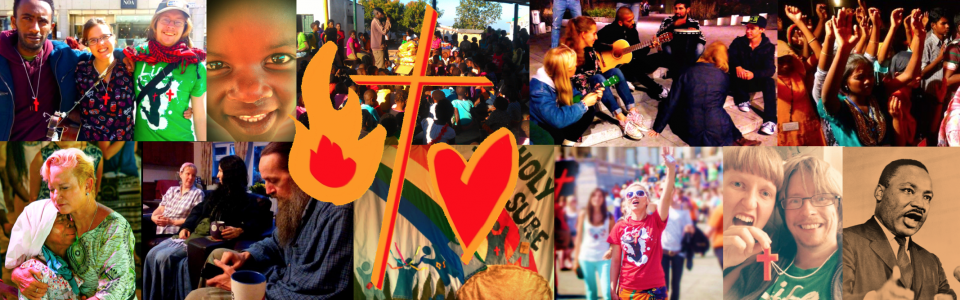
I’m currently at the Frizon (“Free Zone”) Festival, one of the biggest Christian youth events in Sweden. It’s actually a music festival with concerts and stuff, but it also includes services, Bible studies, seminars and everything else you’ll find at a Christian conference. And what I really love is that it both welcomes charismatic fire and radical activism. For example, you will find:
Daily testimony meetings where the youth share miracles they’ve experienced
Almost completely vegetarian food
Prophetic guidance where prophetic people pray for you
Seminars about migration policy, poverty reduction and the fight against trafficking
(more…)
A Church That Kicks Out the Poor

Photo: Michael Coghlan
(Thanks to Robert Martin for the video.)
A friend of mine just told me about her home church in a rich European city. Lots of wealthy people are going there, and eventually a poor Romanian beggar showed up asking for money outside the church. My friend and her friends felt compassion for this poor woman, got her some breakfast and invited her in. People were staring. People were whispering. A lady came to them and said that the Romanian woman is scaring her children and that she’s probably involved in trafficking, with criminals taking the money she is begging for. Eventually, a man came and led her out of the church. She wasn’t welcome.
Needless to say, my friend and her friends were chocked. They took this lady to another church. Here, she was radically saved, receiving Christ as her saviour. She was very happy, but even though if she wasn’t kicked out this time, most people didn’t speak to her or tried to build a relationship with her. My friend and her friends were the exception of course, they collected money for her to pay for her son’s surgery back in Romania, but it was hard since many fellow Christians didn’t want to give.
Suppose a man comes into your meeting wearing a gold ring and fine clothes, and a poor man in filthy old clothes also comes in. If you show special attention to the man wearing fine clothes and say, “Here’s a good seat for you,” but say to the poor man, “You stand there” or “Sit on the floor by my feet,” have you not discriminated among yourselves and become judges with evil thoughts?
Listen, my dear brothers and sisters: Has not God chosen those who are poor in the eyes of the world to be rich in faith and to inherit the kingdom he promised those who love him? But you have dishonored the poor. Is it not the rich who are exploiting you? Are they not the ones who are dragging you into court? (James 2:2-6)
Before we judge these churches though, examine yourself and your own congregation. John Chrysostom said “When you are weary of praying and do not receive, consider how often you have heard a poor man calling, and have not listened to him.” Are there any poor people in your church? If not, why don’t they come? If there are, are their needs met? What is your attitude to the beggar on the street? Do you give to the one who asks you as Jesus commanded us (Lk 6:30)? Do you have prejudices like in the video above?
Parallells Between Anabaptism and Pentecostalism

Logo for Pentecostals & Charismatics for Peace and Justice
My previous blog post about charismatic theology and miracles among the early Anabaptists became very popular, it’s already one of the most wildly read posts this year! So since you obviously like that stuff I want to share an excerpt from another great article, A Pentecostal Drawn to Anabaptism, by Richard Gillingham:
Why I was drawn to Anabaptism
In the history of Classical Pentecostalism, particularly through reading the late Walter Hollenweger’s excellent book Pentecostalism, I found a narrative in which my experience could be placed, interpreted and one of which I could be proud. What then of my relationship with Anabaptism? In conversations with others it is clear that the primary means of attraction to the Anabaptist Network is relational, but in my case this was not so. My interest in Anabaptism was as a consequence of re-reading John Howard Yoder’s The Politics of Jesus after researching the theology of Stanley Hauerwas in my postgraduate work.
In my reading it was clear that Anabaptism, like Pentecostalism, is strongly apocalyptic. I think this similarity is a key reason for my attraction to the Anabaptist vision (more on that later). Reading their respective histories some of the similarities between Pentecostalism and Anabaptism are striking. For example:
A Charismatic view of the Church
Pentecostalism is well known for its emphasis on the spiritual gifts, particularly the gift of tongues. While Anabaptism, especially in its early history, certainly had similar manifestations this is not what I mean by calling both churches charismatic. Rather, both have a very strong emphasis on every-member ministry in the Church. Early Pentecostals regularly claimed that Pentecostalism had no earthly leaders. Both traditions assert that every member of the Church has been gifted for a unique ministry. The historian Augustus Cerillo writes that the ‘central element in Pentecostal ideology was its belief in the church as a Holy Spirit-created egalitarian community in which all the walls of separation produced by racial, ethnic, gender, and class differences would be washed away in the blood of Jesus Christ’ (Pentecostal Currents, 237-238).
(more…)
John Wimber: Justice Goes Hand in Hand with Revival and Renewal

“Sometimes I wish we still were Quakers”, Christy Wimber said this morning at the Nordic Vineyard Summer Camp, which I am currently enjoying. Christy belonged to the Yorba Linda Friends Church where John Wimber and his family worshipped, and joined them as they got kicked out of it when they started to heal the sick and baptize converts. She has been a Vineyarder ever since and married one of John’s sons. But she still wishes she was a Quaker.
I can see why. Quakerism, with its teaching on radical discipleship, pacifism and social justice, never left John either. I’ve already collected some quotes from him about poverty and social justice, but now I got hold of a book here at the conference, The Way In is the Way On, where chapter three is totally devoted to John’s teaching about this issue. Here’s an excerpt:
I love to teach on social justice! It really is one of my passions. Justice always go hand in hand with true revival and renewal of the Spirit. Justice – setting things right for the poor and marginalized – is one of the primary purposes for God sending His Son into the world. He came in order to set things right. Great leaders in the history of the church have always understood the relationship between faith and justice. There has never been a movement of God started on fire that did not have a ministry to the poor.
God vs Wealth, part 8: Were Jesus and Paul Rich?
To read other parts of the series, go here.
 I always get confused when some Christians argue that Jesus was rich, since it is like claiming that Donald Trump is poor. How can you think that a homeless, jobless foot-walking preacher was wealthy? Have they found a hidden Bible verse that states that Jesus had a mansion somewhere, despite saying that “the Son of Man has no place to put his head” (Mt 8:20)? Have they found an ancient document that shows that He actually owned a jet plane? My Bible says that he was totally aid-dependent, recieving His support from women and sharing everything with His disciples, practicing community of goods (Lk 8:1-3, Jn 13:29).
But the main argument for the rich Jesus is His seemless garment. John 19:23-24 says:
When the soldiers crucified Jesus, they took his clothes, dividing them into four shares, one for each of them, with the undergarment remaining. This garment was seamless, woven in one piece from top to bottom.
“Let’s not tear it,” they said to one another. “Let’s decide by lot who will get it.”
This happened that the scripture might be fulfilled that said,
“They divided my clothes among them
and cast lots for my garment.”
I’ve seen countless articles and heard many sermons that use this passage to prove that Jesus was rich, since they claim that a seemless garment must have been the clothing of the wealthy. I’m not sure if I would call a homeless, jobless, foot-walking guy who didn’t have anything but a shirt rich though. And more importantly, I can’t find any evidence that only rich people had seemless garments. The Bible sure never says it. And it isn’t hard to create seemless clothing. All you really need to do is to cut a hole in a blanket and ta daa – you got a seemless poncho.
Voices about Iris Ministries
On greatnonprofits.org, there are 31 reviews of the charismatic missionary organisation Iris Ministries, or Iris Global as they nowadays call themselves. Everyone have given five out of five stars. Here are some of the reviews:
Iris Global wholeheartedly beats with the heartbeat of God. They move to bring the love of Jesus to not just the poor, widowed, orphaned but also and always to the person that stands right in front of them. It’s incredible to see and organization recklessly abandoned to take the love of Christ to every single heart that they encounter, without a secret agenda but to solely love! The experience I had with Iris was life-changing, I can never be the same.
My life was personally transformed in immeasurable ways through Iris Global. Never had I been so powerfully and overwhelmingly loved. One thing is being personally changed by a non-profit, but another is witnessing the trustworthiness and reliance one can have in KNOWING so beautifully that every penny invested towards Iris’ work is exponentially having life-giving impacts to both individuals and corporate masses.
When I spent time in Mozambique with Iris ministries I saw the lives of many many precious children, mamas , papas, young men and young woman being changed daily! Not only did I witness a love that was so transcendent I found I was the one that was being blessed by These incredible villages full of transformed people living in poverty but having a richness that could not be added in dollars! I saw children with no hope being given a hope for the future! The work iris is doing worldwide is in my opinion some of the most important work of our lifetime! I believe that through the laid down love of the body of Christ serving with Iris Global we will see an end to world hunger in our life time! Hearts yielded to love.
Is the Bible Supporting Capitalism or Communism?

The other day a friend sent me this article, written by Swedish economist Paul Segerstrom, about “what the Bible teach about economics”. The title should rather have been “Why capitalism rocks and communism sucks, and here’s some Bible quotes to prove my point”. It isn’t well written and it is using very weak arguments. I still want to comment it though, since it is an oppurtunity for me to share what I think about capitalism vs communism (hint: I think the Kingdom is better than both of them).
In summary, Segerstrom is saying that the Old Testament is teaching great respect for private property, especially in the tenth commandment (“you shall not covet… anything that belongs to your neighbor” – Ex 20:17). The Old and New Testament is a unity and both Paul and Jesus were teaching about the ten commandments, thus they also defended private property. Of course, we should be generous in charitable giving to the poor, Segerstrom is careful to emphasise this – still he doesn’t like equality but says that good ol’ Abraham proves that we can and should be richer than others.
Segerstrom is stating several times that some Bible verses indeed can be used to support socialism “if taken out of their context”. However, he is not commenting any of them. He’s not even mentioning the community of goods in Acts 2 and 4, something you would expect from a real study about “what the Bible says about economics”. It gets really awkward in the section “What does Jesus teach about economics?” (p. 13) where Segerstrom quotes Matthew 19:18-19 to show that Jesus wants us to follow the ten commandments, but doesn’t even mention verse 21 in the same chapter where Jesus is commanding the rich man to sell everything he has and give to the poor – nor any other of Jesus’ countless economic teachings!
Videos from my Trip

Heart for filming
The first prophetic word I recieved in SA was that I would use my video camera to spread God’s glory. So here are some of the glorious stuff i filmed down there:
Mama Tesia Nicole, South Africa’s version of Heidi Baker, asked me to do a video for them about Village of Hope, their community center in Backdoor which works to improve people’s lives and spread the Gospel of hope. In Backdoor, the unemployment rate is around 80 %, the HIV rate is extremely high and only one third of the youth finish high school. To tackle these problems, Village of Hope includes a pre-school, a feeding programme, a youth center and more.
In this video, Pastor Surprise Sithole shares two testimonies in Iris Revival Church, Nelspruit South Africa: Firstly, a church member has been healed from cancer; secondly, Surprise’s wife Tryphina and their son Enoch saw a castle in the sky. The castle was levitating in the air. Both of them saw it clearly. Suddenly the castle was covered by clouds, and when they disappeared the castle was gone. “What do you think it means?” some one asks Surprise. “Well, a castle belongs to a King.”
The Danger of the “Sowing and Reaping” Teaching
Don't have to tithe
In my previous post, I wrote about how God does want to prosper the poor but not to bring them to a state of luxury and wealth but to a state of generosity and sharing so that there may be equality for all. I wrote that the dangers of the prosperity teaching is that it glorifies gluttony and despises simplicity. But I didn’t mention the, in my opinion, greatest danger of the prosperity teaching here in Africa – the theology of sowing and reaping.
I was listening to a pastor teaching other pastors about how to break poverty bonds. He talked about prosperity and giving. At first I thought it was a nice combination – sure God can prosper the poor but it’s also the responsibility of the rich to give. Then I realized that what he was saying was that it is the responsibility of the poor to give to the pastor or the ministry in order for God to prosper them, because you reap what you sow.
He was exhorting these South African pastors never to be afraid of demanding generous offerings even in very poor churches, because “no one is too poor to give”. His proof texts for these statements were 2 Cor 8:1-4 and 9:6, where Paul is telling the Corinthians about how the Macedonians, despite their “extreme poverty”, gave generously over their ability, and that if you sow generously you will reap generously.
I raised my hand and argued against him. Firstly, the Macedonians and Corinthians were giving to the poor of Jerusalem, not a pastor or a church building (the latter didn’t even exist). Secondly, 2 Cor 9:6 is not necessarily talking about a financial reward, especially in the light of Mt 19:21 and 1 Tim 6:5. Finally, while Paul seems impressed of the Macedonians giving so generously despite their poverty, he is careful in pointing out that he doesn’t want the Corinthians to do the same:
(more…)
Good and Bad Prosperity

In need of prosperity
The prosperity gospel is basically saying that God will bless you with money. A lot of money. In the West (especially in the U.S.), prosperity preachers often prove how blessed they are through buying luxuries, mansions and jet planes. This grotesque gluttony has spread to the African continent, where superstar pastors are “prospering” en masse while their church members are starving.
That was what I knew about prosperity teaching. And then pastor Jerry brought me to a shack church in the South African bush, where most church members are unemployed as well as have lost family members in AIDS. And he preached prosperity. God will give you a job. God will change your situation. God will lift you out of poverty.
I even started to like the prosperity message and preach it myself. Because it’s true, God wants to prosper the poor and break the chains of poverty. The Bible was written in a developing country, and the prosperity it talks about is not about cars or suits but about getting good harvests so that you’ll survive the winter, and to have a job so that you don’t have to be a beggar. Biblical prosperity is not about bringing people to a state of luxury, but to deliver them from poverty to a state of generosity and sharing, so that it may be equal for all (2 Cor 8:13).
(more…)
Crushing the Spirit of Apartheid

Nelspruit
I knew SA would be unequal, but this is ridiculous. White River is a 100% Western town, with supermarkets, KFC:s, cinemas and luxurious houses with large fences. 15 minutes from it you will find Backdoor, an informal township where thousands live in favelas without running water, where there is 80 % unemployment and where so many are suffering from HIV.

Backdoor
The contrast is so painful. It’s obvious to all that the poor aren’t poor because of lack of resources, but because they have been oppressed and neglected for decades.

White River
However, it would be wrong to say that apartheid created Backdoor’s poverty. The swati people living there were probably just as poor before they immigrated to Backdoor, or even poorer. What apartheid does is that it ignores people and denies them their rights. And even though there has been some progress during the later years, the spirit of apartheid is still alive here, separating people based on their colour.
Pray for Moldova
The poverty is devastating in Moldava. It is one of the poorest countries in Europe. You can help easily.
This video is made by “Serve East”, founded by brothers and sisters from the Vineyard in Bern, Switzerland. They pour out their hearts and lifes into this country.
Pray for the people of Moldova to encounter a God who gives them hope, acceptance, justice and restoration.
Visit “Serve East” here: http://www.serve-east.ch/
or on Facebook: https://www.facebook.com/stepout.goeast
Stories of Hope from the Syrian Border
As I’ve mentioned previously, Iris Relief is right now helping Syrian refugees in Jordan, bringing food, love and the power of the living God. On their facebook feed as well as through other sources, the team publish several testimonies of hope and relief in the midst of unimaginable suffering. Here are some of those testimonies:
I have been been brought to tears today as I sat with the Syrian Refugees listening to their tragic and horrific stories of what war has cost them. Love looks like something! – Daniel

Our Iris Relief Middle East team had so much favor today and made it into the refugee camp in Zaa-tari where 100,000 refugees are staying. We listened to horrendous stories of imprisonment and torture. We saw inner healings as well as many physical healings as we prayed at each tent. The indigenous Jor-danians said that the kind of breakthrough that we saw today has never happened before. These desperate people are absolutely beautiful and Papa God has broken our hearts for them – Christian

Sitting in a UNHCR tent w/ a family of Sy-rian refugees who fled war only 4 days before, I was blown away by this muffin. At her young age she has lived through bombs, bullets and 2 massacres. 1 of 400 ppl and another of 500 ppl. Looking deep into her eyes, holding her in my arms and echoing each other’s giggles I could only lean back on the goodness of God. No matter how bad the circumstance, his love is ALWAYS enough. Always. His beauty is found in the hope he brings to the hurting, the life he restores to the broken-hearted and the fact that he powerfully pursues us wherever we’re at. We’ve seen so much pain, so much devastation but I’ve never been more in love or filled with more hope. – Cassandra (more…)
God vs Wealth, part 7: The Woman with the Alabaster Jar

Image from theepottershand.com
In the previous parts of my God vs Wealth series, I’ve explained why I’m convinced that Christians neither should be rich nor spend money on unnecessary stuff like luxury, beauty products and entertainment. There’s a common counter argument against this though: the woman with the alabaster jar.
In Matthew 26, Mark 14 and John 12, we read about this woman who poured out really expensive perfume from her alabaster jar on Jesus’ body. The disciples get upset and tell her that that perfume could have been sold for a lot of money, which could have been given to the poor.
However, Jesus’ defends the woman and calls her act “beautiful”. Countless (rich) Christians have told me that this is the proof that there are times when we don’t have to give our money to the poor but spend them on luxury instead. If it was okay for Jesus, and He was sinless, why would it be a problem if we from time to time enjoyed some extravagance and glamour?
My answer to that is that this text cannot be applied to any situation today whatsoever. I’ll show you what I mean. Firstly, we have to realize that the disciples are doing something very logical if we think about the teaching Jesus already has given them. He commanded them in Lk 12:33 to sell everything they have and give the money to the poor – of course they get upset when a woman refuses to do the same with an extremely expensive perfume (it says that it was worth 300 denarii – a year’s wage for the avarage worker).
Seven Reasons Why Inequality Sucks

Inequality in Sao Paulo, Brazil. Photo: Milton Jung
I’ve already described how the Bible tells us to support social and economic equality and bridge the gap between the rich and the poor. Now that I am going to one of the most unequal countries in the world, I feel the need to return to this topic. Let me explain why I’m convinced that inequality is immoral, unjust and unholy.
There is a very common argument against equality, used by Christians and non-Christians alike: inequality is acceptable and right if everyone benefits from it. For example, if inequality produces more economic growth than equality would have done, and rich and poor alike benefits from this growth, then inequality is something good.
There are several problems with this argument:
1. Inequality produces social problems. In 2009, Richard Wilkinson and Kate Pickett authored a book called The Spirit Level, which looked upon how inequality impacts social issues in OECD countries. The results were staggering: they found correlation between inequality and infant mortality, crime, poor health, lack of education, etc. Of course the poor suffered most, but even the rich were worse off in unequal societies compared to equal ones. Thus, the thesis that everyone can benefit from inequality is not true when it comes to social aspects and quality of life.
 Charismactivism