
Home » Church & Theology (Page 7)
Category Archives: Church & Theology
The author

Micael Grenholm, a Swedish charismactivist, apologist and author.
Resurrecting Mini Churches

Meeting in my house church Mosaik
We’ve all heard about megachurches – enormous congregations with thousands of people that sometimes looks like big stadiums. Their pastors become famous and their services become giant shows. I won’t dig into the criticism against mega churches – many has done so before me – but I want to question what we usually believe is a “normal church”. You know, the one that has around 100-200 members, a pretty little church building and a youth group, children’s group and gathers families on sundays. I’m very critical to those as much as to the mega churches.
See, “normal” churches are mega churches in miniature. The services are shows where people are expected to sit down and listen most of the time. Except for some singing in the start and some prayer in the end, one should be passive in church. And quiet. Furthermore, the building costs a LOT of money – and most church members are fine with that. In fact, most of them don’t even know what it costs but they trust their clergy to handle it for them. Now, the funny thing with buildings is that they’re mostly very unflexible. If the church attendance shrinks, the church building becomes increasingly expensive until it’s not useful to have it the same size anymore. If church attendance grows – we have to build a bigger church! Which would make most pastors and priests very excited. But again, that costs TONS of money!
In fact, the goal of many church leaders is for their church to grow, and grow, and grow until they basically looks like a mega church. I’ve heard several talk dreamingly about how they heard about this awesome pastor who started his church with a tiny bit of followers but now leads a mega church. Of course, every respected pastor or priest would say that the main goal of the church is to lead people to Christ and give them eternal life, but then it would be pretty neat if the church also grew bigger, and bigger, and bigger. So we have to rebuild the church building again, and again, and again.
The Miracle of the Resurrection of Christ
Paul summed up the Gospel like this:
“For what I received I passed on to you as of first importance: that Christ died for our sins according to the Scriptures, that he was buried, that he was raised on the third day according to the Scriptures, and that he appeared to Cephas, and then to the Twelve. After that, he appeared to more than five hundred of the brothers and sisters at the same time, most of whom are still living, though some have fallen asleep. Then he appeared to James, then to all the apostles, and last of all he appeared to me also, as to one abnormally born.”(1 Corinthians 15:3-8).
As you can see, Paul thinks that at the core of the Gospel lies Jesus’ death for our sins, His burial and His resurrection. And among these three, the resurrection receives most attention. He lines up everyone he knows of that has seen the resurrected Jesus, including himself. Then he goes on discussing the resurrection in the rest of the chapter.
Likewise, Paul, Peter and others who preach the Gospel in the book of Acts often emphasize the resurrection even more than they emphasize the cross. This used to confuse me, since the atonement happened on the cross. It was on the cross that Jesus died for our sins and defeated the devil – the cross is at the core of all atonement theories. The resurrection is great of course, Jesus is alive hallelujah, but shouldn’t the death of Jesus be the focus of the apostles rather than His resurrection?
(more…)
Holy Communion Requires Holy Community

Today, millions of Christians around the world are remembering the first last supper and celebrate holy communion themselves. However, all to often communion has become something different than what Jesus intended. I would like to take this opportunity to stress the importance of community when celebrating communion.
The famous text in 1 Cor 11 that most churches quotes when celebrating communion, has an interesting remark that is not quoted very often concerning the extent of the Eucharistic food and the socioeconomic status of the participants:
So then, when you come together, it is not the Lord’s Supper you eat, for when you are eating, some of you go ahead with your own private suppers. As a result, one person remains hungry and another gets drunk. Don’t you have homes to eat and drink in? Or do you despise the church of God by humiliating those who have nothing? What shall I say to you? Shall I praise you? Certainly not in this matter! (1 Cor 11:20-22)
Now, modern churches surely avoids the embarrassing situation of people getting drunk after receiving communion simply by just offering a little sip. But they aren’t solving the hunger problem by just offering a tiny biscuit. When I became a Christian, 1 Cor 11 confused me since I honestly believed that the communion ritual my Lutheran church celebrated was the actual one that Jesus instituted. But obviously it isn’t – the Biblical communion was a real meal.
(more…)
When Conspiratists View a Sixth Century Fragment as More Reliable than the First Century Gospels
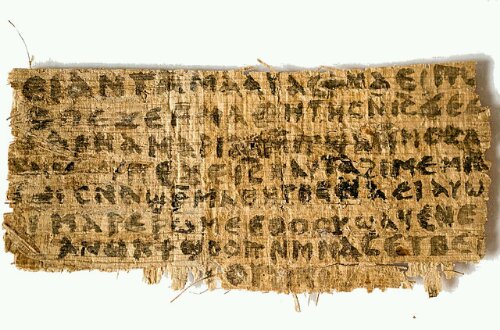
The Gospel of Jesus’ Wife
Two years ago, professor Karen L. King at Harvard Divinity School announced that they had found an ancient papyrus fragment where Jesus is saying that He has a wife. Needless to say, it caused a lot of controversy; apologets, academics, the Vatican and others said that the document was a modern fraud. One of the arguments for this was that the text seems to be based on the Gnostic Gospel of Thomas, and includes a typo made in modern times in a PDF document (!).
However, just a few days ago Harvard announced that the document had been subject to radiocarbon analysis and spectroscopy, and it turned out that both the papyrus and ink indeed were ancient, being produced somewhere between 659-859 AD. Professor King guessed that the original text, from which this papyrus was copied, could have originated in the second to fourth centuries, but this is speculation and not something the radiocarbon analysis show.
Harvard’s press release states that “[t]he fragment does not in any way provide evidence that the historical Jesus was married, as Karen L. King, the Hollis Professor of Divinity at Harvard Divinity School (HDS) has stressed since she announced the existence of the fragment in the fall of 2012.” King has said “don’t say this proves Dan Brown was right.” Rather, she sees this as an interesting contribution to our understanding of how Christians and pseudo-Christians viewed celibacy in the early church.
(more…)
No Christus Victor Here – Atonement According to the Apostolic Fathers

Polycarp, disciple of John the apostle and a smart theologian who was burned alive for the sake of the Gospel
As promised in my last blog post about atonement theology, I want to share what I’ve found when researching the early church fathers’ view on the death of Christ. My countryman Gustaf Aulén wrote a book 83 years ago called Christus Victor when he argued that the church fathers didn’t believe in penal substitution but in a “classical” atonement framework which he calls Christus Victor, the victorious Christ.
The difference between the two views is essentially that while penal substitution emphasises that Jesus took the punishment for our sins on the cross, Christus Victor emphasises that Jesus defeated the devil and his wicked forces when he died on the cross. A form of Christus Victor which according to Aulén was popular during the age of the church fathers was the ransom theory, the idea that God sent Jesus as a “bait”, and when satan killed him he got hooked by the power of God like a sloppy wet fish.
Now, I don’t have any problems at all with the Christus Victor perspective. As a third wave charismatic, I think it suits well with the Kingdom message of the Gospels – Jesus is indeed at war with satan, which is evident in His healings, exorcism and finally His death and resurrection. The Bible clearly speaks about how Christ defeated the powers of darkness on the cross. So I do believe in Christus Victor. What I don’t believe is that this perspective by any means replaces the fact that Jesus took the punishment for our sins on the cross, which is also what the Bible teaches. As William Evans brilliantly argues, Christus Victor and Penal Substitution are not mutually exclusive and should be viewed as equally true perspectives rather than conflicting paradigms.
I also have a problem with that this blog and that blog and even Wikipedia as well as several books uncritically says that the majority of the church fathers believed in Christus Victor and that it was dominant for a thousand years before Anselm of Canterbury messed it up, and therefore we should not believe in penal substitution. Firstly, even if they emphasised Christus Victor we cannot conclude that they didn’t believe in penal substitution unless they say so, and as I wrote in my last blog post I think it’s really hard to deny penal substitution without ignoring large parts of the Bible.
Ten Reasons Why the Catholic View on the Early Church is Wrong

Peter preaches in Jerusalem, Acts 2
Christian primtivism is the logical idea that the church Jesus founded was the church He wanted. It’s connected to the idea of restorationism, that teaches that we should restore Church to its original form when it starts to behave weird and contradict Scripture. As you’ve probably noticed I’m a passionate restorationist, and while I love and cooperate with people from the historical churches I think that their tendency to contradict the Biblical Church is quite harming. A couple of days ago a friend sent me an article on Catholic Answers called The Problems with Primitivism by Dwight Longenecker, which says that we should really not try to model church as Jesus and the apostles modeled it. Allow me to disagree. I will quote each of Longenecker’s arguments and turn them on their heads:
1 Cultural Relevance
First, each restorationist movement, although it seeks to return to the ancient church of the apostolic age, is actually produced as a reaction to the circumstances of its own age and culture. For example, the peasant movement of the Bogomils came out of a church weighed down with corruption and aristocratic influence. The radical reformers in 16th-century Europe and the New World were influenced by the utopianism, the rise of the nation state, and revolutionary spirit of their age… Restorationists believe they are restoring something ancient. In fact all they do is create an expression of Christianity which is a reaction against the circumstances and assumptions of the age in which they live.
Well, I know of no restorationist movement that claims that we need to speak Arameic and live in the Roman Empire to be the original church. All churches adapt the Gospel to their culture and historical context – including the Catholic Church. It’s hard to argue though that since we need to adapt to our culture we need to believe in purgatory and seven sacraments.
2 Information about the Early Church
Second, while restorationist movements are reactions to the particular age in which they live, they are also conditioned by the long history of restorationist movements. For hundreds of years, Protestants have perpetuated a particular vision of the early Church. Each new restorationist movement borrows those ideas, never questioning whether the tradition they are inheriting is actually true to the reality of the early Church or not. Therefore, the restorationist doesn’t so much restore primitive Christianity; he simply replicates are earlier restorationist model, reproducing what he has been told early Christianity was like.
It’s true that some restorationists are lazy, not double-checking their doctrines and practices by Scripture, but the same thing can definitely be said about Catholics. For example, they believe that there are seven sacraments – neither more nor less – an idea that originated with Peter Lombard in the 12th century! All restorationist movements at least try to break unbiblical traditions and restore biblical Christianity, Catholicism however is not even trying.
(more…)
A Defense for Penal Substitution

The Crucifixion by Simon Vouet
So the kids I like to play with tend to reject the doctrine of penal substitution, the idea that Jesus took the punishment for our sins in order to satisfy the wrath of God. A recent article on the Sojourners website gives a good example of this:
Essentially, the cross is explained exclusively in legal terms. You and I are the criminal, God is the blood-thirsty judge and executioner, and Jesus becomes the one who steps in between us and lets the angry judge beat and kill him in our place. Having killed an innocent person, this judge is somehow satisfied and a little less angry, so he sets friends of the innocent dead man free as he awaits the “end times” when he’ll finally get to let the bodies hit the floor and feel good about himself.
It’s actually quite twisted when you break it down. Jesus protects us from God? Or, if you accept the inspiration of Scripture (which I 100 percent do), it gets even more uncomfortable when you see Jesus say things like: “If you have seen me, you have seen the father, for we are one,” or in Hebrews, when it is stated that Jesus is the “exact representation of God’s being.”
Accepting both the inspiration of Scripture and the penal substitution theory of the atonement, one could actually say that Jesus died to protect us from Jesus.
Which is quite silly, really — from one aspect this makes God look schizophrenic, and on the other, it makes the cross look like a bad case of domestic violence — something I personally find offensive.
With hardly any Scriptural quotations at all, Benjamin Corey goes on claiming that penal substitution is responsible for the capital punishment and crual legal system of the United States, and like many other critics of the penal substitution theology he claims that the idea was founded by Anselm of Canterbury in the 11th century and that no Christian believed in it in the first millenia of the church.
Allow me to disagree.
Sweden is Preparing for Revival
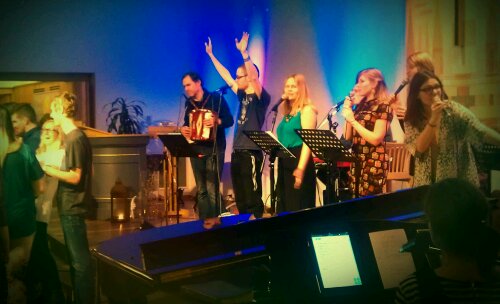
Worship at the Heaven Now conference in Stockholm
It’s exciting to see what’s happening in Scandinavia right now. Sweden’s starting point for revival is perfect – we are one of the most secularised countries in the world, xenophobia and racism is spreading, the rich are getting richer and the poor getting poorer – in other words, we’re desperate for something that will turn everything upsidedown. And there are so many disciples that are desperate for this. So many are not only praying for revival, but acting revival, spreading the Kingdom on the streets, in the schools, on the Internet -everywhere! Let me give you some examples of what is going on:
Cessationism is dead in Sweden. I have met one Swedish cessationist in my lifetime, and he wasn’t very young. Among the youth, charismatic theology is almost universal, and more and more are praying for an outpouring of the Holy Spirit. And we’re less focused on people and more on God. This weekend hundreds of people gathered in Stockholm for a Heaven Now conference with students from Bethel School of Supernatural Ministry in California. No big names, just students. And God was there, and people were so hungry, and after they prayed and worshipped they went out on the streets to share the love of God with others.
And we do see a lot on the streets. Me myself is leading street evangelist groups, several others are going out regularly to pray for the sick and preach the Gospel. My friend Durckheim Blessing is seeing a lot, as is evident in the clip above. More and more people start questioning the tradititional, unbibilical way of doing church where the service really isn’t a service but a internal concert followed by a lecture, more and more people wants to go out, take risks, connect with strangers and see daily miracles and conversions.
(more…)
Jonathan’s Enormous Sacrifice

Jonathan and David
I was preaching a prophetic sermon last Sunday. In my house church Mosaik we have been covering the Kingdom of God and the coming of the King in the Old Testament, and I was sitting in the kitchen figuring out what to speak about. My community brother Andreas entered and I asked him “What should I preach about, it must be from the Old Testament about the Kingdom of God?” “Jonathan”, Andreas answered. “Speak about Jonathan. You know what, I think that’s a prophetic word.”
Now what Andreas didn’t know was that I was actually looking at the texts about David, Jonathan and Saul in 1 Samuel 16-31, so it was prophetic allright. And a few hours later when the church gathered in our apartment I talked about how Jonathan made an enormous sacrifice.
As the son of Saul, Jonathan would eventually be the king of Israel. Instead, he helped and saved David simply because he loved him and recognized the power of God upon his life. He realized that the anointing of the Spirit isn’t static – it isn’t necessarily passing on to the next generation and it isn’t necessarily remaining on someone who once has received it – Jonathan clearly saw how his father became possessed and crazy.
New Book by Me and Friends, Coming Fall 2014

A Living Alternative
As some of you know, I am proud to be a part of the awesome MennoNerd blogging network, a bunch of bloggers that identify themselves with anabaptism, the radical reformation in the 16th century that wanted to go back to the Biblical roots in a better and more radical way than Luther, Calvin and Zwingli.
Unlike these mainline protestants, the anabaptists rejected violence and war, they argued that people should choose to follow Christ and not be baptized as infants, they protested against the state-church system and eagerly desired the supernatural gifts of the Spirit in a time where most protestants were cessationists.
Many people are not very familiar about what anabaptism is about, so that’s why me and my fellow MennoNerds are writing a book about it! It’s called A Living Alternative: Anabaptist Christianity in a Post-Christendom World, is published by Ettelloc Publishing and will be available this fall. The presentation of the book goes like this:
The Merging of Neo-Pentecostalism and Roman Catholicism

Francis and Kenneth
Many were surprised a couple of weeks ago when pope Francis sent a message to a Word of Faith conference led by Kenneth Copeland, speaking about unity and asking them to bless and pray for him, as he blesses and prays for them. And Copeland got excited and blessed him back. It’s surprising because Francis and Copeland are very distant theologically – besides the usual differences between Catholicism and Pentecostal Protestantism, Francis is a guy who is well-known for economic simplicity and an emphasis on redistribution to the poor, while Copeland is well-known for his capitalist prosperity preaching. He not only owns a mansion worth 6 million dollars and several private jet planes, but also his own freakin’ airport, Kenneth Copeland Airport, where he stores his private jet planes close to his 6 million dollar-mansion!
However, this surprise doesn’t come close to what Christians in Sweden experienced two days ago when it was revealed that Ulf Ekman, the leader of the Word of Faith movement in Scandinavia, converts to Roman Catholicism. Ulf Ekman is probably the most well-known Swedish Christian living today, his international ministry reaches millions and he is well-known among both Christians and non-Christians, mostly because he manages to be constantly controversial.
He brought the “name it claim it”-teaching from Kenneth Hagin and Oral Roberts to northern Europe, emphasizing health, wealth and success, and gathered prayer warriors wanted charismatic revival in Sweden and political domination for Israel in the middle east. And they despised Catholics, arguing that they represented a dead religion that quenched the Spirit and stood for countless heresies.
Are there Apostles Today?

Paul the Apostle
The issue of modern apostles is a controversial one; since the apostles had such authority in the early church, modern-day apostles obviously would have a great degree of spiritual authority, and people usually doesn’t like that. The historical churches argue that their bishops are sort-of modern day apostles, and several Pentecostal and charismatic churches use the a-word when describing some of its leaders, especially in the majority (so-called “third”) world. Some evangelicals protest against this, arguing that there are no apostles today. I think they’re wrong.
To solve this question we obviously have to define what an apostle is. The word apostolos means “being sent out”, and when we look at what the apostles did in the New Testament, they were translocal church planting leaders who did miracles (Paul says that miracles are the sign of an apostle in 2 Cor 12:12). Now, these people do hang around today. Surprise Sithole, Heidi Baker and Hans Sundberg are just some people that have those kinds of ministries. Still, some are not ready to call these people apostles.
The main reason for this is that they point to Acts 1 where Matthias is elected to be an apostle since he has witnessed Jesus life from His baptism until his ascending to Heaven. Thus, since nobody has seen that today there are no apostles today, the argument goes. But if one thinks that the Acts 1 description is the definition of apostle, then Paul isn’t an apostle.
The key is of course that “the twelve” and apostles are not the same thing – there are many apostles, Paul lists additional ones in his letters (e.g. Rom 16:7). I would say that the Biblical understanding of an apostle is what we today call missionary – somebody travelling around planting churches, spreading revival and equipping the body of Christ. We’ve got rid of the title, not the ministry.
(more…)
Clever Christian Comics
I really appreciate a lot of Adam Ford’s comics. Myself being an (nowadays somewhat inactive) comic drawer, I love the medium and I think Adam’s message is Gospel-centered, radical and thought-provoking. I don’t agree with everything, he is clearly Calvinist, but I love his zeal for truth and taking Jesus seriously. Now here are some comics!

New Song: God is a Criminal
I wrote a song the other day! It goes like this:
1. God is a criminal, it isn’t hard to see
In the book of Acts He breaks the law to set the captives free
An unjust law is no law at all, compassion is the key
God is a criminal, so that’s what I want to be
2. God is a hippie, it isn’t hard to tell
He commands us to love our enemies and all our stuff to sell
Among the poor and prostitutes is where He likes to dwell
God is a hippie, and so am I as well
The Average Christian: A Black Pentecostal

Worshipper at Iris Village of Joy, Pemba, Mozambique
The course in dogmatics I’ve just taken at my seminary was, as I’ve previously written, lacking global perspectives in general and charismatic theology in particular, but our teacher was very aware of this. He stressed that charismatic theology becomes more and more important as a result of the spread of Pentecostalism in the global South while non-charismatic Christendom is dying in the North (West), and recommended us to check out Philip Jenkins’ The Next Christendom, a book that I’ve now have had a look at.
Jenkins argues that Christianity has never been just a Western religion but a global one, and that the privileged position of Western Christendom is about to fall down. Today, Christianity is basically growing everywhere except Europe: in Latin America, Africa, Asia and even the Middle East millions are being saved. With the help of statistical predictions, Jenkins argue that in 2050 only one Christian in five will be white, and that proportion will probably continue to shrink.
Now, charismatic theology is very dominant among the Southern churches. Recently, Christianity Today, which traditionally has not been a big fan of the charismatic movement, argued that most Africans aren’t charismatic, emphasizing that most of them belong to Catholic, Anglican, Reformed or independent churches. But Jenkins show that most Southern Christians within these traditions have charismatic theology, even if they don’t call themselves charismatics or Pentecostals.
 Charismactivism