Home » 2013
Yearly Archives: 2013
The author

Micael Grenholm, a Swedish charismactivist, apologist and author.
The Promised Land, part 4: Has the Church Replaced Israel?

Stephen Sizer
The Promised Land is back! In the previous parts of the series, we have looked at the origin of Christian Zionism, we saw that it was totally absent in the early church and we have discussed how important it is to realize that just because one isn’t a Christian Zionist, one isn’t necessarily an anti-Semite (and shouldn’t either). Now, we will turn to exegesis to see what the Bible has to say about Israel and the Promised Land. Let’s start by discussing God’s Chosen People.
Israel is the name of a man, Jacob, and it was used to describe his descendants. These were expected to believe in the Lord, and thus be God’s people, but they were actually not the only ones that belonged to Israel. This is something Stephen Sizer has pointed out (and the following account is based on his works): the requirement to belong to God’s people was and is primarily faith, not race. In the Psalms, we read:
“I will record Rahab and Babylon among those who acknowledge me—Philistia too, and Tyre, along with Cush—and will say, ‘This one was born in Zion.’ Indeed, of Zion it will be said, ‘This one and that one were born in her, and the Most High himself will establish her.’ The Lord will write in the register of the peoples: This one was born in Zion.” (Ps 87:4-6)
Here, we see that Egyptians, Iraqis, Palestinians, Lebanese and Ethiopians all can be recognized as “born in Zion”, receiving full membership and citizenship of God’s people, if they acknowledge the Lord. Already Moses said in Deut 23:7-8: “Do not despise an Edomite, for the Edomites are related to you. Do not despise an Egyptian, because you resided as foreigners in their country. The third generation of children born to them may enter the assembly of the Lord.” In Esther 8:17 we read “And many people of other nationalities became Jews because fear of the Jews had seized them.” The requirement to belong to God’s people was faith, not race or nationality.
No Christmas Without Angels

Christmas angel
We have a lot of symbols for Christmas, and honestly I feel that neither jingle bells, snowflakes or Santa Claus are adequate representations of this holiday compared to angels. Angels play a huge role in the birth of Jesus. Massive, in fact. This is yet another reason I believe that people without charismatic experience or theology won’t get what the Gospel is all about. You cannot have Christmas without angels.
First of all, the angel Gabriel visits Mary to tell her that she will give a virgin birth to the Messiah (Lk 1:26-38). Then, he visits Joseph to ensure him that Mary has not been cheating but that the Holy Spirit has conceived the child (Mt 1:21). As the Son is born in Bethlehem, angels tell some nearby shepherds that the Messiah has been born, and sings a angelic song about glory to God and peace among men (Lk 2:8-15). After the visitation of the wise men (who surprisingly weren’t led by angels but just by a supernatural star and prophetic dreams) an angel tells Joseph that he must take his family to Egypt to escape Herod’s madness (Mt 2:13). And after some time, Joseph gets to know that it’s clear for him to go back to Israel by – you guessed it – an angel (Mt 2:19f.).
Basically, angels are involved in almost every event in the Christmas story. What do people do with that? Well, since many lack the experience of angelic visitations even within the church, even Christians try to remove them. They’re viewed as mythological ornaments or exotic phenomena without any relation or application to our own lives. I’ve heard Christians who argue that Biblical angels are not supernatural creatures, but since “angelos” means messenger they were simply random people that brought messages from God… with the ability to fly up to heaven, I guess (Lk 2:15).
This modern form of saduceism (Acts 23:8) is only possible among Christians who haven’t met angels. And so I want to use this Christmas season to share a testimony of some angelic visitations that have received much attention in Scandinavia. Two years ago, a Pentecostal church in Finland released a video where the pastor interviewed a woman called Marita Mäntyniemi. She had been driving in her car and suddenly she saw that several other cars had stopped in the middle of the road. She looked to the side and among the trees was a giant angel. It had a prophetic message on its wings about revival for Finland, and it was massive! People bent their knees in the snow and were astonished by the vision.
God is a Criminal

St Peter Freed from Prison (Photo credit: Wikipedia)
In Acts 12, when Peter is sitting in prison for having preached the Gospel. God sends an angel to free him from his chain, blind the eyes of the guards and open the gates. Now that’s serious criminality. If you have a friend in jail, you have to respect the legal procedures and hope that s/he is freed in court – you’re not allowed to send a supernatural being to crush some chains and doors. That’s not legal. That’s not obedient. Still, God does that. According to divine law, evangelism is not a crime. For the same reason, Jesus was crucified as a criminal even though He is sinless according to the divine law.
Thus, Christians aren’t supposed to follow the law at all time. If the law says that we cannot preach the Gospel, or that Jews should be killed, or that whites and blacks have to be separated, we have to disobey in order to be obedient to our Lord. This is why I have been a strong supporter of civil disobedience.
Recently, I have been forced to think a bit extra about this though, because of this blog post at Jesus Radicals. In it, some anonymous people write about how they took 200 sexist calendars from a local kiosk and replaced them with signs like “Misogyny is out of stock” and “The female body is not a commodity”. They also give some tips of how to rob stores effectively.
Several news media have written about the event and many thought that the post simply meant that Jesus Radicals is behind the crime, while they argue that it was sent to them anonymously and they just posted it to encourage debate. Putting that aside, is the action moral? Obviously, stealing is wrong both according to human law and divine law – “You shall not steal” is a command that is repeated both by Jesus (Mark 10:19) and Paul (Eph 4:28). But what is stealing then?
How to End Economic Inequality in the Global Church

Church Building in Clau-Clau, South Africa
During this semester I have taken a course in environmental economics at Uppsala University. Our final assignment for the course was to pretend to write an article for the Solutions journal that explores an economic solution to a sustainability problem. I chose to write about how economic inequality is a root cause to many sustainability challenges and argued that the church should start practicing economic equality again just like in Acts 2:44-45. Below is an excerpt (with some added subtitles), and the whole article can be downloaded right here: One Heart and Mind – A Challenge of Redistribution for the Global Church.
Redistribution on the Denominational Level
If the church sees itself as a global body of brothers and sisters equal in value, economic equality across borders is logical. This is not very foreign to Christian practical theology – the only time the New Testament talks about churches giving money to other churches, it is stated that “[t]he goal is equality”.[1]
On the denominational level, the Roman Catholic Church has a unique position. It is one single transnational organization with 1.2 billion members, with most people in the global South and most money in the global North. Because all national jurisdictions are subordinated to the Vatican leadership, redistribution would be easier practically compared to a network of autonomous denominations. Since the current pope, Francis, is Latin American and emphasizes the importance of poverty reduction, social justice and simplicity;[2] internal redistribution of finances may not be a totally foreign idea for the Vatican.
Ideally, ecclesiastical provinces and dioceses should be economically equal, adjusted to population and a certain list of needs like poverty, climate change vulnerability, special interests of the Church, etc. This would result in that churches in developing countries generally becoming slightly richer than their Western counterparts.
Why Santa Shouldn’t be a Penguin, but a Dead Penguin

Santa
Earlier this week Aisha Harris wrote an article about how confused she was as a child since Santa Claus who was sitting in the malls and who was present in the television shows was white, but the Santa who visited her African-American home was black. She argues that the normative white male Santa is problematic and argues that Santa instead should be a penguin, that people of all colours can relate to. Megan Kelly from ultra-conservative Fox News got frustrated and argued that Santa has to be white and that Jesus was white, which of course He wasn’t.
Initially I liked the idea of a penguin Santa, and there’s already a lot of pictures of her/him, but then I thought – why do we need Santa? Today Santa is king of consumerism, speeding up environmental destruction like crazy in order to give stuff primarily to rich people. As I say in my campaign video Selling Christmas (below), Jesus’ model of generosity was about selling stuff and give the money to the poor, while the Christmas generosity is about buying stuff to give to the rich. An awful way to celebrate the birth of the homeless Saviour.
Santa is thus a not very good represntative for S:t Nicholas either, since he gave gifts to the poor children so that they would survive, not playstations or mascara. So I’d say we kill Santa. Replace him with Jesus, the Middle Eastern version, and share His Gospel about justice and eternal life. And give your money to Unicef or Iris Relief instead of buying unnecessary stuff. Merry Christmas!
Related articles
- Santa Is A Penguin (combine26to28.wordpress.com)
- The (Race) War on Christmas: Megyn Kelly Declares ‘Santa Claus Just Is White’ and So Was Jesus (mediaite.com)
- Really?? Fox News Anchor Tells Black Kids Santa Claus AND Jesus Are White So Stop Complaining (bossip.com)
- Harris: It’s time to give Santa Claus a makeover (newsday.com)
Contemporary Charismatic Activism in Developing Countries

Miller and Yamamori’s book
I finished my bachelor’s thesis Holy Spirit Development earlier this fall. Here’s an excerpt:
It is an interesting phenomenon that the Pentecostal and charismatic movement grows rapidly among the poor, something that has been explained with the charismatic promises of healing, prosperity and answered prayers (Togarasei 2011, Pfeiffer et al 2007). But how do charismatic churches in developing nations tackle the poverty of their members? In 2007, Donald Miller and Tetsunao Yamamori published a book called Global Pentecostalism: The New Face of Christian Social Engagement. Originally the authors wanted to write about churches in general that work with social justice in developing nations, but when they, to their surprise, discovered that the vast majority of churches that did so were Pentecostal, they decided to study this movement further.
According to the authors, the stereotype of Pentecostals being so caught up in eschatological expectations and evangelistic focus that they are not “wasting time” on social and political change (Miller & Yamamori 2007, p. 21), is not very relevant for Pentecostal and charismatic Christianity in the global south. Instead, the authors come up with the term “Progressive Pentecostals” to describe what they believe is very common: Pentecostals seriously involved in social action. Throughout the book, they give examples of how Pentecostals and charismatics run charities as well as mobilize political campaigning for social justice as a result of their faith.
God vs Poverty, part 4: Liberating
This is as the title suggests the fourth part of my God vs Poverty series.
“Give a man a fish and he has food for a day. Teach him to fish and he has food for a lifetime.” We’ve all heard that, haven’t we? It’s a good proverb about the importance of empowerment and long-term solutions in aid giving. But what about the lake? What if the man cannot fish even after we taught him because the lake is polluted by a multinational corporation, or illegal to fish from because of an unrighteous regime? In other words, are there structures that are blocking development and poverty reduction?
The Bible is well aware of structures that oppress the poor. It is very common that the Old Testament not only talks about giving to the poor but treating them fair in court (see for example Prov. 22:22-23), so that they will not be discriminated. When Isaiah prophesies about true fasting, he doesn’t just talk about giving food and clothing to the ones in need but he also says that it includes “to loose the chains of injustice and untie the cords of the yoke, to set the oppressed free and break every yoke” (Is 58:6). In order to fight poverty effectively, we have to identify oppressing structures and crushing them.

So, You Think Mandela Was a “Terrorist”?

Nelson Mandela
As Nelson “Madiba” Mandela went home to the Lord, basically all of my activist friends have mourned his departure, and of course my South African friends as well. When I was in SA this summer many prayed for his healing, not because they thought he was immortal but because they felt that they weren’t ready to live in a South Africa without him.
He stood not only for justice and equality but also for unity and reconciliation, and even though I personally think he treated the whites a bit too kindly through letting them keep large parts of their wealth, and thus not overcoming SA’s enormous economic inequality, the fact that he wasn’t as hostile towards whites as for example Robert Mugabe created an atmosphere of much more tolerance and acceptance.
However, many South African whites are very disappointed with him and the ANC, some for racist reasons and some for facing the fact that they’re not as privileged as before, and thus there is still a hostility towards Mandela. This is appearant in that some whites still call him a “terrorist” just as the racist minority government, as well as the United States, once did. And even today some Americans join their white South African cousins in calling Mandela “terrorist”. Needless to say, this is severely problematic.
One should recognize that “terrorist” is a pejorative term. It is used by states that kill civilians to describe small armed groups that oppose their interests. Yes, states that kill civilians. I know of no state that accuse others of killing civilians that do not do it themselves. And I don’t just mean through collateral damage, but intentional killing of civilians.
My Testimony

How rude of me, I’ve let you reading my blog for 18 months without ever introducing myself! Here’s a short presentation of how and why I received my passion to combine charismatic theology with activism for peace and justice, based on an article I’m currently writing for Pax Pneuma, the journal for Pentecostals and Charismatics for Peace and Justice.
Although being raised in a Swedish Lutheran family, religion never meant very much to me until April 2006, when I was radically born again at a mass in the giant Uppsala Cathedral. I started to pray and read the Bible, and I was fascinated by how the liturgy of my church – that previously was nothing but a bunch of pointless, boring rituals for me – had ancient roots filled with holy meaning.
But I also started to spot differences between church and Scripture. I was surprised that Jesus commanded His disciples to heal the sick and raise the dead (Mt 10:8) – something I had thought were things only Jesus Himself did to prove that He was the Son of God – and I was even more surprised to realize that I was a disciple (Mt 28:19)! “Disciples” was a term that I had thought only referred to the twelve men closest to Jesus, not people today. Now I realized that I was actually supposed to do the things Jesus commanded the apostles to do (Mt 28:20a).
Yet, people weren’t prophesying or casting out demons very much in my Lutheran church, so I started to attend some charismatic and Pentecostal churches. As I grew deeper into the charismatic movement, I saw some differences between church and Scripture here as well though, specifically when it came to peace and justice.
Can God say something prophetically that the Bible DOESN’T say?

Colton Burpo, who says that he has seen Heaven
In my last blog post, I said that prophecy has multiple purposes: practical information about the state of things here on earth; personal revelation about God’s plan for an individual’s life; and repetative teaching about God and the spiritual realms that are in line with the Bible. I argued that evangelicals do not need to worry about that these kinds of prophecies would challenge the authority of Scripture, and thus there is no need to ban all prophetic activity or to wrongly argue that the prophetic gift has ceased. However, now I want to turn to the dangerous type of prophecy – that reveals stuff about the Lord and His Kingdom that you can’t find in the Bible.
Let me take one example. Many of you have probably heard about Colton Burpo, a young boy who started to tell his parents when he was four years old about how Heaven looked like. Amazingly, he even knew about dead relatives that his parents had never told him about. Colton’s visions of Heaven were in large parts in line with the Bible’s visions – something his parents also were really amazed by since they hadn’t taught much of that to him – but it also exceeded the Bible. For example, he said that Jesus had a rainbow horse. And that the Holy Spirit was blue.
Now, evangelical heresy hunters weren’t late to proclaim Colton Burpo as a young false prophet. On my Swedish blog, one of them told me “This is totally non-biblical! Show me in the Bible where the Holy Spirit is blue!” And I simply answered: “Would it had been more biblical if the Holy Spirit had been transparent?”
Can God say something prophetically that the Bible already says?
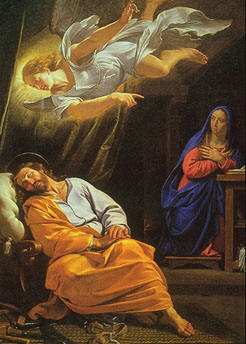
The Angel gives an “unnecessary” message to Joseph
The strange Strange Fire conference has put me into debate with some cessationists, especially when making this video. One common cessationist argument is that if the gift of prophecy still exists, the Bible isn’t our only source for doctrine about God, and thus the door to heresy stands wide open. Tom Pennington also uses this argument in his (bad) case for cessationism.
What I try to explain then is that firstly, prophecy has multiple purposes. 1 Samuel 9 contains a fascinating story about how Saul is looking for his father’s donkeys, and walks to prophet Samuel to see if he can use his prophetic gift to find out where they are. Before he even says something, Samuel invites him to dinner and adds “As for the donkeys you lost three days ago, do not worry about them; they have been found.” Then he reveals that the Lord has showed him that Saul is the new king of Israel, and anoints him.
Now, neither the revelation about the donkeys nor that Saul was to be king was doctrinal revelation; rather, they revealed a practical circumstance and God’s plan for an individual. These prophetic aspects should of course always be tested (1 Th 5:19-22), but there is not much need to worry about false doctrines here.
Furthermore, God can also confirm what He has previously said in the Bible. For example, God can, if He wants to, send an angel to me to tell me that He loves me. I told this to a cessationist, whereby he asked “Why would God send an angel to tell me that He loves me if that information has already been revealed to me in the bible?”
Pope Francis, Capitalism and the Gifts of the Holy Spirit

Francis. Photo: Tomaz Silva
I told you he would be a good pope! Francis has become extremely popular both within and outside the Catholic world. He both teaches and practices simplicity and mercy; he wears simple clothes and refuses to live in the fancy apostolic palace while emphasizing the duty of Christians to embrace the poor, wounded and lost. Recently, his apostolic exhortation Evangelii Gaudium has received a lot of attention in the media. It is mainly about evangelism and missions, but what has caught the attention of many is his criticism of capitalism:
“Just as the commandment ‘Thou shalt not kill’ sets a clear limit in order to safeguard the value of human life, today we also have to say ‘thou shalt not’ to an economy of exclusion and inequality. Such an economy kills.
“How can it be that it is not a news item when an elderly homeless person dies of exposure, but it is news when the stock market loses 2 points?
“As long as the problems of the poor are not radically resolved by rejecting the absolute autonomy of markets and financial speculation and by attacking the structural causes of inequality, no solution will be found for the world’s problems or, for that matter, to any problems.”
Many are quite surprised by this and speculate whether it is an influence of Latin American liberation theology, since pope Francis comes from Argentina. However, while Francis definitely has a stronger emphasis on social justice than his predecessors, this thoughts should probably by no means have been alien to them. John Paul II wrote in his encyclical letter Centesimus Annus:
“It would appear that, on the level of individual nations and of international relations, the free market is the most efficient instrument for utilizing resources and effectively responding to needs. But this is true only for those needs which are ‘solvent’, insofar as they are endowed with purchasing power, and for those resources which are ‘marketable’, insofar as they are capable of obtaining a satisfactory price. But there are many human needs which find no place on the market. It is a strict duty of justice and truth not to allow fundamental human needs to remain unsatisfied and not to allow those burdened by such needs to perish.”
All Things Charismatic – A Mennonite’s Perspective on Visions, Prophesy, and Miracles
Deborah once again writes awesomingly about signs and wonders from a Mennonite perspective. I agree on *almost* everything, not being as critical as her towards the first group of charismatics she describes (those who believe that all people can prophesy).

 If you read this article and you like it, you can check out some of my earlier thoughts on the Charismatic movement by reading this blog post: http://debdebbarak.wordpress.com/2013/07/29/a-mennonite-who-speaks-in-tongues/
In our modern world, the Charismatic movement has gotten a somewhat bad rap unless you are Pentecostal yourself. There are two main ways of thinking of the charismatic movement according to the Christians that I have met. The first way is to view it as a super incredible movement which is the answer to all of life’s problems. I see this view played out all the time by churches which claim that they have raised people from the dead (I sincerely have my doubts about that one), go on mission’s trips with no other purpose than to preform healings, and have youth meetings where the only purpose is to receive Words from the Lord for one another. Although these churches do provide…
View original post 1,983 more words
Suffering and Revival in the Congo – the Story of Helen Roseveare

Helen Roseveare
A month ago, I wrote about the mix of tears and joy, suffering and glory that Iris Ministries in the Democratic Republic of Congo is experiencing. While people are losing their children and the women are raped by soldiers; miracles are abundant and the church has a burning passion for God. This paradoxal relationship between the cross and the glory may be hard for Western people to understand, but it is very real. Today I want to introduce you to a missionary who also experienced this in the Congo – but 50 years ago. Her name is Helen Roseveare.
After studying medicine in the UK and feeling the calling to be a missionary, Helen went to what was then Belgian Congo and started to develop the pretty much non-existant health care system. She was the only doctor for two and a half million people, saving thousands of lives. In the early 60’s, civil war broke lose as the Congolese people wanted to be liberated from Belgian colonialism. The war was extremely brutal. Helen was raped, twice.
Government soldiers came to my bungalow, ransacked it, then grabbed me. I was beaten and savagely kicked, losing my back teeth through the boot of a rebel soldier. They broke my glasses, so I could not see to protect myself from the next blow. Then, one at a time, two army officers took me to my own bedroom and raped me. They dragged me out into a clearing, tied me to a tree, and stood around laughing. And while I was there, beaten and humiliated and violated and ridiculed, someone discovered in the bungalow the only existing hand-written manuscript of a book I had been writing about God’s work in the Congo over an eleven-year period. They brought it out, put it on the ground in front of me, and burned it.
It takes less than that for others to leave both the country and the faith. But Helen knew the power and love of the living God, and she knew that He had called her to Congo to be an instrument of grace and peace. In an interview with Jesus Army, she told about the revival fires that her church saw in the midst of chaos:
God vs Poverty, part 3: Working
This is as the title suggests the third part of my God vs Poverty series.
In the last part of God vs Poverty, I talked about the importance of giving aid to the poor. I am critical to the “trade instead of aid” idea expressed by people like Dambisa Moyo (who thinks that all aid to Africa should be stopped in five years) simply since it is irresponsible, harmful and not very smart. Trade is not the magical solution to poverty reduction, since many companies only have their own profit in mind. In contrast, aid agencies have a genuine goal to help the poor.
Still, trade is important. In fact, it’s necessary for poverty reduction. Acts 20:33-35 says:
“I have not coveted anyone’s silver or gold or clothing. You yourselves know that these hands of mine have supplied my own needs and the needs of my companions. In everything I did, I showed you that by this kind of hard work we must help the weak, remembering the words the Lord Jesus himself said: ‘It is more blessed to give than to receive.’”
In other words, if we are able to work but aren’t doing it, we are using resources that could have been given to the poor. As long as we are healthy and there are job oppurtinities, we should work. But we must remember that all jobs aren’t good jobs!
 Charismactivism