Home » Uncategorized
Category Archives: Uncategorized
The author

Micael Grenholm, a Swedish charismactivist, apologist and author.
Trump Actually Plans to Separate Millions of Christian Children From Their Parents
Donald Trump’s plan to deport 15 million people is both dangerous and inhumane. This plan would require enormous resources, cause humanitarian disasters, and lead to economic and social instability in the United States.
The former president Trump has promised, if he’s elected again despite now being a convicted felon, to deport more people than there are undocumented immigrants in the country, meaning even legal residents and citizens could be at risk. Such an operation would demand a massive amount of resources and personnel, making it extremely costly and logistically complicated—perhaps even impossible. The deportation process would cost over $210 billion and require a workforce larger than the U.S. Army.
Trump often claims that millions of undocumented immigrants to the US come from prisons and mental institutions, but that is simply false and has been described as “laughable” by experts. In reality, immigrants are just like other people: some are bad, most are good.

The humanitarian consequences of Trump’s plan would be devastating. Mass deportations on this scale would result in the separation of millions of families and leave approximately 4.5 million American children without one or both parents. This would place a massive burden on social systems and likely lead to a humanitarian crisis. If the children are not deported themselves, they would need state care, which would cost an additional $118 billion. Most of these children would belong to Christian families.
Economically, deporting such a large portion of the workforce would create labor shortages in several sectors, driving up inflation and harming the economy. It has been estimated that the U.S. GDP would immediately decrease by 1.4 percent and by $4.7 trillion over the next decade. This would also negatively impact the housing market, putting over a million mortgages at risk.
Socially and politically, Trump’s plan involves state National Guards and other security forces conducting mass arrests in cities and communities across the country. This would create a situation where residents live in constant fear of arbitrary and violent interventions. There is also a risk that this would lead to violent confrontations between federal forces and local authorities or residents trying to protect their neighbors.
The motivations behind Trump’s plan are also troubling. Stephen Miller, who has a history of racist, white nationalist, and xenophobic views, sees the deportation of non-white immigrants as a personal mission and has been appointed by Trump to oversee this monstrous project. The plan is not just a political proposal but part of a broader agenda to change the demographic composition of the U.S. Which is in line with Trump’s ambition to remain in power at any cost, even if it requires terminating the Constitution.
Legally and constitutionally, Trump’s plan raises significant issues. The proposal to revoke birthright citizenship violates the Fourteenth Amendment of the U.S. Constitution, and bypassing legal processes to carry out mass deportations would contravene fundamental legal principles. This would undermine the rule of law and set a precedent for future authoritarian measures.
Overall, Trump’s plan to deport 15 million people is both dangerous and inhumane. It would cause significant humanitarian and economic damage, create social and political instability, and undermine the rule of law. We must take this threat seriously and work to prevent Trump’s plans from being realized, as the consequences would be devastating for both individuals and society as a whole.

Jesus said: “When I was a stranger, you welcomed me… Whenever you did it for any of my people, no matter how unimportant they seemed, you did it for me.” (Matthew 25:35, 40). Deporting millions of people from the richest country on earth while making millions of children of children orphans is the opposite of that.
Originally posted at Pentecostals & Charismatics for Peace & Justice.
Why Climate Change Should be a Top Political Issue for Christians
Originally published on Pentecostals & Charismatics for Peace & Justice.
What’s the most pressing political issue Christians should care about today? There are many answers to that question, and different Christians have different priorities, but I want to argue that all Christians should put climate change very high on that list, if not at the top? The climate crisis impacts everything else.

Do you think the economy is important? Climate change will ruin it unless stopped. You think migration is an important issue? Climate change will cause billions of people to flee from their home. Does any other political issue have the top priority for you, like abortion, education or law and order? Climate change might ruin all modern civilizations and all the societal orders connected to them?
As stewards of God’s creation, Christians are called to protect and preserve the earth for future generations. In the face of accelerating global warming, the urgent need for climate action becomes not only a responsibility but a divine mandate. The current state of our planet, marked by rising temperatures, melting ice caps, and increasingly severe weather patterns, underscores a critical moment in human history. It is a moment that demands a collective response grounded in faith, compassion, and justice.
The Biblical Foundation for Environmental Stewardship
The Bible is rich with references that underscore the importance of caring for the environment. Genesis 2:15 teaches us, “The Lord God took the man and put him in the Garden of Eden to work it and take care of it.” This verse highlights our God-given role as caretakers of the earth, entrusted to us to nurture and protect.
Psalms 24:1 further reminds us, “The earth is the Lord’s, and everything in it, the world, and all who live in it.” This psalm beautifully articulates the concept of stewardship, emphasizing that we do not own the earth; rather, we are caretakers of God’s creation.
(more…)The 5 Worst Christian Responses to the Coronavirus Pandemic

We love the church. We love how beautiful, fun, messy and weird she is. She is the body of Christ, the city on a hill, the messenger of salvation.
However, this very love also compels us to point out when some of her bodyparts do things that are very, very wrong.
As the coronavirus pandemic marches on, we’re sad to report that the response of some Christians has been outrageously damaging. Either by using the crisis to earn money, spreading wild conspiracy theories or encouraging their church members to infect each other.
We must not forget that many other Christians do an amazing job of combatting the virus, helping the vulnerable and preaching the Gospel.
That being said, let’s have a look at the five worst Christian responses to the pandemic. (more…)
What I Learned During My Jesus Army Training Year

Originally published at christiancommunity.org.uk.
Coming to the UK was a sacrifice. I had to leave friends and family behind in Sweden, including my girlfriend – now fiancée – Sarah. I had to say no to speaking requests and opportunities to do the things I love the most. I had to prepare and plan the community we want to start in Sweden from a distance, which is far from easy.
This is a price I have been willing to pay. The new friendships I’ve built with people here and the practical experience of community of goods have been invaluable. As David Janzen writes in his Intentional Christian Community Handbook: starting a community from scratch without at least one person having lived in community previously, is a very bad idea. Even the apostles had to be trained in community life by Jesus himself before they founded their Jerusalem community church (John 13:29, Acts 2:44-45).
What I had not expected was the amount of “giving” I felt compelled to do in contrast to “receiving”. As I’ve written before, I have not mainly been inspired during my Training year. Rather, I have focused on inspiring others.
I guess this is because I have a hard time being an onlooker when I notice stuff that can be improved! This has in most cases been welcomed and appreciated, of which I am grateful. (more…)
Heidi Baker: The Blind Woman’s Eyes Transformed

Heidi with another woman
Charismactivist apostle of love Heidi Baker recently visited Sid Roth’s show It’s Supernatural, where she shared testimonies about what God has done in her life and among the poor of Mozambique. The following testimony just gripped my heart, it can be heard from 11:30 onwards in the video:
Heidi says:
Every Monday, in Mozambique, I visit my village. It’s just my local village, I like to keep it real – we have 3500 children in our school from there so I like to see their families. And I just sit and hold he poor, spending time loving them…
And on my way back from visiting a mama named Tina, I saw this little, old woman. And she was really poor, you know, her clothes were shredded, and a strange thing was that she was sitting in the sun. And I thought: “Why is this woman sitting in the sun in Mozambique?” It’s hot! At least she should be in the shade.
And I said “What’s your name?” in our local dialect. And she answered me back and said: “I have no name.” And I was undone by that. I thought, how can anyone on earth not be given a name? (more…)
Highlights from Today’s Global Climate March
As the extremely important COP 21 climate summit in Paris starts tomorrow, activists have taken it to the streets across the globe. I would had been marching in Paris today, had not the awful terrorist attacks happened, which has resulted in that protests are not allowed in the French capital for at least some weeks. Instead, I had praised God and retweeted reports from Sweden, Australia, Bangladesh, US, Japan, Nepal, Senegal, Switzerland and the UK:


The last image is especially powerful: it’s from Paris, where activists have laid out shows to signify the march that never took place there. Let us pray for the upcoming negotiations and that God’s Spirit will promote simplicity and equality.
The Gift of Provocation? Tertullian Certainly Had It!
An excellent article on the 3rd century charismatic pacifist and theologian Tertullian!

I’m Sorry, Christian, But You Don’t Get to Make That Move
An amazing response to people who are anti-immigration and claim to follow Jesus at the same time.
Finding Lazarus in the Calais Jungle
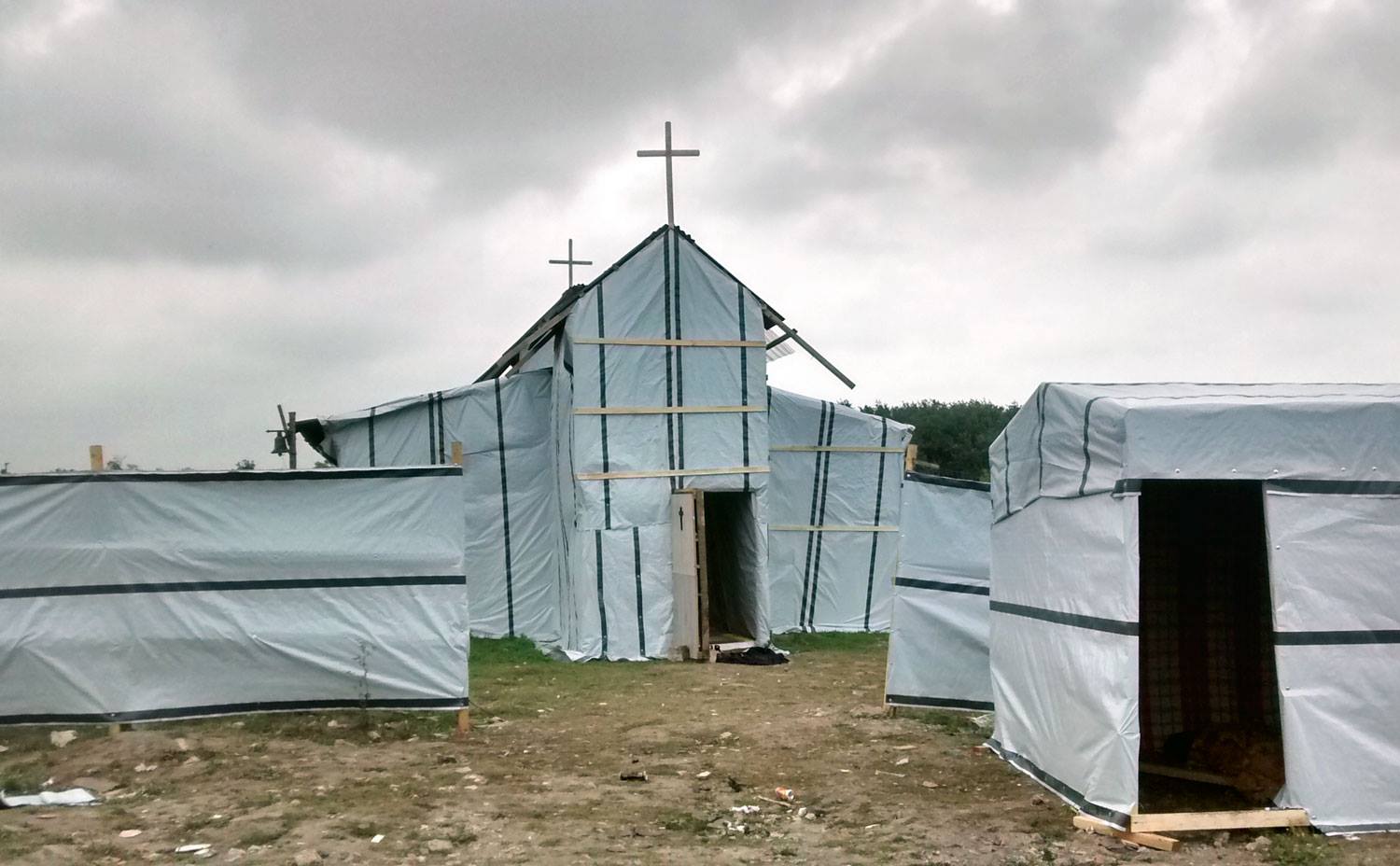
Lazarus Church in Calais
This post is written by Jesus Army member Joram on the Forward blog. We met Joram the other day and he told us about what he had experienced in Calais. This text expresses both the pain and hope of the refugee camp in a brilliant way, which is why I re-post it here.
“There was a rich man who was clothed in purple and fine linen and who feasted sumptuously every day. And at his gate was laid a poor man named Lazarus, covered in sores, who desired to be fed with what fell from the rich man’s table…” (Luke 16:19-21)
Every generation has its ‘Lazarus’: the poor, mistreated, abused, and neglected. Part of this generation’s Lazarus is the third world migrants who wash up on the shores of Europe. Their governments oppress them, abuse them, imprison them, torture them; so those that can escape head for the rich man’s gate known as Europe.
 When they wash up on the shore after unspeakable tragedy at sea, some of them head for western France to Calais and the literal gate to the rich man’s land known as the Eurotunnel.
A diaspora of refugees with families shattered and scattered across the globe, children in one country, fathers in another, mothers in another. It was never meant to be like this.
They redefine the word poor – they have smartphones, Nike trainers, mp3 players and navigate at sea using Google Maps. But only because we, in the rich man’s kingdom, are so driven by our mad consumer desire for the latest ‘thing’, we throw last year’s stuff away. But don’t be fooled by this – the real poverty is the loss of loved ones, of being stateless, homeless, jobless and friendless. The sores on the modern Lazarus are underneath his skin, too deep to be seen by the superficial glance of the citizens of the rich man’s country. (more…)
Justice and Equality According to God
In this sermon, I talk about what the Bible says about justice. You rarely find someone who says that s/he is against justice, but you do find a lot of different definitions of justice. Here are five definitions of economic justice, together with my comments on which is the best from a Christian perspective:
1. Same for All
This is the idea that in a just and equal world, everybody has the exact same amount of money. There are hints towards this perspective in Lk 3:11 and 2 Cor. 8:13-15. However, this definition has received a lot of criticism simply because different people have different needs – people in poor countries without social safety nets need more money than people in rich countries, for example. This why not so many actually agree with this definition, even if we who try to promote equality are often accused of this while we really mean definition no. 2:
2. According to our needs
This is how the early church viewed economic justice: “All the believers were together and had everything in common. They sold property and possessions to give to anyone who had need.” (Acts 2:44-45) We can also see this in Ex. 16 where the people collect heavenly bread every day, and since the greedy are unable to store up a lot for themselves, everyone are able to collect what their family needs for that particular day. The socialist motto “From each according to his ability, to each according to his need” is based on the same line of thinking, but it was a biblical idea long before Marx was even born.
Reclaiming Easter – Towards a Gospel-Centered Understanding of the Cross
An excellent piece by my friend Deborah-Ruth Ferber about how Easter without forgiveness of sins is no Easter at all… despite bunnies and eggs.

 Easter is NOT primarily about the liberation of people of colour, proving that gay lives matter, or radical civil disobedience – it is about proclaiming Christ’s ultimate triumph over evil so that all individuals (regardless of their race, gender, or sexual orientation) have a chance to rule and reign with Him. It is a radical proclamation of self-sacrifice – the most intimate and personal act ever committed by a man, and also the gateway to eternal life and salvation.
It’s Easter Sunday again. My Sunday school children have just gotten back from their frantic morning of Easter egg hunting and indulging in goodies – the only day of the year their parents will let them eat chocolate before breakfast. The choir has sung its cantata, the pastor has preached a stirring sermon on the resurrection, and the church is packed to standing room only with what we coin C&E (Christmas…
View original post 1,614 more words
New Church Bombings in Pakistan – Time to Love Our Enemies
The Pakistani Christian community is on fire, in both a glorious and tragic way. I have several Pakistani Facebook friends who regularly post videos, images and written reports about revival – blind people seeing, deaf people hearing, and many receiving Christ as their Lord and Saviour. For example, my friend Ayoub Khawar posted this healing report the other day:

This girl had mucus coming from her ear from childhood, but after prayer she testified she is healed! Praise the Lord !!
Share about Jesus with someone today! Someone who really needs it, today!!
A month ago, he posted:

People are hungry for the Word of God !!
Over 300 people gave their lives to the Lord and we only had 70 Bibles to give to them.
They were so happy and thankful as they received this treasure !
However, yesterday he contacted me personally to share less joyful news. News about another fire that is burning i the Pakistani Christian community, the fire of persecution. He wrote:
2 Bomb Blasts in Churches in Yohanaabad (our neighboring town), Lahore. Need your urgent prayers ! the situation is so bad about 14 died and more than 68 injured, our neighbors whole family died, husband wife with a baby to be delievered and there little girl died
Were the Apostles Mistaken in Having Everything in Common?
It’s YouTube Friday and the latest entry on the Holy Spirit Activism YouTube channel is this short interview with Huw Lewis, apostolic leader in the Jesus Army, where he explains why the JA practice community of goods. Community of goods means sharing possessions so that nobody is rich and nobody is poor and was being practiced by Jesus and the apostles (Jn 13:29) and in the first church in Jerusalem (Acts 2:44-45). Huw, I and many others think that it is a very good way of living and we encourage all believers to pray about joining a Christian community.
However, there are Christians who think that community of goods isn’t something good but rather, that the apostles were naïvely mistaken when they started to share their possessions. I found an article arguing for this at biblestudytools.com, an article that is used as the official explanation to what community of goods is about and that has received one of the top spots when you search for “community of goods” on Google. It’s horribly bad though so please let me criticise it for you.
All rich people or some?
In Acts 2:44, it is said that, in the infant church at Jerusalem, “all that believed were together, and had all things common,” and (Acts 4:34 f) “as many as were possessors of lands or houses sold them, and brought the prices of the things that were sold, and laid them at the apostles’ feet.” The inference from this, that there was an absolute disposal of all the property of all the members of the church, and that its proceeds were contributed to a common fund, has been disputed upon the ground that the example of Barnabas in selling “a field” for this purpose (Acts 4:37) would not have been mentioned, if this had been the universal rule. The thought conveyed is that all believers in that church held their property as a trust from the Lord, for the benefit of the entire brotherhood, and, as there was need, did as Barnabas.
The author of this article, H.E. Jacobs, almost immediately begins to argue that the Biblical community of goods was not required for all believers in Jerusalem to participate in. This is indeed a difficult task since Acts 4:34 says that all who had property sold it and gave it to the apostles so that they redistributed the money equally. And all really means all. Now, believers who didn’t own property such as widows probably weren’t obligated to give (instead, their participation in the common purse was by receiving) but Barnabas is rather used as an example of one among all the property owners who sold everything to introduce him to the readers. Likewise, Jesus’mother and brothers are mentioned in Acts 1 to highlight some of who were praying, not to say that the others weren’t praying.
A Mennonite Seminarian Turned Pentecostal Intern Re-Examines an Anabaptist Approach Towards Signs and Wonders
Deborah-Ruth Ferber reviews my chapter Charismatic Anabaptism: Combining Signs and Wonders with Peace and Justice, in our new book A Living Alternative. She’s very kind in her judgment! 🙂
 “Holy Spirit come with power, breathe into our aching night. We expect You this glad hour, waiting for Your strength and light. We are fearful, we are ailing. We are weak and selfish, too. Break upon Your congregation, give us vigour life anew.” (1)
“If you believe and I believe and we together pray, the Holy Spirit must come down and set God’s people free. And set God’s people free. And set God’s people free. The Holy Spirit must come down and set God’s people free.” (2)
“Praise the One who breaks the darkness with a liberating light. Praise the One who frees the prisoners, turning blindness into sight. Praise the One who preached the Gospel, healing every dread disease, calming and feeding thousands with the very bread of peace.” (3)
The words to these well-loved Mennonite hymns echoed across the room as we all stood to sing of the…
View original post 1,909 more words
Violent Persecutions of Christians in Iraq

Arabic lettetr for “N”, signifying Christians
A number of houses in Mosul, Iraq, have been marked with the letter “N”. All of these houses belongs to Christians, and “N” is the first word in the Arabic word for Christian, “Nasrani”. Together with the symbol there is often also a text stating “Property of the Islamic state”. This is what pre-genocidal persecution looks like.
The Islamic State of Iraq and Sham (ISIS), also simply known as the Islamic State, is a fundamentalist islamist movement that has been sparked first by the war in Iraq and recently by the Syrian civil war, and that has taken control over a large area in eastern Syria and western Iraq. The movement has an extreme wahhabist interpretation of Islam and uses a lot of violence. It has cooperated with al-Qaeda, but allegedly, al-Qaeda has cut its ties with ISIS because they thought that ISIS was to radical.
Over a month ago, the islamist rebels took control over Mosul, Iraq’s second biggest city, which lies closely to the ruins of the biblical Nineveh. Christians have been living in this city for at least 1600 years, but now they were subject to severe persecutions. Besides the threatful “N” marks on their houses, ISIS gave them an ultimatum: convert to islam, pay the expensive jizya tax, or die. As a result, thousands of Christians have fled Mosul and are now internally displaced. Several Christians have already been killed.
 Charismactivism