Home » Church & Theology (Page 9)
Category Archives: Church & Theology
The author

Micael Grenholm, a Swedish charismactivist, apologist and author.
On Earth as it is in Whatever

Over and over again I see how some fellow Christian activists want to de-emphasize the importance of Heaven. It is often claimed that the reason why traditional evangelical and charismatic churches have not been so involved in promoting peace and justice is because there is too much focus on Heaven, salvation and evangelism – they don’t want to waste their energy and time on politics and activism when they can use it to save souls instead.
To revolt against this heresy, some Christian activists go to another extreme, meaning that giving people eternal life wasn’t Jesus’ main concern, that the Kingdom is mainly here and now and not there and then, that evangelism is not so important, etc. God’s focus is primarily earth, not heaven, and we should mimic that, they claim.
However, Paul wrote:
If then you have been raised with Christ, seek the things that are above, where Christ is, seated at the right hand of God. Set your minds on things that are above, not on things that are on earth. (Col 3:1-2)
and:
Their end is destruction, their god is their belly, and they glory in their shame, with minds set on earthly things. But our citizenship is in heaven, and from it we await a Savior, the Lord Jesus Christ, who will transform our lowly body to be like his glorious body, by the power that enables him even to subject all things to himself. (Phil 3:19-21)
The Power of Jesus Stories
I’ve just attended our yearly church camp where I had the privilege of teaching about Jesus stories (video above). Every Sunday we share Jesus stories in my church – testimonies about what Jesus is doing in our lives. We also try to share them on our website (although it needs to be updated). And of course I love to share them on this blog as well, on the streets – everywhere really.
Even if I know of many other churches that are doing likewise, it is not the case in most of them. These neither share testimonies in their services nor on their websites. Why?
First of all, perhaps not so much is happening! Secondly, the church has not viewed it as something important, having a tradition where testimonies are absent for a long time. And finally, I’ve actually heard people arguing biblically for not sharing testimonies – they point to the fact that Jesus sometimes told people that He had healed not to tell anyone about them.
The problem with that argument is that all those events have been recorded in the most-read book in the whole world, so they did indeed tell someone! The command not to tell was a temporal one. Likewise, Jesus many times forbade people to tell others that He was the Messiah, but today we shout it from the roof tops and use Christ as His surname. Our default position should always be to proclaim His Messiah-ship and His miracles. Psalms 145:4-6 says:
One generation shall commend your works to another, and shall declare your mighty acts. On the glorious splendor of your majesty, and on your wondrous works, I will meditate. They shall speak of the might of your awesome deeds, and I will declare your greatness.
Should Christians Wear “Formal” in Church?

Around the world, many people dress “properly” when they go to church, meaning wearing expensive stuff like suits, dresses, and jewelry. Especially pastors and preachers are expected to wear expensive. I don’t like this for the following reasons:
1. The poor are alienated. Some people are basically so poor that they don’t afford a suit, and the preachers silently distances themselves from them. I know a man in Sweden who told a minister “Thank you so much that you wear normal clothes when you preach, I always feel excluded when the pastor wears a suit.” Clothes are symbols, and “formal” clothes are symbols of wealth. It just doesn’t match with James 2:1-7.
2. It’s based on the thought that church is something you “go to” at a specific time at a specific day, while the Scriptures says that the believers are the church at all times. We are not in God’s house more when we are dressed up in church compared to when we are naked in the shower. Thus, it doesn’t make sense to wear differently than usual when you “go to church” because you ARE the church 24/7.
3. Above all: it’s simply not biblical to dress expensive when you go to church. Some people try to create a theology around it, claiming that it’s honoring God and stuff. But the Bible never says that, and we never read that the disciples dressed in a certain way during their meetings. The only time the New Testament talks about expensive clothes and jewelry is when it forbids us to wear it (1 Timothy 2:9, 1 Peter 3:3)!
Charismatic Theology among the Early Anabaptists

From now on this blog is a part of the MennoNerds network, a bunch of bloggers (or nerds) who like Anabaptism. Ana-what? Anabaptism, the grandmother of the Baptist, Pentecostal and a bunch of other movements, which was and is characterized by pacifism, economic equality and radical theology. While I’m not a part of an Anabaptist church (they simply don’t exist (yet) in Sweden), I was involved in forming the Anabaptist Network of Scandinavia, and together with my friend Andrew Meakins I’m administrating a facebook page called Charismatic Holiness Anabaptist Theology.
While several modern-day Anabaptists eagerly seek miracles and the gifts of the Holy Spirit, there still are many who don’t. Not necessarily because they don’t believe in miracles but rather that they believe it isn’t part of their tradition. But it is. In 1995, Stuart Murray, one of the leading Anabaptist theologians in Europe, wrote this article about the early Anabaptists’ view on spiritual gifts. Here is an excerpt:

Stuart Murray
Anabaptism as a Charismatic Movement: Diverse Phenomena in Early Decades
What would sixteenth-century Anabaptists have made of the “Toronto Blessing” that has impacted many churches in Great Britain in recent months? How did the Radical Reformers respond to such spiritual phenomena’? The charismatic aspect of Anabaptism has not received much attention from historians, but evidence of spiritual phenomena in early Anabaptist groups is substantial. Some welcomed manifestations of the Holy Spirit, while others were wary and attempted to regulate or discourage such expressions. Basic to the Anabaptist view of charismatic gifts, however, was a belief that a transformed life was the true measure and sign of Holy Spirit presence.
[…]
For Dirk Philips, the Spirit had a vital role as agent of regeneration. The Spirit writes the new convenant on the hearts of believers and enables them to participate in the divine nature. The Spirit is the earthly presence of Jesus, empowering ministers called by God and helping believers interpret the Scripture. Anabaptists equated “baptism in the Spirit” with conversion, but expected more to happen experientially than did the Reformers. The radicals were not satisfied with forensic ideas of grace, typified by the legal terminology of “justification by faith”. Rather, they saw grace as “the inner light that directed a life of righteousness “.




The Book of Psalms
The Book of Psalms
The book of Psalms is a devotional worship section of the Bible. It records some of the most intimate prayers and worship songs of Biblical saints. When we read the book of Psalms, it is as though we are stepping into God’s house and reading his private love letters. There is something very sacred about them. They reveal not only the character and yearnings of the sender but also the receiver. Reading these verses, not only gives us encouragement to speak to God with boldness and honesty, but also gives us a glimpse of the magnificence of our God through his communication with these saints.
In Psalms, God is portrayed as omnipotent and omnipresent. He is the creator of all things. He is full of love and has compassion for all he has created. As a ruler, he is just. He has deep concern for the world and listens to the righteous, forgiving those who humbly repent of their sins and turn to him.
By praying the eloquent words of the Psalms, we are able to bare our souls to God in a spirit-led way that brings healing and encouragement, especially in times of personal crisis.
The book reveals that Biblical saints did not just think positive and be happy, when faced with doubt and depression but expressed their honest feelings and confessed their transgressions. In doing so, they brought everything that weighed upon their souls into the light, both their joys and sorrows.
God wants an honest relationship with us, not a false one. He does not value us singing empty words of praise if that is not what we’re really feeling. Although we should praise him at all times, even when full of doubt and disillusionment, we should not pretend to be happy if we are not. In a superficial relationship, people will put on a smile and talk about things which they feel will be acceptable to each other but in an intimate friendship, people will bare their souls to one another. It is clear that the writers of the Psalms, not only bared their souls to God, but were also aware of God’s feelings towards them, which shows us they were trusted friends of God.
By Andrew Meakin http://outreach7.webs.com/
Joseph

This is the story of Joseph.
Joseph was the son of Jacob who was the son of Issac, who was the son of Abraham who God had made a covenant with that his descendants would be as numerous as the stars.(Genesis 15:4) Joseph was son number 11, Jacob had 12 sons(Genesis 35:23-26). Joseph’s brothers hated him because Jacob favoured Joseph and gave him a coat of many colours. (Genesis 37:3-4).
One night God sent Joseph a dream and in this dream, he and his brothers were binding sheaves of grain, when all of a sudden, his sheave arose and stood upright, while his brothers sheaves gathered around his and bowed down to it. The dream showed him he would one day rule over his brothers. So when he woke from that dream, he immediately shared it with excitement with his brothers, who not surprisingly did not share his enthusiasm and they hated him even more. Then he had another dream in which the sun, the moon and 11 stars bowed before him, representing his father and mother and 11 brothers. When he shared this dream, even his father was offended. (Genesis 37:5-10).
So his older brothers went out to feed the flock. Jacob told Joseph to go and see how his brothers were doing. So Joseph went searching for his brothers and finally found them but when they saw him coming from a distance they said “Here comes that dreamer! Let’s throw him into a pit and say a wild animal devoured him, than ripped off his coat of many colours and threw him into a deep pit to die. Then we’ll see what becomes of his dreams!” So when he came, they grabbed him, ripped off his coat of many colours and threw him in a pit. (Genesis 37:19-23).
Walk with New Heart Vision

Lately I felt that one of my greatest wishes is to have everything I say or do or even think coming right and unfiltered from my heart.
I’ve grown quite confident in that wish, because I feel that the promise given in Ezekiel 36:26 becomes my reality:
“But… I mean… what happens when I forget to make this choice one day? Would I be ignorant then to the Spirit? Isn’t this really another religious rule to apply?” – Well, yeah. If you put it this way it kinda is. Which brings me back to my wish uttered in my introduction. It is also a prayer:
God, change my heart
and let me be so fully aware of it
that I can not live any other way
than out of the vision
I have through my new heart of flesh.
Until I see that this has also become my reality, I choose to follow – everyday.
The Gospel told entirely from Old Testament prophesy

5:2)
“Therefore the Lord himself shall give you a sign; Behold, a virgin shall conceive, and bear a son” (Isaiah 7:13)
“For unto us a child is born, unto us a son is given: and the government shall
be upon his shoulder: and his name shall be called Wonderful, Counsellor, The
mighty God, The everlasting Father, The Prince of Peace. Of the increase of his
government and peace there shall be no end, upon the throne of David, and upon
his kingdom, to order it, and to establish it with judgment and with justice
from henceforth even for ever. . . . ” (Isaiah 9:6-7)
“Who hath believed our report? and to whom is the arm of the LORD revealed? For
he shall grow up before him as a tender plant, and as a root out of a dry
ground: he hath no form nor comeliness; and when we shall see him, there is no
beauty that we should desire him. He is despised and rejected of men; a man of
sorrows, and acquainted with grief: and we hid as it were our faces from him; he
was despised, and we esteemed him not. Surely he hath borne our griefs, and
carried our sorrows: yet we did esteem him stricken, smitten of God, and
afflicted. ” (Isaiah 53:1-4)
The Ministry of the Apostle
Old School Apostle
“Pastor” comes from the Latin word for shepherd, and is commonly used as a description for the person leading a congregation. You know how many times the term is used in that sense in the Bible?
Once: Ephesians 4:11.
The other ministries Paul lists there – apostles, prophets, evangelists and teachers – are much more described and discussed in the Scriptures. Still, in many churches and denominations today, pastors are much more common than apostles and prophets (and often evangelists as well).
Let’s focus on the ministry of the apostle. The Greek word describes someone who have been send, a clear illustration to Matthew 28:18-20. Looking at the lives of Peter, James, John, Paul and the others we see that their ministry simply is about missions and church planting. It’s a translocal ministry that equip local churches and start new ones so that the Gospel may reach the end of the world.
Catholics and Orthodoxs have tried to replace the ministry of the apostle with church tradition. Protestants have tried to replace it with the Bible. In both cases, apostleship is viewed as something cessational and temporary, a ministry that gave us the foundation of our faith only in order to disappear after that. This is contradicted by the simple facts that:
1. Apostleship is never described in the Scriptures as something that would cease or decline; on the contrary, more and more apostles pop up the further we read the New Testament (Rom 16:7, 2 Cor 8:23).
The Role of Suffering in the Charismatic Movement

Image: Michael Clarke
We have now entered the holy week, the last step of lent in which the liturgical year remembers the passion, that is suffering, of Jesus. In my experience, it is not so common among Pentecostals and Charismatics to talk about suffering as something achievable. Rather, our emphasis on healing has often made us think that pain is always evil. And while I am convinced that we should always pray and work to alleviate involuntarily suffering, we should also be ready to suffer for Christ’s sake – and even count it as a joy! (Mt 5:11-12)
After all, we follow a crucified God who told us to take up our crosses and follow Him (Lk 14:27). He told us that we should expect persecution and turn the other cheek when attacked (Mt 5:39). We are also told in the Scriptures that we will experience spiritual trials and hardships (Jam 1:2ff.).
This may seem hard to sync with the Kingdom message of fighting suffering through healing, deliverance, poverty reduction and peacemaking. But it is one of the Kingdom paradoxes – while we should alleviate suffering, we should be ready to suffer. We should not seek suffering or be happy when others suffer, but when we are affected by suffering, which undoubtedly will happen from time to time, we should not interpret it as being abandoned by God but see it as a humiliating experience for us to identify ourselves with Christ.
Many Charismatics who experience a lot of miracles and breaktrough has also gone through deep pain. Smith Wigglesworth, the British Pentecostal healing preacher who raised several from the dead, lost his wife in the beginning of his ministry, and he himself got very sick in kidney stones. John Wimber prayed för thousands of people who got healed, but he died in a very painful fight against cancer. Heidi Baker is living in revival in Mozambique but just before the breakthrough she, her husband and her daughter were very, very sick and they had barely any money to continue.
(more…)
The Problems with a European Pope
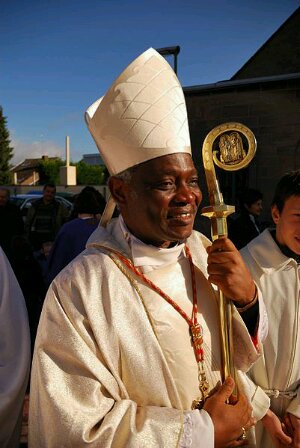
Peter Turkson, possibly the next pope
Yesterday, world news was dominated by the announced retirement of Pope Benedict XVI. After having been amazed by the fact that he is the first pope to resign in almost 600 years, the global media started to speculate about who would become the next bishop of Rome. Many think or hope that he will come from Latin America or Africa.
Since I’m not a Catholic, and especially not a cardinal, it could be argued that I shouldn’t express views on pope elections. But as a Christian with love for all of Christ’s church, across denominations as well as nations, I still want to question the European dominion over the Holy See.
I respect Catholic’s conviction that all popes are elected through the prophetic guidance of the Holy Spirit; still all prophecy should be tested (1 Th 5:19-20). Was it really the will of God that during the last 500 years when Catholicism has expanded across the globe, especially in Latin America, all popes have been European? In fact, before John Paul II, every single one was Italian. Apart from a few North Africans and Syrians, and S:t Peter himself of course, all popes have been white Europeans during all of church history.
Development Aid to the South, Revival Aid to the North

Brother Yun
A month ago I was listening to Chinese pastor and revivalist brother Yun as he was conducting some meetings in Sweden. His autobiography, The Heavenly Man, was one of the first Christian books I read, and it has impacted me a lot. Yun describes both countless miracles and unspeakable suffering, persecution as well as revival. These aspects go hand in hand, he argues, the glory of the resurrection cannot be separated from the pain of Calvary.
As a Western Christian who at that point had neither experienced revival nor persecution, Yun’s testimony opened my eyes to what Christianity really is about. Having fled from China in 2001 to Germany, he had some very interesting reflections about the state of the Western church. Based on the story about the lame man in Acts 3, he wrote prophetically: “The Western church has a lot of silver and gold. The Chinese church rises up and walks.”
Of course there are exceptions, but generally this is painfully true: churches in high-income countries are rich in money but poor in spirit, churches in middle- and low-income countries are poor in money but rich in spirit. I would say the latter group is better off, still I am constantly aware of the urgent material needs they have in order to fight poverty and nurture revival. (more…)
It’s Advent – Let’s Destroy Some Weapons!

The Triumphal Entry, African Style
Happy new year! This Advent Sunday, Christians around the world remember and celebrate when Jesus entered Jerusalem in order to transform into a cute baby and be born in Bethlehem. However, many tend to forget that this event is very political, affecting the way Christians should view war and peace.
As we know, Jesus enters Jerusalem on a donkey with his disciples accompanying him, shouting praises to Him, the son of David. When Pilate used to enter Jerusalem, he rode on a white war horse with soldiers accompanying him, shouting and singing praises to the emperor. For the earliest readers of the gospels, Jesus’ entry was a peace manifestation. In fact, the gospel writers clearly points out that it is fulfillment of the prophecy in Zechariah 9, which says:
Rejoice greatly, Daughter Zion!
Shout, Daughter Jerusalem!
See, your king comes to you,
righteous and victorious,
lowly and riding on a donkey,
on a colt, the foal of a donkey.
I will take away the chariots from Ephraim
and the warhorses from Jerusalem,
and the battle bow will be broken.
He will proclaim peace to the nations.
His rule will extend from sea to sea
and from the River to the ends of the earth. (Zech 9:9-10)
Charismatic Servants
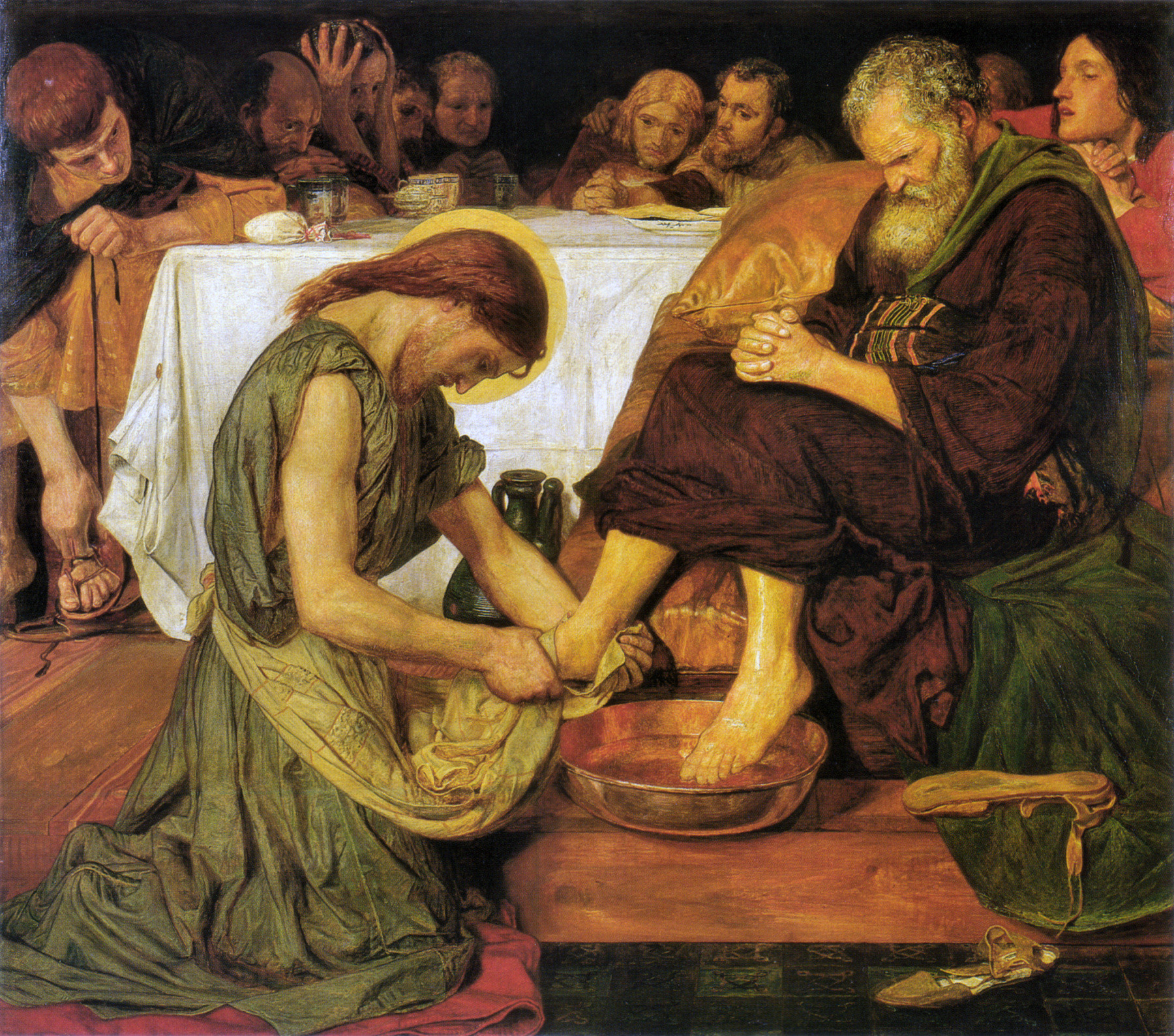
The Servanthood of Jesus
Tragically, preachers and evangelists in the Pentecostal and charismatic movements are often seen as people hungry for power, who control the masses through promises of supernatural encounters only to gain money and status for themselves. Even though the accusation sometime is exaggerated, there are indeed many genuine cases of manipulation and control among us, which is extremely sad and stupid. This is defenitely not something that the Holy Spirit produces; and thus, it contradicts true charismatic living.
The basis of Christianity is love. God is love (1 John 4:8) and He loves us more than we can understand (Eph. 3:19, Rom 8:38-39). Although people have turned away from Him and sin, He loves us so much that He sent Jesus to give us eternal life through He died our death (John 3:16, Rom 5:8). God forgives our sins; by his grace we are saved and receive eternal life, not by earning it with good deeds, but by God’s grace (Eph. 2:8-9).
This grace is the basis not only for our salvation but also for the supernatural gifts that Jesus used to spread the Kingdom of God and instructed his disciples to use, they are gifts given by grace (greek charismata, grace gifts (1 Corinthians 12:4)) that we can not earn or deserve, but we recieve them freely by God’s grace (Ephesians 4:7). (more…)
 Charismactivism