
Home » Church & Theology (Page 3)
Category Archives: Church & Theology
The author

Micael Grenholm, a Swedish charismactivist, apologist and author.
The Role of Relationship in the Kingdom of God

So I’m in a relationship now, which is exciting and overwhelming and horrifying and wonderful. Sarah is a charismactivist with a heart for revival and poverty reduction, a vegan Pentecostal with a global vision for Biblical community-churches that live out the book of Acts. She’s great and I thank God for her every day.
Now, as I’ve written previously I’m really a big fan of celibacy. I have no reason to doubt Paul’s statement in 1 Cor 7:38 about how singleness is “better” than being married. As long as I’ve been a Christian I have found it plausible that a single person can be “undivided” to the Lord in a way that couples can’t (1 Cor 7:33-35).
Now, many would argue that marriage and celibacy are on equal level of both value and sacrifice and that neither is better than the other. I get the impression that this is the official stance of most evangelical and charismatic churches here in Europe at least. Still, in practice, the notion is often that getting a spouse is the priority goal of every Christian’s life and celibacy is the secondary option for those who fail or are uninterested. (more…)
Why Sacraments Don’t Exist
My latest contribution to the MennoNerds vlog concerned the issue of sacraments, where I and my cat friend Kafka argued that they don’t exist:
 Now, some of you may get a knee-jerk reaction when you hear that, so let me clarify what I mean. I’m not saying that things like communion, baptism and anointing of the sick don’t exist or that we shouldn’t do those things, there are clear Biblical commands prescribing us to practice that. But the Bible doesn’t call them “sacraments”, and neither should we. In the video, I briefly describe the origin of the term and how the definition of “sacrament”, which in turn decides what should be included in the category, is completely arbitrary and man-made.
Think for yourself: why isn’t helping the poor described as a sacrament? It’s not because Jesus isn’t telling us to help the poor, because He is. It’s not because helping the poor isn’t a visible sign of invisible grace, as the classical sacramental definition goes, because it is. Let’s face it, the reason why baptism and communion are included in a category that historical churches have found very important whereas helping the poor, evangelism and the Lord’s prayer has been excluded from said category, is because the founders of those sacramental categorizations subjectively thought that some Biblical commands were more important than others. I’ve written more about this here. (more…)
Is the Vatican about to Reject Just War Teaching?

A week ago, Catholic Herald reported that a conference hosted by the Vatican on war and peace rejected just war teaching and call upon pope Francis to make nonviolence the official Catholic stance. The conference had been welcomed and blessed by the pope according to the Vatican Radio as he thanked the participants for “revitalizing the tools of non-violence”.
The conference was hosted by pacifist Catholic organization Pax Christi as well as the Pontifical council on justice and peace. In an appeal directed at the pope, the around 80 participants wrote:
“Too often the ‘just war theory’ has been used to endorse rather than prevent or limit war. Suggesting that a ‘just war’ is possible also undermines the moral imperative to develop tools and capacities for nonviolent transformation of conflict… We need a new framework that is consistent with Gospel nonviolence. We propose that the Catholic Church develop and consider shifting to a Just Peace approach based on Gospel nonviolence.”
Why Liberal Theology Paves the Road for Nazism

I’m a master of blog titles, am I not?
This week my first book in Swedish was released. It’s called Jesus was Also a Refugee and is co-authored with evangelical pastor Stefan Swärd. It develops a Christian perspective on the refugee crisis and the European xenophobic movement. Our conclusion is obviously that Christians should bless and welcome immigrants and refugees and not oppose migration from poor, dangerous countries to rich and safe countries.
One surprising finding is that many xenophobic and racist Christians have a liberal, or progressive, view on theology. This is very evident if you look at Nazi Germany in the 1930’s: liberal theologians like Paul Althaus and Emanuel Hirsch celebrated Hitler and hated Jews. They combined their Nazi rants with biblical criticism and despising any effort to follow the commands of Jesus as they are expressed in the New Testament.
Liberal Christians are also very prominent in the main xenophobic party of my nation, the Sweden Democrats. This party has neo-Nazi roots and try to appeal to Christian values in contrast to Muslim or socialist values. They have been working hard to gain influence in the Church of Sweden, by electing people who hold on to nationalism while also being very liberal theologically. (more…)
The Importance of Excluding People from the Church
Jesus and the apostles were not just focusing on how to include as many as possible in the church through evangelism, but also on how to exclude unbelievers, heretics and sinners who refuse to repent. If we want healthy churches today, we have to start talking about who we should exclude from our midst.
When lots of disciples left Jesus because they couldn’t understand his teaching on eating flesh and drinking blood, He let them go and checked if the apostles would want to go as well (Jn 6:67). He later taught them that sinners should be excluded from the church if they refuse to repent and ask for forgiveness, they should then be viewed as pagans (Mt 18:15-17).
Paul speaks about this extensively in 1 Cor 5, where he commands the Corinthians to exclude a brother who had sex with his stepmother. He points out that this doesn’t mean that Christians should not have any contact with sinners, the problem is when they call themselves Christians but still refuse to repent from their sin: (more…)
Come and See: How Community of Goods Can Become Normal Again

My documentary about community life in the Jesus Army – Everything in Common – is almost complete. It still needs some sound mixing and small fixes, but in a month’s time I will release it on my YouTube channel. I have shown the film to some friends here in Uppsala and many have become inspired and fascinated by this kind of living by watching it. Here’s a snippet where some Jesus saints explain what community life means to them:
The people that have joined me on my trips to the Jesus Army have become dramatically inspired as well during the visits. Just seeing community of goods in practice makes so many disciples thirst for it. Asking people to “come and see” where we live, as Jesus did (Jn 1:39) is a simple but effective way to catalyst a movement.
Many communities have historically been quite isolated, which really isn’t a necessary component of community of goods but a natural consequence of many of them being rural due to their means of sustainance as well as skeptical to communication technology due to their values of simplicity. (more…)

Why All Churches Should Look Like New Testament Churches
Whenever I point out that our churches should be more Biblical and look like the apostolic church in Jerusalem that we read about in the first 12 chapters of the book of Acts, many fellow church leaders argue that there are many equally good models that we can form our congregations after, or that church structure really doesn’t matter much and so we shouldn’t discuss that too much. Allow me to disagree:
In this video I show that church structure does matter a lot, taking the example of Jerusalem and how it seemingly shaped the apostle James’ theology, and I question whether churches with different structures than the Jerusalem church really share the same fruit: conversions every day, nobody living in poverty and an abundance of signs and wonders.
Ending Cell Group Anarchy

Photo from tonight’s cell group in my church, which is basically identical to our Sunday service
In Biblical times, local churches met primarily in homes as a complement to their public evangelism (Acts 2:46, 20:20, Rom 16:5). For at least 250 years home churches were the norm – the earliest discovered church building that wasn’t used as a home is from the late third century. With Constantine stuff changed, basilicas and cathedrals were established, and these were the norm in the state churches.
Radical restorationist groups have often started in the homes, this includes the early Anabaptists, Baptists and the Pietist movement. When less persecuted and more established, they have often built church buildings as their state church counterparts. In the 18th century, Methodist leader John Wesley introduced the concept of having meetings in homes as a complement to the Sunday service in a church building.
In the 20th century this practice has become very popular. Realizing that meetings in church buildings aren’t designed to effectively promote fellowship and discipleship, many church leaders have welcomed cell groups/small groups/house groups in their congregations.
However, there are no fixed standards to what a cell group is and what it should do. Since it’s not viewed as a church of its own, there are usually no requirements of it to include the things that we see that New Testament churches were expected to include. For this reason, there’s basically anarchy when it comes to how cell groups look like. Here are some examples: (more…)
Podcast: Why Eschatology and Eternity Are Important
A new MennoNerds Podcast episode has been released! It’s on eschatology, Heaven and hell and started off in our vlog as a conversation on waiting and patience, which made me think about waiting on the second coming of Christ and the glorious heavenly realm that He will bring:
Deborah followed it up talking about two things that Heaven is and two things it’s not:
And Paul started to talk about hell and three different theological views on its nature: eternal conscious torment, annihilationism and universalism:
Why Jeremiah Explains Jesus’ Sand-Writing
Sermon notes on John 8:1-11.

Jesus went to the Mount of Olives. At dawn he appeared again in the temple courts, where all the people gathered around him, and he sat down to teach them. The teachers of the law and the Pharisees brought in a woman caught in adultery. They made her stand before the group and said to Jesus, “Teacher, this woman was caught in the act of adultery. In the Law Moses commanded us to stone such women.Now what do you say?” They were using this question as a trap,in order to have a basis for accusing him. But Jesus bent down and started to write on the ground with his finger. (Jn 8:1-6)
“Well, kill her of course” would be a proper Phariseic response to this question. Many witnesses had seen her commit this sin, and the Old Testament punishment for adultery is death (Lev 20:10). There is obviously a gender-based injustice here since only the woman is supposed to be punished, while the man she had sex with is nowhere to be seen, but many Pharisees would not care so much about that.
Jesus’ response, though, is revolutionary and unexpected:
When they kept on questioning him, he straightened up and said to them, “Let any one of you who is without sin be the first to throw a stone at her.” Again he stooped down and wrote on the ground.
At this, those who heard began to go away one at a time, the older ones first, until only Jesus was left, with the woman still standing there. Jesus straightened up and asked her, “Woman, where are they? Has no one condemned you?”
“No one, sir,” she said.
“Then neither do I condemn you,”Jesus declared. “Go now and leave your life of sin.” (Jn 8:6-11)
Why Believing in God isn’t Like Believing in Santa

It feels like this article shouldn’t have to be written, and yet it’s not uncommon to hear people say “Believing in God is like believing i the tooth fairy or Santa”, “There are no more evidences for God than what there are for Santa” or “Believing in an all-knowing, magic Santa is ridiculous, so is belief in an all-knowing, supernatural God.” The idea is basically that since Santa doesn’t exist, God doesn’t exist, because they are too similar.
This doesn’t work, for many reasons:
1. Adults believe in God
Shouldn’t come as a surprise to anyone. While basically only kids believe that Santa exists due to their parents telling them so, the majority of the world’s adult population believe in some sort of Deity. Now, some atheists would say that’s because God-believers are like kids who just believe what someone else told them without checking for evidence, but that’s not just insulting but false; while nobody “converts” to belief in Santa Claus as an adult, several atheists have become theists (like C.S. Lewis, Greg Boyd, Anthony Flew) after examining arguments at hind evidence. Which brings us to point number 2:
Did the Catholic Church Just Say That Jews Don’t Need Jesus?
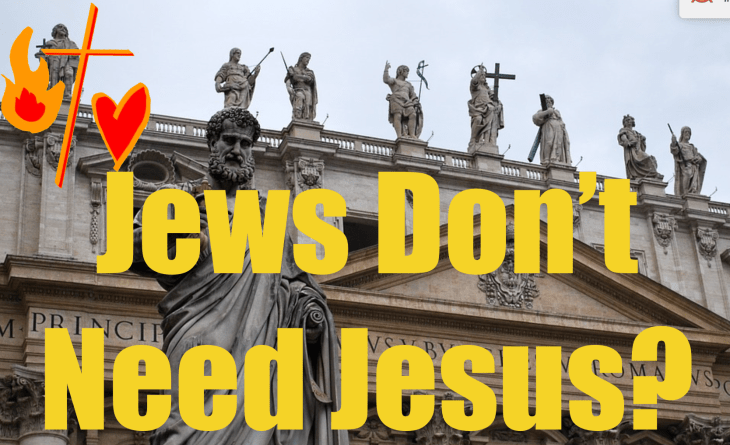
Yeah, they sort of did. The new Catholic document The Gifts and the Calling of God Are Irrevocable states: “From the Christian confession that there can be only one path to salvation, however, it does not in any way follow that the Jews are excluded from God’s salvation because they do not believe in Jesus Christ as the Messiah of Israel and the Son of God.” They also add: “In concrete terms this means that the Catholic Church neither conducts nor supports any specific institutional mission work directed towards Jews.”
The document is a sequel to 1965’s Nostra aetate, which was a good document: it condemned antisemitism and persecution. This new paper however takes it some steps further. It is mainly a long exegesis of Romans 9-11, and their conclusion is that the Catholic Church should not seek to institutionally lead Jews to Christ, even though they can’t stop individual Catholics from doing so.
My take on this can be found in the video. Jesus loves to heal and save His Jewish brothers and sisters, as He recently did in Tel Aviv, and it’s always strange when people tend to believe that the best way to make sure that you don’t hate or kill a religious group is to say that they go to Heaven. Evangelism doesn’t lead to antisemitism; stupidity, hatred and disobedience to Jesus leads to antisemitism. Let’s encourage both Catholics and Jews to seek the truth in Jesus, rather than trusting in the doctrine of man.
Statement of Faith
Based on the Nicene Creed as well as statements of faith from the Vineyard movement, Azusa Apostolic Faith Mission, the Jesus Army, the old Assemblies of God, Schelitheim Anabaptists and the Lausanne Covenant.
God
We believe in one God, the Father Almighty, Maker of heaven and earth, and of all things visible and invisible.
Jesus
And in one Lord Jesus Christ, the only-begotten Son of God, begotten of the Father before all worlds; God of God, Light of Light, very God of very God; begotten, not made, being of one substance with the Father, by whom all things were made.
Who, for us men for our salvation, came down from heaven, and was incarnate by the Holy Spirit of the virgin Mary, and was made man; and was crucified also for us under Pontius Pilate; He suffered and was buried; and the third day He rose again, according to the Scriptures; and ascended into heaven, and sits on the right hand of the Father; and He shall come again, with glory, to judge the quick and the dead; whose kingdom shall have no end.
The Holy Spirit and His Gifts
And we believe in the Holy Spirit, the Lord and Giver of Life; who proceeds from the Father; who with the Father and the Son together is worshipped and glorified; who spoke by the prophets.
We believe that the Holy Spirit indwells every believer in Jesus Christ and that He is our abiding Helper, Teacher, and Guide. We believe in the filling or empowering of the Holy Spirit, often a conscious experience, for ministry today. We believe in the present ministry of the Spirit and in the exercise of all the biblical gifts of the Spirit. We practice the laying on of hands for the empowering of the Spirit, for healing, and for recognition and empowering of those whom God has ordained to lead and serve the Church. (more…)
The Bible and the Quran – Equally Violent?

A couple of people have asked me to comment on a recent viral video from the Netherlands called the Holy Quran Experiment, in which two guys read violent, scandalous passages from what they claim to be the Quran to people on the street and ask them to comment and compare it with the Bible. The respondents say that it’s horrible and that the Bible is much more peaceful, and then comes the reveal – the book they’ve read from is the Bible!
The video has become popular both among those who want to combat islamophobia and think that people are hypocritical to how they view their own religious heritage compared to others, and among people who think that all religions are stupid and inspire violence and bad values.
Now, as an apostolic Christian I’m the first to say that there are commands and descriptions of practices in the Bible that no one should follow today, such as the violent punishments in the Old Testament. And it is indeed the Old Testament that the Dutch guys read from, with one exception: Paul’s statement in 1 Tim 2:12 on how women shouldn’t teach, a command most Protestant churches today would say is culturally bound (women had hardly any access to education in ancient times, and most couldn’t read). (more…)
Progressives and Prosperity-Preachers Make the Same Errors

Kenneth and Gloria Copeland, fans of prosperity preaching
You may have noticed that I haven’t blogged for a week; that’s because I’m spending much time nowadays finishing my first book! It’s about how signs and wonders are combined with peace and justice in the Bible, throughout church history and today. During the last week I’ve focused on the history part, researching and writing about saints like Francis and Agnes of Assisi and radical church movements like the Moravian church and the Jesus Family in China.
I am so encouraged to see these myriads of people who combine miracles and activism. Did you know that Maria Woodworth-Etter, who is often considered the grandmother of the Pentecostal movement, was baptized in the Spirit in a Quaker church and at one time ministered in a denomination founded by Mennonites? Or that the Salvation Army, famous for its evangelism and social ministry to the poor, experienced tons of signs and wonders in its early days?
I have now arrived to the part where I discuss movements that only have one half of the Biblical Holy Spirit Activism combination. Like patriotic, prosperity-preaching Pentecostalism, or miracle-doubting progressive liberalism. Interestingly, both of these streams originated roughly at the same time, the 20th century. They are not just unbiblical, but historically unique. (more…)
 Charismactivism