
Home » Articles posted by Micael Grenholm
Author Archives: Micael Grenholm
The author

Micael Grenholm, a Swedish charismactivist, apologist and author.
Trump Sold Bibles to Pay for Legal Fees to a Porn Star he Cheated With and Compared Himself to Jesus
Yes, you read that correctly.
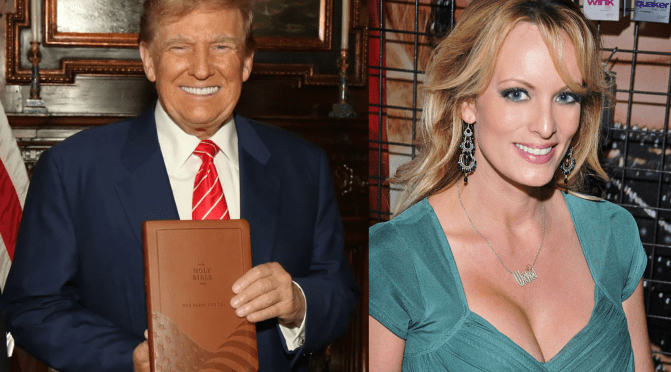
Last year, Donald Trump was indicted for having paid over a hundred thousand dollars to the porn star Stormy Daniels to keep quiet about their sexual encounter shortly after his wife Melania gave birth to their son Barron. Trump’s former lawyer Michael Cohen admitted to the crime, calling it a “sex scandal of biblical proportions” and admitting that it was done on Trump’s orders.
Trump also accidentally admitted to the crime in 2018, but has since denied it. He is really bad at playing innocent – he threatened “death and destruction” if he was charged, which he was. Several of his supporters call it persecution and communism that he is being charged – they do not care that Trump himself has already admitted to it.

While he was in court, Trump shared on social media an image comparing himself to Jesus Christ. As people who have read the Bible might recall, Jesus was in fact never on trial for being accused of paying hush money illegally to a porn star. Sure, Trump’s point was that he was as innocent as Jesus was when Jesus was falsely accused of blasphemy and was put to death by the Romans. But again, Trump had actually admitted that he made the payment to the porn star – thus, he was not innocent.
Lo and behold, Trump was found guilty on 34 charges and became the first former president to be a convicted felon. What happened next, you ask? Trump started to sell Bibles. The “God bless the USA Bible”, which mixed the Holy Words of Scripture with secular, political writings—almost as if the separation of church and state doesn’t mean much to him. These Bibles cost 60 dollars each and while the organization that sells them isn’t owned by Trump it has a “paid licensing agreement” with one of his companies.
As of yet, Trump has made at least 300,000 dollars from these Bibles and as he can’t use those funds for his political campaigns, it is likely that he used them to pay his mounting legal fees after his failed court case with Stormy Daniels.
And here’s the really crazy part. Hardly any evangelical leader that normally supports Donald Trump has rebuked him for any of this. Their loyalty to Trump is clearly stronger than their loyalty to Christ and the Bible. Likewise, they mostly remained silent when he said that he was the most honest human being God ever created or when he was pleased when someone compared him to the second coming of God:
When will evangelicals finally abandon this guy?
Why Many Pentecostals Are Abandoning Donald Trump

Join your name to this statement here!
We who have signed this statement are Spirit-filled Pentecostal and Charismatic Christians who believe that the Bible is the Word of God and that Jesus is the Way, the Truth and the Life. Because of this, we refuse to vote for or support Donald Trump and his MAGA movement.
We do not feel that we need to compromise with or ignore our faith when we take a stance against Trumpism. On the contrary, it is precisely because of our commitment to the Lord Jesus Christ that we cannot in good conscience endorse Donald Trump and what he stands for.
The Demonization of Immigrants
At the center of our Pentecostal spirituality is the miracle of Pentecost, in which the Holy Spirit united people of various nations through the miracle of tongues. The modern Pentecostal movement has one of its origins at Azusa Street in Los Angeles in which a multi-racial group of Americans and immigrants were baptized in the Holy Spirit together.
Leviticus 19:33-34 clearly states that we should love immigrants as ourselves and treat them as natives. Treating immigrants with love and empathy is a core value of any Christian.
For these reasons, we are horrified when we see how:
- Trump repeatedly dehumanizes immigrants by calling them “animals” and “not people”.
- Trump falsely accused Haitians in Springfield, Ohio, of eating pets, which led to bomb threats and harassment from the Ku Klux Klan – something Trump has refused to take responsibility or apologize for.
- Trump called these same Haitians illegal immigrants, even though they came to the US legally, and said that he want to deport all of them.
- Trump recently claimed that migrants have “bad genes”.
- Trump has said that “laziness is a trait in blacks”.
- Trump has said that migrants are “poisoning the blood of our country”.
- Trump has referred to Haiti and several African nations as “shithole countries”.
- Trump wants to enforce a mass deportation process that would cost over $210 billion and require a workforce larger than the U.S. Army, which would result in the separation of millions of families and leave approximately 4.5 million American children without one or both parents.
Most of the migrants that Trump employ this hateful, vile rhetoric towards are Christians. And most of those he wants to deport to poor, war-torn countries are also Christians. As fellow Christians, we cannot stand behind this.

The Disrespect, Belittling and Criminal Abuse of Women
As Pentecostal and Charismatic Christians, we strive for holiness and to become more Christ-like in all that we do and say and want to support people of good character. Evangelical Christians used to be the ones that emphasized the importance of politicians’ personal morality the most – that has rapidly changed during the reign of Trump.
While we do not believe one has to be perfect to be a president, the Bible emphasizes the importance of good character in both political and spiritual leaders (Deuteronomy 17:17, 1 Timothy 3:2). In particular, greed and sexual immorality are sins that bring God’s wrath upon people as they are equal to idolatry (Colossians 3:5). Donald Trump abounds in these sins without being repentant which has even led to criminal convictions:
- Trump has admitted to walking in on pageant contestants’ dressing rooms while some were naked or half-naked.
- Trump has called women he doesn’t like fat pigs, dogs, slobs and disgusting animals.
- Trump has bragged about grabbing women by their genitals and sleeping with other married women.
- Trump is a legally defined sexual predator after being found to have raped journalist E. Jean Carroll.
- Trump was found guilty on 34 charges for paying hush money to a porn star in order to conceal his adulterous affairs with her when his youngest son was four months old.
- Trump said in 1990 that he doesn’t think adultery is a sin.
Notice that Trump has done all this while claiming to be a Christian and without ever apologizing for any of these acts towards women. He also said in 2015 that he has never asked God for forgiveness.

The Threat to Democracy
Pentecostal and Charismatic Christians have been pioneers for democracy around the world, since our conviction that the Holy Spirit can and wants to use anyone empowers them to make a difference for their lives and their communities. Jesus taught that we should do to others as we would have them do to us (Matthew 7:12) and that leaders should serve rather than rule as kings (Matthew 10:42-45). Thus, we believe that democracy is biblical while dictatorship leads to tyranny and oppression.
Donald Trump has become alarmingly authoritarian over time and researchers have found that Trumpism has made the Republican party more akin to authoritarian parties such as AKP in Turkey and Fidesz in Hungary. It has become increasingly clear that Trumpism is a threat to democracy:
- Trump has praised President Xi in China for consolidating power in order to become president for life, saying he wanted to try the same thing.
- Trump has repeatedly “joked” about serving longer than the legal limit of two terms.
- Trump has repeatedly praised authoritarian leaders, including Putin, Duterte, Erdogan, el-Sisi, and Orbán.
- Trump has defended those who stormed the Capitol to prevent Joe Biden from being democratically elected and said he would pardon them if he becomes president again.
- Trump has explicitly written that the U.S. Constitution should be suspended to prevent him from losing elections.
- Trump told his supporters that they wouldn’t need to vote again after this election.
- Trump has repeatedly said that he would “only” be a dictator on day one if he’s re-elected and would use presidential power dictatorially to get revenge on his political enemies.
- Trump also recently claimed that all his political enemies will be arrested when he comes to power.
Obviously, the fact that we view Trump as a threat to democracy does in no way legitimize or excuse the awful assassination attempts on Donald Trump’s life. As Christians, we reject all types of political violence. At the same time, we cannot stay silent about the threat to democracy that Trumpism forms in the light of all the evidence given above.
Conclusion
As Spirit-filled Christians, we affirm the inherent God-given value of all human beings and whole-heartedly oppose all hate and belittling towards migrants, women and minorities. Our primary loyalty is to Jesus Christ, not to a political party, and our faith remains in him. This is why we cannot embrace Trumpism and refuse to vote for Trump in this year’s presidential election.
What Will it Take for Evangelicals to Stop Supporting Republican Sexual Predators?
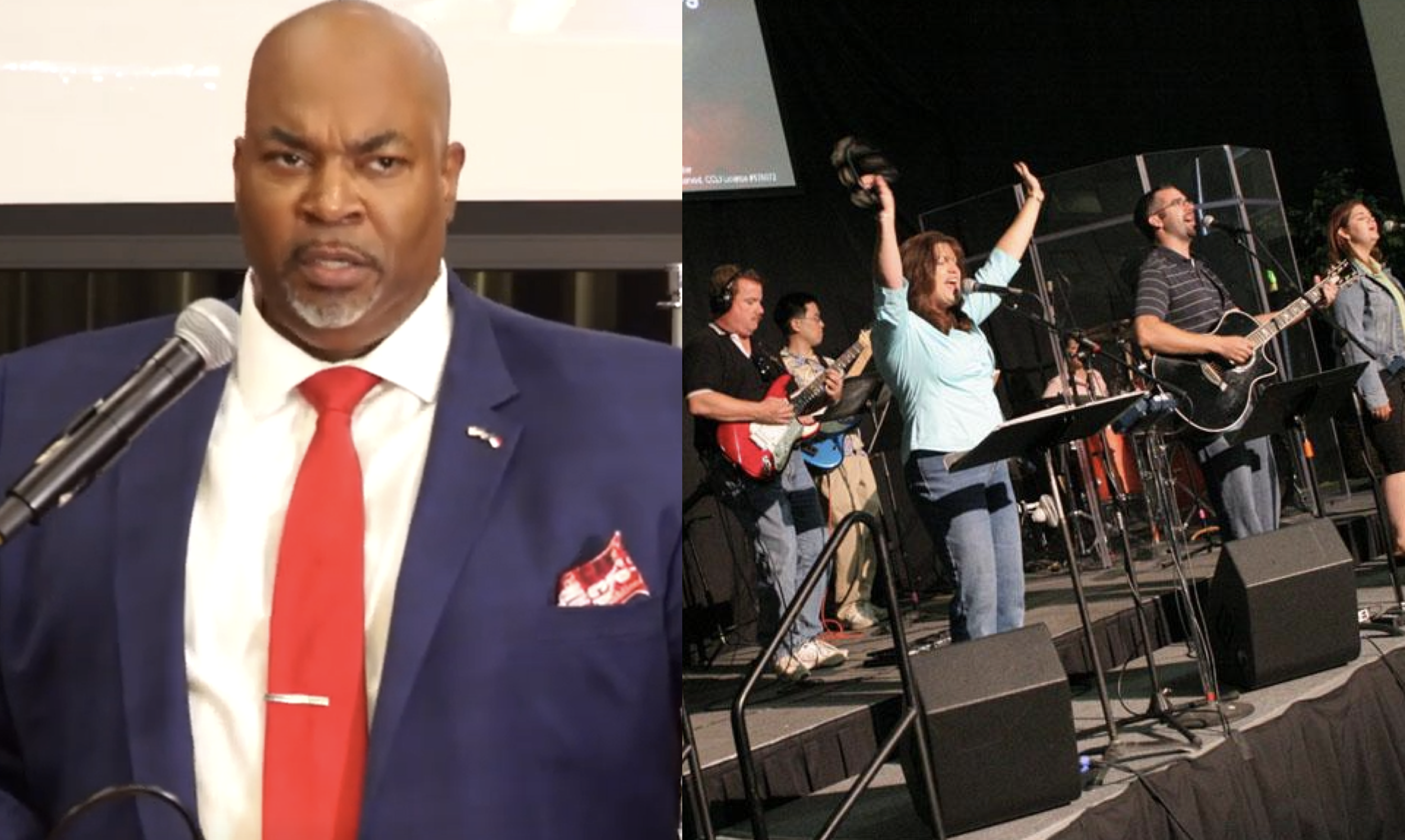
Republicans can literally call themselves Nazis and openly admit to adultery without losing much evangelical support, apparently.
Republican Mark Robinson has been a frequent visitor to an adult website called Nude Africa where he regularly watched transgender sex and posted comments guaranteed to offend a variety of constituencies.
In comments Robinson posted on the porn site, he praised Hitler, called himself a “black NAZI,” said he supported slavery, confessed to formerly “peeping” on women as they showered, admitted an affair with his wife’s sister; and called civil rights leader Martin Luther King Jr. “Martin Lucifer Koon.”
Donald Trump endorsed Robinson’s current campaign to be North Carolina’s next governor, praising him as “Martin Luther King times two.” According to Raw Story, many evangelical leaders in North Carolina say they still support Robinson and that he clearly loves Jesus. The very same Jesus who said that we should judge the tree based on its fruit (Matthew 12:33-37).
Many of these evangelicals have emphasized “family values” and representing “Biblical morality” when they’ve explained how they reason when they vote. But Robinson represents the opposite of that. As does Donald Trump, obviously, who has bragged about grabbing women by their genitals, sleeping with other married women, is a legally defined sexual predator and was found guilty on 34 charges of paying hush money to a porn star after sleeping with her when Trump’s youngest son was only four months old.
There’s only one word for this evangelical support for Republican sexual predators: hypocrisy. The very thing that Jesus warned his disciples against over and over again. “Be on your guard against the yeast of the Pharisees, which is hypocrisy”, the Lord said. “There is nothing concealed that will not be disclosed, or hidden that will not be made known.” (Luke 12:1-2).
Sadly, 62 percent of millennials think that hypocrisy is one of the main characteristics of the church. Why? Some evangelicals would push back, claiming that these kids have a lot of prejudice and are hypocrites themselves. But hold on a second. What if there are objective, factual reasons for non-Christians to perceive evangelicals as hypocrites?
Jerry Falwell Jr. was one of the earliest Christian leaders to endorse Donald Trump. It may be hard to remember nowadays, but Trump was hardly any evangelical’s first choice. Republican candidates like Ted Cruz were far more popular. It’s common today to hear evangelicals say that they simply don’t care about Trump’s curses, rhetoric and playboy lifestyle, as long as he nails conservative policies.
Falwell Jr. helped pioneer this line of thinking. It used to be the opposite of what evangelicals valued in a president. A few years later, Jerry Falwell Jr. resigned as the president of Liberty University after posting a sexual photo from his yacht on social media and allegedly having approved of an extramarital affair between his wife and a business partner (including watching from a corner while they were having sex).

These statistics show beyond any reasonable doubt that the white evangelical endorsement of Trump has radically changed their values. In 2011, over 60 percent of them said that an elected official who commits an immoral act in their private life cannot behave ethically in their public life. In the Trump era, this conviction remains among less than 20 percent. Falwell Jr. and other evangelical leaders have convinced millions of Christians that a good character simply isn’t relevant when it comes to leadership, despite there being hundreds of verses in the Scriptures that suggest otherwise.
I wish we lived in an age where it was obvious to everyone that Trump is a hypocrite. He said that he would “drain the swamp” in Washington making it less corrupt, but took no action to do so last time he was president but instead filled his administration with relatives, people currently under investigation and career politicians. Trump frequently accuses the media for lying, calling it “fake news”, when even his supporters clearly can see that he frequently lies himself. Just watch him deny that he has said things he actually said:
But here’s the really catastrophic part. In the gallup I referenced above, which shows that most white evangelicals don’t care about moral character in their public officials anymore, there was some stunning evidence of evangelical hypocrisy:

Do you see that? The number rises dramatically if the question is asked after Bill Clinton is mentioned, but plummets when it is Trump’s name instead. This clearly proves that at least a quarter of white evangelicals in the US are hypocrites. They disregard God’s teaching: “My brothers and sisters, believers in our glorious Lord Jesus Christ must not show favoritism.” (James 2:1). They don’t shape their opinion on this matter based on God’s Word, but on the priorities of the Republican party.
The Constantinian relationship many white evangelical leaders have to whatever candidate the Republicans choose to nominate is having a disastrous effect on their discipleship and obedience to the Word. There’s a reason Jesus warned so much against hypocrisy. It’s what he knew that a lot of his future followers would be tempted by.
This was originally posted at Pentecostals & Charismatics for Peace & Justice.

Pentecostals & Charismatics for Peace & Justice is a multicultural, gender inclusive, and ecumenical organization that promotes peace, justice, and reconciliation work among Pentecostal and Charismatic Christians around the world. If you like what we do, please become a member!
Trump Actually Plans to Separate Millions of Christian Children From Their Parents
Donald Trump’s plan to deport 15 million people is both dangerous and inhumane. This plan would require enormous resources, cause humanitarian disasters, and lead to economic and social instability in the United States.
The former president Trump has promised, if he’s elected again despite now being a convicted felon, to deport more people than there are undocumented immigrants in the country, meaning even legal residents and citizens could be at risk. Such an operation would demand a massive amount of resources and personnel, making it extremely costly and logistically complicated—perhaps even impossible. The deportation process would cost over $210 billion and require a workforce larger than the U.S. Army.
Trump often claims that millions of undocumented immigrants to the US come from prisons and mental institutions, but that is simply false and has been described as “laughable” by experts. In reality, immigrants are just like other people: some are bad, most are good.

The humanitarian consequences of Trump’s plan would be devastating. Mass deportations on this scale would result in the separation of millions of families and leave approximately 4.5 million American children without one or both parents. This would place a massive burden on social systems and likely lead to a humanitarian crisis. If the children are not deported themselves, they would need state care, which would cost an additional $118 billion. Most of these children would belong to Christian families.
Economically, deporting such a large portion of the workforce would create labor shortages in several sectors, driving up inflation and harming the economy. It has been estimated that the U.S. GDP would immediately decrease by 1.4 percent and by $4.7 trillion over the next decade. This would also negatively impact the housing market, putting over a million mortgages at risk.
Socially and politically, Trump’s plan involves state National Guards and other security forces conducting mass arrests in cities and communities across the country. This would create a situation where residents live in constant fear of arbitrary and violent interventions. There is also a risk that this would lead to violent confrontations between federal forces and local authorities or residents trying to protect their neighbors.
The motivations behind Trump’s plan are also troubling. Stephen Miller, who has a history of racist, white nationalist, and xenophobic views, sees the deportation of non-white immigrants as a personal mission and has been appointed by Trump to oversee this monstrous project. The plan is not just a political proposal but part of a broader agenda to change the demographic composition of the U.S. Which is in line with Trump’s ambition to remain in power at any cost, even if it requires terminating the Constitution.
Legally and constitutionally, Trump’s plan raises significant issues. The proposal to revoke birthright citizenship violates the Fourteenth Amendment of the U.S. Constitution, and bypassing legal processes to carry out mass deportations would contravene fundamental legal principles. This would undermine the rule of law and set a precedent for future authoritarian measures.
Overall, Trump’s plan to deport 15 million people is both dangerous and inhumane. It would cause significant humanitarian and economic damage, create social and political instability, and undermine the rule of law. We must take this threat seriously and work to prevent Trump’s plans from being realized, as the consequences would be devastating for both individuals and society as a whole.

Jesus said: “When I was a stranger, you welcomed me… Whenever you did it for any of my people, no matter how unimportant they seemed, you did it for me.” (Matthew 25:35, 40). Deporting millions of people from the richest country on earth while making millions of children of children orphans is the opposite of that.
Originally posted at Pentecostals & Charismatics for Peace & Justice.
Why Climate Change Should be a Top Political Issue for Christians
Originally published on Pentecostals & Charismatics for Peace & Justice.
What’s the most pressing political issue Christians should care about today? There are many answers to that question, and different Christians have different priorities, but I want to argue that all Christians should put climate change very high on that list, if not at the top? The climate crisis impacts everything else.

Do you think the economy is important? Climate change will ruin it unless stopped. You think migration is an important issue? Climate change will cause billions of people to flee from their home. Does any other political issue have the top priority for you, like abortion, education or law and order? Climate change might ruin all modern civilizations and all the societal orders connected to them?
As stewards of God’s creation, Christians are called to protect and preserve the earth for future generations. In the face of accelerating global warming, the urgent need for climate action becomes not only a responsibility but a divine mandate. The current state of our planet, marked by rising temperatures, melting ice caps, and increasingly severe weather patterns, underscores a critical moment in human history. It is a moment that demands a collective response grounded in faith, compassion, and justice.
The Biblical Foundation for Environmental Stewardship
The Bible is rich with references that underscore the importance of caring for the environment. Genesis 2:15 teaches us, “The Lord God took the man and put him in the Garden of Eden to work it and take care of it.” This verse highlights our God-given role as caretakers of the earth, entrusted to us to nurture and protect.
Psalms 24:1 further reminds us, “The earth is the Lord’s, and everything in it, the world, and all who live in it.” This psalm beautifully articulates the concept of stewardship, emphasizing that we do not own the earth; rather, we are caretakers of God’s creation.
(more…)Pray for the Children of Gaza and Israel

God, you are the light that darkness cannot overcome. You are the Prince of Peace and the Reconciler, you make the impossible possible.
Protect all those affected by the war between Hamas and Israel. May the horrific acts of terror be stopped, may those taken hostage be freed, may those seeking refuge from rockets and bombs be spared, and may this terrible conflict come to an end.
I pray especially for the children on both sides who are the most vulnerable—hold your hand over them, God, and give them a peaceful future. Amen.
Two things that should be self-evident:
- Murdering, raping, and kidnapping civilians is not a “fight for liberation”; these are horrific acts of terror that Hamas has committed against Israel and cannot be excused.
- Stopping the import of food and water to the entire population of Gaza is the wrong way for Israel to respond to these acts of terror; it is a life-threatening collective punishment that violates international humanitarian law.
Half of the population of the Gaza Strip is children. A million children who bear no responsibility for Hamas’s rule and their horrific terror attacks. They are some of the most vulnerable right now in the war.
Doctors Without Borders are on the ground in Gaza and report that most of their patients are children between the ages of 10 and 14. They have called for humanitarian corridors so that food and medicine can reach the most vulnerable.
They also write that they have offered medical support to Israeli hospitals where a very high number of injured are being cared for after Hamas’s terror attacks. So far, the Israeli healthcare system has managed without their support, but they are ready to help there too if needed.
All people are created by God, and all suffering on both sides must be prevented. As missionary Heidi Baker wrote the other day on site in Jerusalem: “Pray for peace and for the innocent, no matter their nation or creed.”
Micael Grenholm is a Swedish church historian, author and an editor for PCPJ.

Pentecostals & Charismatics for Peace & Justice is a multicultural, gender inclusive, and ecumenical organization that promotes peace, justice, and reconciliation work among Pentecostal and Charismatic Christians around the world. If you like what we do, please become a member!
What would it look like if Jesus entered Jerusalem today?
Happy Easter! Like many others, I’m fascinated and a bit terrified by the quick development of artificial intelligence (AI). But just like the internet, I believe that Christians should do their best to use tools that can cause a lot of harm to promote the Kingdom of God instead. So, when I heard that the latest version of the AI art generator Midjourney could produce photorealistic images, I was eager to give it a try.
As Easter was approaching, I decided to generate images of Jesus entering modern-day Jerusalem to help people of today picture what it could be like for people 2,000 years ago to experience the arrival of the Messiah. I was blown away by the results.





As you can tell, Midjourney version 5 was able to create stunningly vivid images that truly brought the story to life. I was thrilled to share these images with others, as they can be a powerful tool to help people visualize the Bible stories and connect with them on a deeper level. Before long, the images were shared over 1,000 times on Facebook.
Admittedly, many shared them just because they found them funny. They also stirred a lot of debate, since many complained that this Jesus was too white compared to the original. Others pointed out that several people in Israel, Palestine, Lebanon and Syria doesn’t have much darker skin tone than this. As for me, I make no claim that this represents a historically accurate portrayal of the Savior – rather, it portrays the common Western conception of him which makes him recognizable to most of us.
Some also pointed out that a motorcycle really isn’t a good modern equivalent to a donkey, both in terms of cost and environmental destruction. So I generated new images in which Jesus chooses a cheaper, more climate-friendly mode of transportation into the holy city:



With the ability to generate photorealistic images so easily, the risk of deception and manipulation becomes a very real concern. In a world where deepfakes and fake news are becoming increasingly common, it’s important to be aware of the potential risks of technology like this.
In fact, I experienced this firsthand when I also decided to generate images of the pope getting married as a playful experiment. AI generations of Francis had already gone viral, and I generated these images to contribute to the meme as well as providing subtle criticism of Catholic priests and bishops not being able to marry despite there not being any biblical command of that sort (on the contrary, the apostle Peter had a mother-in-law!).


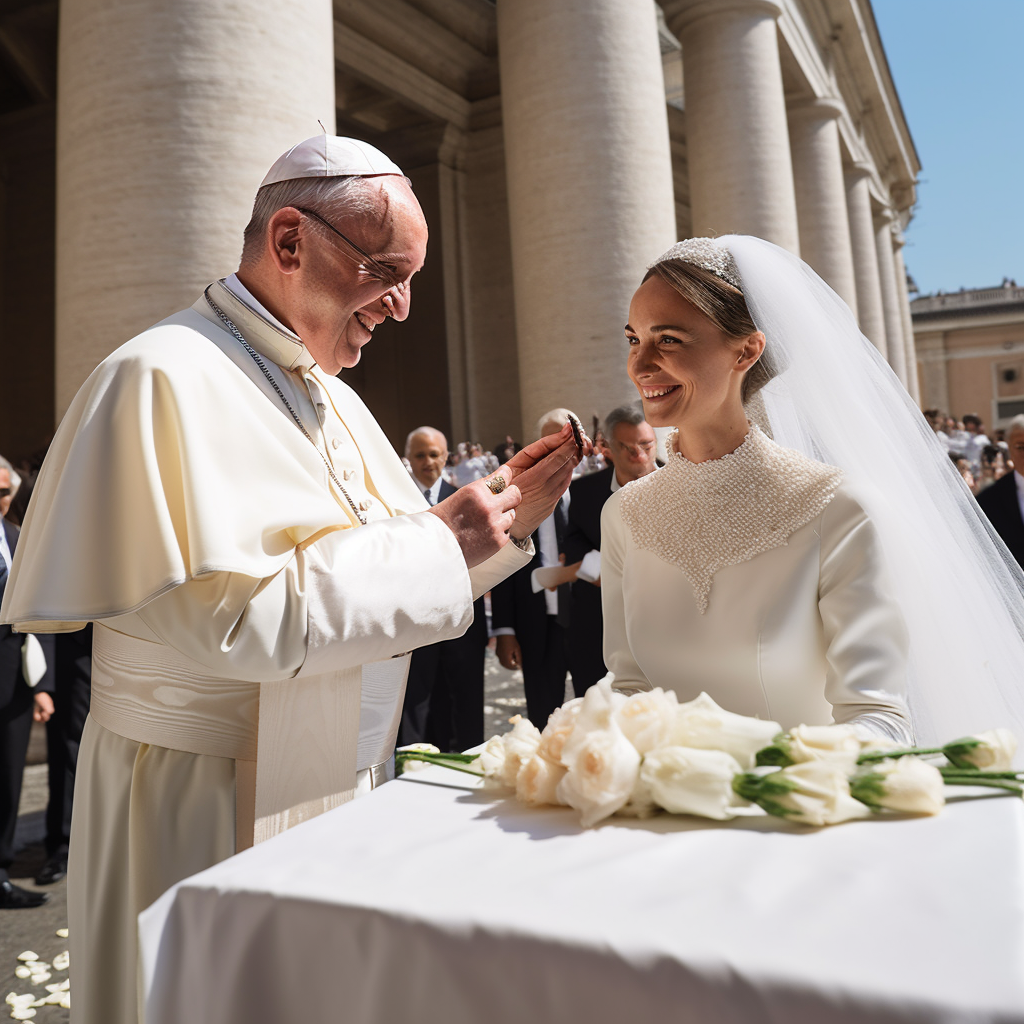


Even though I shared the images in a group called “Midjourney AI”, they quickly found a life of their own in which their AI origins were shrouded in darkness. After a few days, they went viral in Nigeria and Congo, with many people believing that they were genuine as influential people on social media claimed that they were photos and some even gave the “wife” a name! If one looks closely at the images, it is clear that the face of the “wife” changes from picture to picture, and hands and other details are far from perfect. But who has time to look closely in an age of instant gratification and quick shares? Fortunately, a Congolese paper eventually clarified that the images were generated by AI. Unfortunately, this led to Facebook labelling all uploads of the images as “disinformation” – even when posted in AI groups!
This experience was a stark reminder of just how easily technology can be used to deceive and manipulate people. As Christians, it’s important for us to approach technology with caution and discernment. While tools like Midjourney version 5 can be powerful tools for creating meaningful and inspiring art, we must also be aware of the potential dangers they can pose. We must use these tools responsibly and with integrity, always keeping in mind the potential impact they can have on those who view them.
While my experience with Midjourney version 5 has been both exciting and eye-opening, it’s important to remember that technology is a powerful tool that must be used responsibly. As Christians, we must remain vigilant and discerning, using our creativity to glorify God and uplift others, while avoiding the pitfalls of deception and manipulation that can accompany technology like this.
Hundreds of People Saved at Asbury Revival, According to Professor
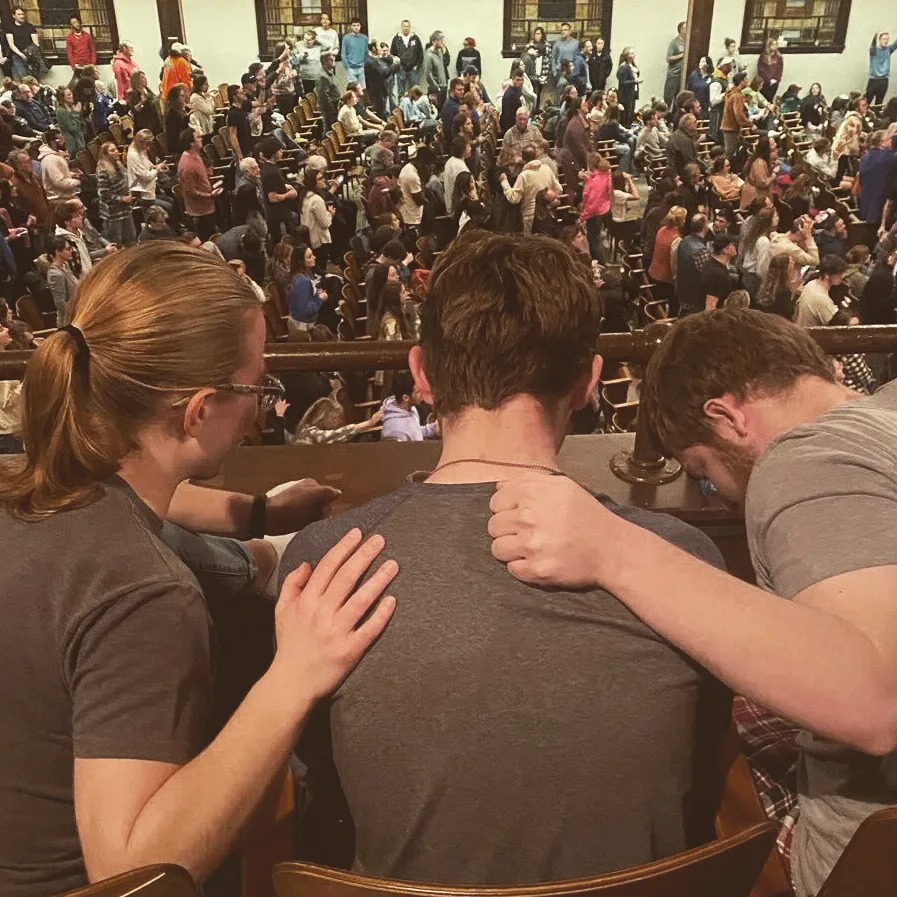
Dr. Craig S. Keener, a highly respected New Testament scholar at Asbury Theological Seminary, is widely known for his work on the Bible’s background and his enormous books consisting of thousands of pages with tens of thousands of references. He’s not known to be a very emotional guy. And yet, during the Asbury revival, he proclaimed that he could feel the tangible presence of God just by walking near the chapel area.
The Asbury Revival, which took place at Asbury University in Wilmore, Kentucky, began on February 8, 2023, when a group of students spontaneously stayed in Hughes Auditorium after a regularly scheduled chapel service. Asbury President Kevin Brown sent out a brief email inviting others to join in the worship. News of the revival quickly spread through social media and Christian online publications, drawing thousands of people each day, with total visitors ranging between 50,000 and 70,000.
Dr. Keener, who joined the Asbury faculty in 2011 after teaching at Palmer Theological Seminary and Hood Theological Seminary, has authored 25 books and more than a million copies in circulation. He was an eyewitness to what went on during the revival meetings and has defended the outpouring against critics on YouTube. Recently, I had the honor of interviewing Dr. Keener about how the revival started, why the public phase eventually was shut down – and how the Holy Spirit impacted him personally:
It’s not every day that you see an accomplished New Testament scholar proclaim in all caps on social media: “I CAN FEEL THE TANGIBLE PRESENCE OF GOD”. But this was indeed what Dr. Keener experienced, and he hadn’t even got inside the building yet! Keener could tell me that a teacher he trusts reports that hundreds of people have been saved during the outpouring, including students who come from Christian families but have never taken the faith of their parents seriously. Additionally, there are many reports of healing as well as you can see in this video:
Dr. Craig Keener’s experience at the Asbury Revival serves as a powerful testimony to the profound impact that such events can have on individuals, regardless of their academic or spiritual background. It illustrates the importance of remaining open to the divine presence and the transformative power it can bring to our lives. As a testament to the power of faith and the presence of God, the revival demonstrates the potential for spiritual growth and transformation, even among those who approach their faith from a more intellectual perspective.
“Jesus Revolution” Movie Causes People to Worship in Theaters, with Some being Saved

The film Jesus Revolution about the youth revival in the 1970s has done much better than expected in US cinemas – and now there are reports that some have even given their lives to Jesus after seeing the film. At a movie theater in Miami, a prayer and praise meeting arose after the film was over where some made the decision to become Christians.
Here I have made a video where I have collected clips from the revival meeting at the cinema:
People were saved even during filming. When Jonathan Roumie, who plays the hippie preacher Lonnie Frisbee in the film (and who also plays Jesus in the series The Chosen) filmed a scene where Lonnie baptized hundreds of people in the sea, some of the extras said that they had never been baptized but wanted to be born again in the name of Jesus. Thus, some of the baptisms that made it into the movie are not staged, but the cameras filmed people being baptized for real! 🙌
The film’s producer also said that many in the studio and on the production team who were not Christians were moved to tears when they saw the film and wanted to know more about Jesus. This is truly no ordinary Hollywood movie!
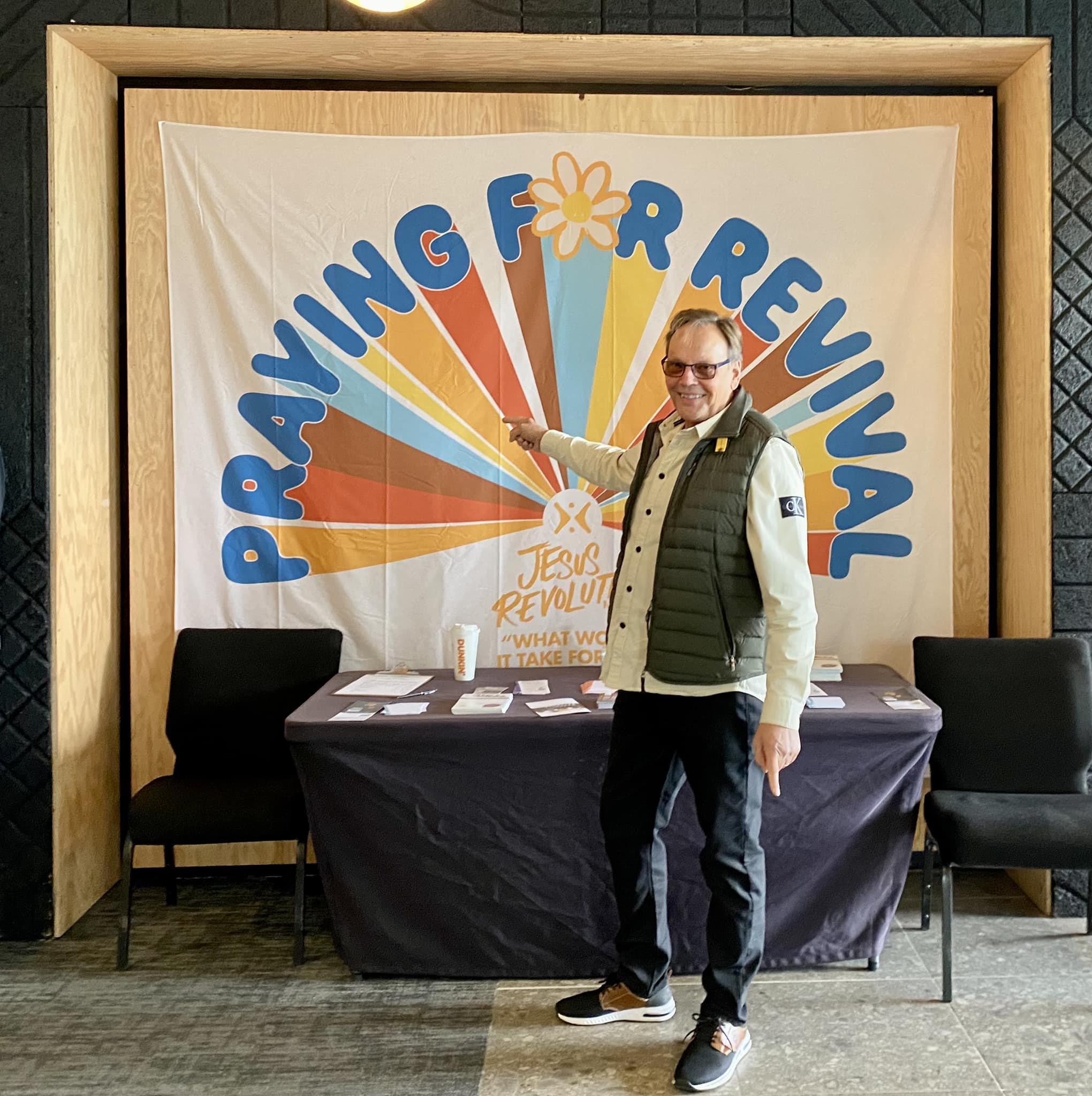
It’s amazing to see how the Holy Spirit is impacting people’s lives through this movie. Now sadly, I haven’t been able to watch the movie myself since I live in Sweden, but a Swedish friend of mine, Anders-Petter Sjödin, went to the premiere in Los Angeles and said that it was amazing. If you have the opportunity to see it, you should definitely take it.
The Prayer that Started the Asbury Revival

Right now, an amazing renewal is taking place at Asbury University in Kentucky – a prayer meeting that usually lasts for 15 minutes has instead been going on with uninterrupted prayer and worship for over a week. Thousands have made their way to the meeting, with students and teachers worshiping together with family members and strangers. Classes and assignments have been cancelled to be replaced with tearful prayers for God’s power and love.
“Revive us by your love”, pastor Zach Meerkreebs prayed at the chapel meeting of Asbury University on February 8th, 2023. Since then, the prayer and worship of that meeting hasn’t ceased and thousands have come to be blessed, healed, saved and transformed by the power of God. In this video, you can hear Zach’s full prayer as well as some testimonies about what God has done to them:
Jason Vickers, one of the teachers, wrote: “The peacefulness in that place is so palpable that a mere ten minutes had made an impression that will last the remainder of my lifetime.”
(more…)The Gospel of Guns vs the Gospel of Jesus

I live in a country where there are no school shootings. It’s probably due to us having extremely restrictive gun laws in Sweden, as it is illegal for civilians to carry a gun unless they have a license and guns are required to be unloaded, hidden, and supervised when transporting them.
The United States, on the other hand, has more guns than people, guns are involved in 79 % of homicides (compared with 4 % in the UK) and the gun lobby is extremely rich. Tragically, many pastors and other Christian leaders enthusiastically support the gun industry despite Jesus’ words about loving our enemies and turning the other cheek. As a result, many of them refuse to acknowledge the need for more gun control in order to prevent school shootings like the one in Uvalde that killed 19 children and two adults.
For example, worship leader Sean Feucht warned his followers against seeking political solutions to the gun problem, telling them that the solution is to bring God “back in schools” (which, ironically, is a political suggestion):

In fact, when the National Rifle Association (NRA), the leading gun lobby organisation in the US, arranged a prayer breakfast at their national convention just a few days after the shooting, nobody on stage mentioned the attack or prayed for the families of the victims. Instead, they prayed against “Democrats and liberals” who want to have better background checks on those who want to buy guns. After all, this is the same organisation that has actively lobbied against background checks and undermined efforts to keep firearms away from those with mental illness.
Yet, there was a voice in the wilderness, a remnant of righteousness among the gunmongers. Our friend Shane Claiborne, activist and theologian, was there. Not because he is a NRA supporter, but because he wanted to show the people at this prayer breakfast the difference between the Gospel of Jesus and the gospel of guns.


He and some friends started to pray for the victims of the shooting in Uvalde, and immediately were kicked out by the police. Shane writes at Red Letter Christians blog:
I carried with me the Uvalde paper we had picked up. The front page had all those babies’ faces and the two teachers who died with them. We also had a list of all their names, along with the names of the 10 people killed in Buffalo. Our goal wasn’t to get kicked out of the prayer breakfast. Our goal wasn’t event to disrupt it.
We had tickets and waited until there was a space without speakers in the program so we didn’t interrupt. Our goal was singular – to pray for the victims by name, and to invite everyone to join us. With the help of a coalition of clergy around the country known as National Faith Leaders For Ending Gun Violence, we had created a liturgical, call-and-response, prayer. Before reading aloud each name, we say together, “God knows their names.” And after each name, we say, “Lord, have mercy.” Simple, heartfelt prayer.
As we were told that the program would pause, and breakfast would begin, I stood, holding the Uvalde paper, and invited people to join us in prayer for the victims. After the first name, we were told that we would be arrested if we did not leave. So we invited people to join us outside, as we respectfully complied with police orders. It is noteworthy that the police came quicker to kick us out of the prayer meeting than to confront the shooter in Uvalde.

“I’m going to go straight to Jesus and say we cannot serve two masters. And we really are at a crossroads where we’ve got to choose: Are we going to follow Jesus or the NRA? And literally, you couldn’t come up with much more contrasting messages. The gospel of Jesus — turn the other cheek, love our enemies — stands in direct opposition to the rhetoric of the NRA — stand your ground. The gun and the cross give us two very different versions of power.”
[…]
“Idols are things that we put our trust in. They’re not God, but we treat them like they are,” Claiborne said. “We put this sort of sacred reverence into things that should only be given to God. And it’s been said that idols are things that we are willing to die for, kill for, and sacrifice our children for. And literally, by that definition, I think guns would have that sort of unreasonable dedication.”
“Guns are not made in the image of God but children are,” he added.
Amen.
Research Shows Nonviolence is Twice as Effective than Violence

We live in a violent world. The war in Ukraine is killing thousands and causes huge waves of refugees, economic instability and food shortages. The war in Syria is still going on, and the conflicts in Yemen, Afghanistan and South Sudan no longer even make headlines. During most of the last decade, the world has become less peaceful.
In response to such violence, many people think that the solution is more violence. Conventional wisdom tells us that we need to arm ourselves so we become stronger and deadlier than the “bad guys”.
Christian pacifists, who just like most Christians for the first 300 years believe that Jesus’ words about loving our enemies and turning the other cheek mean that we should not use violence, are often accused of being naive. Some have even claimed that Christian pacifism is evil! While abstaining from violence sounds loving in theory, many argue that the practical consequences of such a stance is catastrophic with countless innocent people killed as the “good guys” refused to harm or kill those who were after civilian blood.
War and violence are thus portrayed as a necessary evil, a last resort that we unfortunately have to use to stop authoritarian, mass-killing regimes.
All this is intuition. It’s what seems reasonable. But when researchers started to compare violent resistance to nonviolent resistance, they were in for a chock.
It turns out that nonviolence is at least twice as effective.
I encountered this research when I was part of a program in peace and conflict studies at Uppsala University. The findings is a real game-changer, making scholars from all around the world rethinking the need and use for military violence in the modern era.

An influential study by conflict researchers Erica Chenoweth and Maria Stephan from 2012 showed that nonviolent movements are twice as effective as violent movements in achieving their goals. They expanded upon this research in the book Why Civil Resistance Works. They collected data from over 300 protest movements between 1900 and 2016. 53 % of the nonviolent movements managed to achieve their goal, usually a change of regime, within a year, compared with 26% of the violent movements.
Of the 25 largest movements they studied, 20 were nonviolent, and 14 of them achieved their goals. Most astonishingly, if the nonviolent movements included at least 3.5% of the population, they always succeeded in meeting their goal. Always. Chenoweth calls this the “3.5 rule”.
This study was groundbreaking, as no one had compared the results of violent and nonviolent methods in such a comprehensive way before. In 2018, Chenoweth published a new study together with Evan Perkoski that examined how well nonviolence compared to violence counteracted mass killing, when regimes kill 1000 people or more. They found that nonviolent movements were five times more effective at avoiding this than violent movements.
What are the reasons for the effectiveness of nonviolence? Chenoweth points to several factors. Nonviolence is generally cheaper and can easily recruit many more, there is greater variety of nonviolent methods than violent methods, it is psychologically more difficult for loyalists to harm or kill nonviolent trainees than armed rebels, and it is easier for loyalists to change sides and unite with nonviolent protests and nonviolent sabotage.

Chenoweth’s work has made a significant impact on peace and conflict research in general. Even non-pacifists like James Pattison and Ed Cairns have gained greater respect for non-violent methods and warned against resorting to violence too quickly. Cairns wrote:
I’ve never believed that pacifism is an adequate answer to a world of atrocities that – in truly exceptional cases – call out for an armed response. But there’s an awful lot of evidence for caution – and reason to give peace a chance.
Note that Chenoweth’s research does not say that nonviolence leads to guaranteed success. Rather, nonviolence is more likely to succeed than violence. Even in countries where nonviolent campaigns have failed, people have been ten times more likely to move to democracy within a five-year period than if they protested with violence.

Even if you can not guarantee that non-violence will succeed, you can also not guarantee that violence will succeed. The “necessary” in violence as “necessary evil” is difficult to prove scientifically.
This is great news! Loving enemies, like Jesus commanded us to, is actually more beneficial than killing them. Such love does not have to be at the expense of protecting the innocent. The question now is if the leaders of the world will take this research seriously and spend time and money developing nonviolent defense systems rather than military ones?
Politicians Who Refer to the Bible as They Bomb Children

On a war rally in a Moscow stadium last Friday, Russian dictator Vladimir Putin said that his “special military operation” in Ukraine, which he refuses to call a war, reminded him of the words of Jesus in John 15:13: “There is no greater love than to lay down one’s life for one’s friends.”

This is just a few days after a pregnant woman who was damaged by Russian bombing in the occupied city of Mariupol died along with her unborn baby. Ukrainian authorities claim that over 100 children have died in the war as of yet, and although the numbers are difficult to verify at this point there is no doubt that Putin has killed children in this conflict.
One of them was named Alisa Perebyinis. She was nine years old, and her father found out that she had died along with his wife and 18-year old son on Twitter.
To kill children in a pointless, unlawful and unrighteous war is despicable in and of itself. But Putin goes even further than that, claiming that his sinful acts are an expression of Biblical love.
He quoted someone who never used violence against anyone and who taught us to love our enemies, Jesus Christ, in order to justify slaughtering innocent people – many of which are Christians!

Putin is of course far from the only politician who has religious rhetoric in order to motivate people to war. George W. Bush claimed that God told him to invade Afghanistan and Iraq and called the war on terrorism a “crusade“.
Israel’s former corrupt prime minister Benjamin Netanyahu constantly refers to biblical texts when justifying Israel’s occupation of Palestinian land and its warfare against Palestinians.
Even the Nazis during World War Two quoted passages like Romans 13 in order to make people submit to Hitler.
Jesus warned that there would be false prophets who claim to follow him but refuse to do his will (Matthew 7:21). He said that there would be those who persecute Christians who actually think that they serve God (John 16:2).
Whether Putin is deluded enough to actually think that he is loving people as he bombs children is impossible to know. Perhaps he hates God and just uses religious language to gain support.
In either case, the Bible makes it clear that all those who take the Lord’s name in vain to justify their own evil actions will stand accountable before him on the last day. God will restore all those who fell victim to injustice, and invite us to an eternal life with him without any wars, lies or oppression.
All thanks to the one who truly gave his life because of his love for us: Jesus Christ, the Prince of Peace.
Here’s how you can donate to help the victims of war in Ukraine.
My Master’s Thesis on the Pentecostal Pacifists Who Welcomed Apocalyptic Genocide

“War is not the will of God, this we know.”
– Folke Thorell, Evangelii Härold, 1967.
“God will let the satanic rearmament of nuclear weapons and biological warfare strike the godless themselves in forms of plagues that will exterminate large portions of humanity.”
– Folke Thorell, Evangelii Härold, 1968.
Pentecostals were the largest religious group among conscientious objectors in Sweden between 1967 and 1971, a time characterized by passionate debates on the ethics of war in the shadows of Vietnam and the Israeli-Palestinian conflict. In my master’s thesis on church history, I aimed to review and analyze how the Pentecostal periodicals Evangelii Härold and Dagen described and ethically motivated military violence and pacifism during this period.
The purpose was to identify potential motivations for pacifism and/or military support during a time when a large number of Pentecostals refused to bear arms, with particular interest in how these motivations related to ethical evaluation on contemporary wars.

The findings were fascinating. Pacifism and conscientious objection were regularly promoted and seldom criticized, while most contemporary military violence was condemned with one glaring exception: Israeli warfare.
Folke Thorell, quoted above, thought that God principally is against war, but allows them to fulfill his eschatological plans and even engages himself in warfare. He envisioned two-thirds of all Jews to die in a future third world war involving nuclear bombs, a genocide so brutal it would make the Holocaust seem “minuscule” in comparison.
Unlike the American war effort in Vietnam, Israel’s wars were commonly viewed as eschatologically significant and biblically predicted holy wars, with several writers suggesting that God himself has waged and will wage war on Israel’s behalf. Pacifism was primarily motivated by obedience to the Bible rather than empathy, fitting with Lisa Cahill’s theory of obediential pacifism being distinct from empathic pacifism in the Christian tradition.
Support for Israeli warfare was also derived from biblical interpretation, primarily based on Old Testament texts. It was further motivated by ideas of Jewish suffering and death being part of God’s plan, with several Pentecostal writers speculating that an apocalyptic genocide would precede the second coming of Christ.
Many Pentecostals did not see this as standing in conflict with personal pacifism and conscientious objection, as both views were perceived as biblical.
Future research could further explore the relationship between Pentecostal eschatology and empathy, along with how mid-century Pentecostal Zionism might have been influenced by antisemitic ideas from the 1930’s.
Why We Should Not Portray Jesus’ Birth as Something Cute and Cosy
by Greg Boyd, originally published on his blog and in the Minnesota Christian Chronicle, Volume #28 No.21, December 3, 2006.

Few things capture the spirit of Christmas better than a traditional nativity scene for many people. The star shines down on the serene baby Jesus, sleeping in a nice little manger with golden straw spilling out from the edges. He’s surrounded by Mary, Joseph, three wise men and several shepherds. They are all radiantly peaceful as they gaze in wonder at the newborn Christ child. Even the animals lying in their nice clean hay seem almost Spirit-filled as they look serenely upon the infant Savior. As the song goes, even when the cattle start lowing and the poor baby wakes, the little Lord Jesus no crying he makes. It’s a cute, quaint scene, capturing the spirit of a cute, quaint holiday.
Now, I don’t mean to be a scrooge, and I’m not suggesting there’s anything heretical about this cute, quaint scene. I’m all for tradition – our family sets up a nativity every year. On the other hand, I think it’s important to realize that this scene is not completely accurate.
Try to imagine for a moment how things most likely unfolded the night Jesus was born. Mary and Joseph were probably teenagers when they traveled to Bethlehem, for in first century Jewish culture girls were usually engaged around the age of 12 or 13 and boys around 16 or 17. The two were undoubtedly exhausted from their long journey when they arrived at the inn, but all the rooms were taken. The two decided to bed down with the animals in the inn’s stable, which must have been an act of utter desperation (was Mary beginning to have contractions?). They really had no choice, since the possibility of Mary giving birth in public was (especially in first century Jewish culture) completely unthinkable.
Plus, an early church tradition tells us that the stable was a cave, a suggestion many scholars find plausible. So the young, unwed mother and her fiancé make their way to this cave, which was probably animal-packed if the inn was full. We should probably imagine these two exhausted and desperate teenagers squeezing past livestock, stepping over animal droppings, making their way to a corner of an unventilated, smelly, dimly lit cave so Mary can have her baby with some degree of privacy.
Suddenly the manger scene is beginning to look a bit less cute and quaint.

Now try to imagine what the actual process of giving birth might have been like. Even with the best preparation and medical assistance, the birthing process is painful, “messy” and, at times, terrifying. Yet, Mary and Joseph would have had little preparation, and likely no medical assistance. They were alone.
When the child was born, they placed him in a manger – which in this context can only refer to a trough the animals ate or drank from. This certainly couldn’t have been their first choice! It’s hard to imagine anyone remaining calm and serene given these circumstances.
If even half of these assumptions are accurate, they suggest a nativity scene that was much less cute and quaint than what we traditionally picture. We should imagine two desperate, exhausted teenagers passed out on bloody, manure-filled hay in a crowded, smelly, dark cave while their baby sleeps – and sometimes wails – in a slimy feeding trough. The original audiences of the Gospels would probably have imagined something like this, and it would have shocked them. I believe this is a central point of the story.
Our God uses his almighty power to dive into the worst this world has to offer. He dives into the shame of an unwed Jewish mother. He dives into the rejection of an already-full inn and the darkness, odor and inconvenience of an overcrowded stable. He dives into the desperation and fear of a young, ostracized couple. He dives into our humanity; and not humanity at our best, but humanity at our worst. He’s not a God who gravitates toward the cute and the quaint, but a God who immerses himself in our mess, our manure, our pain, our fear, our sin and our shame.
He is a God who takes on himself everything that is shockingly ugly and redeems it all – and by doing so, he reveals himself to be a God who’s shockingly loving and beautiful.
This Christmas if you set up a nativity scene, don’t worry too much about what it looks like. There’s a place for tradition, and I doubt many stores sell “realistic” manure-filled caves to put on your end table! But remember that our God isn’t cute and quaint. He is a God who’s beautiful because he takes on our shocking ugliness and lovingly transforms us.
And I’ll take that Christmas story over cute and quaint any day.
 Charismactivism