
Home » Posts tagged 'Equality' (Page 7)
Tag Archives: Equality
The author

Micael Grenholm, a Swedish charismactivist, apologist and author.
Obama says that we should live “environmentally friendly like Jesus”

(This is a April’s Fools joke. Obama would never say this, unfortunately).
I was really discouraged when I heard about the new IPCC report, which shows that unless we change our lifestyle quickly we will be heading for disaster that will kill and damage millions of people, especially in poor countries. However, I was very pleased to see President Barack Obama’s response to the report; firstly because he acknowledge that a quick lifestyle change is necessary, and secondly because he referred to Jesus Christ when seeking for inspiration for this lifestyle change. The Guardian reports:
“What we now have is a massive environmental crisis that requires urgent action,” Obama told reporters. “My meeting with pope Francis the other day reminded me of the simplicity and charity of Jesus of Nazareth, a person that is of great inspiration not only to me personally but to millions of other Americans. Christians, of course, but also Muslims, Hindus, and non-believers.”
The president argued that Jesus lived “environmentally friendly” by using a sail boat and his mere feet as means of transport, creating food and other resources out of thin air and commanding the rich to sell everything they have and give the money to the poor. Likewise, Obama said that the United States must end its consumer culture, quickly reduce its emmissions and increase its aid to developing countries.
Basil the Great: Woe to the Rich!

Basil “kick-ass” the Great, 330-379
Back in the days, people really could write. In the patristics course I’m taking, I’m writing about early Christian attitudes toward wealth and community of goods. In my research I found this awesome sermon by Basil the Great (330-379) – a commentary to Matthew 19:16-22 simply called “To the rich”. Basil is one of the most influential church fathers, known for his defense of the divinity of the Holy Spirit, and boy he had some serious stuff to say about rich folks. I think the text is really prophetic in that it speaks directly to the unequal, consumerist, individualist society of today. Enjoy!
You call him teacher, and you won’t do his lessons? You acknowledge him to be good, and what he gives you you throw away? But, surely, he who is good supplies good things; this is obvious. Although what you ask about is eternal life, you give proof of being utterly addicted to the enjoyment of this present life. What, after all, is this hard, heavy, burdensome word which the Teacher has put forward? “Sell what you have, and give to the poor.”
If he had laid upon you agricultural toils, or hazardous mercantile ventures, or so many other troubles which are incidental to the life of the wealthy, then you’d have had cause for sorrow, taking the order badly; but when he calls you by so easy a road, without toil or sweat, to show yourself an inheritor of eternal life, you are not glad for the ease of salvation, but you go away pained at heart and mourning, making useless for yourself all that you had labored at beforehand. […]
Now, you are obviously very far from having observed one commandment at least, and you falsely swore that you had kept it, namely, that you’ve loved your neighbor as yourself. For see: the Lord’s commandment proves you to be utterly lacking in real love. For if what you’ve claimed were true, that you have kept from your youth the commandment of love, and have given to each person as much as to yourself, how has it come to you, this abundance of money?
Lonnie Frisbee and his Charismatic Hippie Communal Houses
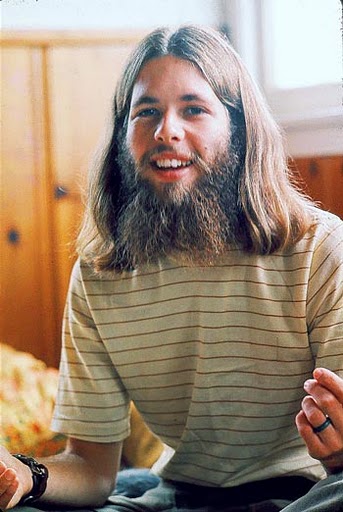
Lonnie Frisbee, 1949-1993
Lonnie Frisbee was an amazing Jesus freak. Being a key figure and informal leader of the Jesus People Movement in the 60’s and 70’s, his impact on Western Christianity is huge. With his long hair and beard he tried to look like Jesus himself “because there’s no one else I want to look like”, he preached on the beaches to his hippie friends that the Holy Spirit is even better than LSD and brought thousands of them to church.
The Jesus movement spread rapidly across California, US and the world, but most churches closed the door for them – after all, they were hippies. A church that did welcome them though was Calvary Chapel led by Chuck Smith, not because he was a hippie, nor because he wanted to become one, but because he liked them.
While Chuck emphasized Bible studying and evangelical values (which Lonnie thought was awesome) Lonnie himself was a holy roller. He cast out demons, spoke in tongues, healed the sick and prophesied loudly. He proclaimed himself to be a prophet and a mystic, and the whole Jesus Movement became a radical charismatic movement.
In 1980 he visited John Wimber‘s Vineyard church and released the youth into full scale charismatic renewal, which had a huge impact on Wimber himself and the whole third wave charismatic renewal. In John Wimber: The Way it Was, John’s wife Carol Wimber shares how important Lonnie was for the Vineyard, and she has some awesome testimonies from a trip to South Africa she, John and Lonnie made where they literally saw the blind and lame being totally healed when they imparted the power of the Holy Spirit to them.
God vs Poverty, part 5: Praying
This is the fifth and final part of my God vs Poverty series.
Once we start praying and working for a better world, there is a risk of struggling in our own strength and power. And since everyone are sinners (Romans 3:10-18), the human way lined with failures, accidents, discouragement and fatigue. The Bible says that through the power of God, we are able to more than in our own force (Philippians 4:13). And that can sometimes be a little bit more dramatic than getting some extra energy as by an invisible vitamin kick. Sometimes, it means walking on water or raising the dead.
The ministry of Jesus and the apostles not only included human deeds but also acts of God, things that only God can do. While they gave money to the poor (John 13:29) and they also used the miraculous gifts of the Spirit to help them. As they combined action with prayer, there was suddenly no limit to what their aid work was able to do.
For example: Jesus raised a widow’s son from the dead, which besides being extremely joyful in itself saved her from economic misery (Luke 7:11-17). Jesus also did food miracles out of His compassion for the hungry (Matt. 14:13-21; 15:29-39). His healing miracles had an activist dimension as well; in Mark 10:46-52 He heals a blind beggar, who thus is rescued not only from a life in darkness but also from a life in poverty.
How to End Economic Inequality in the Global Church

Church Building in Clau-Clau, South Africa
During this semester I have taken a course in environmental economics at Uppsala University. Our final assignment for the course was to pretend to write an article for the Solutions journal that explores an economic solution to a sustainability problem. I chose to write about how economic inequality is a root cause to many sustainability challenges and argued that the church should start practicing economic equality again just like in Acts 2:44-45. Below is an excerpt (with some added subtitles), and the whole article can be downloaded right here: One Heart and Mind – A Challenge of Redistribution for the Global Church.
Redistribution on the Denominational Level
If the church sees itself as a global body of brothers and sisters equal in value, economic equality across borders is logical. This is not very foreign to Christian practical theology – the only time the New Testament talks about churches giving money to other churches, it is stated that “[t]he goal is equality”.[1]
On the denominational level, the Roman Catholic Church has a unique position. It is one single transnational organization with 1.2 billion members, with most people in the global South and most money in the global North. Because all national jurisdictions are subordinated to the Vatican leadership, redistribution would be easier practically compared to a network of autonomous denominations. Since the current pope, Francis, is Latin American and emphasizes the importance of poverty reduction, social justice and simplicity;[2] internal redistribution of finances may not be a totally foreign idea for the Vatican.
Ideally, ecclesiastical provinces and dioceses should be economically equal, adjusted to population and a certain list of needs like poverty, climate change vulnerability, special interests of the Church, etc. This would result in that churches in developing countries generally becoming slightly richer than their Western counterparts.
Why Santa Shouldn’t be a Penguin, but a Dead Penguin

Santa
Earlier this week Aisha Harris wrote an article about how confused she was as a child since Santa Claus who was sitting in the malls and who was present in the television shows was white, but the Santa who visited her African-American home was black. She argues that the normative white male Santa is problematic and argues that Santa instead should be a penguin, that people of all colours can relate to. Megan Kelly from ultra-conservative Fox News got frustrated and argued that Santa has to be white and that Jesus was white, which of course He wasn’t.
Initially I liked the idea of a penguin Santa, and there’s already a lot of pictures of her/him, but then I thought – why do we need Santa? Today Santa is king of consumerism, speeding up environmental destruction like crazy in order to give stuff primarily to rich people. As I say in my campaign video Selling Christmas (below), Jesus’ model of generosity was about selling stuff and give the money to the poor, while the Christmas generosity is about buying stuff to give to the rich. An awful way to celebrate the birth of the homeless Saviour.
Santa is thus a not very good represntative for S:t Nicholas either, since he gave gifts to the poor children so that they would survive, not playstations or mascara. So I’d say we kill Santa. Replace him with Jesus, the Middle Eastern version, and share His Gospel about justice and eternal life. And give your money to Unicef or Iris Relief instead of buying unnecessary stuff. Merry Christmas!
Related articles
- Santa Is A Penguin (combine26to28.wordpress.com)
- The (Race) War on Christmas: Megyn Kelly Declares ‘Santa Claus Just Is White’ and So Was Jesus (mediaite.com)
- Really?? Fox News Anchor Tells Black Kids Santa Claus AND Jesus Are White So Stop Complaining (bossip.com)
- Harris: It’s time to give Santa Claus a makeover (newsday.com)
God vs Poverty, part 4: Liberating
This is as the title suggests the fourth part of my God vs Poverty series.
“Give a man a fish and he has food for a day. Teach him to fish and he has food for a lifetime.” We’ve all heard that, haven’t we? It’s a good proverb about the importance of empowerment and long-term solutions in aid giving. But what about the lake? What if the man cannot fish even after we taught him because the lake is polluted by a multinational corporation, or illegal to fish from because of an unrighteous regime? In other words, are there structures that are blocking development and poverty reduction?
The Bible is well aware of structures that oppress the poor. It is very common that the Old Testament not only talks about giving to the poor but treating them fair in court (see for example Prov. 22:22-23), so that they will not be discriminated. When Isaiah prophesies about true fasting, he doesn’t just talk about giving food and clothing to the ones in need but he also says that it includes “to loose the chains of injustice and untie the cords of the yoke, to set the oppressed free and break every yoke” (Is 58:6). In order to fight poverty effectively, we have to identify oppressing structures and crushing them.

Pope Francis, Capitalism and the Gifts of the Holy Spirit

Francis. Photo: Tomaz Silva
I told you he would be a good pope! Francis has become extremely popular both within and outside the Catholic world. He both teaches and practices simplicity and mercy; he wears simple clothes and refuses to live in the fancy apostolic palace while emphasizing the duty of Christians to embrace the poor, wounded and lost. Recently, his apostolic exhortation Evangelii Gaudium has received a lot of attention in the media. It is mainly about evangelism and missions, but what has caught the attention of many is his criticism of capitalism:
“Just as the commandment ‘Thou shalt not kill’ sets a clear limit in order to safeguard the value of human life, today we also have to say ‘thou shalt not’ to an economy of exclusion and inequality. Such an economy kills.
“How can it be that it is not a news item when an elderly homeless person dies of exposure, but it is news when the stock market loses 2 points?
“As long as the problems of the poor are not radically resolved by rejecting the absolute autonomy of markets and financial speculation and by attacking the structural causes of inequality, no solution will be found for the world’s problems or, for that matter, to any problems.”
Many are quite surprised by this and speculate whether it is an influence of Latin American liberation theology, since pope Francis comes from Argentina. However, while Francis definitely has a stronger emphasis on social justice than his predecessors, this thoughts should probably by no means have been alien to them. John Paul II wrote in his encyclical letter Centesimus Annus:
“It would appear that, on the level of individual nations and of international relations, the free market is the most efficient instrument for utilizing resources and effectively responding to needs. But this is true only for those needs which are ‘solvent’, insofar as they are endowed with purchasing power, and for those resources which are ‘marketable’, insofar as they are capable of obtaining a satisfactory price. But there are many human needs which find no place on the market. It is a strict duty of justice and truth not to allow fundamental human needs to remain unsatisfied and not to allow those burdened by such needs to perish.”
God vs Poverty, part 3: Working
This is as the title suggests the third part of my God vs Poverty series.
In the last part of God vs Poverty, I talked about the importance of giving aid to the poor. I am critical to the “trade instead of aid” idea expressed by people like Dambisa Moyo (who thinks that all aid to Africa should be stopped in five years) simply since it is irresponsible, harmful and not very smart. Trade is not the magical solution to poverty reduction, since many companies only have their own profit in mind. In contrast, aid agencies have a genuine goal to help the poor.
Still, trade is important. In fact, it’s necessary for poverty reduction. Acts 20:33-35 says:
“I have not coveted anyone’s silver or gold or clothing. You yourselves know that these hands of mine have supplied my own needs and the needs of my companions. In everything I did, I showed you that by this kind of hard work we must help the weak, remembering the words the Lord Jesus himself said: ‘It is more blessed to give than to receive.’”
In other words, if we are able to work but aren’t doing it, we are using resources that could have been given to the poor. As long as we are healthy and there are job oppurtinities, we should work. But we must remember that all jobs aren’t good jobs!
Selling Christmas
How could you possibly celebrate the birth of a Saviour in a better fashion than mass consumption and environmental destruction? Well, perhaps you can. Christmas is all about generosity, and Jesus surely liked that, but the Christmas generosity seems to be about buying stuff that you primarily give to rich people, while the Jesus genorosity was about selling stuff and giving the money to the poor (Mark 10:21).
How about we use this season where everyone wants to buy stuff to sell stuff? It’s good for the environment and we will be able to give a lot more to beggars and aid organizations. Simply go to second hand websites or donate them to some charity driven second hand store.
It’s something that’s surely gonna make the reason for the season very happy 🙂 Merry christmas!

Shopping Jesus, from Soul Thoughts
God vs Poverty, part 2: Giving
This is as the title suggests the second part of my God vs Poverty series.
Rich folks are experts on producing arguments why we shouldn’t give to the poor. Have you also heard Christians using this Bible verse as Bible proof for inaction:
“Each of you should give what you have decided in your heart to give, not reluctantly or under compulsion, for God loves a cheerful giver.” – 2 Cor 9:7
Was Paul’s point really that if you are a grumpy, greedy Scrooge McDuck, God is perfectly fine with that? No, of course Paul wants us to be cheerful givers, and he states in the next verse that we will be poorly rewarded in Heaven if we aren’t generous on earth, but his point is that we cannot force people to be generous. Giving to the poor still is our duty though: to refuse to give to the needy even if you’re able to, is sinful (Deut 15:9).
Another argument against giving to the poor is an unbiblical one: aid doesn’t work. This is both applied to foreign aid and giving to beggars on the streets. In the former case, people blame corruption and other structural problems, or they simply state that aid undermines incentives to work. In the latter case, people blaim drugs and other social problems, or state that rewarding begging undermines incentives to work.
(more…)
An Economic Explanation to Speaking in Tongues
 I’m taking two courses right now, one in exegesis (Bible interpretation) and one in environmental economics. I see numerous parallells between them. In the exegesis course, I’m doing interpretations of Deut 15:7-11 and Luke 21:1-4 – about how the rich are sinning if they don’t give to the poor and how it’s not about how much you give but how much you have left that matters. And in the economics course, we were assigned to make a video where we try to answer a random question using economic theories. I chose the question “Why do Pentecostals speak in tongues?” Enjoy!
Related articles
- Whatever you need to know about Economics, get it here (edwardcollin742.wordpress.com)
- Lazarus and the Rich Man – Act 3 (friarmusings.wordpress.com)
- Speaking in Tongues: Medical Study proves it’s the Holy Spirit praying (discernthetime.wordpress.com)
- (1) What is the gift of speaking in tongues? (altruistico.wordpress.com)
God vs Poverty, part 1: Loving
As promised, here comes the first part of the new official sequel to God vs Wealth, creatively called God vs Poverty. While the former video series discussed whether a Christian should be rich or not (and found out that the answer was “not”), this series will look at what the Bible says about poverty reduction. It was filmed when I visited Iris South Africa (with a lot of wonderful children “helping” me with the shooting) and consists of five parts:
- Loving
- Giving
- Working
- Liberating
- Praying
In this first part, I argue that poverty reduction must be based on love and that one of the main economic problems in the world is that the rich don’t know the poor. South Africa is one of the most unequal countries in the world and the reason is of course that the rich separated themselves and refused to get to know the poor. When people from different socio-economic classes become friends, it will be impossible for the wealthy to ignore their needs and problems of the needy. Our generosity should not be excluded to people we know of course, but if we only know people with our own socio-economic status, something is terribly wrong. (more…)
Capitalism and the Sin of Self-Interest

Yesterday, IPCC presented the first part of their new report about climate change in Stockholm, Sweden, and it was yet another reminder of the horrible catastrophy we have put ourselves into. The economic system that created climate change and other environmental problem is structurally wicked and needs to change quickly if we are going to save the lives of all the people that are in risk of dying because of environmental destruction and natural disasters. We have to challenge and change capitalism.
All the bishops of the Lutheran Church of Sweden wrote an article in our biggest newspaper today where they argued that changing our lives in response to climate change is a spiritual matter that the church has to adress. I completely agree. In fact, I think the reason why the capitalist economic system has put us into this mess is because it is detached from Christian holiness.
Of course, not everyone think this is the case. I once read an article by a Christian who claimed that the Bible supports capitalism, and he challenged the “misconception” that capitalism is based on greed and thus is sinful. This is not the case, he said, because self-interest does not equal greed, but is something all people base their lives on. Whenever we eat a sandwich we do it out of self interest, and there is nothing wrong with that, he said.
The problem with this argument is that the Bible actually says that self-interest is wrong:
“Do nothing out of selfish ambition or vain conceit. Rather, in humility value others above yourselves, not looking to your own interests but each of you to the interests of the others.” – Phil 2:3-4
Is the Church of Acts Abnormal?

In my pursuit for combining signs and wonders with peace and justice, I often get to see parallells between the Charismatic and activist streams of Christianity. One is that both want to get back to the original church; Pentecostals, as you probably know, want to resurrect the charismatic explosion of Acts 2, and radical Christian activists want to see the community of goods and the overflowing love and unity of Acts 2.
But then there’s a problem both parties face. Some Christians don’t want to return to Acts, basically because they argue that Acts was temporary – we’re not supposed to live like that any longer. You will find this among cessationists, who argue that the miracles in the book of Acts died with the apostles, and among most other Christians as well who argue that the community of goods and radical economic equality of the early church was just a temporary experiment. The church of Acts may have been good for that time but is not very relevant for our churches today. Guess we’re smarter now, or something.
This view has always surprised me since the very reason we value the New Testament as the Word of God is that it’s written by the apostles, or their direct disciples. The apostles had authority (Acts 2:42) since they were elected by Jesus and were the first church leaders. How come that we value their words more than their lives? If they were healing the sick and practicing community of goods, how could that possible be abnormal Christian living?
Jack Deere has written about this. He’s an ex-cessationist who became one of the main leaders in the Charismatic Vineyard movement after the Vineyard pastor John White went to his church and healed som people and drove out some demons. He really nails the problems with the theology of the abnormal Acts in his book Surprised by the Voice of God (Kingston 1996, ss. 61-63), which I qoute below: (more…)
 Charismactivism