
Home » Posts tagged 'Equality' (Page 2)
Tag Archives: Equality
The author

Micael Grenholm, a Swedish charismactivist, apologist and author.
Why Capitalism Will Never Save the Climate

I often hear that the Biblical views on the sinfulness of wealth, the need for simplicity and the universal calling to economic equality are radical ideas. But they’re actually extremely realistic, in contrast to the mammonistic and neoclassical ideas of the necessity of wealth, growth and inequality. Not only because the Biblical ideas, if put in practice, fights poverty much more effectively, but also because they’re the only ones that can reduce the devastating impacts of the upcoming climate change catastrophe.
The other day I listened to a very interesting lecture by professor Kevin Anderson from Manchester University. He talked about the really dangerous form of climate change denial, which isn’t the goofy ideas that the planet isn’t warming or that its warming but we’re not the primary cause and so on. Those views are rejected by the vast majority of scientists and most ordinary people don’t believe in them either. No, the real problem is when scientists adjust or deny their results in order to communicate that we can mitigate and adapt to climate change without too much reduction in economic growth and without adjusting our economic system. He writes on his website:
In several important respects the modelling community is self-censoring its research to conform to the dominant political and economic paradigm. Moreover, there is a widespread reluctance of many within the climate change community to speak out against unsupported assertions that an evolution of ‘business as usual’ is compatible with the IPCC’s 2°C carbon budgets. With specific reference to energy, this analysis concludes that even a slim chance of “keeping below” a 2°C rise, now demands a revolution in how we both consume and produce energy. Such a rapid and deep transition will have profound implications for the framing of contemporary society and is far removed from the rhetoric of green growth that increasingly dominates the climate change agenda.
Why Churches Should Abandon Stage Lights and Fog Machines

Are there any reasons to believe that colourful stage lights and fog machines are anything else than the toys of Christian stage technicians and a compensation for lack of Biblical revival? No. The global trend of churches investing billions of dollars in superfluous show equipment has increased dramatically over just the last few decades, but not many have asked themselves why we do it and what happens to church when we do it.
Of course, if someone dares to question this unbiblical practice that person is easily dismissed as someone who doesn’t understand young people or who isn’t into culturally relevant evangelism. So hi, I’m a young evangelist, and I hate stage lights. And fog machines, those horrible, stupid fog machines! How painfully obvious isn’t it that modern, Western churches lack God when they literally try to fabricate something which the Scriptures describes as a manifestation of the Lord’s presence?
As I’ve explained in my God vs Wealth series, Jesus doesn’t want us to be rich but live as simply as possible so that we can give as much to the poor as possible. This applies not just to individual disciples but to churches as well. There are hundreds of millions of Christians around the world living in poverty. If we truly think that they are our brothers and sisters, we can’t ignore their suffering by spending loads of money on superfluities.
As John puts it: “If anyone has material possessions and sees a brother or sister in need but has no pity on them, how can the love of God be in that person?” (1 Jn 3:17) (more…)

The History of the Jesus Army
Today on the MennoNerd vlog I talk about how awesome it is that the Jesus Army organises their local congregations around their intentional communities, where people live, eat and sleep every day, rather than around unbiblical church buildings that stand empty most of the time:
This is just one of many things that make the Jesus Army different from many other churches. The church owned businesses where everyone receive the same wage, the support for celibates, the emphasis on covenant and unity and the loud and proud emphasis on Jesus is quite extraordinary. Where does this church come from and what does its history look like? Those were the questions me and Sarah brought to Mike Farrant, who lives with me at the Holy Treasure community in Kettering, in a recent episode of our Swedish podcast “Jesus People”:
Mike shared how it all began when an outpouring of the Holy Spirit hit a Baptist chapel in the small town of Bugbrooke, Northamptonshire, which made hundreds of student, hippies, drug addicts, businessmen and many other sorts of people join the church. They soon started to practice community of goods like in the book of Acts and changed name to Jesus Fellowship Church. Mike has been living in community for 41 years and obviously knows a lot about both its advantages and challenges.
How the “Everything in Common” Documentary Was Made
My documentary about community of goods at the Jesus Army now has over 750 views on YouTube, and I’ve received lots of positive feedback not the least from fellow Jesus people folks. Recently I had the opportunity to contribute to Jesus Army’s Colourful Church blog, writing about how the film was made. Here’s an excerpt:
My plan was not to make a second trip, but to only use the material I recorded in 2014. And that could certainly have been the case, the material was, as mentioned, quite extensive. But life went on, half a year passed without me starting the editing process. I only used the material once when I made a clip for my YouTube channel Holy Spirit Activism in which Huw describes how the Jesus Fellowship started to practice community. It was mixed with Kalimba by Mr Scruff, which was simply included as sample music on my laptop. The clip turned out to be very good and is actually included in its totally in the documentary (save the introduction I recorded in my Swedish bedroom).
But again, I didn’t find time to start with the actual documentary. Then suddenly, in January 2015, Holy Spirit inspiration hit me. For some reason I just wanted to make documentary and nothing else, and so I sat for about ten hours and edited in Windows Movie Maker, which was the only editing software I had. I delayed my school work just to edit this film. And during that session I produced what’s pretty much still the first 14 minutes of the film. (more…)
Why Do You Want Richness?
Guest post by Taruna Rettinger

Blessed are the poor and blessed are the poor in spirit
*
Blessed are the poor
Why do you want richness?
Blessed are the poor
Why do you keep slaves for your comfort?
Blessed are the poor
Why do you seek wealth on earth?
Blessed are the poor in spirit
But you want to feel rich
Blessed are the poor in spirit
But you want to be served by others
Blessed are the poor in spirit
But you want wealth here and now
“Blessed are the poor in spirit, for theirs is the kingdom of heaven.”
So feel your poverty in spirit and cry for Heaven
“Blessed are you who are poor, for yours is the kingdom of God”
So strive for poverty and long to live with God
Pentecost Wasn’t A Mistake

Community life at Jesus Army
Article written for New Creation Christian Community, Jesus Army’s community organisation.
I’ve never viewed Pentecost as a mistake.
The first time I read the remarkable account in Acts 2 of how the Holy Spirit filled Jesus’ disciples with miraculous power so that they could speak other languages; how Peter’s passionate sermon resulted in 3,000 receiving Jesus; how all the disciples then had everything in common so that nobody had to be poor – I knew that this was good. In fact, it was awesome. Luke’s point isn’t that this is a tragic event that shouldn’t be repeated, he’s describing the best church ever!
I realised that a lot of miracles are better than a few miracles, that a lot of saved people are better than a few saved people, and that no economic inequality is better than existing economic inequality. I realised that if I were to claim that we don’t “need to” make our churches look like Jerusalem, I would in fact be arguing that our churches don’t need to be as good as they should.
It would be like saying that a fire extinguisher doesn’t need to extinguish fire, or that a surgeon doesn’t need to save the lives of the patients he or she is caring for. (more…)
Is Community of Goods for Everyone?
As a passionate advocate for community of goods, I often get the question whether every Christian “has to” have everything in common, if it’s a universal commandment or a calling for some. Most Christians seem to assume that’s the latter is true and get upset if I were to disagree. But in this video I’d like to challenge their conclusion, which I suspect that they have reached to quickly. There are three major problems with the idea that community of goods is just for some that need to be adressed:
- The Biblical problem: If it’s just for some, why is it portrayed as a universal commandment in Lk 12:33 and 14:33, and why did everyone do it in Jerusalem?
- The empirical problem: If individual economies and spontaneous giving are just as good as community of goods, why are the only churches who exterminate poverty within themselves churches that have community of goods?
- The demographical problem: Are all poor Christians called to community of goods?If not, why doesn’t God want to exterminate the poverty of all poor Christians? And if they are, don’t we need all rich Christians to join as well to finance it all?
For a more detailed description if these arguments, watch the video.
Why I Moved to the United Kingdom

I can’t remember what kind of Google search or hyperlink that first led me to the website of Jesus Army almost seven years ago, but I remember how thrilled I was to finally encounter an evangelical, charismatic church that has complete community of goods. The closest resemblance to such an apostolic church that I had previously discovered was in a dusty, old book in my father’s home library called In His Footsteps. I was so excited as I earnestly turned the pages and read about this amazing church in the middle of nowhere which took Jesus seriously, had everything in common and led countless people to the Lord. Then I came to the last page which revealed that it was all fiction.
But the Jesus Army was real! I sent them an email, asking to come and visit them in Northamptonshire for a few days in April 2010. I was interested in the Training Year they offer and wanted to get a feeling about what New Creation community life was like. It was amazing; as I’ve previously shared I was baptised in the Holy Spirit during that trip, and I was so encouraged to see that community of goods is not just possible in the western world today – it’s very effective!
Without giving any convinced promises I told the Jesus saints that I wanted to do a training year (or rather, six months) in 2011. But after some time I told them I wasn’t going. I was feeling too young, insecure and inexperienced to take such a step. God was good and let me experience some amazing things in Sweden during that time. But I now know that of course I would have enjoyed and benefited a lot from a Jesus Army training year back then. I’m not luring myself into believing that whatever my life ends up like is what God wanted all along. He wants me and everybody else to share our possessions from the day we are saved. But even as we fail God can lead us onward, never forsaking us but faithfully caring for us.
Obstacles and Opportunities for a Christian Community Revolution
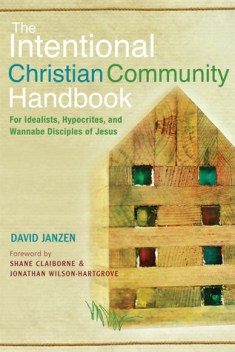
Half a year ago I cofounded an association here in Sweden called the Jerusalem Project, which promotes Christian community life and aspires to make community of goods like in the book of Acts more common in the churches. I and the others in the board have been planning for some months to start an intentional community if our own next year, and as a preparation we follow a common rule that outlines a simple lifestyle, prayer routines, Bible reading and ethics. We also read The Intentional Christian Community Handbook by David Janzen together and discuss it over Skype.
In Janzen’s book, Brandon Rhodes has contributed with some great chapters on how modern culture impacts the prospects for increasing Christian community life. In the West, people are more individualistic than they used to be, which is both an obstacle to community since such a life is very communal, as well as an opportunity since it may stir a longing for an alternative social way of living.
Rhodes also point out that more people than ever before come from divorced families, that the line between youth and adulthood has been completely blurred, and the fact that people are online more than ever. These things, and many more, pose challenges to community life that need to be taken seriously. (more…)

It’s Here: Everything in Common, a Documentary About the Jesus Army
In a British church known as the Jesus Army, around 400 Christians share all their possessions just like in the book of Acts. This documentary explains how such a community of goods works practically, how it affects those who are part of it and what other churches may learn from the Jesus Army when it comes to having everything in common.
Watch the whole film right here:
It took me two years to make Everything in Common. The quality is obviously not top-notch, but the passion and love I have for this way of living truly are! 🙂 I’m very grateful to God and to all those who helped me finish this project.
If you watch the film, I would love to get some feedback! Just comment below or contact me personally. Blessings!
Rules for Christian Community

Me and Sarah Stenmark from the Jerusalem Project with two nuns, who shared with us what community can look like
I’m so excited! Today I’ve had a Skype meeting with some brothers and sisters in the Jerusalem Project, an association I co-founded a few months ago that encourages Christian community of goods in Sweden. We talked about the vision for community that God has put in our hearts, and we listed some basic principles that we want to be foundational for the community that we plan to start, a community where everyone have everything in common.
As some inspiration for such a rule, I have looked at both ancient and modern examples of monastic rules. I will give you two examples here before I showcase what principles we have talked about in the Jerusalem Project.
The Old
First out is St. Basil’s rule, written in the fourth century. These are just the chapter titles, the actual rule is like a small book: (more…)
Come and See: How Community of Goods Can Become Normal Again

My documentary about community life in the Jesus Army – Everything in Common – is almost complete. It still needs some sound mixing and small fixes, but in a month’s time I will release it on my YouTube channel. I have shown the film to some friends here in Uppsala and many have become inspired and fascinated by this kind of living by watching it. Here’s a snippet where some Jesus saints explain what community life means to them:
The people that have joined me on my trips to the Jesus Army have become dramatically inspired as well during the visits. Just seeing community of goods in practice makes so many disciples thirst for it. Asking people to “come and see” where we live, as Jesus did (Jn 1:39) is a simple but effective way to catalyst a movement.
Many communities have historically been quite isolated, which really isn’t a necessary component of community of goods but a natural consequence of many of them being rural due to their means of sustainance as well as skeptical to communication technology due to their values of simplicity. (more…)
Podcast: Simplicity and Sustainability

I had the privilege of joining the MennoNerds Panel talk on simplicity and sustainiability last Tuesday. I had proposed the topic since fighting personal wealth and promoting a simple lifestyle are issues that God really has put on my heart. Participating were MennoNerds Hillary Watson, Paul Walker and myself, with Mark Groleau as moderator. You can listen to it in the MennoNerds podcast as well as in the YouTube clips down below:
During the first hour, we talked about theological and theoretical perspectives, such as:
- How do we define simplicity?
- What are the Biblical arguments for the need of simplicity?
- What are the Biblical arguments for the need of environmental sustainability and creation care?
- Should Christianity be seen as an anthropocentric religion, i.e. how do we deal with ideas like having dominion over the Earth?
It should be noted that we were a bit divided on anthropocentrism, whereas some questioned this I for example argued that it’s not just Biblical but morally necessary. (more…)
The Anti-Community Conspiracy in Biblical Scholarship
Extremely few Protestants live in a community of goods similar to that of the apostolic church in Acts 2 and 4. In fact, most Protestant denominations don’t have any single community connected to them. Just like charismatic, supernatural gifts used to be a rarity within Protestantism due to cessationism, something that has drastically changed over the last century, so is having everything in common. Both miraculous power and community life are biblical practices that many Christians simply don’t want, and both charismatic cessationism and economic cessationism have been defended and strengthened by forms of academic theology which quite frankly use very bad arguments.

Reta Halteman Finger
Mennonite scholar Reta Halteman Finger wrote an excellent paper back in 2004 called ”Cultural attitudes in western Christianity toward the community of goods in Acts 2 and 4” (Mennonite quarterly review, vol. 78, no. 2). It’s a baffling read. An obvious mistake from Catholic and Orthodox theologians during pre-Reformation times was to equate the apostolic community of goods in Acts with the community of goods in the monastic movement, even though the latter is only available for celibates.
When Luther and Calvin protested in the 16th century, they rejected the monastic movement and thereby community of goods. Both argued that the only lesson we should learn from Acts 2 and 4 is that we should give a little gift sometimes to a poor person, not that we should have everything in common with them. They criticized Anabaptists for wanting to live apostolically; Luther argued that it is impossible to do what the apostles did for modern believers. The Hutterites proved him wrong, having lived in total community for over 400 years.
As liberal theology and the historical-critical method in biblical scholarship sprung up during the 19th and 20th century, Protestant academics such as Eduard Zeller, Ernst Hanchen, Hans Conzelman and Luke T. Johnson questioned the historicity of Luke’s account in Acts 2 and 4. Their main argument for this was that community of goods in their eyes is extreme and difficult, therefore the author of Acts must be making it up. Haenschen for example argued that only celibates can manage to live in community, suggesting that Hutterites don’t exist. (more…)

Why the Prosperity Preaching at Bethel Church is a Huge Problem
Kris Vallotton at Bethel Church recently held a sermon called “Poverty, Riches and Wealth” which is nothing less than pure, economic prosperity preaching. His conclusions are basically that all Christians with some few exceptions should be rich and that wealth isn’t a problem as long as it multiplies and grows exponentially. In this video I respond to his arguments and show why they don’t work:
As you may know, I’ve argued that Christians should not be rich in my God vs Wealth series and I recently did a Holy Hangout on prosperity theology with some friends where I criticized the “health and wealth gospel” for being unbiblical and hurtful.
Now, some people have told me that Vallotton’s position actually is “balanced” and even close to my own, that he’s not that off after all. I strongly disagree. I was surprised to hear how radical his prosperity thinking was and how deliberately he ignored or distorted relevant Bible passages.
Vallotton starts off in 1 Tim 6, arguing that love of money isn’t the root to all evil but a root to some evil (the text actually says a root to all evil). He does not mention verses 5-9 at all, probably because they crush all forms of economic prosperity theology. Verse 5 talk about “people of corrupt mind, who have been robbed of the truth and who think that godliness is a means to financial gain.” (more…)
 Charismactivism