
Home » Posts tagged 'Bible Study' (Page 5)
Tag Archives: Bible Study
The author

Micael Grenholm, a Swedish charismactivist, apologist and author.
The Bruderhof on Why Community of Goods is for Everyone

Bruderhof folks in Georgia. Image from emerging-communities.com
The Bruderhof is a radical, Anabaptist Christian movement that has practiced community of goods since the 1920’s. Founded in Germany, it had to flee Hitler going to Paraguay, the US and England, although new communities around the world are emerging. Their website and YouTube channel is packed with inspiration and teaching on community of goods, and I found this article by Charles E. Moore to be a brilliant apology of why all Christians should have everything in common. Here’s an excerpt:
Peter does not tell Ananias that he could have come into the Christian community without renouncing the private ownership of his goods. How could he, when Luke wrote that “not a single one said anything was his own” (Acts 4:32) and that “whoever possessed fields or houses sold them,” and that “all the faithful together had everything in common” (Acts 2:44), and so on? Didn’t Jesus say to the crowds, “Every one of you who does not renounce all he has cannot be my disciple” (Luke 14:33). Ananias’ sin was that he pretended be a Christian via a counterfeit renunciation. This is why his sin was dealt with so severely. The entire thrust of both Luke and Acts is that those who follow Jesus freely give up everything.
Read the rest of the article here.
A Christian World Vision

I often debate with fellow Christians who, contrary to me, oppose migration from poor countries to rich countries, aid from rich countries to poor countries or that rich countries should take greater responsibility for the environment than poor countries by living simpler. When I argue for why I think these ideas are good, I often point to facts and statistics that for example show that poor countries receive 80 % of all refugees today, or that aid donations are less than 0.3 % of rich countries’ GDP, or that environmental pollution kill more people today than malaria and HIV. Quite often I even have to start with explaining that rich countries are rich; most xenophobic people here in Sweden think that Sweden isn’t a rich country, which of course is the opposite of what the Global Wealth Report recently stated.
However, while I believe these facts are important for the discussion, they are seldom sufficient for my adversaries to change their mind. I find over and over again that even if we can agree upon that the world is unequal and unfair, they don’t have a problem with that while I certainly do. We have different world visions, and they often tell me that I shouldn’t claim that my world vision is more Christian then theirs.
But it is.
Jesus’ ethical teaching is clear and straightforward. Do to others what you would have them do to you (Mt 7:12). That’s a universal command, meaning it applies to all human beings. We should love everyone, even our enemies, and do good to them just as the Father loves and does good to all human beings (Mt 5:43-48). (more…)
Can Christians be possessed by demons?

Jesus Exorcism
The Assemblies of God (AoG), the biggest Pentecostal denomination in the US, has famously argued that it is impossible for Christians to be possessed; no one who has received the Holy Spirit, they say, can be overtaken by demonic forces. This differs from the view shared by many neo-Pentecostals, charismatics, Catholics as well as many Pentecostals in the majority world (Asia, Africa and Latin America), who all say that Christians might actually become demonized.
When John Wimber, the founder of the Vineyard movement, was asked if he believed that Christians could have demons, he provokingly replied “Well yeah, I’ve cast them out of pastors!” His wife Carol wrote in her biography about her husband something like: “When we encountered a demon, we simply cast it out – without checking baptismal records. What else could we do? Wait until they become Hindus and then cast them out?”
Now, AoG-folks and like-minded may object that such allegorical evidence does not mean much compared to arguments from Scripture. Which is generally true, although in this particular case the usual claim concerning extra-Biblical supernatural phenomena – it’s a demonic deception! – is quite counterproductive. But the Bible is always important in theological matters, so let’s have a look. (more…)
Did Jesus Say that Poverty Will Never be Eliminated?

My favourite Global Goal. To fight poverty we also need to fight wealth.
Today is a historic day, the United Nations General Assembly adopted the Global Goals for sustainable development just a few hours ago. These goals are sort of a sequel to the Millennium Development Goals (MDGs) which has been surprisingly successful in making the world a better place: extreme poverty has been cut in half, hunger too, more children go to school, less women and babies die in childbirth, and people live longer. Praise God! John Green, educated Youtuber and a Christian, explains briefly the achievements of the MDGs in this video:
The Global Goals step things up a bit though; the new ambition is to totally eliminate extreme poverty by 2030 and also make sure that nobody goes hungry. Other goals (there are 17 of them) include global gender equality with no more discrimination against women anywhere, reduced economic inequality, reasonable consumption, action against climate change and environmental pollution, etc.
Should Christians support the Global Goals? Duh, obviously. Helping the poor and caring for God’s creation is extremely Biblical, isn’t it? Well, some brothers and sisters do object against the goals in general and the first one about ending poverty in particular. The general critique against goals like this is that we should not imagine ourselves being able to turn this world into a paradise, since all men are sinful (Rom 3:23) and the Kingdom of God is not of this world (Jn 18:34). The particular critique against the idea of ending poverty is that Jesus actually said:
The poor you will always have with you, and you can help them any time you want. But you will not always have me. (Mark 14:7)
Why Does the Bible say “The Lord Sends Poverty and Wealth”?

Hannah praying
When the Lord miraculously helped an Israelite woman named Hannah to bear a child, she praised Him in a prayer that is recorded in 1 Samuel 2. It says, among other things: “The Lord sends poverty and wealth; he humbles and he exalts.” (v. 7) Like basically every Bible verse ever, it has often been taken out of context to be used as a proof text for people’s personal views. In this case, it has been argued that 1 Sam 2 divinely sanctions the poverty of the poor and the wealth of the rich, as well as promoting fatalism. I’ve heard several times “It’s not wrong to be rich, it says that the Lord sends wealth”, and sometimes also “It’s useless to fight poverty, it says that the Lord sends it.”
Here’s a radical idea: Let’s look at the context! Hannah says in verses 4 and 5: “The bows of the warriors are broken, but those who stumbled are armed with strength. Those who were full hire themselves out for food, but those who were hungry hunger no more. She who was barren has borne seven children, but she who has had many sons pines away.”
Thus, Hannah argues that there is a transition of fairness at work, where the first will be last and the last will be first. And who’s responsible for this?
Lecture: Signs, Wonders and Social Justice

You know what’s awesome? Miracles! You know what’s also awesome? Social justice! Let’s combine the two, like Jesus did. The Spiritual gifts that God has equipped His church with are supposed to be used to serve others (1 Peter 4:10), and obviously our activism for a more equal and just world will be even more effective when the Holy Spirit empowers us with supernatural abilities. A couple of months ago I hold a lecture on this core idea of Holy Spirit Activism:
It’s super-obvious that miracles and social justice go hand-in-hand in the Holy Scriptures: the Old Testament prophets exercised many miraculous gifts while promoting the rights of the poor and marginalised (see for example the book of Amos); Jesus healed the sick and cast out demons right before His famous Sermon on the Mount about social ethics (Mt 5); and as the apostolic church was filled with the Holy Spirit and spoke in tongues they eradicated the gap between rich and poor through community of goods (Acts 2).
In the lecture I go through these and other relevant Bible passages, as well as sharing testimonies from people today who combine miracles and social justice, like Simon Adahl and Heidi Baker. I also bring up and criticize theologians and philosophers who deny the existence of miracles or at least its presence in the life of the ordinary believer, like David Hume, Rudolf Bultmann and John MacArthur. Enjoy the video!
7 Reasons Why House Churches are Awesome
Who needs buildings when you have homes? Here’s a video I made where I describe why I’m such a passionate promoter for house churches. The seven reasons are the following;
1. They’re biblical – Acts 2:46, 1 Cor 16:19, Col 4:15 and other passages tell us that the early Christians met in homes. The earliest archeologically discovered church, the Dura Europos church, was a house church. In fact, church buildings where people didn’t eat and sleep wasn’t constructed until the late third and early fourth century.
2. They’re utilized – again, people actually eat and sleep there. Most church auditoriums – the big room with a lot of pews – stands empty for the most part of the week. Homes, in contrast, are usually used daily.
3. They’re small – and this is a good thing! 1 Cor 14:26 tells us that everyone attending a church meeting should contribute with something. When was the last time you’ve experienced that? Frankly, you need a small group to have such a wonderful spiritual interaction. (more…)
Prophet Isaiah (700 BC): Bring Food to the Arab Refugees!
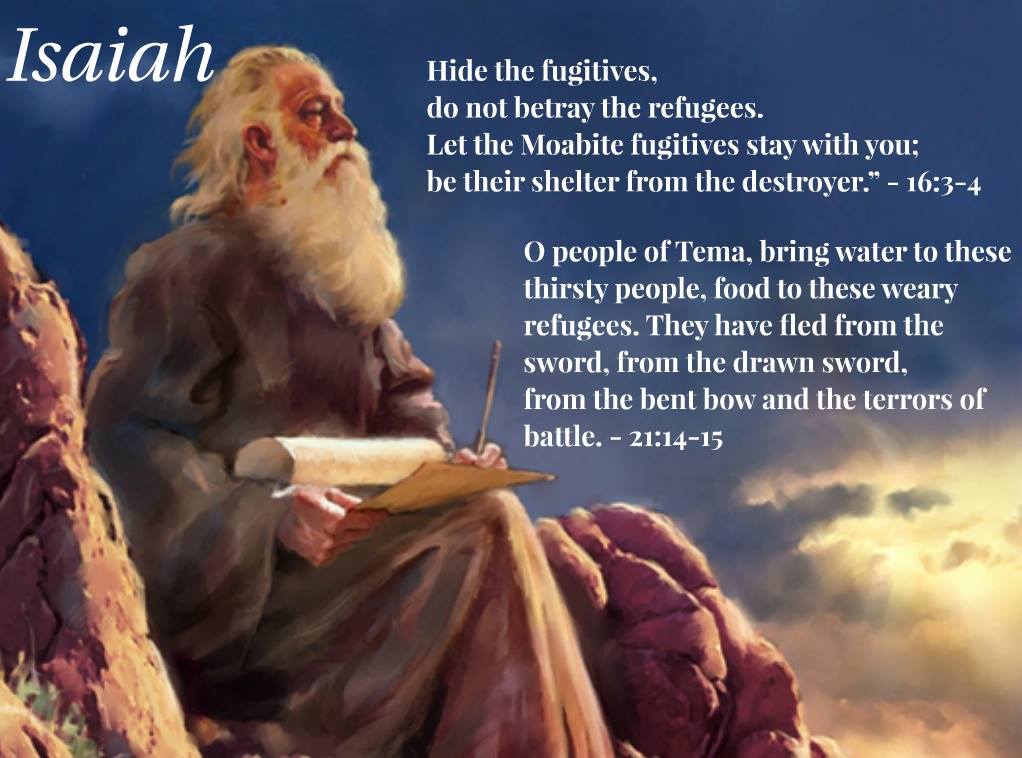
Earlier this summer when I was preparing my lecture Jesus vs Xenohpobia, I went to my favourite Bible study site biblehub.com and searched the Scriptures for the word “refugee”. Two passages touched me in a special way, both being from prophet Isaiah’s book.
Isaiah 16:3-4 says: “Hide the fugitives, do not betray the refugees. Let the Moabite fugitives stay with you; be their shelter from the destroyer.” This is in the middle of a prophecy against Moab, that warns the kingdom for an upcoming disaster. In the previous chapter, God says: “My heart cries out over Moab; her fugitives flee as far as Zoar, as far as Eglath Shelishiyah. They go up the hill to Luhith, weeping as they go; on the road to Horonaim they lament their destruction.” (Is 15:5).
It is thus clear that even though this catastrophe is described as being the result of God’s judgment due to the idolatry of the Moabite people, He still cares for them and wants people to give them shelter from the ones who destroy them. Even people who do not worship the Lord still deserves love, care and humanitarian aid. (more…)
Countering 7 Arguments Against Community of Goods
We’ve now taken the train home to Sweden after an incredible Jesus Army week in the UK. One of the last things I got to do was to organize a little round table with Huw and Mike who both have lived in Christian community for almost 40 years, I brought up seven arguments against community of goods that I often hear when I discuss the topic, and asked them to counter them. You can enjoy it in the video above, and below are the seven arguments along with a brief summary of what we said:
1. There’s no command to have everything in common
Yes, the process of having everything in common – and thus eliminating poverty – starts with people selling what they have according to Acts 2:45 and 4:34. And to sell everything one has is exactly what Jesus commanded not just one rich ruler to do (Mt 19:21), but all His disciples to do (Lk 12:33)
2. Community was practised because the Jerusalem church was persecuted
They started to practise it before persecution, and the reason given was not that they excepted persecution but that they loved each other and didn’t want anyone to be poor. Besides, since “everyone who wants to live a godly life in Christ Jesus will be persecuted” (2 Tim 3:12), ought we not to live a life like that today?
3. Community was practised because the apostles errantly thought that Jesus would come back in their lifetime
Again, there is no reference in the Bible to any other reason for community of goods other than that the early Christians loved each other and didn’t want anyone to be in need. They also clearly wanted to follow the commands of Jesus, including the one in Lk 12:33. Besides, shouldn’t we have even more reason to expect Jesus’ soon return now 2000 years later? (more…)
Finding Lazarus in the Calais Jungle

Lazarus Church in Calais
This post is written by Jesus Army member Joram on the Forward blog. We met Joram the other day and he told us about what he had experienced in Calais. This text expresses both the pain and hope of the refugee camp in a brilliant way, which is why I re-post it here.
“There was a rich man who was clothed in purple and fine linen and who feasted sumptuously every day. And at his gate was laid a poor man named Lazarus, covered in sores, who desired to be fed with what fell from the rich man’s table…” (Luke 16:19-21)
Every generation has its ‘Lazarus’: the poor, mistreated, abused, and neglected. Part of this generation’s Lazarus is the third world migrants who wash up on the shores of Europe. Their governments oppress them, abuse them, imprison them, torture them; so those that can escape head for the rich man’s gate known as Europe.
 When they wash up on the shore after unspeakable tragedy at sea, some of them head for western France to Calais and the literal gate to the rich man’s land known as the Eurotunnel.
A diaspora of refugees with families shattered and scattered across the globe, children in one country, fathers in another, mothers in another. It was never meant to be like this.
They redefine the word poor – they have smartphones, Nike trainers, mp3 players and navigate at sea using Google Maps. But only because we, in the rich man’s kingdom, are so driven by our mad consumer desire for the latest ‘thing’, we throw last year’s stuff away. But don’t be fooled by this – the real poverty is the loss of loved ones, of being stateless, homeless, jobless and friendless. The sores on the modern Lazarus are underneath his skin, too deep to be seen by the superficial glance of the citizens of the rich man’s country. (more…)
Christian Community is for Everyone!

How good and pleasant it is when God’s people live together in unity! (Ps 133:1) We’ve now visited around seven different community houses here at the Jesus Army, and it’s so beautiful to see the mixture of different people. Everybody believe in Jesus of course, but apart from that there is great diversity when it comes to age, ethnicity, social background, employment and civil status. Everyone are welcome to join the community, as long as they are committed and serious about it.
This is obviously very Biblical as the apostolic community in Jerusalem that we read about in the book if Acts literally included all the believers: “All the believers were together and had everything in common. They sold property and possessions to give to anyone who had need.” (Acts 2:44-45)
In the Jesus Army’s New Creation Christian Communities, you meet all sorts of people. Yesterday and today we’ve spoken to former drug addicts who have been saved and joined the common purse, as well as academics, nurses and teachers. We’ve spoken to 90-year-olds and people in their 20’s, as well as to parents with kids under the age of five. Everyone are welcome to sell everything and join the community of goods, even those who hardly have anything and mostly bring their debts to the common purse! And there is a strong, tangible brotherhood in the church that is quite unique in our individualist society.
If We Want a Better World, the Rich Have to Pay for It!

We shouldn’t just talk about how to fight poverty, but also how to fight inequality.
In September, world leaders will gather in New York to agree upon new Sustainable Development Goals (SDGs) that will succeed the old Millennium Development Goals (MDGs). Several of the MDG:s were actually fulfilled, such as halving the proportion of poor people worldwide and increasing global health and literacy.
Now, the goals are even more ambitious, striving to eradicate poverty, hunger and illiteracy completely, along with environmental goals such as preserving ecosystems and combating climate change. A key to all this, I think, is goal number 10: to decrease inequality between and within countries.
People aren’t poor because there is a lack of resources in the world, but because they are unevenly distributed. 20% of the world’s population consume 80% of the world’s resources. And the mass consumption of the rich hurts the environment: if everyone lived like the average Swede, we would need three planets. If they lived like the average American, we would need five. In fact, World Overshoot Day, when we have consumed what the earth produces in a year, is today, August 13! This means that during the rest of 2015, we spend, consume and trash resources that we do not replace, and this date has been pushed further back almost every year in the calendar.
How Should Christians View Multiculturalism?

Chapel of Grace, a multicultural church in the UK
It’s very popular to speak negatively about multiculturalism in Europe these days, the idea that multiple cultures can thrive and co-exist within the same state. It’s a bit strange since most European countries are democracy, and the idea that anyone can say, believe and live the way they want is quite essential to democracy, but Germany’s Angela Merkel, Britain’s David Cameron and Denmark’s Pia Kjaersgaard have all condemned multiculturalism as something that should be prohibited (Kjaersgaard have even condemned the idea of a multiethnic society).
Since the culture these politicians are defending is labeled Christian (even though it’s rather Constantinian), and the culture that they portray as the main antagonist is islamic culture, many Christians have condemned multiculturalism in a similar fashion and argued that Muslims should be deported so that European Christianity is preserved.
The condemnation of multicultural states is also known as nationalism, the idea that each state should have one language and one culture. But is this idea Biblical? Are Christians supposed to prohibit or promote multiculturalism?
In the Old Testament, God gave laws to the Israelites that were not just moral but also cultural. the Pentateuch tells the Israelites how they should eat, dress and behave, what holidays they should have and how they should worship the Lord. These cultural laws are still being practised by Jews to this day. And while immigrants were very welcome to Israel and were treated as natives (Lev 19:33-34), they were expected to follow most of the laws. There were some exceptions, kosher food was not required for example (Deut 14:21), but in general immigrants were expected to follow the cultural laws of Israel. Not much multiculturalism there. (more…)
Jesus vs Xenophobia: Christian Responsibility to Love Immigrants as Ourselves

Should Christians welcome or deport asylum seekers and other immigrants? Is aid to refugee camps really better than receiving refugees? And is it a Christian duty to christianize territories and then protect them against islamization?
These are some of the issues I talked about at my seminar Jesus vs Xenophobia on the annual summer camp for the Scandinavian Vineyard movement. A friend filmed it all and I have now uploaded it to the Holy Spirit Activism YouTube channel. The first part deals with what the Bible says concerning migration, borders and refuge, the second part describes the global refugee crisis and discusses some of the arguments anti migration advocates use, and the third part is a short Q & A.
So what do you think? Who would Jesus deport, and why would He do it? Let me know in the comments 🙂
4 Prooftexts Rich Christians Use to Keep Their Wealth
My MennoNerd friends have been talking a lot about wealth and poverty in our vlogging relay race recently, something I also contributed with in my video about community of goods. In today’s video I bring up four prooftexts that brothers and sisters who have quite a lot of money often point to when I explain to them why I’m convinced that Christians should not be rich.
The prooftexts are:
- People in the Old Testament being rich (Gen 13:2, 2 Chron. 9:22 and others)
- Jesus being fine with expensive alabaster being poured upon Him (Mark 14:1-9)
- Paul saying that he is content both when he has plenty and when he is needy (Phil 4:12)
- Jesus possessing a seamless undergarment (John 19:23)
For more Bible studies on why Christians shouldn’t be rich, check out my God vs Wealth series.
 Charismactivism