
Home » Evangelism & Missions (Page 3)
Category Archives: Evangelism & Missions
The author

Micael Grenholm, a Swedish charismactivist, apologist and author.
10 Self-defeating Statements You Should Stop Using

As a culture that despises logic, Western society is filled with self-defeating ideas and ideologies that people throw out into discussions and debates as self-evident truths. While there can be doubts and question marks concerning many things, we know that these self-defeating statements are false because logically incoherent concepts cannot exist. These statements are as non-existing as square circles, finite eternities and married bachelors.
An example of a self-defeating statement that is, thankfully, less commonly used is “This statement is false”. It cannot be true on its own standards, and therefore it’s meaningless and there’s no point in taking it seriously. Another example is “No words that I write have any meaning”. If it was true, then nobody needs to care about what I just wrote.
The following 10 statements are much more commonly used, especially in discussions about God, religion, metaphysics and philosophy. You may very well find that you have used some of them yourself, and has taken for granted that it is an obvious fact even though on closer inspection, it does not meet its own standards. If so I highly recommend that you simply stop using them. (more…)
Proving God’s Existence Using Your Phone

Sarah and I have spent the weekend in the small village of Åsele in northern Sweden, doing evangelism with the pancake church at a big market fair. We’ve had the opportunity to talk to, pray with and love hundreds of people, mostly youths. One girl received salvation there and then after she was healed in her neck, many others received Bibles and were very interested in getting to know God more.
On Saturday evening I hung a paper plate around my neck that said “Evidence for God in 2 minutes”. Needless to say it caught lot of attention, and I got to have apologetic and evangelistic discussions with at least 25 people. I illustrated my points using my phone, which was very effective and increased the attention rate of my listeners even more.
“This phone is very unique”, I said, “because it has no cause for its existence. It popped into being out if nothing without a cause, and now I use it to call people and take photos. Do you believe me?” Nobody said yes, some looked at me as if I was a madman and others just laughed out loud. Then I explained that of course this is not the case, everything that begins to exist must have a cause. “So what do you think is the cause for the big bang and the origin of the universe?”
Charismatic Apologetics: Combining Reason with Power
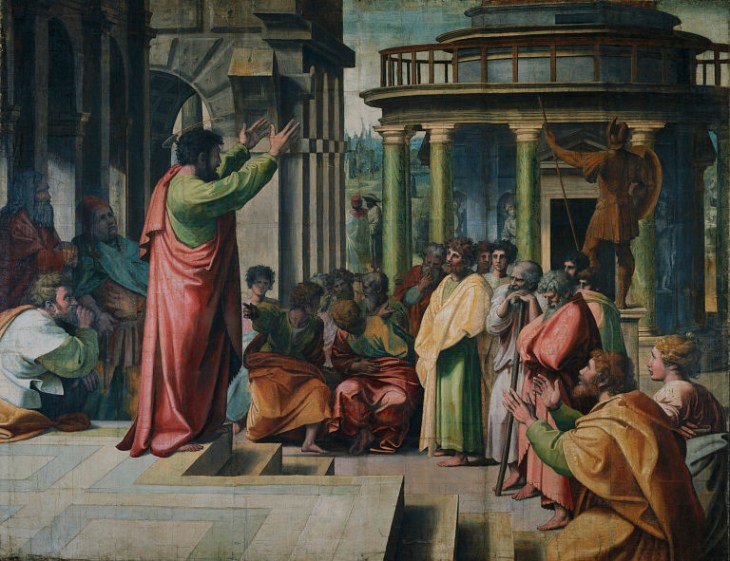
I had not in any way planned to be so apologetic this semester, but the Lord has led me to both studying and producing apologetic material as you probably have noticed. Identifying myself as an apologist is new but exciting, and it makes sense since I’ve for a long time been inspired by Stephen in Acts 6-8. He combined miracles with poverty reduction and nonviolence, and he was an apologist as well. Just look at these verses:
Now Stephen, a man full of God’s grace and power, performed great wonders and signs among the people. Opposition arose, however, from members of the Synagogue of the Freedmen (as it was called)—Jews of Cyrene and Alexandria as well as the provinces of Cilicia and Asia—who began to argue with Stephen. But they could not stand up against the wisdom the Spirit gave him as he spoke. (Acts 6:8-10)
Stephen was a charismapologist! He could heal the sick on Monday and defend the faith on Tuesdays, all the time while serving soup to the widows. For Stephen, there was no conflict between demonstrating the power of God through miracles and arguing for the truth of Christianity intellectually. (more…)

Sex in the Pews
Today I’m starting a new series on my YouTube channel called Radical Bible which aims to do Bible study in a prophetic, profound and a bit provoking way. The first episode is about people having sex in church pews and what to do when ministry gets messy.
Why It’s Irrational to be a Naturalist

C.S. Lewis
I’m currently reading C.S. Lewis’ classic book Miracles, where he starts off by discussing why naturalism – the idea that nature is all that exist and that anything supernatural is impossible – really is an unreasonable position to hold. This is because reason itself would be fully explained by nonrational causes, and thus be unreliable. Naturalism is thus self-defeating since one cannot then reasonably subscribe to it.
“This, as it seems to me, is what Naturalism is bound to do”, Lewis writes. “It offers what professes to be a full account of our mental behaviour; but this account, on inspection, leaves no room for the acts of knowing or insight on which the whole value of our thinking, as a means to truth, depends.” (Miracles, Fontana Books 1947, p. 22).
Alvin Plantinga has developed a simliar argument where he points out that evolution, which basically all naturalists accept, presents a defeater for why one should believe in naturalism. this evolutionary argument against naturalism can be presented as such: (more…)
The Human Trinity
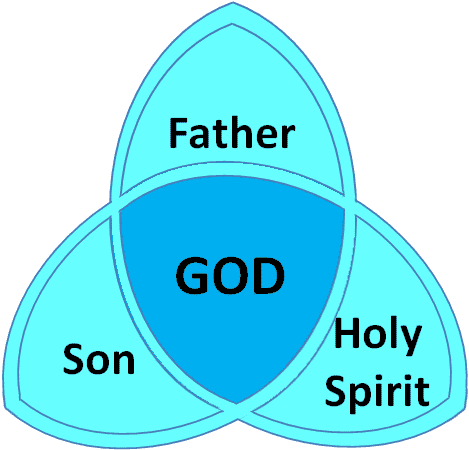
I’m currently at one of Sweden’s biggest Christian conferences called Torp where I am co-responsible for evangelism. We’re teaching biblical principles on how to share the faith in the afternoons, and in the evenings we do outreach in the local town of Örebro with the Pancake Church. It’s tiring but awesome!
The other day a group of Muslims came to us and started to ask us questions like how do we know that the miracle claims of the Gospels are true, and how does one know which religion is true. And of course, one of them raised an issue that Muslims are often concerned with: how can you believe that God is three?
The answer I gave him made him say “Now I understand! Now I understand!” Which is great since a common response to Christians explaining the Trinity rather is “Now I’m just more confused”. But he isn’t the first one to appreciate the analogy I often use to portrait how God can be three in one: the human trinity. (more…)
The Hiddenness of God: a Charismatic Response
There’s a theological problem known as the hiddenness of God which is sometimes used by atheists as an argument for God’s existence. If there is a God and He cares for human salvation, why isn’t He making His existence more obvious? Why isn’t He putting a neon cross in the sky or stamp every cell with “Made by God” in Hebrew letters? Why is He so silent and invisible if He exists?
Apologists generally offer two responses to this. First, God’s existence is already obvious as it is, the arguments from natural theology are good and atheism is really a position held by a minority on a global scale. Second, we cannot be sure that more people would actually be saved if God’s existence was even more obvious, knowing that He exists isn’t the same thing as building a relationship with Him.
I think those responses are good but would also want to offer a third response – a charismatic one. In the video above you can see how a deafmute boy in Zambia starts to hear and speak. On this page you will find resources on medically verified healings. There you go, evidence for God’s existence.
The atheist may respond that these events have natural explanations that we just don’t know yet. But that’s probably what s/he would say about the neon cross and the “Made by God”-stamps as well. And so there’s no way those kind of atheists will accept the existence of God. But if they’re open-minded, they’ll realise that He isn’t far away from any of us, and He can do convincing miracles in all of our lives.
Atheism as an Extremist Position
My video on how atheists need to deny evident truths like everything that begins to exist having a cause or the objectivity of moral values and duties gave rise to a debate between me and an atheist called John Hammond in the YouTube comment section. He confirmed my point in that he as an atheist did deny that everything that begins to exist has a cause and that morality is objective, but he thought that it was evident that these things aren’t true.
What follows is our online discussion, with John’s comments in quotation blocks and my responses in normal bread text:
Its so easy to mock others on YouTube that don’t agree with you isn’t it. We atheists are so stupid according to you aren’t we. I have argued against the Kalam Cosmological Argument so many times that I can’t be bothered to type it all out again. So will this do?
Subjective morality. Lets take two people, Hitler and me, both moral people. Now Hitler’s morality allowed him to initiate the murder of millions of people. My morality does not allow me to hurt anyone. So Hitler and me do not agree on what’s good or bad, whats moral. This is whats called ‘subjective morality’ I think Hitler’s morality was wrong. He would have thought my morality was wrong. Now lets develop this a little more. There are something like seven billion people in the world. That’s seven billion different moralities although most would agree on most points like not eating babies or torturing little kittens. We get our morality [what we personally think is right or wrong, good or bad] because of being a social animal, our upbringing and the society we live in. I personally think murdering millions of people is wrong, Hitler or Jehovah for example think its O.K. to murder millions of people.
No, we atheists do not deny truths as you falsely claim, we just stay within the bounds of reality and what we do know, not what we don’t know. In other words we do not believe in your supernatural God.
I respect you right to your beliefs sir so please respect my beliefs [or non belief] as an atheist.
With respect, John.
Atheists Denying Evident Truths
In this video I eat a delicious avocado sandwich and talk about how atheists often have to deny truths that are really evident to most of us in order to defend their atheism. I’m thinking for example on how most atheist debators argue against one or both of the premises in the Kalam cosmological argument, which are:
- Everything that begins to exist has a cause
- The universe began to exist
This is of course to avoid the conclusion of the universe having a cause, since this cause must be transcendent, outside of space, matter and time, and very powerful – which of course sounds an awful lot like God. But the premises aren’t easy to refute, they seem in fact very obvious. Of course everything that begins to exist has a cause, and of course the universe began to exist.
Another example is the moral argument for God’s existence, which states:
- If God does not exist, there is no objective morality
- There is objective morality
- Therefore, God exists
You’ll be surprised to find when discussing with atheists that many believe in both premises while they refute the conclusion. In fact, some will claim that they deny both premises and they’ll try to efute premise 1 by providing support for premise 2, and vice versa. I believe this is because we live in a culture that despises logic and so what young people in particular are told is that no opinion is better than another and that nothing’s objectively true, while they’re also told that certain moral beliefs are outrageous and unacceptable. The same person can firstly accuse Christianity for claiming that certain moral truths are universal and required by all, and later accuse Christianity for having errant moral stances on marriage or abortion.
What the atheist then has done is simply to just support both premises and so, s/he has to admit that God exists. Of course, it often takes time before the atheist is ready to make such a shift, and often the reason one is an atheist is not primarily intellectual but emotional. But as we continue to point out that atheism is incompatible with some of the most foundational truths that are universally accepted, hopefully more and more people will realize that there is a God who is both Creator and a moral anchor point.
A Defence for the Miraculous Argument
Since I first presented my formulation of the miraculous a argument for God’s existence I’ve made a slight adjustment. The content is the same but I’ve added an extra premise (2), and because of that an extra conclusion (4), to clarify why the argument is valid even if it isn’t God himself that’s responsible for a certain miracle. This is how I nowadays formulate the argument:
- If miracles occur, a supernatural reality exists
- If a supernatural reality exists, God exists
- Miracles occur
- Therefore, a supernatural reality exists
- Therefore, God exists
As this is a deductive argument, the conclusions (4 and 5) are necessarily true if it can be shown that the premises (1-3) are true. So let me briefly defend each one of them.
1. If miracles occur, a supernatural reality exists
This premise is fairly non-controversial as long as one gets the definition of “miracle” straight. The definition I have suggested is a supernatural act impacting nature as demanded by human beings. However, if one uses a definition that doesn’t mention the supernatural cause, for example an event requested by humans which is scientifically and naturally inexplicable, then one needs to defend the first premise by showing why it is more plausible than not that such events have a supernatural cause rather than an unknown natural cause. If the supernatural cause is integrated into the definition of miracles on the other hand, such a defence belong to premise 3.
Three Apologetic Defenses for Miracles
As I’m developing a formulation and defense for the miraculous argument for God’s existence I’ve enjoyed listening to lectures on YouTube by other Christian apologists where they defend the key premise, that miracles occur, from both a philosophical and an empirical perspective. The main philosophical objection to miracles was raised by David Hume in the 19th century, an argument that is still often referenced to by atheists and skeptics but which is actually circular and not very persuasive, as Timothy McGrew explains:
It is generally agreed today that Hume was simply lacking miraculous experience himself and so just assumed that nobody else was experiencing it. His remark of how a dead man coming back to life “has never been observed in any age or country” is embarrassingly naïve, not just dismissing the resurrection of Jesus a priori but also the numerous dead raising accounts of his time. As I have met and interviewed a man who was raised from the dead I can assure you Hume was wrong. (more…)

The Amazing Life of John Wimber
In this new episode of my YouTube series Heroes of Faith, I present how Vineyard leader and charismatic apostle John Wimber became a Christian, discovered his Spiritual gifts and advocated social justice as well as revival:
Watch the previous Heroes of Faith episode about Heidi Baker here.
Aid and Revival in Mueda with Heidi Baker
Yesterday Heidi Baker spoke at a church in Stockholm not far from where I live. I wasn’t aware of her trip until it was too late, but I’m not sad since yesterday was an amazing day for me even without Heidi. Jesus showed Himself to me again just as He did when I just had become a Christian and needed a sign for His presence. It was in my house church as the brothers and sisters prayed for a very important decision I have to make, and I sobbed and praised Him for revealing Himself in this manner for the first time in nine years.

But yeah, Heidi rocks! And her ministry Iris Global have just published two beautiful videos about a recent outreach to the Mueda region in Mozambique. The first one is just mute recordings from the adventure with a powerful and touching worship song on top of it:
In the second one Heidi and Iris staff narrates what actually happened on the outreach. Wells were dug, education was supported, a deaf-mute girl was healed and people were saved. Praise the Lord! (more…)
The Illogical Age of Secularism

The two latest episodes of the Apologetics Canada Podcast have been dealing with the lack of logical thinking in modern culture. It wasn’t too long ago I realized that all liberal theology per definition is completely illogical since it claims to be Christian while denying things that Christ taught and practiced. And liberal theology is just the Christian version of the trend that postmodern secularization has brought with it: a departure from logic.
As an example the ACP guys name the viral video where a man asks college students what they think about various identical attributes he applies to himself that contradicts his physical appearance. He starts with claiming to be a woman, which all of the students think is great. Then he goes on claiming to be Chinese, two meters tall and seven years old, asking permission to enroll for first grade. The logic that most students had self-implodes due to this reductio ad absurdium.
In fact, most people don’t study much logic in school. And many arguments used in popular debate are emotional rather than logical. While people often refer to science as an argument of authority and certainly think that they’re logical, I have noted myself in recent debates with both Christian nationalists on receiving refugees and with atheists on the existence of God, that their arguments don’t follow the rules of logic. (more…)
Fruits of Evangelism

I’m very happy and very tired. Last Saturday was Walpurgis night which for some reason is a huge thing here in Uppsala, hundreds of thousands of people fill the streets and so it’s a great opportunity for evangelism. We were out with the Pancake church at a central square and ministered to hundreds, and one guy from Morocco came and wanted to get saved. Just like that. He had some extremely bad experiences from Islam and had realized that Jesus is the Way, so we helped him receive Him.
The next day was Sunday, I was organizing the service for our house church and we got a new visitor that I had been in touch with on Facebook. She wanted to be saved as well. We rejoiced, prayed with her and then talked about and answered questions that she had about the Old Testament, God’s character and other religions as we went out to evangelize according to our “Come in, go out” principle.
And then last Tuesday my friend Johannes and myself were invited to a folk school where we got to speak about faith, doubt, atheism and theism for three hours. Johannes has struggled a lot with atheism and I used to be an atheist in my early teens before turning to God. We covered several arguments for God’s existence as well as sharing our own stories and answering questions, and it was appreciated. (more…)
 Charismactivism