
Home » Church & Theology (Page 6)
Category Archives: Church & Theology
The author

Micael Grenholm, a Swedish charismactivist, apologist and author.
No more boasting about human leaders!

John Wimber, Heidi Baker, Jesus and me 🙂
We’ve all met these kinds of people, haven’t we:
Brothers and sisters, I could not address you as people who live by the Spirit but as people who are still worldly—mere infants in Christ. I gave you milk, not solid food, for you were not yet ready for it. Indeed, you are still not ready. You are still worldly. (1 Corinthians 3:1-3a, NIV)
Yeah, those worldly Christians who can only eat spiritual baby food. It’s comfortable to believe that Paul is talking about people that weren’t like me, that haven’t read the Bible as much as me and that are way more sinful than me, right? But what is it really that Paul is adressing?
You are still worldly. For since there is jealousy and quarreling among you, are you not worldly? Are you not acting like mere humans? For when one says, “I follow Paul,” and another, “I follow Apollos,” are you not mere human beings? What, after all, is Apollos? And what is Paul? Only servants, through whom you came to believe—as the Lord has assigned to each his task. I planted the seed, Apollos watered it, but God has been making it grow. (3:3-6)
Oops. I’ve read this countless times, but today I realized that I’ve been a worldly baby for a very long time. I’ve put a lot of pride in human leaders and traditions – whether its John Wimber, Shane Claiborne, Anabaptism or something else.
And of course, I do think that they’re all more Biblical than, say, the Lord’s Resistance Army in central Africa, but I have gotten more uncomfortable with identifying myself too much with one denomination or theological stream, because I see the Spirit moving in so many of them. Isn’t it ironic that many Protestant denominations have got their name from individuals – Calvinism, Lutheranism, Mennonitism – precisely what Paul warned us for! We should not focus on the gardeners, but the one who makes the church grow, God Himself.
That being said, leaders are of course not useless: (more…)
When the Holy Spirit leads us to satan

Today I was preaching in my house church Mosaik on Luke 4, and I’d like to share with you the unique relationship between the Holy Spirit and satan that is presented there. Not relationship in the sense that light has anything to do with darkness, but in the sense that when you are baptised in the Holy Spirit, He may take you to where satan lives to beat him up:
Jesus, full of the Holy Spirit, left the Jordan and was led by the Spirit into the wilderness, where for forty days he was tempted by the devil. He ate nothing during those days, and at the end of them he was hungry. The devil said to him, “If you are the Son of God, tell this stone to become bread.” Jesus answered, “It is written: ‘Man shall not live on bread alone.’ ”
The devil led him up to a high place and showed him in an instant all the kingdoms of the world. And he said to him, “I will give you all their authority and splendor; it has been given to me, and I can give it to anyone I want to. If you worship me, it will all be yours.” Jesus answered, “It is written: ‘Worship the Lord your God and serve him only.’”
The devil led him to Jerusalem and had him stand on the highest point of the temple. “If you are the Son of God,” he said, “throw yourself down from here. For it is written: “ ‘He will command his angels concerning you to guard you carefully; they will lift you up in their hands, so that you will not strike your foot against a stone.’ ” Jesus answered, “It is said: ‘Do not put the Lord your God to the test.’ ” When the devil had finished all this tempting, he left him until an opportune time.
(Luke 4:1-13)
In prior to this, Jesus was baptised by John in the Jordan river, and at the same time He was baptised in the Holy Spirit by God the Father, who spoke in an audible voice and called Him His beloved Son. And note that Jesus was then led by the Spirit into the wilderness, where He fasted for forty days until He finally got hungry, and was tempted by the devil. The Spirit sent Jesus to satan.
How to Transform a Mainline Church into a Christian Community

Worship in New Creation Christian Community, Jesus Army, United Kingdom
In this third and final part of “extreme church makeover”, we will look at how a mainline, conventional church that doesn’t practice community of goods like the church of the apostles (Acts 2:43-44), can be transformed into a church that does practice community of goods like the church of the apostles. Because of my trip to the Jesus Army in the UK – that practices community of goods – in August I have already written a lot recently about sharing everything and explained why it isn’t impossible and why the example of the apostolic church in Jerusalem should be followed rather than ignored. Hence, I won’t go into that in this blog post.
Let us instead discuss the practical part – how can we deliver mainline churches from the claws of mammon so that they practice economic equality instead of inequality? In my previous posts, where I’ve talked about how to make a mainline church evangelize on the streets and how to transform a mainline church into an organic house church, the practical applications have come in the form of bullet points in the end, which honestly is because I felt it necessary to explain why these reforms are needed so that in the end, I didn’t have too much time discussing the practice (I usually don’t want to spend more than one hour on blogging per day).
What I think is important to note when it comes to all of these three reforms, or restorations rather, is that they are indeed entirely possible. That is, I am fully convinced that we could see thousands – millions even – of churches around the world going back to the apostolic structure of mandatory evangelism, organic simplicity and community of goods. Just look at the charismatic movement. 120 years ago, most Protestant churches believed that miraculous gifts had ceased, and very few included healing, prophecy or speaking in tongues at their meetings. Now, this is the standard in millions of Protestant churches around the globe. When the Holy Spirit spreads revival, the church can change very fast.
How to Transform a Mainline Church into an Organic House Church
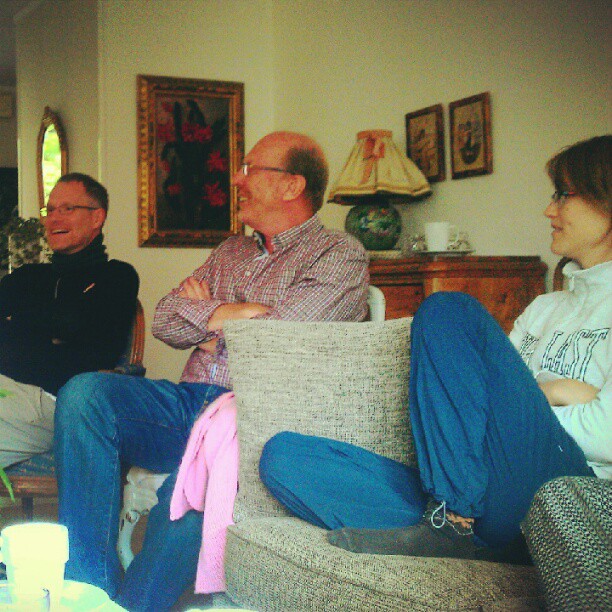
Sunday service in my church, Mosaik
In my last blog post I discussed how we can inspire and exhort mainline churches to make evangelism as mandatory and natural as Sunday services, since the apostolic, biblical church evangelized in the streets, synagogues and temple courts probably even more than they met for internal meetings in the homes, based on how church life is described in the gospels and in the book of Acts. Today I want to talk about how we can inspire and exhort mainline churches to become house churches, i.e. to sell their expensive building and form organic, discipleship training communities that gather in houses as well as on the streets.
It’s no secret that the Biblical church was a house church movement, Luke says that they gathered in the homes as well as in public (Acts 2:46), Paul talks about the church that meets in Prisca’s and Aquila’s house (Rom 16:3-5). In fact, there are no evidence of any church buildings at all earlier than the late third century. While some things are a bit ambiguous when it comes to the early church, this is not one of them: the early church was a house church movement.
Now, Christians who belong to building churches* are often quite eager to explain why this does not by any means show that churches should organize themselves in homes rather than in expensive buildings. The most popular theory is that the early church was forced to meet in homes rather than in church buildings because of persecution. And there is defenitely some truth to that. But this argument does not in itself contradict the position that house churches are better than building churches; devotion to Christ and a commitment to follow Him even to death was probably stronger during persecution compared to when persecution ended, but that doesn’t make devotion and commitment less valuable – rather, the contrary is true.
How to Make a Mainline Church Evangelize on the Streets

Me and some friends were out on the streets evangelizing yesterday, by handing out free pancakes and sharing the Gospel
I’m not a reformer, Im a restorer. While several intentions of the reformation were good, the emphasis on reform in itself doesn’t express what we really want the church to look like, and so I know several Lutherans who defend unbiblical teachings and changes with the claim that the church should be constantly reforming itself, which isn’t a very Biblical idea. Restorationist Christians on the other hand, like Anabaptists or Pentecostals, have emphasized that we should restore the Biblical church and thus has a clearly expressed goal with the reforms. Just by looking at the Holy Scriptures, we see how Jesus did church, how the apostles did church and how they thought that we should do church. And they didn’t call it “church”, since that’s obviously an extremely boring word, they called it the Way (Acts 9:2); the Lifestyle, basically.
The charismatic movement, which I am a part of, have used restorationism to resurrect a hunger for the baptism of the Holy Spirit and miraculous gifts. But there are some things that I think still needs to be restored in most charismatic churches: mandatory evangelism, organic simplicity and community of goods. I will explain more about what these three things mean and how they should be practically restored in mainline churches in three blog entries, this being the first.
So what do I mean with “mandatory evangelism”? Well, the apostolic church which was funded and lead by guys who knew Jesus personally had two sorts of meetings, or “services” if you like: “Every day they continued to meet together in the temple courts. They broke bread in their homes and ate together with glad and sincere hearts” (Acts 2:46). They both met in the homes and in the temple courts. The latter was the place where Jesus had His theological debates – it was a place where all the religiously interested came to worship God and discuss with each other. And the early Christians both join the Jews for prayer in the temple (Acts 3:1), and to heal them (3:6-10) and preach the Gospel to them (5:21).
Community Houses are Better than Church Buildings

Fellowship in the New Creation Hall, Jesus Army's oldest community house
Jesus Army is ultimately a hourse church movement. While the revival that birthed the movement started in a small Baptist chapel in Bugbrooke, the Jesus Fellowship Church didn’t build new chapels or church buildings as they grew; instead they organised themselves in their community houses. Thus, the same buildings that were used for worship and preaching were used for living and sleeping, which of course reduced costs and increased flexibility. This is how the early church did it as well – they worshipped in their homes and had everything in common.
The church is simply organized in “households”, which generally corresponds to a community house plus church members that do not live in community. Generally this means between 30 and 50 people. They are often divided into cell groups of around 10 people each that have their own meetings once a week (just like cell groups in many other churches). All the church households in one city make up a congregation, which meets sometimes for regional events, and about six times a year there are national celebrations where the whole church gets together. In the 80s they bought a big tent for some of these occasions, the Golden Marquee. Other times, like on Jesus London Day, they simply celebrate in public on the streets.
So apart from the Bugbrooke chapel, which they actually bought to have for weddings and funerals, the Jesus Army has not had any church buildings. But in 2000, the Northampton congregation decided to by a cinema and convert it to a Jesus Centre. The idea was to mainly use it as a social centre to help the homeless, immigrants, elderly and other groups while also having it as a place for worship, prayer meetings and big celebrations. It has been quite succesful and they have started Jesus Centres in Coventry, Sheffield and London as well.
(more…)
A Cross-Centered Church

We’ve just finished a very intense and Spirit-filled festival here at the Jesus Army in the UK, and the theme for the three-day event was “A Cross-Centered Church”. One of the most charasteristic things with the Jesus Army is our red crosses. Sadly, the cross has to many become a piece of jewelry, pieces of gold and silver which middle-class Christians hang around their necks to pretend to follow Jesus’s words in Luke 14:27 while they go on with their Mammon lifestyle. The Jesus Army just uses simple material as wood and plastic, and paints it all red to remind people on the blood of Jesus. A true cross isn’t a shiny golden relic, but a tool for torture and execution.
Jesus Army’s motto is “Love, power and sacrifice”, and on this cross-centered conference the focus has been on the latter. Why have Jesus Army succeeded with still practicing community of goods 40 years after it started when so many other Christian communities have ended after less than ten years? Well, they have emphasized from the beginning that it requires commitment and sacrifice. Jesus spoke a lot about denying yourself and leaving stuff behind when you’re following Him. He’s not calling us to comfortability, but to commitment.
A cross-centered church is a Jesus-centered church, and it’s not the cosy, lamb-petting Jesus that you see on postcards but the naked, wounded, dying Jesus with nailed hands and a pierced heart. “Greater love has no one than this: to lay down one’s life for one’s friends”, He said (John 15:13), and He truly showed it by dying for us so that we through His blood may receive eternal life. He died our death so that we may share His life.
Living like the Apostles at the Jesus Army

All the believers were together and had everything in common. They sold property and possessions to give to anyone who had need. (Acts 2:44-45)
Yesterday, me and my friend Frida arrived in Kettering, England, to visit one of my favourite churches, the Jesus Army. As I’ve pointed out several times before, the Jesus Army is one of the very few examples of when the Jesus hippies of the 70’s organized themselves in their own church instead of joining existing churches, and this has made them able to sustain the radicality, fire and passion for God that characterised the Jesus revival. What is most noticable is that the Jesus Army practices community of goods just like the apostolic New Testament church, something that unfortunately has become very rare among Protestant Christians.
You see, cessationism is sadly not just a doctrine of the margins within the Protestant movement, but a key factor in how both Luther and Calvin viewed Scripture. While claiming that they based their theology on Scripture alone, they deliberately ignored large parts of the Bible that didn’t fit with their theology. Cessationism is generally defined as the idea that miraculous gifts have ceased with the apostles, but within Protestantism we also teach that the community of goods we read about in Acts 2 and 4 ceased with the apostles.
With cessationism, you basically are your own god who make your own bible. Jack Deere, a former cessationist, writes in Surprised by the Power of the Spirit how he didn’t like fasting very much, so he claimed that fasting has ceased with the apostles as well. After all, there are not so many people fasting in the later books of the New Testament. But the problem is of course that the Bible never says that anything – miracles, community, fasting or whatever – would cease with the apostles, and so cessationism is just a way for Christians who claim to be Bible-believing to have a reason not to believe in all of the Bible.
(more…)
John Piper: Why Jews Don’t Have a Divine Right to the Land Anymore

Pastor Piper
Ten years ago, John Piper held a sermon on Israel, Palestine and the Middle East. It was a hot topic then and may be an even more hot topic now, and I really recommend you to read it. It may not be any convincing for Jews themselves, since they don’t believe in the New Testament, but Piper gives a good case why Christians should not think that Israel has to occupy Gaza and the West Bank in order for Jesus to come back, but instead support a solution that secures the safety and peace of both Israelis and Palestinians, no matter how the borders look like. Below, I qoute point 3-5 from Piper’s seven-point sermon:
3. The promises made to Abraham, including the promise of the Land, will be inherited as an everlasting gift only by true, spiritual Israel, not disobedient, unbelieving Israel.
This was the point of Romans 9. When Paul grieved over the lostness of so many Jews who were rejecting Jesus and were perishing, he said in verses 6-7, “It is not as though the word of God has failed. For not all who are descended from Israel belong to Israel, 7 and not all are children of Abraham because they are his offspring.” In other words, the promises cannot be demanded by anyone just because he is Jewish. Jewish ethnicity has a place in God’s plan, but it is not enough to secure anything. It does not in itself qualify a person to be an heir of the promise to Abraham and his offspring. Romans 9:8 says it clearly: “It is not the children of the flesh who are the children of God, but the children of the promise are counted as offspring.” Being born Jewish does not make one an heir of the promise—neither the promise of the Land nor any other promise.
This was plain in the Old Testament, and it was plain the teachings of Jesus (which we will see under truth #4). For example, in the terrible list of curses that God promised to bring on the people if they broke his covenant and forsook him was this: “ And as the Lord took delight in doing you good and multiplying you, so the Lord will take delight in bringing ruin upon you and destroying you. And you shall be plucked off the land that you are entering to take possession of it” (Deuteronomy 28:63 ). Throughout the history of Israel, covenant breaking and disobedience and idolatry disqualified Israel from the present divine right to the Land. (See also Daniel 9:4-7 ; Psalm 78:54-61 .)
The Idea of the Sinless Israel

Israeli propaganda, describing themselves as protecting civilians while Hamas use them as human shields
As the conflict in Israel and Gaza is going on, conservative Christian friends of mine are posting videos and images that tell the message that everything is Hamas fault while Israel only defends itself, that Hamas wants to kill civilians and use them as human shields while Israel actively tries to avoid hurting civilians, that Hamas wants war while Israel wants peace, that Hamas is evil while Israel is good. Over and over again I hear that if Hamas lays down its weapons, there will be peace, but if Israel does it all Israelis will be killed. One Christian friend told me that Israel is righteous while Hamas has a demonic, Nazi spirit.
Now, there are indeed big differences between Hamas and Israel. Hamas is a fundamentalist organization where there is a lot of antisemitism and hatred, and they do indeed target civilians and use them as human shields. But to blame everything on them and nothing on Israel, is not a true portrait of reality. Israel has done attrocities (for example, the use of human shields) and many of them are on a structural level: the settlements, not letting enough goods through to Gaza in order to stop the humanitarian crisis, breaking international humanitarian law over and over again, etc.
And in the conflict, it is the Palestinians that suffer and die the most. People that are pro-Israel often point out how many rockets Hamas is firing into Israel, but they are often quite silent about the fact that very few die from them. During operation Cast Lead in 2009, 1391 Palestinians died and 5 Israelis. More than half of the killed Palestinians were civilians, while all five of the killed Israelis were soldiers. In the current conflict between Hamas and Israel, over 100 Palestinians have died and 77% of them are civilians. (more…)
Cross My Heart and Hope…
An awesome article from Jesus Army’s Streetpaper.

The Jesus Army’s famous red crosses
You can’t get away from it. It’s everywhere.
The cross.
In homes, in films, in paintings, in pop videos. Worn as an earring, on a necklace. Stitched or studded onto leather or denim. Tattooed onto skin…
What would Coca Cola or McDonalds give to own a symbol that millions wear round their necks every day?
The cross is the universal Christian symbol, acknowledged by millions of Christians everywhere as the single visual sign of their faith.
Which is weird, isn’t it? Because the cross was originally a symbol of suffering and defeat. The Roman Empire killed thousands of its enemies by nailing them to wooden crosses.
It’s like wearing a gibbet round your neck. Or hanging a little golden lethal injection from your necklace.
European Anabaptism vs Global Pentecostalism #MennoNerdsOnRace
A few days ago, the Anabaptist blogging network MennoNerds, which this blog is a part of, arranged a webinar called Race, Mutuality and Anabaptist community. It was all recorded via Google Hangouts and can be watched in the video above. Unfortunately, I wasn’t able to join the discussion live since time here was around 2 AM, but we MennoNerds now have a chance to contribute to the conversion via our blogs, which is what I’m doing right now.
Christianity is a Middle Eastern religion and for the first 300 years, most of the important theologians (the so called “church fathers”) came from the Middle East, Northern Africa and what is now Turkey. The present churches in for example Egypt, Syria and Ethiopia have survived since the time of the apostles. But since the Western Catholic church distanced itself from and condemned the eastern and oriental churches, the experiences, stories and theology of non-white Christians became peripheral. To this very day, it is common among Western Christians to identify themselves with and be inspired by Christian streams from Western Europe: Catholicism, Anglicanism, Calvinism, Lutherism, Anabaptism, Quakerism, Methodism, Salvationism, Baptism, and so on.
It gets increasingly problematic when people of European descent expect other people to submit to these European interpretations of the teachings of Jesus when they are born again, i.e. asking them to become “Lutherans” or “Anabaptists”. Don’t get me wrong, I love Anabaptism and identify myself with the movement, and I think that people like Drew Hart does an excellent job in outlining “Anablacktivism” and interpreting the Anabaptist message about justice and peace from an African-American perspective. Truth is that all of the church streams I mentioned above are global today – Catholicism is biggest in Latin America which their Argentinian pope signifies, Anglicanism is bigger outside England and the biggest Lutheran denomination in the world is Mekane Yesus in Ethiopia.
These voices need to be recognized and influential within these church streams. Yet, we cannot get away from the fact that if you want to get to the roots of the movement, as A.O. Green likes to do, you’ll have to read what a bunch of white, European men wrote. And that’s a bit boring, isn’t it?
(more…)
What a Truly Pentecostal Church Looks Like
Yesterday, on Pentecost day, I had the honour to preach in my dear house church Mosaik. We’re always outside in the park during the summer, and this Sunday we had som English speaking visitors – so for the first time in a year I preached in English. And since a friend of mine recorded it all, it’s now available for you guys!
I started with talking about the Pentecostal language miracle, when one is able to speak existing languages that one hasn’t studies, and gave some testimonies about when this has happened in modern times. This was also what my last blog post was about. Then, I talked about how Peter, in his Pentecostal sermon in Acts chapter 2, really emphasises miracles when he talks about Jesus. He presents the Messiah by saying “Jesus of Nazareth was a man accredited by God to you by miracles, wonders and signs, which God did among you through him, as you yourselves know” (Acts 2:22). Then he goes on with “God has raised this Jesus to life, and we are all witnesses of it. Exalted to the right hand of God, he has received from the Father the promised Holy Spirit and has poured out what you now see and hear. (vv. 32-33). Thus, Peter proves that Jesus is the Messiah by pointing at His miraculous ministry, His resurrection and the miracles His Spirit does.
The people “were cut to the heart” (v. 37) when they heard this and asked Peter what they should do, and he answered “Repent and be baptized, every one of you, in the name of Jesus Christ for the forgiveness of your sins. And you will receive the gift of the Holy Spirit.” (v. 38). 3000 people did so, and suddenly the apostolic league of disciples had become a mega church – but not in the modern sense, since they lacked a church building. They were a charismatic, evangelistic house church movement that spread rapidly, as Luke famously portrays:
They devoted themselves to the apostles’ teaching and to fellowship, to the breaking of bread and to prayer. Everyone was filled with awe at the many wonders and signs performed by the apostles. All the believers were together and had everything in common. They sold property and possessions to give to anyone who had need. Every day they continued to meet together in the temple courts. They broke bread in their homes and ate together with glad and sincere hearts, praising God and enjoying the favor of all the people. And the Lord added to their number daily those who were being saved. (Acts 2:42-47)
The Mission and Vision of the Jesus Army
I’ve written several times about the Jesus Army, a charismatic, evangelical church in the United Kingdoms that is known for its active evangelism and social work. It is one of the extremely few churches I know of in Europe that practices community of goods, where everybody share everything so that there is no longer any rich nor poor. Around one quarter of Jesus Army’s members live this way in around 60 community houses that are called New Creation Christian Community. The Jesus Army is mainly a house church movement, where people gather for worship in the community houses or other homes, but during the last decade they have also built Jesus Centres which are places for social ministry to help immigrants, homeless people and others.
I’m very inspired by this church! It’s a remnant of the amazing Jesus hippie revival in the 70’s and a church that is very similar to the Biblical church of Acts, that also was a house church movement that practiced community of goods. Today, I got a confirmation that it’s possible for me and my friend Frida to come and visit the Jesus Army in August. It’s the second time I’m visiting the Army and I’m so excited! My dream and prayer is that the Holy Spirit will use me to plant more Jesus churches, in Sweden and elsewhere.

To celebrate this, here are some central documents from Jesus Army’s website, describing who they are:
About the Jesus Fellowship
The Jesus Fellowship Church, which is also known as the Jesus Army, is an evangelical Christian church with a charismatic emphasis and Baptist roots. The church aims to be a contemporary expression of historic Christianity. It is orthodox in doctrine, and upholds the established Christian creeds. Details of the church are listed in the UK Christian Handbook and the English Church Census. It is linked with other churches and groups in the UK and overseas through the Multiply Christian Network, and is a member of the Evangelical Alliance UK.
What it Means to be Anabaptist, and Why You Should be One

An Anabaptist being martyred in 16th century Europe
As many of you know, I am glad to be a part of the MennoNerds network, an international blogging community made up by people who are nerdy about Mennonite and Anabaptist theology. The Anabaptists were the central figures in the radical reformation during the 16th century. While Luther and Calvin opposed Catholic teaching they still wanted to kill people and were opposed to freedom of religion. Anabaptists however both criticized Catholic teaching and the Catholic church model when one baptizes entire countries, gather people in cathedrals and kill those who don’t agree with you.
The Anabaptists were of course persecuted and killed both by Catholics and Protestants. However, some survived and can today be found in three main groups: the Amish who dress funny and live environmentally friendly, the Hutterites who dress funny and have everything in common, and the Mennonites who dress boringly and write blogs about Anabaptism.
My fellow MennoNerd Tyler M. Tully has written an excellent introduction to Anabaptism, where he also defines three core distinctives that define Anabaptist theology. These three are, in short:
- Jesus Centered– Jesus stands as the lens by which Anabaptists read the entire Bible, and the exemplary by which we engage all theology.
- Free Church of Confessing, Baptized Disciples – the Anabaptists were opposed to infant baptism partly because it wasn’t Biblical, and partly because it created a society where your nationality, not your faith, defined you church membership, and that was opposed to freedom of religion
- Agents of God’s Shalom – Anabaptists are pacifists committed to non-violence, but not only do we want an absence of war but also a presence of Shalom, justice and harmony.
 Charismactivism