
Home » Posts tagged 'Simplicity' (Page 2)
Tag Archives: Simplicity
The author

Micael Grenholm, a Swedish charismactivist, apologist and author.
4 Prooftexts Rich Christians Use to Keep Their Wealth
My MennoNerd friends have been talking a lot about wealth and poverty in our vlogging relay race recently, something I also contributed with in my video about community of goods. In today’s video I bring up four prooftexts that brothers and sisters who have quite a lot of money often point to when I explain to them why I’m convinced that Christians should not be rich.
The prooftexts are:
- People in the Old Testament being rich (Gen 13:2, 2 Chron. 9:22 and others)
- Jesus being fine with expensive alabaster being poured upon Him (Mark 14:1-9)
- Paul saying that he is content both when he has plenty and when he is needy (Phil 4:12)
- Jesus possessing a seamless undergarment (John 19:23)
For more Bible studies on why Christians shouldn’t be rich, check out my God vs Wealth series.
Christ-like Christmas Contradicts Consumerism
 My blog post and YouTube video on rejecting consumerism and celebrating simple Christmas has gained attention. My friend Sunniva wrote in the comments about how she and her mother celebrates a simple Christmas:
We (read my mother and I) celebrate Christmas as an extended birthday. If we celebrate each others birthdays, we do so for Jesus so much more. Perhaps I will write a blog post how we do this, but for now: its a feast that’s Jesus-centered – anticipation begins at least a month before with old and home-made Christmasdecorations and greens from forest floor (no real tree-cutting here) appearing around the house bit by bit, with Christmas music, and by attending church in Advent-time.
On Christmas Eve we will decorate our home-altar with fairtrade-roses, fast from food and water till dark, sing Jesus-songs by the fire, go to Church, cook a vegetarian meal that’s 90 or so percent organically grown and which we present to Jesus before eating, watch the movie The Nativity (and Karl Bertil Jonsson’s Christmas is a must too, a modern Christmas Robin Hood story) and attend midnight mass, etc etc. We give each other a few meaningful presents to commemorate the joy, like fair-trade coffein-free chocolate and tea, something handmade and something useful etc (from this year not wrapped in paper but in a personal reusable gift-cloth-bag), while giving aid to the poor as well.
In short: Jesus is worth a splendid birthday celebration!
The only thing I miss is sharing this beautiful time with more people, wanting to be a minister so I can do that more easily. My dream is to arrange Christmas-retreats with simple feast-food and much prayer.
Jesus Army’s Forward blog has collected a number of different voices on the topic, that deals with the Christmas dilemma: Jesus’ birthday wasn’t celebrated very much in Biblical times (which is why we don’t know the actual date), rather, paganism has influenced the modern Christmas celebration quite a lot and today it’s a mindless consumption feast. At the same time, Christmas expresses love and community and many do connect it to Jesus. Here are some of the thoughts expressed by our fellow Jesus hippies as they try to deal with Christmas in a non-consumerist way: (more…)
How to Celebrate a Simple Christmas

Mammon, the deceptive demon of wealth, has poisoned the church so that rich Christians thrive in luxury and superfluities while the poor starve and suffer. 50 000 people die because of poverty every day, while 20% of the world’s population consume 80% of the world’s resources. The biggest consumption feast of them all is Jesus’ birthday, and this has escalated massively during the last 50 years so that we now here in Sweden spend twice as much money on Christmas shopping than we give in Official Development Aid to developing countries. Then we complain about how we can’t help the homeless or receive immigrants since we’ve ran out of money.
Christians are like boiling frogs who are slowly killing their radical spirit when following the ungodly trends of the world. They are like dead fish, following the dark stream of environmental destruction and idolatrous tradition. And so they eat more meat, buy more expensive presents and spend more time and energy on pointless secular rituals, and while they hate to engage in biblical practices like fasting or street evangelism, they have no problems with putting a pointless tree in their living room or buying video games for their kids. Jesus called us to sell our stuff and give the money to the poor. On Christmas, we use our money to buy stuff to give to the rich.
Yesterday I posted this video, called “Stop Celebrating Christmas“. We have to stop this harmful and ungodly consumption feast that has replaced any decent remembrance of the birth of the Son of God. To modify the traditional Christmas celebration isn’t enough, then we risk to fall back to the old destructive wheel-tracks. No, we need to envision a radically different Christmas celebration, a simple, miraculous, worship-centred celebration. This is what it could look like:
Why Jesus Doesn’t Like Inheritance
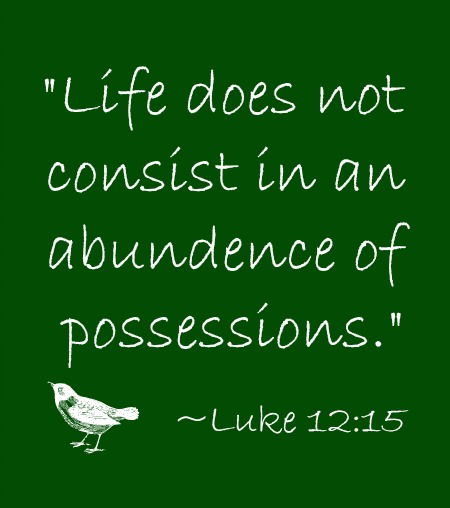 It isn’t surprising that Jesus often is surprising, but I find this response of His particularily fascinating in that it’s defenitely not what I would expect someone else to say:
Someone in the crowd said to him, “Teacher, tell my brother to divide the inheritance with me.” Jesus replied, “Man, who appointed me a judge or an arbiter between you?” Then he said to them, “Watch out! Be on your guard against all kinds of greed; life does not consist in an abundance of possessions.” (Luke 12:13-15)
Most pastors, rabbis or other kind of leaders I know of would never, ever, give such an answer. They would politely obey the person and strongly encourage the person’s brother to share their inheritance equally. We all want to be fair, right? But Jesus firstly questions why the person views Him as a judge or an arbiter, secondly He warns the whole crowd for greed and for wanting an abundance of possessions.
See, if it’s fair to split an inheritance equally, how much more fair isn’t it to split all the world’s wealth equally? Jesus practiced community of goods with His disciples (John 13:29), and the church continued to do so when He had levitated into Heaven (Acts 2:44-45). But the inheritance of the world is private, those with rich parents inherits more than those with poor parents. Since the world doesn’t have the Jubilee economic system that Old Testament Israel was supposed to have, there is no mecanism to stop this other than tax, which in most cases doesn’t create much equality (in Sweden we used to have an inheritance tax, but the conservative “Christian democratic” government abolished it). (more…)
How to Transform a Mainline Church into an Organic House Church
Sunday service in my church, Mosaik
In my last blog post I discussed how we can inspire and exhort mainline churches to make evangelism as mandatory and natural as Sunday services, since the apostolic, biblical church evangelized in the streets, synagogues and temple courts probably even more than they met for internal meetings in the homes, based on how church life is described in the gospels and in the book of Acts. Today I want to talk about how we can inspire and exhort mainline churches to become house churches, i.e. to sell their expensive building and form organic, discipleship training communities that gather in houses as well as on the streets.
It’s no secret that the Biblical church was a house church movement, Luke says that they gathered in the homes as well as in public (Acts 2:46), Paul talks about the church that meets in Prisca’s and Aquila’s house (Rom 16:3-5). In fact, there are no evidence of any church buildings at all earlier than the late third century. While some things are a bit ambiguous when it comes to the early church, this is not one of them: the early church was a house church movement.
Now, Christians who belong to building churches* are often quite eager to explain why this does not by any means show that churches should organize themselves in homes rather than in expensive buildings. The most popular theory is that the early church was forced to meet in homes rather than in church buildings because of persecution. And there is defenitely some truth to that. But this argument does not in itself contradict the position that house churches are better than building churches; devotion to Christ and a commitment to follow Him even to death was probably stronger during persecution compared to when persecution ended, but that doesn’t make devotion and commitment less valuable – rather, the contrary is true.
Things that make the Jesus Army unique

Frida enjoying the Jesus Army
Today, me and Frida will travel to London to Jesus Army’s Spreading Flame community house, and after spending a day there we will go back to Sweden. Both of us have been very inspired and with the help of the Holy Spirit we hope to launch a similar church in Sweden that combines community of goods with the power of the Holy Spirit and evangelism. I’ve written a lot about the Jesus Army’s community of goods, their Jesus-centered focus and their social, eco-businesses, but there are many other things that make this church quite unique. Some examples:
The Jesus Army doesn’t sent out missionaries, instead they have an international partnership network called Multiply. Most of the churches and leaders connected to it are in Africa and Asia, and so many of them inspire and preach to the Britons rather than the other way around, while the Jesus Army still finance projects to fight poverty over there.

Training Year info
Jesus Army doesn’t have a Bible school, instead they have a training year where you live in a community house, work in a Kingdom business and partake in all the evangelism, social work, Bible studies, worship and prayer the church organize. You also get a mentor with whom you study Scriptures with and deepen your faith. Far more practical, biblical and intergrated with church life than most Bible schools I know of.
Jesus Army doesn’t do expensive weddings or celebrate Christmas and birthdays with lots of consumption and indulgence. Instead they value simplicity, fellowship and constant celebration. They want to avoid luxury and wealth, and are striving for a lifestyle of humbleness, free from materialism.

There are many more things to write, but our transport to London is leaving now. Blessings!
Community Houses are Better than Church Buildings

Fellowship in the New Creation Hall, Jesus Army's oldest community house
Jesus Army is ultimately a hourse church movement. While the revival that birthed the movement started in a small Baptist chapel in Bugbrooke, the Jesus Fellowship Church didn’t build new chapels or church buildings as they grew; instead they organised themselves in their community houses. Thus, the same buildings that were used for worship and preaching were used for living and sleeping, which of course reduced costs and increased flexibility. This is how the early church did it as well – they worshipped in their homes and had everything in common.
The church is simply organized in “households”, which generally corresponds to a community house plus church members that do not live in community. Generally this means between 30 and 50 people. They are often divided into cell groups of around 10 people each that have their own meetings once a week (just like cell groups in many other churches). All the church households in one city make up a congregation, which meets sometimes for regional events, and about six times a year there are national celebrations where the whole church gets together. In the 80s they bought a big tent for some of these occasions, the Golden Marquee. Other times, like on Jesus London Day, they simply celebrate in public on the streets.
So apart from the Bugbrooke chapel, which they actually bought to have for weddings and funerals, the Jesus Army has not had any church buildings. But in 2000, the Northampton congregation decided to by a cinema and convert it to a Jesus Centre. The idea was to mainly use it as a social centre to help the homeless, immigrants, elderly and other groups while also having it as a place for worship, prayer meetings and big celebrations. It has been quite succesful and they have started Jesus Centres in Coventry, Sheffield and London as well.
(more…)
Resurrecting Mini Churches

Meeting in my house church Mosaik
We’ve all heard about megachurches – enormous congregations with thousands of people that sometimes looks like big stadiums. Their pastors become famous and their services become giant shows. I won’t dig into the criticism against mega churches – many has done so before me – but I want to question what we usually believe is a “normal church”. You know, the one that has around 100-200 members, a pretty little church building and a youth group, children’s group and gathers families on sundays. I’m very critical to those as much as to the mega churches.
See, “normal” churches are mega churches in miniature. The services are shows where people are expected to sit down and listen most of the time. Except for some singing in the start and some prayer in the end, one should be passive in church. And quiet. Furthermore, the building costs a LOT of money – and most church members are fine with that. In fact, most of them don’t even know what it costs but they trust their clergy to handle it for them. Now, the funny thing with buildings is that they’re mostly very unflexible. If the church attendance shrinks, the church building becomes increasingly expensive until it’s not useful to have it the same size anymore. If church attendance grows – we have to build a bigger church! Which would make most pastors and priests very excited. But again, that costs TONS of money!
In fact, the goal of many church leaders is for their church to grow, and grow, and grow until they basically looks like a mega church. I’ve heard several talk dreamingly about how they heard about this awesome pastor who started his church with a tiny bit of followers but now leads a mega church. Of course, every respected pastor or priest would say that the main goal of the church is to lead people to Christ and give them eternal life, but then it would be pretty neat if the church also grew bigger, and bigger, and bigger. So we have to rebuild the church building again, and again, and again.
Obama says that we should live “environmentally friendly like Jesus”

(This is a April’s Fools joke. Obama would never say this, unfortunately).
I was really discouraged when I heard about the new IPCC report, which shows that unless we change our lifestyle quickly we will be heading for disaster that will kill and damage millions of people, especially in poor countries. However, I was very pleased to see President Barack Obama’s response to the report; firstly because he acknowledge that a quick lifestyle change is necessary, and secondly because he referred to Jesus Christ when seeking for inspiration for this lifestyle change. The Guardian reports:
“What we now have is a massive environmental crisis that requires urgent action,” Obama told reporters. “My meeting with pope Francis the other day reminded me of the simplicity and charity of Jesus of Nazareth, a person that is of great inspiration not only to me personally but to millions of other Americans. Christians, of course, but also Muslims, Hindus, and non-believers.”
The president argued that Jesus lived “environmentally friendly” by using a sail boat and his mere feet as means of transport, creating food and other resources out of thin air and commanding the rich to sell everything they have and give the money to the poor. Likewise, Obama said that the United States must end its consumer culture, quickly reduce its emmissions and increase its aid to developing countries.
Francis – a Good Name for an Activist Wonder-Worker

Pope Francis
As I hoped, we got a non-European pope! And as I suspected, the non-European pope was quite passionate for social justice. Even though some question marks have been raised concerning Jorge Mario Bergoglio’s actions during the Argentinian civil war in the 70’s, few can deny that he has been working hard against inequality, poverty and oppression as archbishop of Buenos Aires. He combines this activism with simplicity – as a cardinal, he lived in an ampartment instead of the usual palace, he took the bus instead of his chaffeur-driven car, and he cooked his own meal.
Many has pointed to the fact that his papal name, Francis, expresses this concern for the poor. S:t Francis of Assisi (1181-1226) sure was a radical, Christ-like activist. He sold everything he had, preached simplicity, loved the poor, criticised the rich and proclaimed the Kingdom of God. However, the new Pope is said to have another Francis in mind as well: S:t Francis Xavier (1506-1552). He is less well-known but just as radical – as a missionary in Asia he worked hard for poverty reduction and development while he was also spreading the Gospel.
Both of these Francises were charismatic activists. They combined their passion för justice and evangelism with marvelous signs and wonders in the power of the Holy Spirit. Francis of Assisis most famous miracle is probably the stigmata – the wounds of Christ supernaturally appearing on his body. But he experienced a lot. Marilynn Hughes writes:
Fighting Climate Change Through Fighting Wealth

Today the 18th international climate negotiation conference (COP18) starts in Doha, Qatar. I don’t know how they chose host country for the conference, but since Qatar is rich on oil, owns the “best airline in the world” and has turned into one of the richest country in the world per capita, it wouldn’t have been my primary choice. To end the enormous problem with climate change, we need to dramatically decrease oil use, flying and wealth.
Scripture tells us that the love for money is the root of all evil (1 Tim 6:10), which is evident when it comes to the horrors of climate change. Of course, developing countries have a right to develop and fight poverty, I am defenitely not against that. But I’m against that rich countries, corporations and individuals keep getting richer although they know that this will result in coming catastrophies.
The climate problem has been publically known for 20 years, but global greenhouse gas emissions are still increasing. Recently the World Bank published a shocking report which said that even if all countries implement what they have promised to do, we still risk a rise of global temperature with four degrees, resulting in humanitarian disasters affecting millions. The aspirations of especially rich countries are simply far too weak. We really need to pray for miracles in Doha.
 Charismactivism