
Home » Posts tagged 'Church History' (Page 4)
Tag Archives: Church History
The author

Micael Grenholm, a Swedish charismactivist, apologist and author.
The Promised Land, part 1: Origins of Christian Zionism
For the rest of the blog posts in this series, go here.
John Nelson Darby (1800-1882) (Photo credit: Wikipedia)
Israel should of course have all of the land that God gave them from the beginning, and then there is no space left for a Palestinian state.

This comment appeared two days ago on my Swedish blog in a discussion about the conflict in the Middle East. And this guy is not alone, millions of Christians think that it is God’s will for the Jewish people to possess all of the Biblical land of Canaan once more in order for Jesus to come back. While I honour their zeal against anti-semitism and passion to follow God’s will, I have to disagree with them.
In my opinion, Christian Zionism is not only unbiblical but it has had, and continues to have, very serious consequenses in the Middle East. In a blog series of approximately eight parts called “The Promised Land”. I will dig deeper into what Christian Zionism is, what it has led to in the Middle East and what the Bible really says.
In this first part, we will look at the historical origins of Christian Zionism. Benjamin Corey writes:
For those who grow up in churches that preach the Church and Israel distinction, this theology seems as if it is a normal part of orthodox Christianity, and never gets questioned. However, the truth is that this theology is a new theology and is not part of orthodox Christianity.
This theology was popularized by denounced heretic John Nelson Darby in the 1800′s. Darby is considered the father of dispensationalism, which is a dwindling subset of American Fundamentalism. Dispensationalism is a collection of extra-biblical beliefs (such as the “rapture”) which is typically known by a preoccupation on the end of the world, and a pessimistic worldview. Among Darby’s heresies included this new idea that God had two, simultaneous covenants, one for Jews and one for Gentiles.
Parallells Between Anabaptism and Pentecostalism

Logo for Pentecostals & Charismatics for Peace and Justice
My previous blog post about charismatic theology and miracles among the early Anabaptists became very popular, it’s already one of the most wildly read posts this year! So since you obviously like that stuff I want to share an excerpt from another great article, A Pentecostal Drawn to Anabaptism, by Richard Gillingham:
Why I was drawn to Anabaptism
In the history of Classical Pentecostalism, particularly through reading the late Walter Hollenweger’s excellent book Pentecostalism, I found a narrative in which my experience could be placed, interpreted and one of which I could be proud. What then of my relationship with Anabaptism? In conversations with others it is clear that the primary means of attraction to the Anabaptist Network is relational, but in my case this was not so. My interest in Anabaptism was as a consequence of re-reading John Howard Yoder’s The Politics of Jesus after researching the theology of Stanley Hauerwas in my postgraduate work.
In my reading it was clear that Anabaptism, like Pentecostalism, is strongly apocalyptic. I think this similarity is a key reason for my attraction to the Anabaptist vision (more on that later). Reading their respective histories some of the similarities between Pentecostalism and Anabaptism are striking. For example:
A Charismatic view of the Church
Pentecostalism is well known for its emphasis on the spiritual gifts, particularly the gift of tongues. While Anabaptism, especially in its early history, certainly had similar manifestations this is not what I mean by calling both churches charismatic. Rather, both have a very strong emphasis on every-member ministry in the Church. Early Pentecostals regularly claimed that Pentecostalism had no earthly leaders. Both traditions assert that every member of the Church has been gifted for a unique ministry. The historian Augustus Cerillo writes that the ‘central element in Pentecostal ideology was its belief in the church as a Holy Spirit-created egalitarian community in which all the walls of separation produced by racial, ethnic, gender, and class differences would be washed away in the blood of Jesus Christ’ (Pentecostal Currents, 237-238).
(more…)
Charismatic Theology among the Early Anabaptists

From now on this blog is a part of the MennoNerds network, a bunch of bloggers (or nerds) who like Anabaptism. Ana-what? Anabaptism, the grandmother of the Baptist, Pentecostal and a bunch of other movements, which was and is characterized by pacifism, economic equality and radical theology. While I’m not a part of an Anabaptist church (they simply don’t exist (yet) in Sweden), I was involved in forming the Anabaptist Network of Scandinavia, and together with my friend Andrew Meakins I’m administrating a facebook page called Charismatic Holiness Anabaptist Theology.
While several modern-day Anabaptists eagerly seek miracles and the gifts of the Holy Spirit, there still are many who don’t. Not necessarily because they don’t believe in miracles but rather that they believe it isn’t part of their tradition. But it is. In 1995, Stuart Murray, one of the leading Anabaptist theologians in Europe, wrote this article about the early Anabaptists’ view on spiritual gifts. Here is an excerpt:

Stuart Murray
Anabaptism as a Charismatic Movement: Diverse Phenomena in Early Decades
What would sixteenth-century Anabaptists have made of the “Toronto Blessing” that has impacted many churches in Great Britain in recent months? How did the Radical Reformers respond to such spiritual phenomena’? The charismatic aspect of Anabaptism has not received much attention from historians, but evidence of spiritual phenomena in early Anabaptist groups is substantial. Some welcomed manifestations of the Holy Spirit, while others were wary and attempted to regulate or discourage such expressions. Basic to the Anabaptist view of charismatic gifts, however, was a belief that a transformed life was the true measure and sign of Holy Spirit presence.
[…]
For Dirk Philips, the Spirit had a vital role as agent of regeneration. The Spirit writes the new convenant on the hearts of believers and enables them to participate in the divine nature. The Spirit is the earthly presence of Jesus, empowering ministers called by God and helping believers interpret the Scripture. Anabaptists equated “baptism in the Spirit” with conversion, but expected more to happen experientially than did the Reformers. The radicals were not satisfied with forensic ideas of grace, typified by the legal terminology of “justification by faith”. Rather, they saw grace as “the inner light that directed a life of righteousness “.
Pacifism in the early Church

Pacifism:
The principal support for the view that the Bible advocates pacifism comes from Christ’s Sermon on the Mount. In Matthew 5:39-44, He states:
But I say to you, do not resist him who is evil; but whoever slaps you on your right cheek, turn to him the other also. And if anyone wants to sue you, and take your shirt, let him have your coat also. And whoever shall force you to go one mile, go with him two. Give to him who asks of you and do not turn away from him who wants to borrow from you. You have heard that it was said, You shall love your neighbor, and hate your enemy. But I say to you, love your enemies, and pray for those who persecute you.
In addition, in Luke 6:27-35, from Christ’s sermon on the plain:
But I say to you who hear, love your enemies, do good to those who hate you, bless those who curse you, pray for those who mistreat you. Whoever hits you on the cheek, offer him the other also; and whoever takes away your coat, do not withhold your shirt from him either. Give to everyone who asks of you, and whoever takes away what is yours, do not demand it back. And just as you want men to treat you, treat them in the same way. And if you love those who love you, what credit is that to you? For even sinners love those who love them. And if you lend to those from whom you expect to receive, what credit is that to you? Even sinners lend to sinners, in order to receive back the same amount. But love your enemies, and do good, and lend, expecting nothing in return; and your reward will be great, and you will be sons of the Most High; for He Himself is kind to ungrateful and evil men.
John 6:15:
Jesus, knowing that they intended to come and make him king by force, withdrew again to a mountain by himself.
Mathew 26:50-52:
Then the men stepped forward, seized Jesus and arrested him. With that, one of Jesus’ companions reached for his sword, drew it out and struck the servant of the high priest, cutting off his ear.
“Put your sword back in its place,” Jesus said to him, “for all who draw the sword will die by the sword.”
God vs Wealth, part 4: The Church Fathers
To read other parts of the series, go here.
Early Christian Teaching on Wealth and Poverty
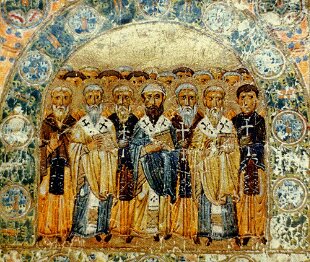
“Share everything with your brother. Do not say, ‘It is private property.’ If you share what is everlasting, you should be that much more willing to share things which do not last.” – The Didache, c. 90 AD, (Did. 4:8)
“Now then hear me and be at peace among yourselves, have regard one to another, and assist one another, and do not partake of what God has created alone in abundance, but share it with those that are in need. For some men through their much eating bring weakness on the flesh, and injure their flesh: whereas the flesh of those who have nothing to eat are injured by not having sufficient nourishment, and their body is ruined. This absence of community therefore is hurtful to you that have and do not share with them that are in want. Think of the judgment that will come! You then, that have more than enough, seek out them that are hungry!” … “Take heed therefore; as dwelling in a strange land prepare nothing more for yourself but a competency which is absolutely sufficient and necessary.” – The Shepherd of Hermas, c. 110 AD, (Herm. Vis. 3:9:2-5 and Herm. Sim. 1:6)
“They [Christians] love one another. They do not overlook the widow, and they save the orphan. He who has, ministers ungrudgingly to him who does not have. When they see strangers, they take him under their own roof and rejoice over him as a true brother, for they do not call themselves brothers according to the flesh but according to the soul.” – Aristides, early 2nd century (Apology 15)
“We who once took most pleasure in the means of increasing our wealth and property now bring what we have into a common fund and share with everyone in need.” – Justin Martyr, 100-165 AD (1st Apology 14)
(more…)
God Bless John Wimber!

John Wimber, 1934-1997
John Wimber, the founder of the Vineyard movement who went home to the Lord in 1997, is one of my heroes in faith. As a man dedicated to combine signs and wonders with evangelism and social justice, he is of great inspiration to me. The text below is taken from an article by Jon Panner which can be found here.
“Remember your leaders who spoke the word of God to you. Consider the outcome of their way of life and imitate their faith. Jesus Christ is the same yesterday and today and forever” (Hebrews 13:7-8).
A president of an evangelical seminary once introduced John Wimber with these words: “John Wimber is the greatest theologian of the 20th century.” I nearly burst with laughter. John looked at me, winked, stood up, shuffled slowly to the microphone and opened with, “Really, I’m just a fat saxophone player trying to get to heaven.”
[…]
At moments like these, he seemed like our collective grampa. His Santa Claus demeanor reassured us, “Kids, I’ve read the end of the book. Guess what? We win!” (more…)
Community of Goods at the Jesus Army
Is it really possible to share everything, like the apostles did on Pentecost (Acts 2:44-45), today? Many Christians in the Western world seem to think that the community of goods is an unrealistic utopia, and thus, they don’t even try to live like the apostles. But the Jesus Army in the UK proves that it indeed is possible to live a New Testament life. Many of their church members live in the New Creation Christian Community, where they share everything, just like in the book of Acts. They write:
CHRISTIAN COMMUNITY
Practising a radical ‘New Creation’ lifestyle in the Jesus Fellowship
 You don’t have to live in Christian community to belong to the Jesus Fellowship! But many of us do! Around 700 of us share our possessions and pool our income and wealth (if we have any!) to live like the early Christians. They had “all things in common”[Acts 2:44] and “no-one said that any of the things which he possessed was his own”.[Acts 4:32]
That was the result of the power of the Holy Spirit coming on the church at Pentecost. And our community life, too, is the result of the Holy Spirit’s presence. We have power to love! Power to serve! Power to share!
We’re able to break the mould. To escape from the rut. The question we ask is “How does God want us to live?” Of course it’s to love. Of course it’s to share. Of course it’s to show that through new life in Jesus He brings into being a new way of living!
Jesus had little to call His own.[Matt 8:20] He shared a pooled fund with His disciples.[Mark 10:28] He warned of the love of money.[Mark 10:21,22] Small wonder then that Peter led the new converts at the day of Pentecost into Christian community.
All of Pentecost
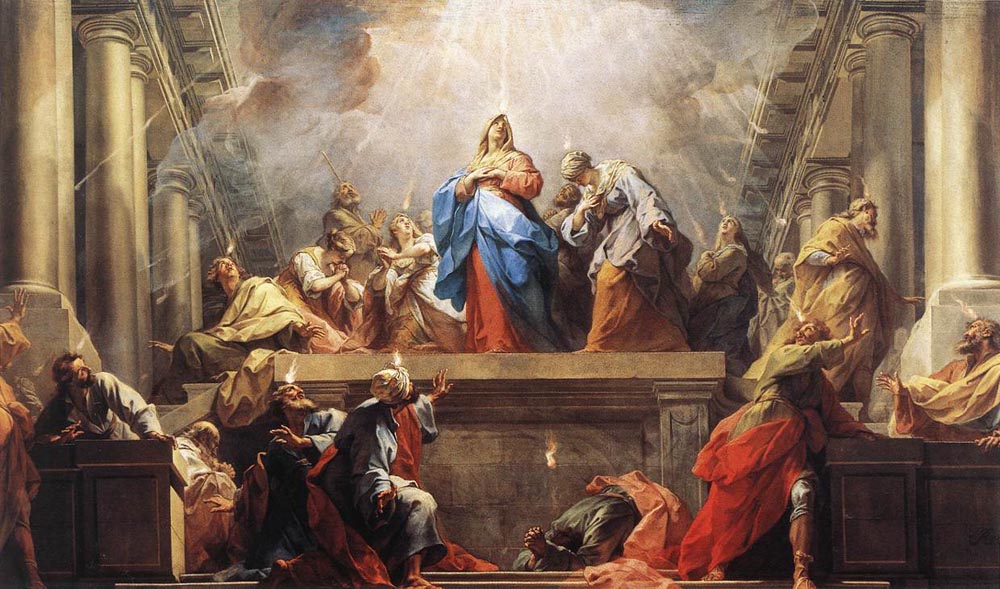
Pentecost is a forgotten holiday, when even Pentecostals celebrate Valentine’s day more than they celebrate Pentecost, it is obvious that we have a problem. We have to celebrate Pentecost – not by starting some strange tradition of dressing trees with small tongues of fire and eating dove-formed chocolate – but by intensively praying for an outpouring of the Holy Spirit. Pentecost, as it is described in Acts chapter 2, is repeatable, and that is fantastic news for the sleeping church in the Western world.
When the Holy Spirit was poured out in Acts 2 there was indeed an explosion of the miraculous gifts of the Spirit – tongues, healing, prophecy etc. – but also of the sanctifying fruits of the Spirit – love, joy, peace etc. These fruits are not only nice feelings, they lead to a radical lifestyle. On Pentecost, the first Christians had everything in common; they put economic equalization into practice, while they were performing signs and wonders. The charismatic gifts were combined with poverty reduction.
Charismatic Poverty Reduction
In 2010, a 20 year-old woman named Teresa Jebiwot participated in a revival meeting in Kisumu, southern Kenya. She was born without a cornea, which made her totally blind, not knowing if it was day or night unless someone told her. On the revival meeting however, she got completely healed when the prophet David Owour prayed for her, and she started to see perfectly. This was verified by an eye specialist, Dr. Agnes Maiyo, at the Iten District Hospial. More information about the healing can be found here.
I find this very beautiful; it is not easy to be blind in such a poor country as Kenya, but the wonderworking power of God did what no aid organisation can do. Teresa’s healing is a contemporary parallel to Bartimaeus’ healing in Mark 10:46-52. He was a blind beggar, and when Jesus healed him, three things happened: Firstly, people realized that God exist. Secondly, Bartimaeus could see God’s beautiful creation. Thirdly, he never had to beg again. Jesus used a miracle to set him free from poverty. Signs and wonders was combined with social justice. (more…)
 Charismactivism