
Home » Posts tagged 'Bible Study' (Page 7)
Tag Archives: Bible Study
The author

Micael Grenholm, a Swedish charismactivist, apologist and author.
Why Wealth is Wrong: The Mathematical Argument

In my God vs Wealth series and God vs Inequality E-book, I’ve mostly based my arguments for why Christians shouldn’t be rich on Bible study, as well as a bit of early church history.
However, I have noticed that many Christians who defend their personal wealth do not just use the Bible, but also theoretical arguments that are based on economics, ethics and experience. Most of them are quite easy to counter with other arguments in the same field for why wealth is wrong. So in a couple of blog posts, I would like to discuss some of these arguments for and against wealth, while also connecting them to the Bible.
The first argument I often hear is “You need to be rich in order to give money to the poor” or, alternatively, “It’s good to give money to the poor, but there’s nothing wrong with being rich.” Now, I could agree with the first statement if we define rich as “having an income that exceeds one’s own/family’s needs” because then, per definition, only rich people will be able to give money to the poor without harming themselves or their families.
However, what’s really confusing is that oftentimes, people who use this argument do not solely define “rich” as “earning a large income”, but also as “possessing abundant capital” (i.e. owning a lot of stuff) or “consuming superfluities” (i.e. buying unnecessary stuff). And these definitions are often mixed up, so that I’ve even met Christian brothers and sisters who argue that it’s perfectly fine to spend money on big houses and cars, because you need to be rich in order to give money to the poor.
Now, this clearly contradicts the basic rules of mathematics. Let us take John the Baptist’s redistribution commadment as an example: “Anyone who has two shirts should share with the one who has none, and anyone who has food should do the same.” (Luke 3:11). Simple mathematics that most of us learn even in preschool tells us that if person A has 2 shirts and gives 1 to person B who has 0, they both suddenly have 1 shirt each and voilà, there is economic equality. Person A cannot keep and give away one of his shirts at the same time, 2-1=1. (more…)
Video: 7 Reasons Street Evangelism Rocks
Being a Christian isn’t just an indoor activity. Here are seven reasons why everyone – yes everyone – who have chosen to follow Jesus should share the Gospel about Him in public areas.
Check out the Biblical foundation for why churches should view street evangelism as mandatory meetings just like Sunday services.
And here’s a description of how my own church does this in practice.

Why All Christians Should Participate in Street Evangelism

As I’ve written about previously, my church has a 50/50 vision where half of our activities being outreaches, and one way we practice this is through “Come In, Go Out”-services (or “Go Out, Come In”) where we simply spend one hour inside and one hour outside. We see evangelism as something every Christian should be doing, just like prayer or Bible reading, and we are not just exhorting people to evangelize, we show and train them by doing it together.
At first I thought our “mandatory evangelism” was just a cool thing, but then I realised that in the Biblical Christian community, corporate evangelism in public places was indeed a part of what all believers were expected to participate in. In Acts 2:46-47 we read:
Every day they continued to meet together in the temple courts. They broke bread in their homes and ate together with glad and sincere hearts, praising God and enjoying the favor of all the people. And the Lord added to their number daily those who were being saved.
Thus, the Biblical, apostolic Church had two kinds of meetings: one internal in the homes and one external in the temple courts. It was in the homes where they were eating the Lord’s supper (or Jesus Lunch as I like to call it), so it was this meeting that developed into our modern Sunday services. The temple meetings were not internal, they included evangelism so that people were saved daily.
Christian Nonviolence and ISIS: You’re Asking the Wrong Question
This post is written by Micah Bales at his own blog and is published here with permission. It is the best article I’ve seen so far about Christian nonviolence and ISIS.
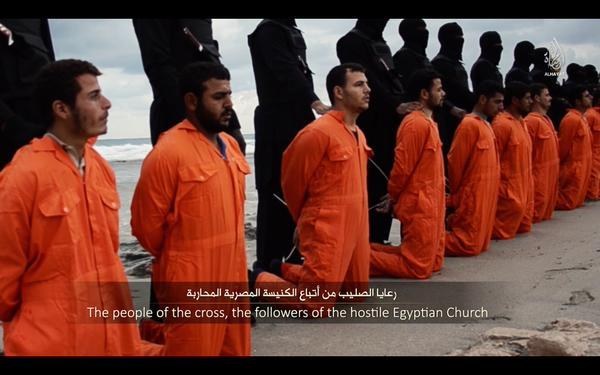
A couple of folks I really respect – Kate Gould of Friends Committee on National Legislation (aka, the Quaker Lobby), and Jim Wallis of Sojourners – were recently on the O’Reilly Factor. For those of you who don’t watch cable news, this is a television program where Bill O’Reilly basically screams at people and incites hatred of anything non-white, non-rich, and non-Republican. I normally don’t watch the show. But when I heard that Kate and Jim were going to be talking, I tuned in.
I knew almost immediately this wasn’t going to be good. It’s Bill’s program, so he gets to frame the question. Here’s what he asks: Do Christian pacifists have a solution for stopping ISIS?
It’s the wrong question. O’Reilly knows it’s the wrong question, and that’s why he’s asking it. Unfortunately, both Gould and Wallis attempt to answer his question directly and rationally. Gould presents an argument for diplomatic measures to curb ISIS’ support. Wallis tries to explain that O’Reilly’s rhetoric of holy war will only lead to a wider conflagration and cost more lives.
This is great for Bill O’Reilly. To these subtle, rational arguments, all he has to do is scream and berate. At one point, O’Reilly interrupts Jim Wallis mid-sentence and demands: How would you stop the ISIS savages from murdering innocent people? How? (more…)
How to Become a Saint
Don’t you want to be a saint? Here’s how you become a saint.
Step 1: Be saved.
If you don’t know how to be saved check this article or simply listen to the wise words of the apostle Paul: “If you declare with your mouth, ‘Jesus is Lord,’ and believe in your heart that God raised him from the dead, you will be saved.” (Rom 10:9)
Step 2:
There is no step 2, you’re already a saint! 😀 Congratulations, well done saint. There is no need for any pope. There is no need for any canonization. All it takes to be a saint is to follow Christ, and here are som Bible verses that prove this:
“Lord, I have heard from many about this man, how much harm he did to Your saints at Jerusalem” (Acts 9:13)
“I ask you to receive sister Phoebe in the Lord in a manner worthy of the saints …” (Romans 16:2).
“For the equipping of the saints for the work of service, to the building up of the body of Christ” (Ephesians 4:12).
“…the mystery which has been hidden from the past ages and generations, but has now been manifested to His saints, to whom God willed to make known what is the riches of the glory of this mystery among the Gentiles, which is Christ in you, the hope of glory.” (Colossians 1:26-27)
“All the saints greet you, especially those of Caesar’s household.” (Philippians 4:22)
Co-Suffering with Jesus and the Poor

I attended a 48-hours prayer meeting a couple of years back in Stockholm, and during a worship session a dear friend of mine approached me, asking me to pray for her so that she may receive the same passion for the poor that the Lord has given me. I was so glad that this was what she wanted, but as I started praying I realized that it would be impossible for her to have the same passion as I have without feeling the pain and suffering of making sacrifices, knowing more about the horrible face of poverty and realizing how many it is that do not get help.
This was why I became an activist in the first place – I realized that innocent people were dying while I was playing video games and dreamt of getting a car and a house. I just prayed that God would make it impossible for my friend to close her eyes to the suffering of the poor, and that she would partake in their suffering.
I don’t know if she ever got the same passion for them as I have, at least she’s not revealing it as clearly on Facebook 🙂 But there and then I think we both realized that this was truly what was necessary for passion. When we follow Christ, a cross is always attached. As He Himself said:
“Whoever does not carry their cross and follow me cannot be my disciple… suppose a king is about to go to war against another king. Won’t he first sit down and consider whether he is able with ten thousand men to oppose the one coming against him with twenty thousand? If he is not able, he will send a delegation while the other is still a long way off and will ask for terms of peace. In the same way, those of you who do not give up everything you have cannot be my disciples.” (Luke 14:27, 31-33)
“Go Out, Come In” – a New (or Old) Type of Church Service
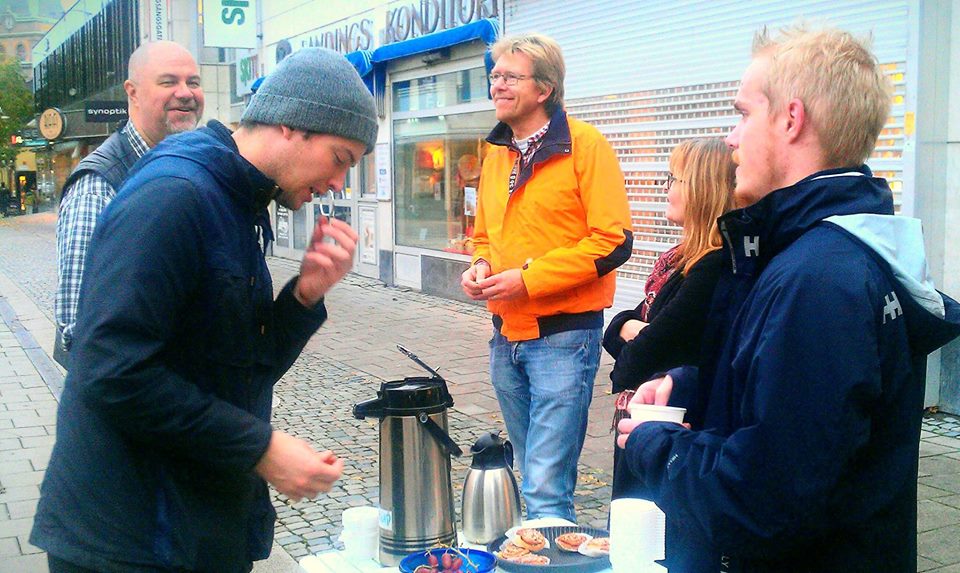
Outside
I love my church! Uppsala Mosaik is a small house church in Uppsala, Sweden (not to be confused with the mega church Mosaic in Los Angeles, California (we’re way smaller than them)) focusing on the Kingdom of God. We’re evangelical, charismatic and activist, and our aim is, like many other churches, to love God and love people.
When I visited Mosaik for the first time in 2010, I was amazed by its structure. We met in a pub back then. We had coffee break in the middle of the service, between worship and Jesus stories. Jesus stories, by the way, are when everyone can share a testimony about what Jesus has done in their life. And when the service was coming to an end, students flooded the pub while Mosaik volontueers started to serve free pancakes.

Inside
I sat down with the pastor, Hans Sundberg, and he explained the theology behind what Mosaik looked like. In Sweden, people are leaving churches like crazy, so that statistically, if the drop-off speed would remain at this rate, there would be no Christians here in 2040. Now, God is good and we pray for revival, but Hans was convinced that the church must leave the old Christendom-structures that builds large cathedrals expecting people to fill them, and becoming sad when they don’t.
World’s Richest Country Makes Feeding the Poor Illegal

Me sitting with Doinita, a Romanian Pentecostal who has to beg to survive
I wish this was a joke. The government of Norway will soon make begging illegal. Many have already pointed out how ironic this is since Norway is in the top five of richest countries in the world (in fact, if you exclude city-states from the list, that have an unfair chance of climbing the top of it, Norway is the richest country in the world). But the madness doesn’t end there. When details in the law proposal were released two days ago, it turned out that the government also wants to criminalize those who help begging people:
The scope of the law, which was originally intended to ban homeless people from begging on the street, has been extended to also criminalise those offering money or other help… Under the law, organised begging would become a crime, punishable with a prison sentence of up to one year. The same punishment would apply to those aiding beggars.
Some of you may recall that a town called Fort Lauderdale in Florida has inforced a similar law, so that 90-year-old Arnold Abbott was arrested when he was handing out food to homeless people through his organization Love Thy Neighbor. I wrote a blog post about this in November last year, reflecting on how strange it is that some reach the conclusion that helping the poor is not helping the poor, while not helping the poor is in fact helping the poor.
Just like my country Sweden, Norway has had many visitors from eastern Europe that are extremely poor and marginalised, who are begging on the streets. Most of them are Romanis, the most discriminated ethnic group in Europe. In Romania, Romanis were slaves up to 1850, and even today 80 % of Romanis in the country are unemployed, 80 % lack water, sanitation or electricity and one in seven of Romani children never attend school. 30 % cannot read or write.
How to be Saved
Why am I a Christian? I started to follow Jesus to be saved. Saved from what? Saved from death, destruction and suffering.
When I was fifteen, I had some very depressing thoughts about life and death. My worldview, which I shared with many of my friends, was that there was nothing after death, and that I along with all of humanity are inevitably heading for nonexistance, where it won’t be dark because we will not have eyes to see with and it will not be quiet since we will have no ears to hear with. We won’t even remember that we’ve ever lived, and in the end no one else will remember it either. Everything is pointless. It takes less than that to give you anxiety.
My Lutheran father brought me to church on April 2 2006, and I wasn’t too excited since I had been there before and literally thought that it was the most boring place on earth. But for the first time, I actually started to listen to what they were saying. The Apostles’ Creed said “I believe in the resurrection of the body, and life everlasting”. Now, these were good news! I started to read the Gospels, learned that “gospel” really means good news and that it’s central message is that when we follow Jesus into the Kingdom of God, we get eternal life:
The life appeared; we have seen it and testify to it, and we proclaim to you the eternal life, which was with the Father and has appeared to us. (1 John 1:2)
Very truly I tell you, whoever obeys my word will never see death. (Jesus in John 8:51)
To those who by persistence in doing good seek glory, honor and immortality, God will give eternal life. (Romans 2:7)
For the perishable must clothe itself with the imperishable, and the mortal with immortality. When the perishable has been clothed with the imperishable, and the mortal with immortality, then the saying that is written will come true: “Death has been swallowed up in victory.” (1 Cor 15:53-54)
I was thrilled, realizing this! Death will not be victorious, Jesus will be! If I believe in Him, I will be immortal. I drank deeply from the comforting words in the Bible that spoke about the eternal glorious life that Jesus promised His followers. (more…)
3 Additional Ways the Modern Church Looks Nothing Like the Early Church

Paul preaching the Gospel. Art by Giovanni Paolo
This awesome article has been frequently shared by people in my networks the last couple of days; Preston Sprinkle writes about 4 ways the modern church doesn’t look like the early church (and, as several have pointed out, this goes especially for the modern mainstream Western church). These four areas are:
1. How we view other Christians. When the early disciples called themselves brothers and sisters, they actually treated each other like brothers and sisters and had a community that was far more relational and sacrificial than fellowship in most Western churches.
2. How we spend our money. The early Christians didn’t collect money for church buildings and pastors’ wages but for the poor.
3. How we think about power. The early church refused to be patriotic but was pacifist and persecuted.
4. How we study the Bible. Early Christians let every new convert study the Scriptures in a detailed manner, and most disciples then knew the Bible better than many Western church goers today.
I totally agree with all of Sprinkle’s points, and I’m glad that more and more start descovering the radical roots of the Christian faith. However, I would like to pinpoint three additional areas where the early church looked different from the mainstream Western church life today: (more…)
Were the Apostles Mistaken in Having Everything in Common?
It’s YouTube Friday and the latest entry on the Holy Spirit Activism YouTube channel is this short interview with Huw Lewis, apostolic leader in the Jesus Army, where he explains why the JA practice community of goods. Community of goods means sharing possessions so that nobody is rich and nobody is poor and was being practiced by Jesus and the apostles (Jn 13:29) and in the first church in Jerusalem (Acts 2:44-45). Huw, I and many others think that it is a very good way of living and we encourage all believers to pray about joining a Christian community.
However, there are Christians who think that community of goods isn’t something good but rather, that the apostles were naïvely mistaken when they started to share their possessions. I found an article arguing for this at biblestudytools.com, an article that is used as the official explanation to what community of goods is about and that has received one of the top spots when you search for “community of goods” on Google. It’s horribly bad though so please let me criticise it for you.
All rich people or some?
In Acts 2:44, it is said that, in the infant church at Jerusalem, “all that believed were together, and had all things common,” and (Acts 4:34 f) “as many as were possessors of lands or houses sold them, and brought the prices of the things that were sold, and laid them at the apostles’ feet.” The inference from this, that there was an absolute disposal of all the property of all the members of the church, and that its proceeds were contributed to a common fund, has been disputed upon the ground that the example of Barnabas in selling “a field” for this purpose (Acts 4:37) would not have been mentioned, if this had been the universal rule. The thought conveyed is that all believers in that church held their property as a trust from the Lord, for the benefit of the entire brotherhood, and, as there was need, did as Barnabas.
The author of this article, H.E. Jacobs, almost immediately begins to argue that the Biblical community of goods was not required for all believers in Jerusalem to participate in. This is indeed a difficult task since Acts 4:34 says that all who had property sold it and gave it to the apostles so that they redistributed the money equally. And all really means all. Now, believers who didn’t own property such as widows probably weren’t obligated to give (instead, their participation in the common purse was by receiving) but Barnabas is rather used as an example of one among all the property owners who sold everything to introduce him to the readers. Likewise, Jesus’mother and brothers are mentioned in Acts 1 to highlight some of who were praying, not to say that the others weren’t praying.
Putting Away the Sword of Self Defense: Scriptural Reflections of a Pentecostal Pacifist
This article is one of the best defenses for Christian pacifism I have read, written by Pentecostal pastor Eric Gabourel. It was originally posted on the website of his church, Live Oaks Community Church in New Orleans.

Who would Jesus kill?
At the last Passover Seder Jesus told His disciples that if they didn’t have a sword to sell their cloaks and buy one (Luke 22:36). This statement is often abused by Christian just war theorist to advocate Christian participation in war. Those who take the position that Jesus was telling His disciples to be prepared for battle or for self-defense only emphasize this phrase from the passage. To have an appropriate assessment of this statement one must treat the entire text of Luke 22:7-53.
Before Jesus tells His disciples to buy swords He calls them to recollect the instance when He told them to go out and preach the Gospel without carrying purse, bag, or sandals (Luke 22:35; Luke 10:4). He then asks them what they lacked when they were sent out to live by faith. Naturally they said “nothing” because of God’s sustaining power that responds to human faith in a lifestyle of radical simplicity and abandonment. Jesus’ teachings on worry and anxiety (Luke 12:24-34) states that we should not be concerned about human necessities: food, shelter, clothing, because these are the things that pagans run after. Moreover, He tells His followers to, “Sell their possessions and give to the poor” (Luke 12:33). Therefore, Jesus in telling his disciples to now carry a purse and a bag was not telling them to expunge what He initially taught them. Jesus was telling them to do these things as a symbol of the impending crisis that was to ensue.
Jesus telling His disciples to carry possessions wasn’t a contradiction just as His prayer on the Mount of Olives wasn’t. In this prayer we also witness the tension of the crossroads that Jesus was standing at. He asked the Father, “if you are willing, take this cup from me” (Luke 22:42). This prayer does not imply that Jesus was trying to avoid His salvific mission to bear the sins of the world. His prayer stresses the overwhelming burden that He was about to bear. He knew and understood His task. That’s why He continued to pray, “yet not my will, but yours be done” (Luke 22:42). The tension was so intense that Luke states that Jesus’ sweat was like drops of blood falling to the ground (22:44).
A Christian Response to the Charlie Hebdo Attacks

When Jesus said “Love your enemies”, He didn’t add “except terrorists”. On the contrary, it was probably them He had in mind. Charismatic activist Bob Ekblad has written an excellent piece on how Christians should respond to the horrible terrorist attack against Charlie Hebdo in Paris, which I quote a large portion of below. I have nothing to add except a little cartoon about Jesus’ amazing enemy love.
How might followers of Jesus respond to this escalation of hatred and violence? Jesus warned his disciples: “You will be hearing of wars and rumors of wars. See that you are not frightened, for those things must take place, but that is not yet the end” (Matthew 24:6). Jesus expects his listeners to be aware that history is heading toward increasing tension and to resist the natural tendencies toward hard- heartedness or violence.
“Because lawlessness is increased, most people’s love will grow cold. But the one who endures to the end, he will be saved. This gospel of the kingdom shall be preached in the whole world as a testimony to all the nations, and then the end will come” (Matthew 24:12–14). Anyone listening to Jesus is told to not be fearful, but to get on with the highest priority work—announcing the Gospel of the Kingdom. What is this Gospel?
It most certainly does not include Christians identifying with or justifying swift and effective retaliation, increased surveillance, growing suspicion, incarceration, hatred against Muslims, or fear. When James and John ask Jesus if they should call down fire from heaven to consume the Samaritans who refused them entry as they traveled toward Jerusalem, Jesus rebukes them, saying: “You do not know of what spirit you are of. For the son of man did not come to destroy men’s lives but to save them” (Luke 9:55–56).
Why Jesus Wouldn’t Attend Anti-Muslim Demonstrations

A Cross painted in German colours at a Pegida anti-Muslim demonstration in Dresden
Jesus came in contact with several people who weren’t orthodox Jews, but rather were heretics or idolaters. We have the Samaritans, who had mixed Judaism with pagan influences, and who were forbidden to worship the Lord in Jerusalem. The Romans were colonialist immigrants from other parts of the empire, and even if some had become proselytes (like Cornelius, Acts 10), most of them worshiped the Roman idols of Jupiter, Mars and others. There were also adherents of other religions in the areas of Decapolis, where Jesus did some miracles (Mark 5).
How did Jesus relate to these idolatrous Gentiles? Well, He simply took control over a state, became President and deported them. Wait, He didn’t? Then at least He commanded His disciples to take control over a country and deport all the idolaters? Huh, He didn’t do that either?!
Not that those ideas didn’t float around in Jesus’ time. The Zealot movement and other radical Jewish groups wanted to fight against the Romans and drive those stupid colonialists back to Europe (which they also tried in 70 and 135 AD, and failed miserably). Many believed that this was what the Messiah was supposed to do. Jews had nothing to do with Samaritans (Jn 4:9), and vice versa, and when some Samaritans heard that Jesus was on His way to Jerusalem, they forbade Him to enter their village. Enraged, John and James suggested that Jesus should order a heavenly genocide from above, burning those heretics alive (Lk 9:51-54).
But Jesus rebuked them. He didn’t come to barbeque idolaters but to save them. He loved Samaritans, shared the Gospel with them and used a Samaritan as the good example in His famous parable about loving everyone indiscriminately (Jn 4, Lk 10). He told His Jewish disciples to love the Romans, pray for them, and walk the extra mile with them (Lk 6). Do to them as you would have them do to you (Mt 7:12). He didn’t fight to kick the Romans out of Israel. Instead, He was crucified by them, dying for their sins. On the cross, He shouted: “Father, forgive them, for they do not know what they are doing!” (Lk 23:34). (more…)
Becoming Immortal

When I was younger, I thought that the role of the church was just to remember Jesus, to be His fan club. When the church celebrated Jesus’ resurrection during easter, I thought that the point was simply “how good for Him! He didn’t remain dead. I’m so happy for Him!” What I didn’t get was that the Bible actually says that those who follow Him will rise from the dead just as He rose from the dead. He is “the firstborn from among the dead” (Col 1:18). Or as Paul puts it in his famous passage about the resurrection in First Corinthians:
Christ has indeed been raised from the dead, the firstfruits of those who have fallen asleep. For since death came through a man, the resurrection of the dead comes also through a man. For as in Adam all die, so in Christ all will be made alive. (1 Cor 15:20-22)
I seriously didn’t know this when I grew up. Even though I said that I believed in God somehow, I believed that I would disappear into emptiness when I dropped the ground, that I would simply become nonexistent. And I realized that this didn’t mean that everything would become black and silent, because I wouldn’t have eyes or ears to see or hear with. It was quite frightening to try to imagine what death would be like.

