Home » 2022
Yearly Archives: 2022
The author

Micael Grenholm, a Swedish charismactivist, apologist and author.
The Gospel of Guns vs the Gospel of Jesus

I live in a country where there are no school shootings. It’s probably due to us having extremely restrictive gun laws in Sweden, as it is illegal for civilians to carry a gun unless they have a license and guns are required to be unloaded, hidden, and supervised when transporting them.
The United States, on the other hand, has more guns than people, guns are involved in 79 % of homicides (compared with 4 % in the UK) and the gun lobby is extremely rich. Tragically, many pastors and other Christian leaders enthusiastically support the gun industry despite Jesus’ words about loving our enemies and turning the other cheek. As a result, many of them refuse to acknowledge the need for more gun control in order to prevent school shootings like the one in Uvalde that killed 19 children and two adults.
For example, worship leader Sean Feucht warned his followers against seeking political solutions to the gun problem, telling them that the solution is to bring God “back in schools” (which, ironically, is a political suggestion):

In fact, when the National Rifle Association (NRA), the leading gun lobby organisation in the US, arranged a prayer breakfast at their national convention just a few days after the shooting, nobody on stage mentioned the attack or prayed for the families of the victims. Instead, they prayed against “Democrats and liberals” who want to have better background checks on those who want to buy guns. After all, this is the same organisation that has actively lobbied against background checks and undermined efforts to keep firearms away from those with mental illness.
Yet, there was a voice in the wilderness, a remnant of righteousness among the gunmongers. Our friend Shane Claiborne, activist and theologian, was there. Not because he is a NRA supporter, but because he wanted to show the people at this prayer breakfast the difference between the Gospel of Jesus and the gospel of guns.


He and some friends started to pray for the victims of the shooting in Uvalde, and immediately were kicked out by the police. Shane writes at Red Letter Christians blog:
I carried with me the Uvalde paper we had picked up. The front page had all those babies’ faces and the two teachers who died with them. We also had a list of all their names, along with the names of the 10 people killed in Buffalo. Our goal wasn’t to get kicked out of the prayer breakfast. Our goal wasn’t event to disrupt it.
We had tickets and waited until there was a space without speakers in the program so we didn’t interrupt. Our goal was singular – to pray for the victims by name, and to invite everyone to join us. With the help of a coalition of clergy around the country known as National Faith Leaders For Ending Gun Violence, we had created a liturgical, call-and-response, prayer. Before reading aloud each name, we say together, “God knows their names.” And after each name, we say, “Lord, have mercy.” Simple, heartfelt prayer.
As we were told that the program would pause, and breakfast would begin, I stood, holding the Uvalde paper, and invited people to join us in prayer for the victims. After the first name, we were told that we would be arrested if we did not leave. So we invited people to join us outside, as we respectfully complied with police orders. It is noteworthy that the police came quicker to kick us out of the prayer meeting than to confront the shooter in Uvalde.

“I’m going to go straight to Jesus and say we cannot serve two masters. And we really are at a crossroads where we’ve got to choose: Are we going to follow Jesus or the NRA? And literally, you couldn’t come up with much more contrasting messages. The gospel of Jesus — turn the other cheek, love our enemies — stands in direct opposition to the rhetoric of the NRA — stand your ground. The gun and the cross give us two very different versions of power.”
[…]
“Idols are things that we put our trust in. They’re not God, but we treat them like they are,” Claiborne said. “We put this sort of sacred reverence into things that should only be given to God. And it’s been said that idols are things that we are willing to die for, kill for, and sacrifice our children for. And literally, by that definition, I think guns would have that sort of unreasonable dedication.”
“Guns are not made in the image of God but children are,” he added.
Amen.
Research Shows Nonviolence is Twice as Effective than Violence

We live in a violent world. The war in Ukraine is killing thousands and causes huge waves of refugees, economic instability and food shortages. The war in Syria is still going on, and the conflicts in Yemen, Afghanistan and South Sudan no longer even make headlines. During most of the last decade, the world has become less peaceful.
In response to such violence, many people think that the solution is more violence. Conventional wisdom tells us that we need to arm ourselves so we become stronger and deadlier than the “bad guys”.
Christian pacifists, who just like most Christians for the first 300 years believe that Jesus’ words about loving our enemies and turning the other cheek mean that we should not use violence, are often accused of being naive. Some have even claimed that Christian pacifism is evil! While abstaining from violence sounds loving in theory, many argue that the practical consequences of such a stance is catastrophic with countless innocent people killed as the “good guys” refused to harm or kill those who were after civilian blood.
War and violence are thus portrayed as a necessary evil, a last resort that we unfortunately have to use to stop authoritarian, mass-killing regimes.
All this is intuition. It’s what seems reasonable. But when researchers started to compare violent resistance to nonviolent resistance, they were in for a chock.
It turns out that nonviolence is at least twice as effective.
I encountered this research when I was part of a program in peace and conflict studies at Uppsala University. The findings is a real game-changer, making scholars from all around the world rethinking the need and use for military violence in the modern era.

An influential study by conflict researchers Erica Chenoweth and Maria Stephan from 2012 showed that nonviolent movements are twice as effective as violent movements in achieving their goals. They expanded upon this research in the book Why Civil Resistance Works. They collected data from over 300 protest movements between 1900 and 2016. 53 % of the nonviolent movements managed to achieve their goal, usually a change of regime, within a year, compared with 26% of the violent movements.
Of the 25 largest movements they studied, 20 were nonviolent, and 14 of them achieved their goals. Most astonishingly, if the nonviolent movements included at least 3.5% of the population, they always succeeded in meeting their goal. Always. Chenoweth calls this the “3.5 rule”.
This study was groundbreaking, as no one had compared the results of violent and nonviolent methods in such a comprehensive way before. In 2018, Chenoweth published a new study together with Evan Perkoski that examined how well nonviolence compared to violence counteracted mass killing, when regimes kill 1000 people or more. They found that nonviolent movements were five times more effective at avoiding this than violent movements.
What are the reasons for the effectiveness of nonviolence? Chenoweth points to several factors. Nonviolence is generally cheaper and can easily recruit many more, there is greater variety of nonviolent methods than violent methods, it is psychologically more difficult for loyalists to harm or kill nonviolent trainees than armed rebels, and it is easier for loyalists to change sides and unite with nonviolent protests and nonviolent sabotage.

Chenoweth’s work has made a significant impact on peace and conflict research in general. Even non-pacifists like James Pattison and Ed Cairns have gained greater respect for non-violent methods and warned against resorting to violence too quickly. Cairns wrote:
I’ve never believed that pacifism is an adequate answer to a world of atrocities that – in truly exceptional cases – call out for an armed response. But there’s an awful lot of evidence for caution – and reason to give peace a chance.
Note that Chenoweth’s research does not say that nonviolence leads to guaranteed success. Rather, nonviolence is more likely to succeed than violence. Even in countries where nonviolent campaigns have failed, people have been ten times more likely to move to democracy within a five-year period than if they protested with violence.

Even if you can not guarantee that non-violence will succeed, you can also not guarantee that violence will succeed. The “necessary” in violence as “necessary evil” is difficult to prove scientifically.
This is great news! Loving enemies, like Jesus commanded us to, is actually more beneficial than killing them. Such love does not have to be at the expense of protecting the innocent. The question now is if the leaders of the world will take this research seriously and spend time and money developing nonviolent defense systems rather than military ones?
Politicians Who Refer to the Bible as They Bomb Children

On a war rally in a Moscow stadium last Friday, Russian dictator Vladimir Putin said that his “special military operation” in Ukraine, which he refuses to call a war, reminded him of the words of Jesus in John 15:13: “There is no greater love than to lay down one’s life for one’s friends.”

This is just a few days after a pregnant woman who was damaged by Russian bombing in the occupied city of Mariupol died along with her unborn baby. Ukrainian authorities claim that over 100 children have died in the war as of yet, and although the numbers are difficult to verify at this point there is no doubt that Putin has killed children in this conflict.
One of them was named Alisa Perebyinis. She was nine years old, and her father found out that she had died along with his wife and 18-year old son on Twitter.
To kill children in a pointless, unlawful and unrighteous war is despicable in and of itself. But Putin goes even further than that, claiming that his sinful acts are an expression of Biblical love.
He quoted someone who never used violence against anyone and who taught us to love our enemies, Jesus Christ, in order to justify slaughtering innocent people – many of which are Christians!

Putin is of course far from the only politician who has religious rhetoric in order to motivate people to war. George W. Bush claimed that God told him to invade Afghanistan and Iraq and called the war on terrorism a “crusade“.
Israel’s former corrupt prime minister Benjamin Netanyahu constantly refers to biblical texts when justifying Israel’s occupation of Palestinian land and its warfare against Palestinians.
Even the Nazis during World War Two quoted passages like Romans 13 in order to make people submit to Hitler.
Jesus warned that there would be false prophets who claim to follow him but refuse to do his will (Matthew 7:21). He said that there would be those who persecute Christians who actually think that they serve God (John 16:2).
Whether Putin is deluded enough to actually think that he is loving people as he bombs children is impossible to know. Perhaps he hates God and just uses religious language to gain support.
In either case, the Bible makes it clear that all those who take the Lord’s name in vain to justify their own evil actions will stand accountable before him on the last day. God will restore all those who fell victim to injustice, and invite us to an eternal life with him without any wars, lies or oppression.
All thanks to the one who truly gave his life because of his love for us: Jesus Christ, the Prince of Peace.
Here’s how you can donate to help the victims of war in Ukraine.
My Master’s Thesis on the Pentecostal Pacifists Who Welcomed Apocalyptic Genocide

“War is not the will of God, this we know.”
– Folke Thorell, Evangelii Härold, 1967.
“God will let the satanic rearmament of nuclear weapons and biological warfare strike the godless themselves in forms of plagues that will exterminate large portions of humanity.”
– Folke Thorell, Evangelii Härold, 1968.
Pentecostals were the largest religious group among conscientious objectors in Sweden between 1967 and 1971, a time characterized by passionate debates on the ethics of war in the shadows of Vietnam and the Israeli-Palestinian conflict. In my master’s thesis on church history, I aimed to review and analyze how the Pentecostal periodicals Evangelii Härold and Dagen described and ethically motivated military violence and pacifism during this period.
The purpose was to identify potential motivations for pacifism and/or military support during a time when a large number of Pentecostals refused to bear arms, with particular interest in how these motivations related to ethical evaluation on contemporary wars.
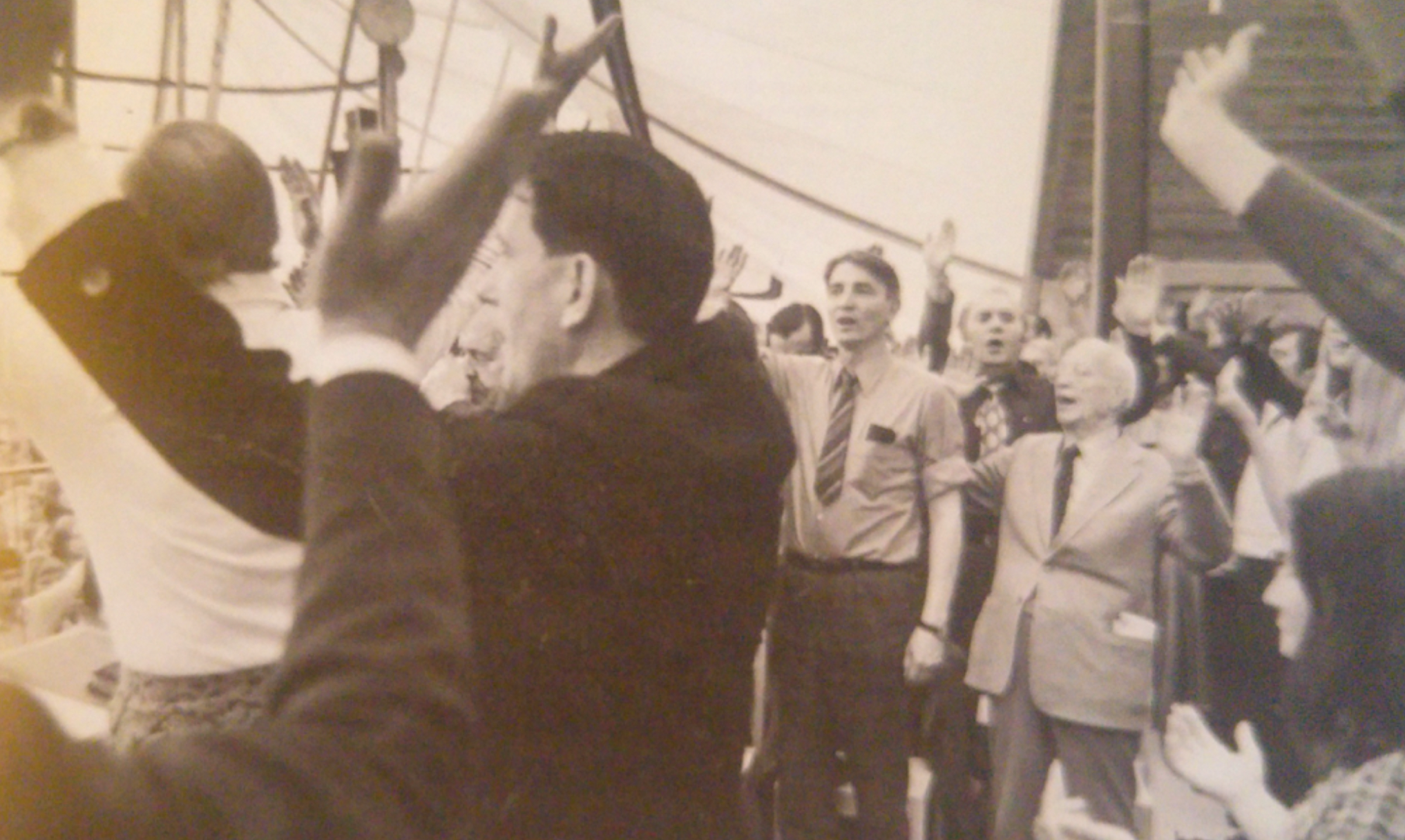
The findings were fascinating. Pacifism and conscientious objection were regularly promoted and seldom criticized, while most contemporary military violence was condemned with one glaring exception: Israeli warfare.
Folke Thorell, quoted above, thought that God principally is against war, but allows them to fulfill his eschatological plans and even engages himself in warfare. He envisioned two-thirds of all Jews to die in a future third world war involving nuclear bombs, a genocide so brutal it would make the Holocaust seem “minuscule” in comparison.
Unlike the American war effort in Vietnam, Israel’s wars were commonly viewed as eschatologically significant and biblically predicted holy wars, with several writers suggesting that God himself has waged and will wage war on Israel’s behalf. Pacifism was primarily motivated by obedience to the Bible rather than empathy, fitting with Lisa Cahill’s theory of obediential pacifism being distinct from empathic pacifism in the Christian tradition.
Support for Israeli warfare was also derived from biblical interpretation, primarily based on Old Testament texts. It was further motivated by ideas of Jewish suffering and death being part of God’s plan, with several Pentecostal writers speculating that an apocalyptic genocide would precede the second coming of Christ.
Many Pentecostals did not see this as standing in conflict with personal pacifism and conscientious objection, as both views were perceived as biblical.
Future research could further explore the relationship between Pentecostal eschatology and empathy, along with how mid-century Pentecostal Zionism might have been influenced by antisemitic ideas from the 1930’s.
 Charismactivism